Weekly marketing wisdom you can read in 5 minutes, for free. Add remarkable ideas and insights to your inbox, once a week, by subscribing to our newsletter.
Uncategorized
How to Choose a Digital Marketing Agency: A Strategic Guide for Business Growth
Before shortlisting digital marketing agencies, the first step is internal. You must translate broad business goals into specific commercial outcomes. What revenue targets, lead volumes, and cost-per-acquisition metrics are you accountable for? Without this clarity, you risk investing in marketing activity, not measurable results.
Defining Your Commercial Objectives Before Starting Your Search
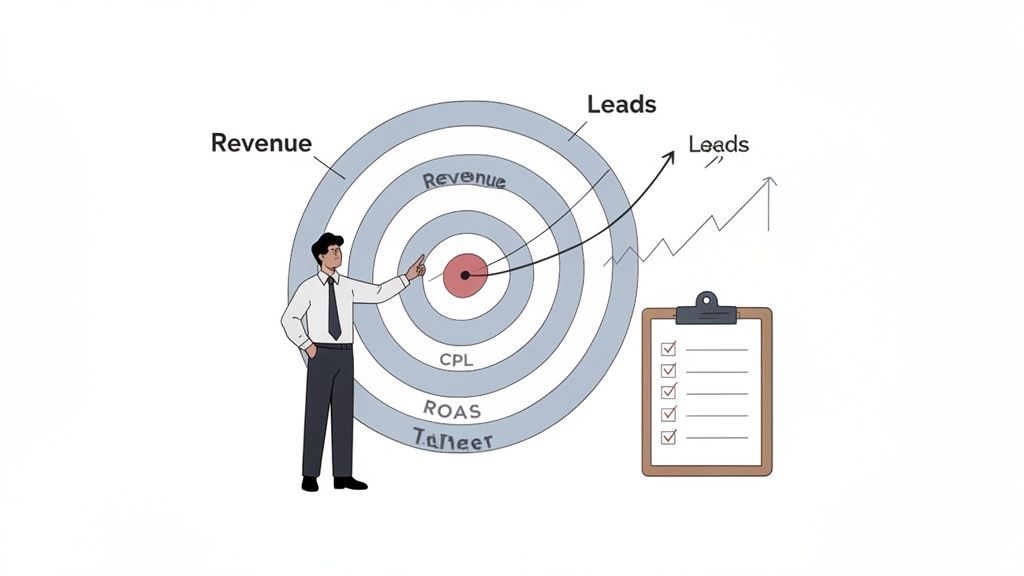
Hiring an agency without a clear commercial objective is like commissioning a build without architectural plans. You will see plenty of activity, but the final structure is unlikely to meet your strategic needs.
You must move beyond vague aspirations like "we need more traffic" or "let's improve brand awareness." A genuine growth partner requires a destination. Your role is to provide the coordinates, grounded in the financial reality of your business.
This is not about buying services; it is about investing in a predictable growth engine that delivers a measurable return. It is also important to weigh the pros and cons of an in-house vs agency marketing team before beginning your search. That decision is a fundamental component of your strategy.
From Revenue Goals to Marketing KPIs
The most effective way to establish tangible targets is to work backwards from your revenue goal. Let’s assume your objective is to add £500,000 in new revenue over the next 12 months. To achieve this, what must your marketing function deliver?
You will need to analyse your sales funnel and understand your conversion metrics.
- Average Deal Value: What is the typical revenue generated from a new client?
- Sales Conversion Rate: What percentage of qualified leads does your sales team convert into clients?
- Lead-to-Qualified-Lead Rate: Of all initial enquiries, what percentage are a genuine commercial fit for your business?
With these figures, you can calculate the precise number of leads required. For instance, if your average deal is £10,000 and your sales team converts 20% of qualified leads, you need 50 new clients to reach the £500,000 target. If you know that only 50% of initial enquiries are qualified, the calculation shows your marketing must deliver 100 high-quality leads.
Your target cost per lead (CPL) and required return on ad spend (ROAS) are not arbitrary figures. They are a direct reflection of your revenue goals and profit margins. A competent agency will build its entire strategy around hitting these numbers, not just finding creative ways to spend your budget.
Setting a Realistic and Outcome-Focused Budget
Once you know your required lead volume and target CPL, you can establish a marketing budget directly tied to a commercial outcome. Many businesses make the mistake of choosing a budget based on subjective feel rather than what is required to win market share.
You also need to understand the market you operate in. The UK is home to over 8,500 digital agencies in 2024, a number growing by 5.1% annually since 2019. With the industry projected to reach £20.4 billion in revenue by 2025, competition is fierce. A well-defined strategy is the only way to achieve cut-through.
Completing this preparatory work transforms the conversation with potential agencies. Instead of asking what they can do for a random budget, you can provide a direct, performance-based brief: "We need to generate X leads per month at a CPL of no more than £Y. Demonstrate how you will achieve this." This approach helps you find a strategic partner, not just a tactical supplier. To refine this further, our guide on how to effectively segment your target market is an excellent next step.
How to Vet an Agency’s Strategic Capabilities
Any agency can list services on a proposal. SEO, paid advertising, and web development are merely tools. A genuine growth partner, however, is an architect, not just a builder. They sell the blueprint—the strategy—first, before discussing the tools required for execution.
Learning how to vet an agency effectively involves looking past the sales pitch to scrutinise the quality of their strategic thinking.
Your goal is to find a partner who takes accountability for your business results, not one who simply completes a list of tasks. The difference between a tactical supplier and a strategic partner is significant, but only if you know what to look for and which questions to ask.
A tactical supplier will discuss deliverables. A strategic partner will ask about your sales pipeline, customer lifetime value, and profit margins. They aim to understand the commercial mechanics of your business, not just manage marketing channels.
Distinguishing Strategy from Tactics
Initial conversations are incredibly revealing. A tactical supplier will immediately present their service offerings, explaining what they do. A strategic partner will dedicate the first call to asking questions, seeking to understand why any action is necessary in the first place.
You are looking for an agency that is obsessed with your commercial metrics, not just their own.
- Their Discovery Process: Do they ask superficial questions, or do they probe into the details of your sales process, customer profiles, and market position? A true partner must grasp the commercial reality before proposing a solution.
- Their Planning Approach: Is their proposal a generic menu of services, or is it a bespoke plan that ties every activity back to the business objectives you outlined? The strategy must create a clear line from action to outcome, connecting every task to a KPI like lead volume or cost per lead.
- Their Execution Mindset: Pay attention to their language. Do they talk about "managing campaigns" or "driving revenue"? Their choice of words reveals their focus. A strategic partner views themselves as an extension of your growth team.
A strong indicator of strategic depth is how an agency discusses failure. A good partner will be transparent about campaigns that missed their targets, explain what was learned, and show how they adapted. This demonstrates a commitment to achieving the right outcome, not just presenting a flawless highlight reel.
Scrutinising Case Studies for Commercial Impact
Case studies are essential reading, but most people misinterpret them. It is easy to be distracted by impressive-sounding metrics that are commercially meaningless upon closer inspection.
You must look past vanity metrics and identify commercial results. An increase in website traffic is irrelevant if it did not generate a single qualified lead. Ranking #1 for an obscure keyword means nothing if it does not drive sales.
As you review their case studies, you should be able to answer these questions:
- The Problem: Did they clearly define the client’s original business problem in commercial terms?
- The Strategy: Do they explain the ‘why’ behind their work? An effective case study does not just list actions; it outlines the strategic thinking that informed them.
- The Results: Are the results framed as business outcomes (e.g., “reduced cost per lead by 35%” or “increased sales pipeline value by £200,000”)? Or are they simply marketing activities (e.g., “wrote 10 blog posts” or “built 50 new backlinks”)?
If a case study leaves you wondering how the work generated revenue for the client, it is a significant red flag.
Questions That Reveal Strategic Depth
To cut through jargon, you must ask questions that compel an agency to reveal its strategic approach. These questions shift the conversation away from their services and onto your commercial reality. For more insight into this mindset, it helps to understand the benefits of hiring a digital marketing consultant, as that is the business-first perspective you should seek.
Ask every potential agency these three commercially-focused questions:
- "Based on our target of X leads per month at a £Y cost-per-lead, what is the single biggest risk you see in our current setup, and how would you address it in the first 90 days?" This immediately tests their ability to identify problems and prioritise actions based on commercial impact.
- "How would you collaborate with our sales team to ensure the leads you generate are high-quality and progress through our pipeline?" This reveals whether they understand the full sales and marketing journey and are committed to revenue, not just marketing qualified leads (MQLs).
- "Walk me through how you would balance short-term lead generation with long-term brand building and SEO within our budget." This is an excellent way to assess their ability to make strategic trade-offs and build a sustainable growth plan.
An agency that can answer these questions with confidence and clarity is one that thinks like a business owner. They do not see marketing as a cost centre; they see it as a direct investment in profitable growth.
Evaluating Core Competencies: SEO, Paid Media, and Web Development
Once you have assessed an agency's strategic thinking, it is time to scrutinise their technical execution capabilities. A brilliant strategy is worthless if the team cannot execute it effectively. A true growth partner must be proficient across three core areas: SEO, paid media, and web development.
Knowing what to look for is crucial. You need to see past the sales presentation and analyse the commercial mindset behind their work. Are they chasing vanity metrics like rankings and clicks, or are they focused on driving profitable growth for your business?
This flowchart illustrates how the vetting process separates tactical suppliers from strategic partners.
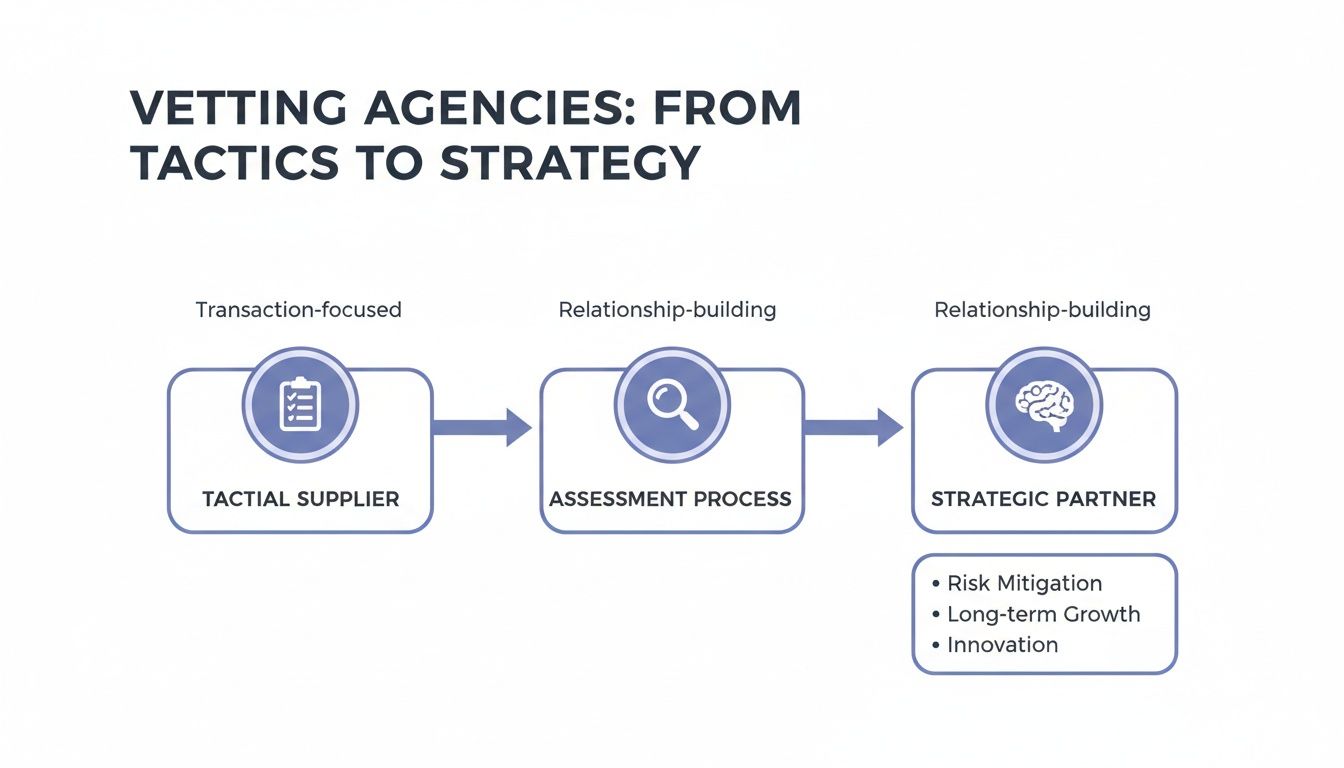
The distinction is simple but profound. A tactical supplier completes tasks. A strategic partner takes ownership of commercial results. Your job is to find the latter.
To assist with this, here is a quick checklist. Use it to score potential agencies on their capabilities and, more importantly, their commercial focus.
Agency Competency Evaluation Checklist
| Area of Evaluation | What to Look For (Growth Partner) | Red Flag (Tactical Supplier) |
|---|---|---|
| SEO | Focuses on organic revenue, lead quality, and traffic from high-intent keywords. | Obsesses over ranking #1 for broad, high-volume "ego" keywords. |
| Paid Media | Discusses Customer Lifetime Value (LTV), target Cost Per Acquisition (CPA), and Return on Ad Spend (ROAS). | Reports primarily on impressions, clicks, and Click-Through Rate (CTR). |
| Web Development | Leads with questions about conversion rates, user journeys, and page speed (Core Web Vitals). | Focuses the conversation on branding, colours, and design aesthetics first. |
| Reporting | Connects all channel activity directly back to pipeline growth, leads generated, and revenue. | Delivers separate, siloed reports for each channel without a unified commercial story. |
| Strategy | Proactively suggests new campaigns and channels based on your business goals and market data. | Waits for you to provide the strategy and a list of tasks to execute. |
This is not about ticking boxes; it is about identifying the difference between an agency that manages campaigns and one that drives genuine business growth.
Assessing SEO for Commercial Growth
Effective SEO is not about achieving the top ranking for a few vanity keywords. It is a systematic process of gaining visibility for search terms that signal genuine buying intent. The goal is a steady, predictable flow of qualified organic traffic that converts into leads and revenue.
An agency that understands this will talk less about rankings and more about traffic quality. They will want to identify which keywords attract prospective customers who are ready to buy, not just browse. Their reporting should draw a direct line from SEO performance to lead volume and sales pipeline value.
Ask them how they are adapting to new influences on search, such as the rise of AI and ChatGPT ranking factors, to assess if they are forward-thinking.
A major red flag: any agency that promises "guaranteed page-one rankings". Modern SEO is far too complex and dynamic for such a guarantee. A credible partner will promise a clear, data-driven process for improving your organic performance for the terms that matter to your bottom line.
Scrutinising Paid Media and ROAS Management
When it comes to paid media, every pound must be accountable. When vetting an agency’s paid advertising capabilities, your focus should be on their approach to budget management, campaign structure, and Return On Ad Spend (ROAS).
A top-tier agency will want to understand your profit margins. They will ask about your customer lifetime value to determine a sustainable Cost Per Acquisition (CPA). They will build highly segmented campaigns that target different audiences directly, avoiding a lazy, one-size-fits-all approach.
Look for proof of:
- Rigorous Testing: Do they have a clear process for testing ad copy, landing pages, and audiences to continuously improve performance?
- Full-Funnel Awareness: Is their discussion focused solely on bottom-of-funnel conversion ads, or do they talk about retargeting, mid-funnel content, and nurturing leads over time?
- Transparent Reporting: Can they show you exactly where every pound is going and what the return is? The report should focus on CPL, CPA, and ROAS, not just clicks and impressions.
If an agency cannot have a detailed commercial conversation about your numbers, they are likely a campaign manager, not the growth partner you require.
Evaluating Web Development for Conversion
Your website is not a digital brochure; it is your primary sales asset. When assessing an agency’s web development team, the conversation must shift from aesthetics to performance. While design is important, its primary function is to drive conversions.
A performance-focused agency views web development through the lens of Conversion Rate Optimisation (CRO). They will discuss user experience (UX), page speed, mobile performance, and the clarity of your calls-to-action. They understand that a website must be engineered to efficiently convert the traffic you are paying to acquire.
This commercial mindset is more critical than ever. The UK digital marketing market, valued at £19.6 billion in 2024, is projected to reach £47.1 billion by 2033. This explosive growth demands an agency that delivers measurable ROI, not just an attractive website.
Key questions to ask a potential web partner:
- What is your approach to CRO and A/B testing?
- How do you ensure the site is optimised for page speed and Core Web Vitals?
- What is your process for creating high-converting landing pages for our paid campaigns?
An agency that begins the conversation with colours and fonts before understanding your conversion goals has the wrong priorities. Your website must be a machine for turning traffic into revenue, and the right partner will build it accordingly from day one.
Understanding Agency Pricing Models and Commercial Terms
Understanding agency pricing can feel like navigating a complex and opaque market. Proposals often vary so widely that a direct comparison is almost impossible unless you understand the models behind the numbers. Your objective is to find a partner whose pricing aligns with your commercial goals, not simply the one with the lowest quote.
The price is only one part of the equation. A cheap agency that fails to deliver qualified leads is a far greater financial drain than a premium partner that generates a predictable return. The key is to decode their commercial terms to ensure they are structured for accountability and shared success.
Demystifying Common Pricing Structures
Most UK agencies operate on one of three core models, each with different implications for your business. Understanding the trade-offs is essential when determining how to choose a digital marketing agency that can drive your growth.
Monthly Retainer: This is the most common model. You pay a fixed monthly fee for an agreed scope of work. It offers budget predictability and allows the agency to dedicate resources to your account. The risk is that a poorly structured retainer pays for activity, not outcomes. A good retainer is always tied to performance KPIs, not just a task list.
Project-Based Fee: This is a one-off cost for a specific project with a clear start and finish, such as a website build or an initial SEO audit. It is ideal for contained projects but is not suitable for ongoing activities like lead generation or paid media management.
Performance-Based Models: Here, an agency's remuneration is directly linked to the results they generate, such as a cost per lead or a percentage of revenue. While appealing, this model requires immense trust, transparent data sharing, and a precise definition of a 'qualified lead'. An agency offering this demonstrates significant confidence in its ability to deliver. Our full guide on finding a genuine performance-based marketing agency provides more detail.
A hybrid model often provides the ideal balance. It combines a base retainer for stability with performance bonuses for exceeding key commercial targets (like CPL or pipeline value). This model gives the agency security while incentivising a sharp focus on your bottom line.
Looking Beyond the Price Tag
An agency's quote is just the starting point. The real value is found in the commercial terms and the scope of work. A lower price often means a narrower scope, less experienced talent on your account, or a lack of strategic oversight.
As you review proposals, examine these key areas closely:
Scope of Work (SoW): Is it clear what is included and, crucially, what is not? Vague terms like "SEO management" should be a red flag. Look for specific deliverables, such as the number of pages to be optimised, the depth of technical audits, or the exact structure of paid campaigns.
Contract Terms: Pay close attention to the notice period. A long notice period of 90+ days may indicate the agency lacks confidence in its ability to retain clients through performance. A standard 30-day notice shows they are prepared to earn your business every month.
Reporting Standards: How will they measure and report on success? The proposal must be specific about the frequency and content of reports. These reports must focus on commercial metrics—leads, cost per lead, pipeline value—not vanity metrics like clicks and impressions.
Ultimately, you are not buying a list of tasks; you are investing in a commercial outcome. The right partner will have a pricing model and terms that reflect this reality, creating a relationship built on transparency, accountability, and a shared commitment to profitable growth.
Making the Final Decision and Ensuring a Fast Start

You have reviewed the pitches, questioned the strategists, and analysed the proposals. Now you are left with two or three strong contenders. Making the final decision can feel difficult, but a structured approach removes guesswork, grounding your choice in commercial logic rather than intuition.
At this stage, you must balance the hard data from their proposals with the softer element of team chemistry. Both are critical for a successful, long-term partnership that delivers profitable growth. Once you have made your decision, a fast and efficient start is vital to maintain momentum.
Using a Simple Scoring Matrix
Before making your final choice, step back from the personalities and presentations to score each agency objectively. This simple action prevents you from being swayed by a slick pitch and keeps the focus on what truly matters: commercial alignment.
Create a basic spreadsheet and score each shortlisted agency from 1 to 5 across key areas. This forces a like-for-like comparison and often highlights strengths and weaknesses you might have missed.
Consider scoring them against these crucial factors:
- Strategic Understanding: How well did they comprehend your business goals and commercial challenges? (1 = Generic pitch, 5 = Deep, specific insight).
- Commercial Focus: Was their proposal built around revenue, leads, and CPL, or did they rely on vanity metrics? (1 = Focused on traffic, 5 = Focused on pipeline value).
- Technical Competence: Based on their answers, how confident are you in their core skills in SEO, paid media, or web development? (1 = Lacked depth, 5 = Clear expertise).
- Team Chemistry: Can you work with these people effectively? Will they challenge you constructively? (1 = Poor fit, 5 = Excellent fit).
- Value for Money: Considering their proposed scope and pricing, how strong is the potential ROI? (1 = High cost, low value, 5 = Strong value proposition).
The goal is not simply to find the highest score. It is to provide a structured framework for an evidence-based discussion with your team.
The Importance of Chemistry and Communication
Never underestimate cultural fit. You are not just hiring a supplier; you are integrating a new team into your business. You will communicate with them daily, rely on their expertise, and entrust them with a significant budget.
A great agency partner feels like an extension of your own team. They should be comfortable challenging your ideas with data-backed reasoning, and you should feel comfortable challenging their assumptions. This constructive tension is where real growth occurs.
Ask yourself simple questions: Do I want these people in my weekly meetings? Do I trust their judgement? A partnership without mutual respect and open communication is destined to fail, regardless of the agency's technical skill.
Creating a Watertight Onboarding Plan
You have made your decision, but the work is not complete. A disorganised onboarding process can kill momentum and delay results by weeks, if not months. A smooth start sets the tone for the entire relationship.
Your new agency should lead this process, but you must be prepared to provide the necessary access and information promptly. A well-managed onboarding is the mark of an experienced, process-driven agency.
Your onboarding checklist should cover these essentials for a fast start:
1. Granting Access to Core Systems: This is the first practical step. Provide them with access to key platforms immediately so they can begin audits and setup.
* Google Analytics and Google Tag Manager
* Google Search Console
* All relevant ad accounts (Google Ads, Meta Ads, LinkedIn Ads)
* Your website's Content Management System (CMS)
* Any existing marketing automation or CRM platforms
2. Scheduling the Kick-Off Meeting: This meeting formalises the partnership. It should involve all key stakeholders from both sides to confirm the strategic direction. The agenda must cover a review of goals, timelines, communication protocols, and reporting standards.
3. Agreeing on the 30-60-90 Day Plan: This is the most critical component. A great agency will arrive at the kick-off with a detailed 90-day plan outlining specific actions, deliverables, and KPIs for the first three months. This plan transforms strategic discussion into tangible action and provides a clear framework for measuring early progress.
By making a structured evaluation and executing a sharp, organised onboarding, you lay the foundation for a profitable, long-term partnership built on clarity and a shared drive for growth.
A Few Final Questions Before You Decide
Even after scorecards and analysis, a few questions often arise before committing. This is a positive sign. Selecting a marketing partner is a major decision, so let’s address the most common uncertainties business owners face.
What Is a Reasonable Budget for a Digital Marketing Agency in the UK?
The right budget is tied directly to your goals, not an arbitrary industry figure. The pertinent question is not "how much does it cost?" but "what return can I expect?"
For a smaller business starting out, a focused SEO or paid advertising campaign might begin around £2,000–£5,000 per month. For a larger company seeking aggressive market share, an integrated, multi-channel strategy could easily require £10,000+ per month.
The key is to work backwards from the revenue targets you established initially. Your budget should be viewed as a direct investment in achieving those commercial outcomes.
Should I Choose a Specialist Agency or a Full-Service One?
This decision depends on your immediate business challenges and your existing internal team capabilities.
A specialist agency, one that focuses exclusively on SEO, for example, can be an excellent choice if you have a specific, isolated problem. They possess deep, focused expertise in that single discipline.
Conversely, a full-service or performance-led agency is typically better for businesses that require a cohesive growth strategy. When you have a partner who understands how SEO impacts paid media campaigns, and how both depend on a high-performing website, you create a powerful multiplier effect. Each channel reinforces the others, creating a growth engine that is stronger than the sum of its parts.
The most important consideration is this: can the agency connect everything they do back to your sales pipeline? A specialist might achieve a number one ranking on Google, but a true growth partner ensures those rankings translate into high-quality leads that your sales team can convert.
What Are the Biggest Red Flags to Watch For When Vetting an Agency?
Finding the right agency is as much about identifying poor fits as it is about finding good ones. The biggest red flags almost always indicate a lack of commercial understanding or strategic thinking.
Remain vigilant for any agency that:
- Makes grand promises without a plan. Guarantees like "#1 rankings overnight" are unrealistic. A true partner will present a robust process, not a miracle solution.
- Obsesses over vanity metrics. If their pitch focuses on 'impressions', 'traffic', and 'clicks' but is light on qualified leads, cost per acquisition, and revenue impact, their priorities are not aligned with your business goals.
- Is vague about reporting or pricing. Ambiguous proposals, unexpected costs, and reports that obscure poor performance are major warning signs. You need a partner who is radically transparent and accountable.
- Does not investigate your business. If they are not asking challenging questions about your sales process, customer lifetime value, and profit margins, they cannot build a strategy that will succeed. A great partner is relentlessly curious.
Choosing the right agency is one of the most important decisions you can make to build a predictable growth engine. If you are looking for a performance-led growth partner that takes strategic ownership of your commercial success, Lead Genera can help. We build commercially-focused strategies that deliver measurable results.
Categories
Do You Need Assistance With
Sign Up To Our Newsletter