Weekly marketing wisdom you can read in 5 minutes, for free. Add remarkable ideas and insights to your inbox, once a week, by subscribing to our newsletter.
Uncategorized
How to Improve Your Google Search Rankings: A Guide to Commercial Growth
To improve your Google rankings in a way that generates leads, you need a disciplined approach. It comes down to three core pillars: flawless technical SEO, commercially-focused content, and genuine website authority. Forget shortcuts; this is about building a digital asset that Google trusts to provide the best answers. Achieve that, and a predictable pipeline of high-quality leads will follow.
Your Starting Point: A No-Nonsense SEO Audit

Before you can improve your rankings, you need an honest assessment of your current position. Attempting to build a content or link-building strategy on a weak technical foundation is a waste of time and budget. The results will be negligible.
A pragmatic, commercially-focused SEO audit is the only logical starting point. The goal is not to produce a hundred-page report filled with technical jargon, but to pinpoint the specific, high-impact issues that are actively preventing your website from attracting and converting customers.
Prioritising What Actually Matters for Growth
A proper audit cuts through the noise to focus on issues affecting search engine crawlers and, more importantly, your potential customers. These are the roadblocks that directly impact your revenue.
Here is where we recommend you start:
- Website Speed: This is a critical ranking factor. If your key pages take longer than three seconds to load, you are losing potential customers. It's as simple as that.
- Mobile Usability: The majority of searches in the UK now happen on mobile devices. If your website is difficult to use on a small screen, your rankings will suffer as a direct consequence.
- Indexability: Can Google find and understand your most important pages? We have seen simple mistakes, like a misplaced "noindex" tag or a confusing site structure, render key service pages completely invisible to search engines.
A common mistake is treating an audit as a one-off project. Your website’s technical health requires ongoing attention, particularly as Google’s algorithm evolves. Regular, lightweight checks prevent small issues from escalating into major ranking problems.
Keeping Up with a Moving Target
Maintaining technical performance is essential because the standards are constantly changing. Consider the major Google Core Algorithm Updates of 2024. They significantly impacted rankings for numerous UK websites.
This is precisely why a structured audit is so vital. By methodically identifying and resolving foundational issues, you build a stable platform for sustainable growth. A great place to start is this guide on how to do a site audit to drive real B2B growth; it provides a solid framework for fixing technical problems and improving the user experience.
Our Recommended Technical Health Checklist
To get you started, here is a prioritised checklist for a foundational technical SEO audit. It focuses on the high-impact issues that we see affecting Google rankings time and again.
| Check Area | What to Look For | Why It Matters Commercially |
|---|---|---|
| Indexing Status | Are your key commercial pages in Google's index? Check for "noindex" tags and robots.txt blocks. |
If your service pages aren't indexed, they cannot rank. This is the most fundamental check for a reason. |
| Mobile-Friendliness | Is your site easy to use on a smartphone? Check for tiny text, clickable elements too close together, and horizontal scrolling. | A poor mobile experience frustrates users and directly harms your rankings in Google's mobile-first index. |
| Page Speed (Core Web Vitals) | How quickly do your pages load and become interactive? Focus on Largest Contentful Paint (LCP) and Cumulative Layout Shift (CLS). | Slow pages lead to higher bounce rates and lost leads. Faster sites convert better and rank higher. |
| Broken Links (Internal & External) | Are there any links on your site pointing to pages that don't exist (404 errors)? | Broken links create a dead-end for users and search crawlers, wasting authority and providing a poor experience. |
| Site Architecture | Is your site structure logical? Can users and search engines find your most important pages within three clicks of the homepage? | A clear structure helps Google understand your site's hierarchy and improves user navigation, increasing conversion potential. |
| Duplicate Content | Do you have multiple pages with the same or very similar content? Check for issues with URL parameters or www vs. non-www versions. |
Duplicate content confuses search engines, diluting your ranking potential and sometimes leading to ranking suppression. |
This checklist is not exhaustive, but resolving any issues you find here will give you a much stronger foundation to build upon.
The Tools and The Process
You do not need a huge budget to begin. Some of the most effective tools are free.
Google Search Console is non-negotiable. It provides direct feedback from Google on how it views your site, flagging critical errors with mobile usability, page experience, and indexing.
Pair that with a crawler like Screaming Frog or the free version of Ahrefs Webmaster Tools. Running a crawl simulates what a search engine does, and it will quickly uncover issues like broken links, redirect chains, or missing page titles that could be damaging your click-through rates.
This audit becomes your strategic blueprint for all subsequent activity. For a more detailed walkthrough, see our guide on how to perform a technical SEO audit.
Building A Keyword Strategy That Drives Revenue
A technically perfect website is your launchpad, but it does not guarantee leads. To improve your Google rankings in a way that generates revenue, you need a keyword strategy grounded in commercial reality.
Ranking for keywords that do not attract potential customers is a vanity metric. It may look good in a report, but it does nothing for your sales pipeline. The key is to stop thinking about what you want to rank for and focus instead on what your ideal customer is typing into Google. This is how you attract motivated buyers, not just casual browsers.
Think Like a Customer, Not a Marketer
The most profitable keywords are rarely the broad, high-volume terms that everyone competes for. Instead, they are the specific, longer phrases that signal a user is close to making a decision. These terms are loaded with commercial intent.
A user starting their research might search for "what is content marketing." But a prospect ready to engage a provider will search for something like "content marketing agency for professional services" or "how much does content marketing cost". This second group is where your leads are.
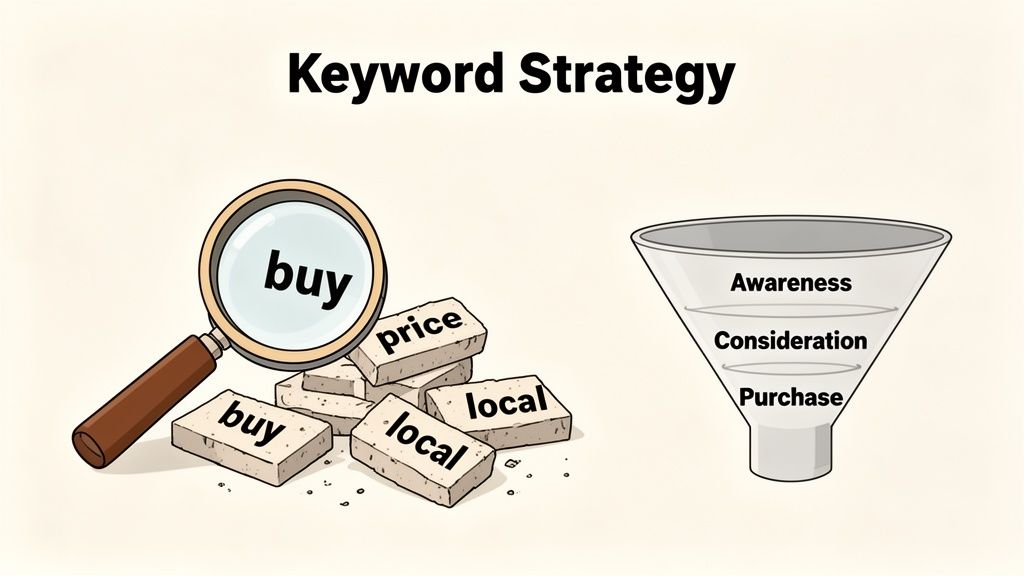
Your objective is to map this entire customer journey with keywords, ensuring you have content that meets them at every critical stage.
Map Keywords to the Buyer's Journey
To build a strategy that drives revenue, you must organise your keywords based on where a prospect is in their decision-making process. This ensures every piece of content you create has a clear commercial purpose, guiding people from discovery to enquiry.
A simple framework for this is:
- Top of Funnel (Awareness): These are informational searches. A user has a problem and is looking for answers, not a provider. An accountant might target "how to calculate corporation tax" to demonstrate expertise.
- Middle of Funnel (Consideration): Now, the user is evaluating options. They are looking for comparisons, solutions, and best practices. The same accountant could target "best accounting software for small business UK."
- Bottom of Funnel (Decision): This is where the commercial opportunity lies. The user is ready to buy. Keywords here are highly specific and often include transactional or local terms, such as "small business accountant in Norwich" or "get a quote for bookkeeping services."
Prioritising these bottom-of-funnel keywords is the most direct path to turning your SEO investment into tangible leads.
One of the most common mistakes we see is businesses focusing all their energy on high-volume, top-of-funnel keywords. These can generate traffic, but it is traffic that rarely converts. A balanced strategy addresses all stages, but a commercially astute one begins with the terms that signal purchase intent.
Find Profitable Gaps by Analysing Your Competitors
Your competitors have already done some of the heavy lifting for you. By analysing which keywords are sending them traffic and leads, you can uncover valuable opportunities.
Use an SEO tool like Semrush or Ahrefs to identify the keywords your competitors rank for. Do not just look at their top terms. Search for "keyword gaps"—commercially relevant phrases they do not rank for, but you could. This is often where you find less competitive, high-intent phrases that can deliver quick wins.
This is not about copying their strategy. It is about reverse-engineering their successes and failures to make your own strategy more efficient and profitable from the outset.
Prioritise Keywords Based on Commercial Value
Once you have a list of potential keywords, you must prioritise ruthlessly. We assess every potential target through a simple, three-part filter:
- Relevance: How closely does this phrase align with our core services? Is the searcher a genuine potential customer?
- Volume: How many people are searching for this term each month? This provides a rough estimate of the total traffic potential.
- Commercial Intent: How likely is the searcher to make an enquiry or purchase? For lead generation, this is the most critical factor.
By focusing on keywords that score highly in all three areas, you ensure your SEO efforts are directly tied to revenue growth. In the UK, this means focusing squarely on Google. As of early 2024, Google holds over 90% of the UK search market. It is the only platform that matters for organic visibility, which is why a meticulously planned keyword strategy is so vital. You can explore the UK search market landscape on Statista.com.
Creating And Optimising Content That Converts

You have resolved your technical issues and compiled a list of commercially viable keywords. The next step is to create content that performs on two fronts: it must satisfy Google’s algorithm to achieve high rankings, and it must persuade human visitors to take action.
Getting this balance right is what separates an SEO campaign that merely generates traffic from one that builds a sales pipeline. Your web pages should be treated not as static information, but as hard-working lead generation assets.
On-Page SEO That Actually Drives Clicks
On-page optimisation is your opportunity to communicate to both search engines and potential customers what a page is about and why it is valuable. Your first impression is made in the search results.
- Title Tags: This is your main headline on Google. It needs your target keyword, but more importantly, it must be compelling enough to earn the click. Treat it as an advertisement for your page.
- Meta Descriptions: While not a direct ranking factor, this is your sales pitch. It should summarise the value of the page and include a clear call to action, such as "Learn more" or "Get a free quote."
A well-crafted title and meta description can significantly increase your click-through rate (CTR), delivering more visitors from the same ranking position. This is more important than ever. Ranking at the top is no longer a guarantee of traffic; you have to earn every single click with persuasive, optimised titles and descriptions.
A Practical On-Page Optimisation Framework
To bring this together, here is a simple framework we use to ensure every key page contributes to commercial goals. The objective is to align what Google requires with what a potential customer needs to see to convert.
On-Page SEO Optimisation Framework
| On-Page Element | Optimisation Goal | Commercial Impact |
|---|---|---|
| Title Tag | Attract clicks with a benefit-driven headline that includes the primary keyword. | Increases click-through rate (CTR) from search results, driving more qualified traffic. |
| Meta Description | Sell the value of the page with a compelling summary and a clear call-to-action. | Improves CTR and pre-qualifies visitors, leading to higher on-page engagement. |
| H1 Heading | Reassure the user they have landed in the right place, closely matching the title tag. | Reduces bounce rate by immediately confirming the page's relevance to the user's search. |
| Body Content | Answer the user's core questions clearly and persuasively, using keywords naturally. | Builds trust and authority, guiding the user towards the desired conversion action. |
| Call-to-Action (CTA) | Provide a clear, relevant, and compelling next step for the user to take. | Directly increases lead generation, enquiries, or sales by making the conversion easy. |
| Internal Links | Guide users to other relevant pages and distribute ranking authority across the site. | Keeps users on the site longer and moves them through the sales funnel effectively. |
Following this structure helps ensure you are not just "doing SEO," but are actively building pages designed to convert traffic into tangible business results.
Structuring Content for Humans (and Conversions)
Once a user clicks through, you have only a few seconds to convince them they are in the right place. A wall of text or a confusing layout will cause them to leave. That is why a clear content structure is a fundamental conversion principle, not just an SEO requirement.
Use a logical hierarchy of headings (H2s and H3s) to break your content into scannable sections. This allows users to quickly find the information they need, keeping them engaged. Short paragraphs, bullet points, and bold text are your allies here; they make your core message easier to digest.
Think of your website pages as conversion systems. Every element, from the headline to the final call-to-action, must guide the user towards the next logical step.
Integrating Your Calls-to-Action
Your content must have a purpose. Whether it is a blog post or a core service page, there must be a clear next step for the reader. These calls-to-action (CTAs) are the bridge between attracting an audience and generating a lead.
Do not simply add a generic "Contact Us" button at the bottom. Make your CTAs relevant to the content the user is reading. For example, a blog post about choosing accounting software could feature a CTA to download a free comparison checklist. A service page detailing your offerings should have a prominent "Request a Quote" or "Schedule a Call" button. These context-aware CTAs feel helpful, not pushy, and have a significant impact on conversion rates.
Building Internal Links to Guide the Journey
Internal links, which connect one page on your site to another, are a vastly underrated tool. They are vital for two key reasons.
First, they help Google understand your website's architecture and the relationships between your content. This distribution of 'link equity' helps to improve your rankings across the entire site.
Second, and more importantly from a commercial perspective, they create pathways for your visitors. By linking from an informative blog post to a relevant service page, you build a natural journey from awareness to consideration, gently moving potential customers down your sales funnel.
After your content is drafted, it is essential to finalise the formatting and keyword placement. We find that proper execution is key when optimizing content for search engines to ensure your investment pays off. Done correctly, this transforms a collection of pages into a cohesive and powerful lead generation machine.
Earning Authority With Strategic Link Building

Once your technical SEO is solid and you are creating content that speaks to your customers, the next piece of the puzzle is authority. In Google's world, authority is still heavily influenced by your backlink profile: the collection of links pointing to your website from other sites. Each link acts as a vote of confidence, signalling to Google that your content is credible.
The rules have changed dramatically. The days of chasing link quantity through high-risk tactics like buying links or submitting to low-quality directories are over. This is a fast track to a Google penalty. Today, sustainable growth comes from earning high-quality, relevant links. One authoritative link from a respected industry publication is worth more than a hundred from irrelevant, spammy sites. This is about building genuine digital authority that drives valuable referral traffic and solidifies your brand's reputation.
Distinguishing a Good Link From a Bad One
Not all links are created equal. An effective approach to link building requires being selective and focusing energy on opportunities that will make a commercial difference.
Here is what to look for:
- Relevance: Does the linking website operate in your industry or a closely related one? A link from a local Chamber of Commerce or an industry trade publication is valuable. A link from a random, unrelated site is not.
- Authority: Is the site well-regarded and trusted? Tools like Ahrefs and Moz offer metrics like Domain Rating (DR) and Domain Authority (DA), which provide a quick assessment of a site's backlink strength.
- Trustworthiness: Does the site publish quality content, or does it feel engineered purely for SEO? Google is exceptionally good at spotting the difference.
Every link building decision should align with Google's core principles of Expertise, Experience, Authoritativeness, and Trustworthiness (E-E-A-T). This framework is crucial. For a deeper dive on how it impacts your rankings, read our guide on E-A-T and SEO. It should inform not just your content, but your entire outreach strategy.
Sustainable Link Earning Strategies for Commercial Growth
Forget quick fixes. The most effective link building strategies are long-term initiatives rooted in creating genuine value. This approach builds a strong, defensible backlink profile that provides returns for years and protects your business from the volatility of algorithm updates.
Creating Link-Worthy Assets
The most powerful way to acquire links is to create content that other websites want to link to. This shifts your position from actively requesting links to passively attracting them. We call this type of content a "linkable asset."
Examples of effective linkable assets include:
- Original Research or Data Studies: If you can publish unique data or fresh insights about your industry, you become a primary source that others will naturally cite.
- In-Depth Guides and How-Tos: A truly comprehensive guide on a complex topic can become the go-to resource in your niche.
- Free Tools or Calculators: Consider what your customers need. A simple, useful tool—such as a mortgage calculator for a financial advisor or a project cost estimator for a builder—can attract a significant number of natural links.
This strategy works because you are adding real value. You are not asking for a favour; you are providing a resource that improves the content of any site that links to it.
Building Relationships with Industry Publications
Another effective strategy is to build genuine relationships with key figures in your field: journalists, bloggers, and editors. This is not about sending generic, bulk emails asking for a link. It is about becoming a trusted source they can rely on.
Start by identifying the key publications your target audience reads. Follow the writers on social media, share their articles, and leave thoughtful comments. When you eventually reach out with genuine news or a unique insight, you will receive a much warmer reception.
By positioning your company's leaders as experts available for comment, you can earn high-authority links and mentions in relevant articles. This not only builds your backlink profile but also establishes your brand as a credible voice in the UK market, driving both direct and referral leads.
Measuring SEO Performance And Proving ROI
SEO without proper measurement is a guessing game. You can create excellent content and build high-quality links, but if you cannot connect those actions to business results, you are operating without a strategy. What is the value of a higher ranking if it does not improve your bottom line?
This is where we move from assumptions to data. It is about looking past vanity metrics like total website traffic and focusing on the numbers that prove a return on investment (ROI). Are we generating more leads? Is the quality of those leads improving? And crucially, what is our cost per lead from organic search?
Setting Up Your Measurement Foundation
To answer these questions, you need two free tools from Google. They are non-negotiable for any business serious about its online performance.
-
Google Search Console: This is your direct line of communication with Google. It shows you which keywords are bringing users to your site, your average ranking position, and click-through rates. It also flags technical problems that could be undermining your efforts.
-
Google Analytics 4 (GA4): This tool tells you what happens after a user lands on your site. You can see their behaviour, which pages they view, and whether they complete valuable actions like filling out an enquiry form or making a purchase.
Correctly configuring these tools is the first step towards accountability and performance measurement.
Tracking The KPIs That Matter To Your Business
Once your tools are in place, it is time to filter out the noise. For most service-based businesses, a handful of Key Performance Indicators (KPIs) tell you everything you need to know about your SEO performance.
Key Performance Indicators for SEO ROI
| Metric | What It Measures | Why It Matters Commercially |
|---|---|---|
| Organic Conversions | The number of leads, enquiries, or sales generated directly from organic search. | This is the ultimate measure of success, directly tying SEO activity to revenue. |
| Conversion Rate | The percentage of organic visitors who take a desired action (e.g., submitting a form). | A rising rate indicates you are attracting not just more traffic, but the right kind of traffic. |
| Keyword Rankings (for Commercial Terms) | Your search position for high-intent phrases like "emergency plumber in Bristol." | This shows you are visible to users who are ready to buy, not just browsing for information. |
| Cost Per Lead (CPL) | The total investment in SEO divided by the number of organic leads generated. | This metric allows you to compare the efficiency of SEO against other channels like paid advertising. |
The conversation needs to shift from "we ranked number one for this keyword" to "our improved visibility for these keywords generated 15 qualified leads last month, contributing an estimated £30,000 to the sales pipeline." That is how you prove ROI.
Creating Reports That Connect SEO to Revenue
The final piece of the puzzle is translating this data into a simple report that tells a commercial story. Do not overwhelm stakeholders with charts and jargon. Your goal is to show a clear narrative connecting your SEO activities to the business's bottom line.
An effective report clearly shows the relationship between your efforts (like publishing a new service page) and the outcomes (a jump in organic leads). For example, you could show a graph where an improvement in rankings for a key page directly correlates with a spike in form submissions from that same page.
This is how you turn SEO from a mysterious marketing cost into a predictable and profitable engine for business growth.
Got Questions About Improving Your Google Rankings?
We have covered the core framework for improving your visibility on Google, from the technical fundamentals to creating content that generates business. However, some questions often remain.
Let's address some of the most common ones we hear from UK business owners.
How Long Does It Really Take to See SEO Results?
The honest answer is: it depends. For a brand-new website, it realistically takes six to twelve months to build the authority required to compete for valuable keywords.
However, if your site has some history and authority, you could see positive movement in as little as three to four months once a sound strategy is implemented.
Some wins can be almost immediate. We have seen sites improve their rankings in a matter of days simply by fixing a critical technical error, such as a key service page being accidentally blocked from Google.
The best way to view SEO is as a long-term investment. You are building a valuable business asset, not flipping a switch for instant leads.
Do I Still Need to Bother With Keywords?
Yes, but your approach must be more sophisticated than simply inserting them into your text. Keywords are the language of your customers. Understanding the exact phrases they use when they are ready to buy is invaluable commercial intelligence.
Instead of seeing keywords as a rigid target, think of them as a direct insight into your customer's search intent. Your objective is to create the single best, most helpful page on the internet for the question that keyword represents. When you achieve that, you will naturally use the right language and rank for the terms that drive business.
Should I Focus on SEO or Just Run Google Ads?
This is a common question, but it presents a false choice. The reality is that SEO and Google Ads are two sides of the same coin, and they work most effectively together.
- Google Ads provides immediate visibility and can start generating leads within hours. It is ideal for testing a new offer or driving short-term demand.
- SEO builds sustainable, long-term organic traffic. The upfront investment is greater, but a strong ranking becomes a low-cost asset that generates leads for years.
The optimal strategy is to use Google Ads for immediate lead flow and valuable keyword data, while your SEO campaign builds a powerful, long-term organic presence in the background. This dual approach creates a truly resilient lead generation system.
At Lead Genera, we do not just chase rankings; we build commercially-focused SEO strategies that turn your website into a predictable pipeline of high-quality leads. If you are ready to focus on measurable growth that impacts your bottom line, let's have a conversation.
Explore our SEO services and start building your sales pipeline.
Categories
Do You Need Assistance With
Sign Up To Our Newsletter