Weekly marketing wisdom you can read in 5 minutes, for free. Add remarkable ideas and insights to your inbox, once a week, by subscribing to our newsletter.

Uncategorized
Segmenting Your Target Market: A Guide to Driving Growth and Efficiency
Segmenting your target market means breaking down a broad audience into smaller, more manageable groups based on shared characteristics. It’s the difference between shouting into a crowd and having a focused conversation. This shift moves your marketing from generic, hopeful messaging to highly relevant communication that improves lead quality, reduces wasted ad spend, and forms the bedrock of any serious lead generation strategy.
Moving Beyond Generic Marketing
Let's be direct: a 'one-size-fits-all' marketing approach is a fast track to a bloated advertising budget and an empty sales pipeline. The commercial reality is that not every customer holds the same value. Some are more profitable, convert faster, or offer greater long-term potential.
Without a clear framework for segmenting your market, you are simply testing tactics and hoping something works. That isn’t a strategy for predictable growth; it’s a gamble with your budget.
Generic campaigns inherently attract low-quality leads because they fail to address anyone's specific problems. When your message is broad, it resonates with no one in particular. This is a primary cause of high bounce rates, low ad engagement, and a sales team wasting valuable time on prospects who were never a good commercial fit.
The Commercial Case for Precision
Effective segmentation isn't just a marketing exercise; it's a commercial imperative with a direct impact on your bottom line. It solves tangible business problems. For many UK businesses, this remains a significant hurdle. In fact, 36% of UK digital marketers admit that defining their target audience is a major obstacle. This highlights a common and costly gap between strategic goals and practical execution.
Here is where precision creates measurable value:
- Improved Lead Quality: When you speak directly to a segment's unique challenges, you attract prospects who already understand the value of your offer. This significantly shortens the sales cycle.
- Lower Cost Per Lead (CPL): Focusing your budget on audiences most likely to convert eliminates wasted spend and improves your return on investment.
- Higher Conversion Rates: When your ads, emails, and landing pages align perfectly with a user's context, they are far more likely to take the desired action.
- Enhanced Customer Loyalty: Relevant communication makes customers feel understood. This builds stronger relationships and increases their lifetime value (CLV).
This entire process is about shifting your mindset from a volume game to a value game. It is about attracting the right business, not just any business. This precision is what enables scalable, efficient, and profitable growth.
To execute this correctly and unlock higher conversions, you must go deep on effective market segmentation for B2B. The process reframes your entire approach, compelling you to build detailed profiles of your ideal customers.
These profiles, often called personas, become invaluable operational tools for both marketing and sales. If you are new to this concept, our guide on what is a buying persona explains how to build one that delivers commercial results. Once you understand these distinct groups, you can tailor every aspect of your strategy—from ad copy to website design—ensuring every pound spent works as hard as possible.
The Four Models of Market Segmentation
Understanding the theory is one thing; applying it to drive results is what matters. Effective segmentation is not an academic exercise. It is about using proven models to create a practical framework for dividing your audience. These are the tools that allow you to sharpen your messaging, maximise ad spend, and ultimately, reduce your cost per lead.
Let’s break down the four core models. Most businesses use a blend of these approaches, but selecting a primary model is the best way to bring focus to your strategy.
Demographic Segmentation: Who Your Customers Are
This is the most direct model, grouping people based on tangible, personal attributes. Consider it the foundational layer of your strategy – the "who" behind the purchase.
While it may seem basic, demographic data is incredibly useful because it is often the easiest to acquire and frequently correlates with needs and buying behaviour. For any service-based business, it provides immediate, valuable context.
Common demographic data points include:
- Age: Are you communicating with recent graduates starting their careers or retirees considering their estate?
- Gender: Some services naturally appeal more to one gender, which can influence everything from ad imagery to tone of voice.
- Income Level: This is a crucial factor. It directly impacts affordability and the perception of value between premium and budget-friendly services.
- Life Stage: Are your ideal customers single professionals, new parents, or empty-nesters? Each group has entirely different priorities and pain points.
Practical example: A UK financial advisory firm might use age and income to segment its audience. One campaign could target individuals aged 25-35 with moderate incomes, focusing on first-time investments and pension planning. A separate campaign could be aimed at the 55-65 age bracket with high disposable income, with messaging centred on inheritance tax planning and wealth preservation.
Firmographic Segmentation: The B2B Essential
For any B2B company, firmographics are the business equivalent of demographics. This model segments organisations based on their attributes, allowing you to focus your sales and marketing resources on the companies that represent the best commercial opportunity.
Without firmographic data, B2B marketing is incredibly inefficient. It prevents you from wasting budget and effort on businesses that are too small, in the wrong sector, or simply not a good fit for your services.
Key firmographic criteria include:
- Industry/Sector: A software provider’s proposition to a construction firm will be fundamentally different from its approach to an NHS trust.
- Company Size: This can be measured by employee count or annual revenue. A start-up with 10 employees has very different challenges to a corporation with 500.
- Geographic Location: This is vital for any service business with a regional focus or for those navigating different regulations across the UK.
- Business Structure: Are you targeting sole traders, limited companies, or PLCs? Their decision-making processes and procurement cycles will vary significantly.
Applying firmographics transforms a vague "we help businesses" message into a sharp, compelling "we help UK-based manufacturing firms with 50-200 employees reduce operational costs." The difference in the quality of leads generated is night and day.
Psychographic Segmentation: Why They Buy
Psychographics move beyond who your customers are to understand why they act. This model segments your audience based on their personality, values, attitudes, interests, and lifestyle. This is how you build a genuine connection, by speaking to their underlying motivations, not just their surface-level needs.
Understanding the "why" enables you to create messaging that resonates on an emotional level. It is how you differentiate your business in a crowded market where the functional benefits of your service may appear similar to competitors'. For example, two business owners might need an accountant, but one could be a risk-averse traditionalist who values security, while the other is an ambitious entrepreneur who prioritises innovation and speed.
A UK-based marketing agency could use this to target business owners. One segment might be 'Growth-Oriented Innovators', who respond to messages about gaining a competitive edge. Another could be 'Stability-Focused Pragmatists', who are far more interested in proven ROI and predictable, steady growth.
Behavioural Segmentation: What They Do
This is arguably the most commercially valuable model for digital marketing. Behavioural segmentation groups people based on their direct interactions with your business. It is about using your own data to understand their intent and level of engagement.
This model is powerful because it is based on actions people have actually taken, not assumed traits.
Common behavioural segments include:
- Purchase History: Are they first-time buyers who need onboarding, or loyal, repeat customers who merit a retention offer? Each group requires a different approach.
- Engagement Level: This could involve tracking email opens, website visits, or content downloads. A highly engaged prospect is significantly closer to converting than a casual browser.
- Benefit Sought: This groups users by the specific problem they are trying to solve. For a web design agency, this could mean separating users interested in e-commerce functionality from those needing lead generation landing pages.
This allows you to tailor your follow-up with incredible precision. For instance, a prospect who downloaded your guide on "Improving Lead Quality" can be automatically entered into an email sequence that nurtures them with relevant case studies and offers. This is how you dramatically increase the probability of conversion.
Choosing Your Primary Segmentation Model
So, which model is right for you? The answer depends on your business, your market, and your commercial objectives. Often, the best strategies use a combination, but it is crucial to have a primary model to guide your thinking. This table breaks down the core focus of each to help you decide on a starting point.
| Segmentation Model | What It Tells You | Best For | Example Application |
|---|---|---|---|
| Demographic | Who your customers are (age, income, location). | B2C businesses with products tied to life stages or specific consumer profiles. | A mortgage broker targeting first-time buyers aged 25-35 in the South East. |
| Firmographic | Which companies to target (industry, size, revenue). | B2B service providers and SaaS companies focusing on specific business types. | An IT support company focusing on legal firms with 10-50 employees. |
| Psychographic | Why your customers buy (values, lifestyle, attitudes). | Brands in competitive markets needing to build an emotional connection. | A sustainable fashion brand targeting ethically conscious consumers. |
| Behavioural | How they interact with you (purchase history, site visits). | E-commerce and digital businesses wanting to personalise marketing based on actions. | An online course provider sending a discount to users who abandoned their cart. |
Ultimately, the goal is not just to create neat boxes for your customers. It is about understanding them on a deeper level so you can serve them more effectively. Start with the model that provides the clearest, most actionable insights, then layer in other data points as your strategy matures.
A Practical Framework for Segmenting Your Audience
Theory is useful, but execution is what generates revenue. A practical, repeatable framework for segmenting your market removes guesswork and prevents you from drowning in data. This is not an academic exercise; it is a commercial process designed to deliver a tangible return on marketing spend.
The objective is to move from vague assumptions to a clear, data-driven understanding of your most valuable customer groups. That clarity then informs everything you do, from ad creative to service development, ensuring your efforts are always focused where they will have the greatest impact.
Let's walk through how to build this framework without overcomplicating it.
Define Your Commercial Goals First
Before opening a spreadsheet, you must be clear about what you are trying to achieve in business terms. Why are you segmenting your audience? A vague objective like "to understand our customers better" is insufficient.
Your goals must be specific, measurable, and tied directly to solving a business problem or capitalising on an opportunity.
Here are some examples of strong, commercially-focused goals:
- Reduce our Cost Per Lead (CPL) by 20% by focusing spend on segments that convert at a higher rate.
- Increase Customer Lifetime Value (CLV) by identifying our most loyal customers and creating targeted retention campaigns.
- Improve sales efficiency by providing the team with qualified leads from our ideal company size and industry.
When you start with a clear commercial objective, every decision made during the segmentation process has a purpose. It keeps the project grounded and prevents it from becoming another theoretical document gathering digital dust.
Gather and Cleanse Your Data
Your own data is your most powerful asset. It reveals how real people have already behaved with your business. The two best places to start are your Customer Relationship Management (CRM) system and your website analytics.
Your CRM is a goldmine of information. Look for patterns in:
- Firmographics: Company size, industry, location.
- Purchase History: Which services did they buy? What was the deal value? How long did the sales cycle take?
- Sales Notes: Your sales team's notes can reveal common pain points, buying triggers, and objections that you would never find in a standard report.
Website analytics tools like Google Analytics provide the behavioural side of the story. You can see which pages different users visit, what content they download, and how they found you. This helps build a picture of their interests and intent long before they submit a form.
Now for the critical part: you must clean your data. Remove duplicates, correct errors, and standardise formats. Inaccurate data leads to flawed segments and wasted investment. Do not skip this step.
Choose Impactful Segmentation Criteria
With your goals set and data cleansed, it is time to decide how you will group your audience. This is where you will combine different models—demographic, firmographic, behavioural, and psychographic—to create segments that are commercially meaningful.
The key is to select criteria that directly influence buying behaviour. A B2B software company might find that a prospect’s existing tech stack and company size are the strongest predictors of a good fit. In contrast, a B2C travel company might find that family status and past holiday destinations are far more revealing.
This diagram illustrates a simple way to think about combining these models.
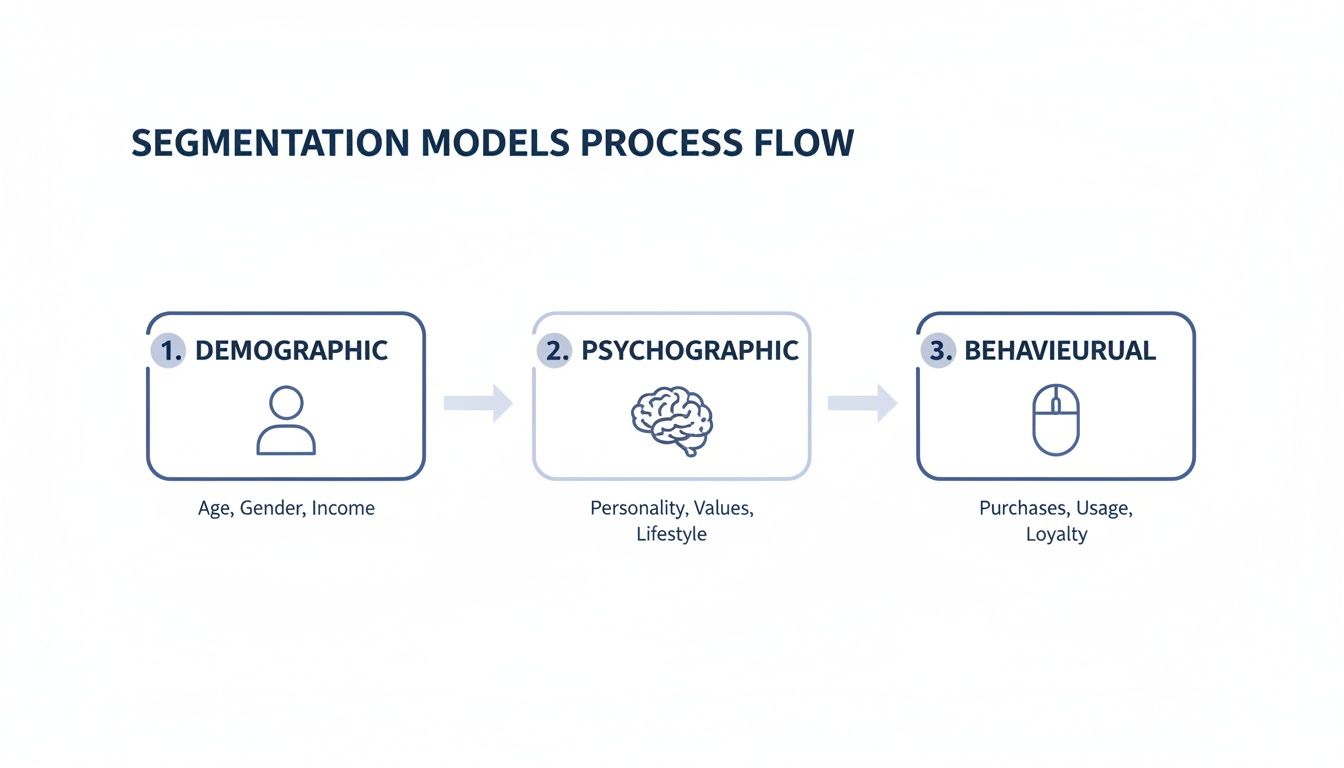
As shown, you can layer different models to become more specific. You might start with broad demographics, add psychographic insights about motivations, and then refine it all with behavioural data to create distinct and actionable groups.
A common mistake is creating too many segments. Start with three to five core groups. Any more, and your marketing execution becomes complex and unmanageable. You are looking for the most significant groups, not every possible permutation.
Develop Practical Customer Personas
Once you have defined your core segments, you need to bring them to life with customer personas. A persona is a character profile of your ideal customer within each segment. It must be a practical tool that your marketing and sales teams can use daily.
A useful persona includes:
- A name and stock photo to make them feel real.
- Key demographic or firmographic details.
- Their primary goals and professional drivers.
- Their biggest frustrations and challenges.
- Where they seek information (e.g., specific blogs, LinkedIn groups, industry events).
- A short quote summarising their general attitude.
Personas turn cold data into relatable human stories. This makes it infinitely easier for your team to write messaging that connects and to tailor their sales approach effectively. For a deeper look, excellent resources are available on customer profiling mastery.
Validate and Prioritise Your Segments
Segmentation cannot be an educated guess. You must validate your new segments against real-world data. Review your historical performance: do these segments represent distinct groups with different conversion rates, deal sizes, or sales cycles? If not, your criteria need adjustment.
Once validated, it is time to prioritise. Not all segments offer equal value. Use a simple scoring framework to rank each segment based on criteria like:
- Size: How large is the potential market in this group?
- Value: What is the average deal size or CLV?
- Accessibility: How easily can we reach them with our current channels?
This forces you to focus your limited time and budget on the segments that offer the highest potential return. This strategic focus is critical for success.
Activating Segments for Better Lead Generation
Defining your audience segments is a major strategic step, but it is only half the job. The real value is unlocked when you activate those segments—turning clarity into tangible marketing campaigns that generate business. An unactioned segmentation strategy is just an interesting report. An activated one is a powerful engine for improving lead quality and driving down acquisition costs.
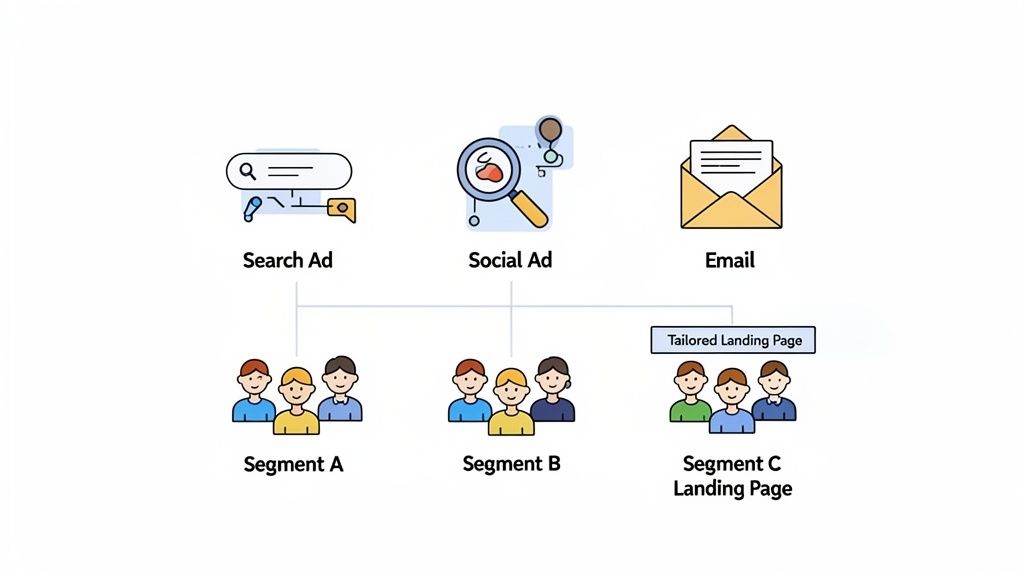
Activation bridges the gap between knowing who your customers are and demonstrating that you understand their world. It involves taking your well-developed personas and letting them dictate the copy you write, the creative you design, and the channels you select. This is where theory becomes practice and you start seeing a return on your strategic efforts.
Tailoring Paid Advertising Campaigns
Your paid media campaigns on platforms like Google Ads and Meta Ads are the perfect environment to apply your new segments. Instead of launching one generic campaign, you can now build distinct campaigns or ad groups for each high-priority segment, allowing you to fine-tune every element for maximum impact.
Imagine you are a B2B technology firm. Here is how that might look in practice:
- Segment A (Enterprise IT Managers): You would run Google Search campaigns targeting highly technical, long-tail keywords. The ad copy would use their language, focusing on security, scalability, and seamless integration. The landing page would offer a detailed whitepaper or a request for a technical demo, rather than a hard sell.
- Segment B (SME Business Owners): For this group, you would use Meta (Facebook and Instagram) with firmographic targeting. The ad creative would focus on efficiency gains and ROI, demonstrating how your technology solves business problems. The landing page would be simpler, perhaps featuring a pricing calculator and a quick-start guide.
This approach ensures the messaging, offer, and entire user journey align with what each segment values. This alignment dramatically improves click-through rates and conversion rates, which directly lowers your Cost Per Lead (CPL).
By speaking directly to each group's specific pain points, you stop wasting budget on clicks from irrelevant audiences. Your Return On Ad Spend (ROAS) increases because every pound is spent with purpose, targeting prospects far more likely to become valuable customers.
With the UK’s social media advertising market projected to reach £9.95 billion, precise targeting is critical. Understanding that X's ad audience is 65.8% male or that Reddit’s UK reach grew 47% year-on-year helps you place your message exactly where your segments are already active.
Personalising the Customer Journey
Activation extends beyond the first ad click. It is about personalising the entire prospect experience, from the moment they land on your website to the ongoing emails you send. Your segments are the blueprint for creating these tailored journeys.
Optimising Website Content and CRO
Your website should not be a static, one-size-fits-all brochure. With defined segments, you can create dynamic experiences for different visitors.
- B2B Example: A high-value firmographic segment, such as manufacturing firms with over 200 employees, could be automatically directed to a unique landing page. This page would showcase industry-specific case studies, testimonials from similar companies, and a call-to-action for a bespoke consultation.
- B2C Example: A behavioural segment, such as returning visitors who have viewed specific service pages, could be shown a pop-up offering a relevant guide or a time-sensitive discount on that service, providing a timely nudge towards conversion.
This level of personalisation makes visitors feel understood, which is fundamental to building trust and significantly lifting conversion rates.
Automating Email Nurture Sequences
Email marketing becomes far more effective when segmented. Instead of sending generic newsletters, you can build automated sequences triggered by a user's segment.
A new lead from your 'SME Business Owner' segment might receive a welcome series focused on business growth tips and client success stories. A lead from the 'Enterprise IT Manager' segment would receive a series highlighting technical specifications and security credentials.
This targeted communication keeps your brand top-of-mind by nurturing leads with relevant content until they are ready to engage with sales. A powerful way to enhance this is by understanding how to create effective lookalike audiences, which helps you find more people who resemble your best segments. You can learn more by reading our guide on why you should use lookalike audiences on your ads campaigns.
Ultimately, activating your segments is the final, crucial step in turning market research into revenue. It is a pragmatic, commercially-focused process that ensures every part of your marketing machine works together to attract, engage, and convert your most valuable customers.
Measuring and Refining Your Segmentation Strategy
You have completed the hard work of building your market segments. It is tempting to consider the job done. However, this is a significant mistake.
Market segmentation is not a one-off project; it is a living part of your commercial strategy. Markets shift, customer needs evolve, and your own business changes. The companies that gain a long-term competitive edge from segmentation are those that treat it as a dynamic process.
This requires a robust process for measuring what is working, identifying what isn't, and adapting accordingly. Without this feedback loop, even the most well-designed segments will lose their effectiveness, and your marketing will drift back towards being generic and inefficient.
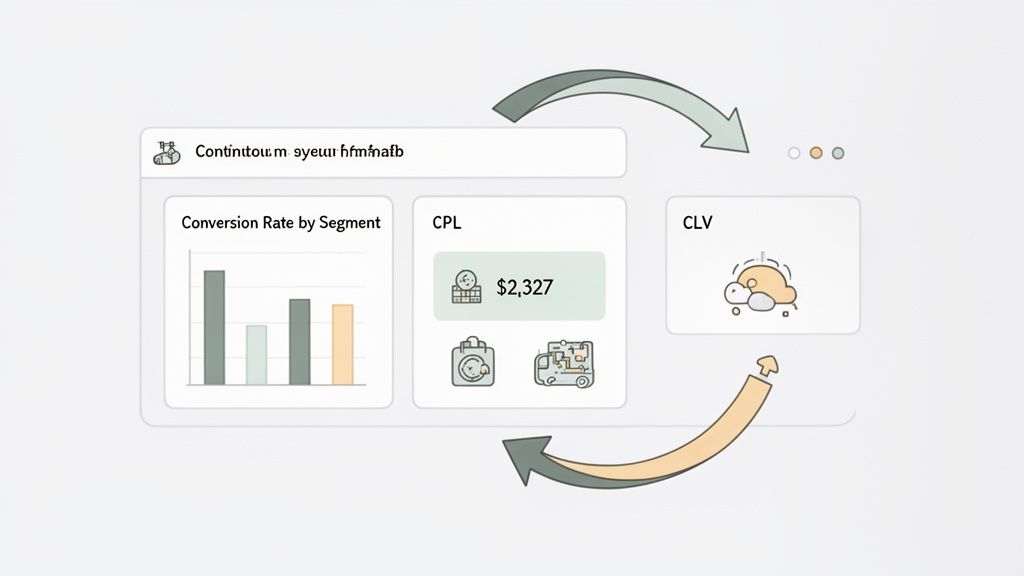
Identifying the KPIs That Matter
To determine if your segmentation is working, you must track metrics that tie directly to profitability and pipeline health. Forget vanity metrics like raw impressions or total lead volume; they can provide a dangerously misleading picture.
You need to focus on segment-specific performance indicators that reveal the real commercial impact.
Your core segmentation dashboard should track:
- Cost Per Lead (CPL) by Segment: This is your primary efficiency metric. Are you paying £25 for a lead from your ‘Start-Up Founder’ segment but £150 for one from your ‘Enterprise Marketing Director’ group? This number shows you exactly where your budget is most effective.
- Lead-to-Customer Conversion Rate by Segment: Which groups are converting into paying customers? One segment might generate many cheap leads, but if none convert, it represents a false economy. This metric uncovers the true quality of leads from each segment.
- Customer Lifetime Value (CLV) by Segment: This is the ultimate measure of value. Tracking the average long-term spend of customers from each segment reveals which groups are not only easy to acquire but also the most profitable over time.
- Sales Cycle Length by Segment: How long does it take your team to close a deal with each group? A shorter sales cycle means faster revenue and a more efficient sales operation.
By breaking down your core business KPIs by segment, you move from a high-level, often confusing, business overview to a sharp, tactical analysis of your customer base. This clarity enables you to make confident, data-backed decisions about where to invest time and money.
A Framework for Continuous Refinement
Once this data is flowing, you can establish a simple but powerful review process. This does not need to be a complex, bureaucratic exercise. For most businesses, a quarterly rhythm is effective. The goal is to make informed adjustments, not to constantly reinvent your strategy.
The Quarterly Segmentation Review
Set aside a dedicated session every three months to analyse the data for your key segments and ask direct questions:
- Performance Check: Which segments are meeting or exceeding our KPI targets? Which are underperforming? Most importantly, why do we believe this is the case?
- Market Shifts: Has anything changed in the wider market that could be affecting our segments? Has a new competitor emerged? Is new technology changing customer needs?
- Strategic Alignment: Are we still focusing our marketing spend and sales efforts on our highest-value segments? If the data reveals a mismatch, it is time to reallocate resources.
This structured review provides the discipline to keep your strategy sharp. You might decide to increase investment in a high-performing segment, adjust the messaging for a struggling one, or even retire a group that consistently fails to deliver a return. This is what strategic ownership looks like, and it is how your segmentation work will continue to drive sustainable, profitable growth.
Answering Your Market Segmentation Questions
Even with a solid framework, practical questions often arise during the implementation of market segmentation. Here are straightforward answers to the queries we hear most frequently from business owners and marketing directors.
How Many Segments Is Too Many?
There is no single correct number, but a common mistake is to over-segment your market, creating a dozen different groups. This almost always leads to an unmanageable marketing strategy where resources are stretched too thin, and no single segment receives the attention it deserves.
For most businesses, aiming for three to five core segments is the sweet spot. This is focused enough to allow for distinct campaigns for each group without overwhelming your team. You can always refine and expand later as you gather more performance data.
How Often Should I Review My Segments?
Your market is not static, so your segments cannot be either. Customer habits change, new competitors emerge, and your business goals will evolve. A segmentation project should never be a "set and forget" exercise.
We find a quarterly review is a practical rhythm for most businesses. This provides enough time to collect meaningful performance data while preventing your strategy from becoming outdated. Use this time to check KPIs, challenge your assumptions, and decide if any segments need to be adjusted, retired, or replaced.
What If I Don't Have Much Data?
A lack of perfect, clean data should not be a barrier to starting. You do not need a large, expensive CRM database to begin thinking in a more targeted way. Even with a small customer base, you can create provisional segments based on qualitative insights.
- Talk to your sales team: They are on the front line, having direct conversations with prospects. They understand pain points and motivations better than anyone.
- Interview your best customers: Call them. Ask why they chose you, what specific problems you solve for them, and what they are trying to achieve.
- Use industry reports: Analyse broader market trends and research to inform your initial hypotheses about who your ideal customers might be.
Start with these informed assumptions and then use your marketing campaigns to test and validate them. The key is to begin the process and build from there.
Ready to stop wasting your marketing budget on the wrong audience? Lead Genera builds commercially-focused lead generation strategies based on a deep understanding of your most valuable customer segments. We turn market insights into a predictable pipeline of high-quality leads.
Discover how we build growth strategies that deliver real results
Categories
Do You Need Assistance With
Sign Up To Our Newsletter