


Weekly marketing wisdom you can read in 5 minutes, for free. Add remarkable ideas and insights to your inbox, once a week, by subscribing to our newsletter.
Brand Building
Storytelling for Business: A Guide to Driving Commercial Growth
In a market saturated with feature lists and data sheets, simply stating what you do is no longer enough to win customers. Storytelling for business is the strategic use of narrative to connect with your audience, build genuine trust, and demonstrate your commercial value. It marks a fundamental shift from listing what you do to explaining why it matters to your ideal customer.
Why Storytelling Is a Commercial Necessity
Many businesses dismiss storytelling as a “nice-to-have” creative task, separate from the serious work of generating leads and closing deals. This is a strategic error rooted in a misunderstanding of how modern buyers make decisions.
Your prospects are not just buying a product or service; they are buying a solution to a persistent problem. They are investing in a better future for their business, and a compelling narrative is the most effective way to illustrate that future. It transforms your company from a faceless vendor into a trusted guide, which has a direct and measurable impact on your revenue.
From Vague Concepts to Tangible Revenue
A well-executed, story-driven approach becomes the strategic backbone for all marketing activity. It is the connective tissue that aligns your website copy, paid advertising campaigns, and sales conversations, ensuring every touchpoint reinforces the same core message.
This alignment builds momentum and improves efficiency across the board. The benefits are not abstract; they are concrete and directly tied to commercial growth:
- Higher Quality Leads: A clear story attracts prospects who understand and value your specific approach, meaning your sales team spends less time with unqualified leads.
- Improved Conversion Rates: When a landing page tells a story that resonates with a visitor’s specific challenges, they are significantly more likely to take action.
- Justification for Premium Pricing: A strong narrative demonstrates your unique value beyond a simple feature comparison, allowing you to command higher prices.
- Greater Customer Loyalty: Customers who connect with your brand’s purpose are more likely to remain loyal, increasing their lifetime value to your business.
The commercial impact of shifting from a feature-led to a narrative-led strategy is significant.
Commercial Impact of Storytelling vs. Traditional Marketing
A story-led strategy does not just feel different; it performs better. It reframes customer interactions from transactional exchanges to transformational partnerships, which has a profound effect on key business metrics.
| Metric | Traditional (Features-Led) Approach | Storytelling (Narrative-Led) Approach |
|---|---|---|
| Customer Engagement | Low. Relies on rational evaluation of specifications. | High. Creates an emotional connection and builds trust. |
| Lead Quality | Mixed. Attracts price-shoppers and researchers. | High. Attracts ideal customers who resonate with the story. |
| Sales Cycle | Often long. Focuses on overcoming objections. | Shorter. Pre-sells the value before the sales conversation. |
| Price Sensitivity | High. Encourages direct feature and price comparisons. | Low. Justifies premium pricing through unique value. |
| Brand Recall | Poor. Easily forgotten among similar competitors. | Excellent. Memorable stories remain in the customer’s mind. |
| Customer Loyalty | Transactional. Prone to switching for a better offer. | High. Fosters a loyal community around a shared purpose. |
The side-by-side comparison makes it clear that a narrative-led approach builds a more resilient commercial foundation.
Market data supports this. A significant 77% of UK adults believe brands should tell stories. This preference translates directly into sales, with 68% of consumers confirming that brand stories have influenced their purchases.
One of the most common mistakes businesses make is casting themselves as the hero of the story. You are not the hero; the customer is. Your role is that of the expert guide with a plan to help them succeed. This shift in perspective is crucial for building trust and driving action.
A cohesive narrative makes every marketing decision simpler and more effective, ensuring every piece of content is consistent and contributes to the same commercial goal. For a closer look at this principle, read our guide on why brand consistency matters for business growth.
Ultimately, storytelling is not an abstract creative pursuit. It is a commercially grounded tool for building a predictable, profitable, and defensible business.
Building Your Core Brand Narrative
Every effective marketing campaign, from a simple Google Ad to your website’s homepage, is built upon a single, powerful story. Neglecting this foundation results in a collection of disconnected tactics that fail to build the trust required for predictable growth. Crafting this narrative is not a creative aside; it is a fundamental strategic task.
The objective is to establish a simple, repeatable story that places your customer, not your business, as the hero of their journey. Your business is the expert guide with a clear plan to help them achieve their goals. This change in perspective is the key to creating a story that truly connects.
Uncovering Your Foundational Story
To begin, you must answer a few fundamental questions about your business and your customers. Set aside the marketing jargon and focus on the core truths. The answers will form the building blocks for all future content.
Ask yourself these three questions:
- What is the ‘why’ behind this business? Beyond profit, what common frustration or problem did you set out to solve? This is your origin story.
- Who is the ‘villain’ in your customer’s story? The villain is not a person; it is the persistent problem they face. Is it operational chaos, wasted ad spend, missed sales opportunities, or reputational damage? Be specific.
- What tangible transformation do you deliver? How is a client’s business or life genuinely better after working with you? Move beyond features and describe the future state they are trying to achieve.
Answering these questions provides the raw material for your narrative. For example, a logistics company’s villain is not “late deliveries.” It is “the constant fear of losing key clients due to unreliable shipping.” The transformation is not “on-time delivery”; it is “becoming the most dependable supplier in their industry.”
This process demonstrates how a strong story captures a prospect’s attention and guides them toward a purchase.
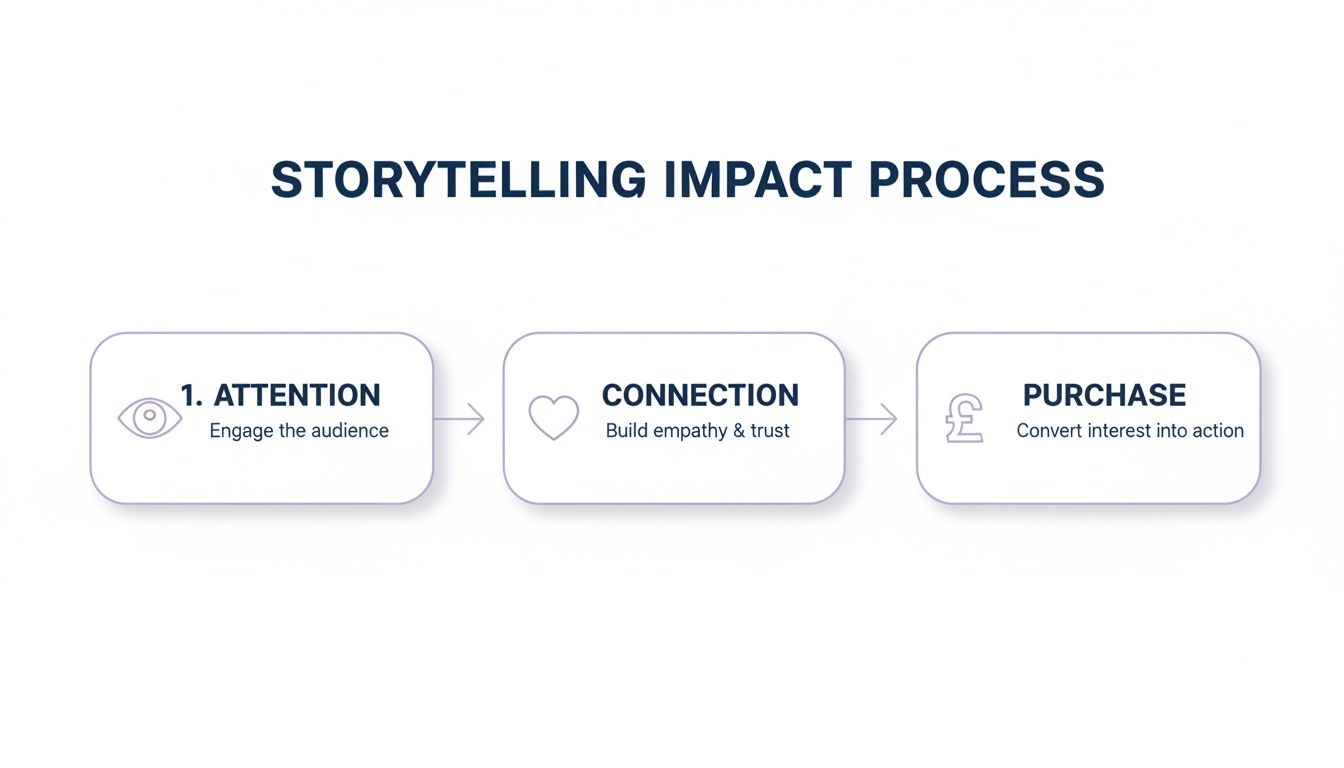
The journey is clear: compelling storytelling grabs attention, forges an emotional connection, and ultimately drives the sale.
Structuring Your Narrative for Commercial Impact
Once you have the core components, you must assemble them into a structure that positions your business as the logical choice. The most effective framework keeps the customer at the centre of the narrative.
Here is a simple, four-part framework that consistently delivers results:
- Start with the Hero and Their Problem: First, demonstrate understanding. Describe the customer’s world and the specific challenge they face. This builds empathy and establishes relevance.
- Position Yourself as the Expert Guide: Now, introduce your role. Show your competence and authority. Briefly explain why you are uniquely qualified to solve this exact problem.
- Provide a Clear, Simple Plan: Do not overcomplicate things. Outline the few simple steps a customer will take to work with you and succeed. This removes uncertainty and lowers perceived risk.
- Show Them What Success Looks Like: Paint a vivid picture of the successful outcome. Use case studies, testimonials, and data to show them the transformation they can expect.
Your core narrative is the single source of truth for all your marketing. It ensures your Google Ads, landing pages, and email sequences are all aligned, building momentum and trust with every interaction.
This structured approach ensures your storytelling is not just engaging, but commercially effective. It guides prospects logically towards a purchase by making them feel understood and confident in your ability to deliver results.
This is a vital first step. If you are questioning its importance, our article can help clarify if your business needs branding. To see how powerful a well-crafted narrative can be, it is worth exploring some impactful brand story examples to see these principles in action.
Crafting Customer Case Studies That Convert
While your core brand narrative is the foundation, your most powerful stories come directly from your customers. A well-crafted case study is more than a glowing testimonial; it is a strategic asset that walks a prospect through a familiar journey, making your solution feel like the logical next step.
When a potential client reads a success story, they are looking for a mirror. They need to see their own frustrations, operational headaches, and ambitions reflected in the story of a business like theirs. This is how you turn a review into a powerful conversion tool.
The data confirms this. In 2023, 78% of UK B2B marketers created case studies, a significant increase from 67% in 2022. Among SaaS companies, 49% rate case studies as ‘very effective’ for driving sales, with 82% using the challenge-solution-results framework. You can explore more content marketing trends in the UK here.
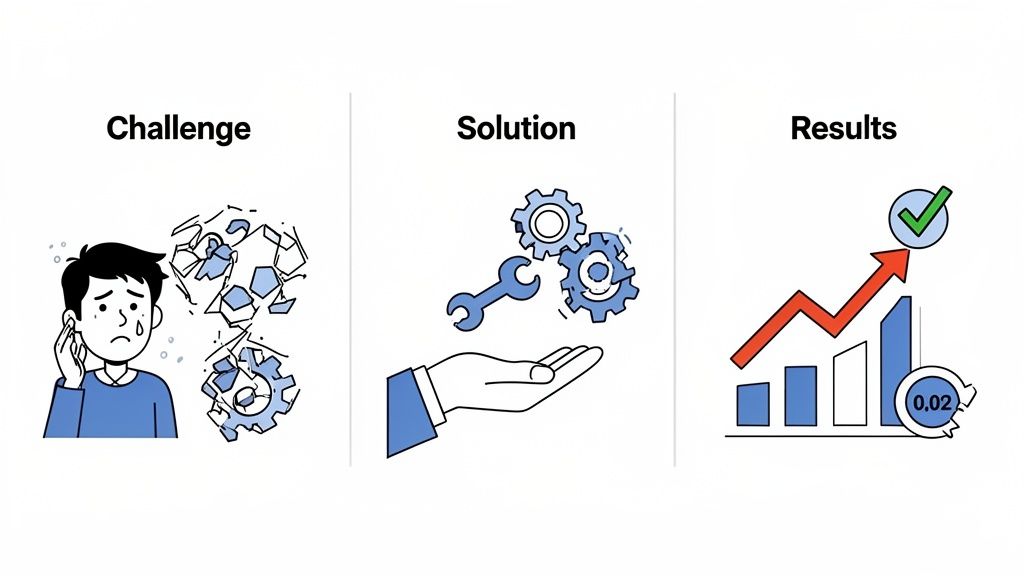
Deconstructing the Challenge-Solution-Results Framework
The most effective case studies follow a simple but powerful structure: Challenge, Solution, Results. It works because it mirrors the buyer’s decision-making process by identifying their pain, presenting a clear path forward, and proving the value of the outcome.
- The Challenge: This is your hook. It must be specific and resonate with your target audience. “Needed more efficiency” is weak. “Manual invoicing was causing a 15% error rate, delaying payments by an average of 21 days” is a problem with tangible consequences.
- The Solution: This section explains what you did. Crucially, do not just list product features. Frame the solution around the actions you took to resolve the specific challenge. Explain the why behind your strategy.
- The Results: This is the payoff. To be credible, it must be quantifiable. Vague claims like “improved ROI” are meaningless. You need hard numbers. “Reduced cost per lead by 42%” or “increased qualified pipeline value by £250,000 in six months“—that is the undeniable proof that drives decisions.
This structure transforms a passive testimonial into an active sales tool, guiding the reader from shared frustration to a vision of their own success.
Extracting the Right Information
The quality of your case study depends entirely on the information you gather from your client. Generic questions yield generic answers. You must dig deeper to uncover the real story.
Before the interview, do your research. What was their business like before they worked with you? During the conversation, focus on drawing out the narrative.
Questions to Uncover the Story
- Before us, what was the biggest frustration keeping you up at night related to [the problem you solve]? (This gets to the emotional core of the challenge.)
- What was the breaking point that made you realise you had to find a solution? (This creates urgency and makes the story more relatable.)
- What tangible impact was this problem having on the business in terms of wasted time, lost revenue, or team morale? (This helps you find the hard numbers for the ‘Challenge’ section.)
- What were your biggest hesitations or concerns before deciding to work with us? (Addressing this builds trust by showing you understand buyer anxiety.)
- Now that the solution is in place, what specific, measurable changes have you seen? Can you share any data? (This is where you get the crucial information for the ‘Results’ section. Always push for data.)
Gathering these details elevates your case study from a simple endorsement to a strategic narrative that anticipates and answers a prospect’s biggest questions.
A great case study does not tell the reader how great you are. It shows them how great their business could be with your guidance. The focus must always be on the customer’s transformation.
Framing the Narrative for Commercial Impact
How you frame the story is critical. The same facts can be presented in different ways to appeal to different buyers. The ‘challenge’ you highlight must mirror a core pain point your ideal customer is currently experiencing.
Consider the difference between these two examples:
- Logistics Company: The challenge is not “inefficient delivery routes.” It is “failed deliveries were costing £15,000 a month in refunds and damaging a 20-year reputation for reliability.” This frames the problem in terms of direct financial loss and a significant business risk.
- Software Firm: The challenge is not “outdated software.” It is “manual data entry was leading to critical compliance errors, putting a major client contract at risk.” This directly connects a small process issue to a massive threat of revenue loss.
When you frame the narrative around high-stakes business outcomes, your case study becomes a powerful tool for proving your value, making the decision to work with you feel not just safe but essential.
Applying Your Narrative Across The Marketing Funnel
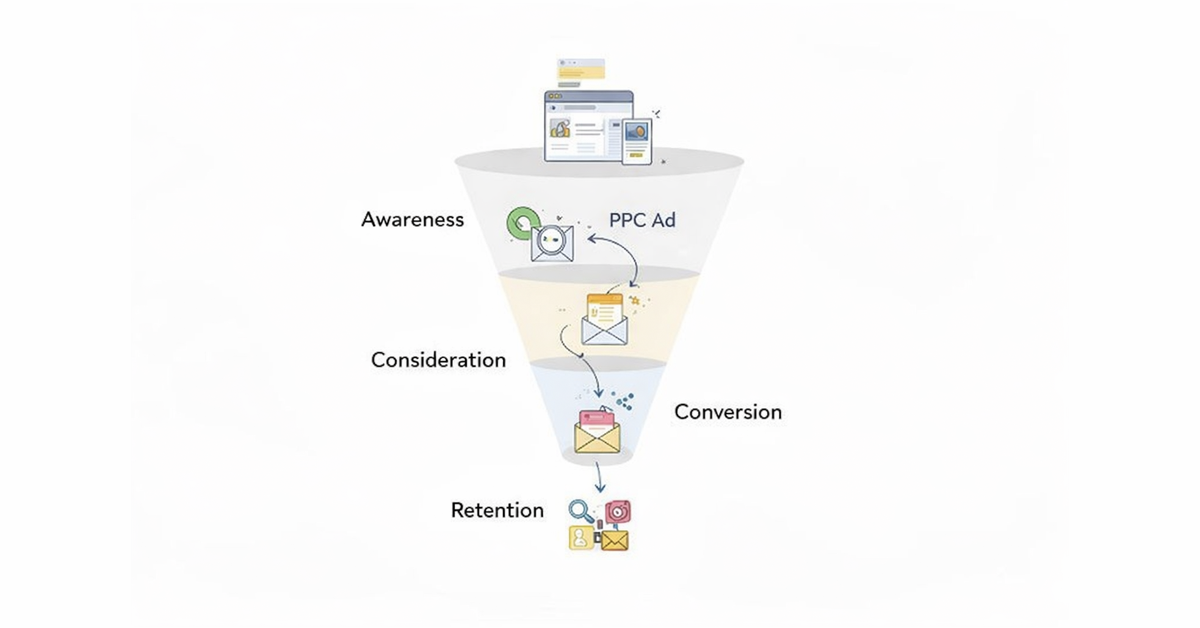
A powerful brand narrative is commercially ineffective if it remains in a strategy document. Its purpose is to be seen, heard, and felt at every touchpoint a potential customer has with your business. This is where strategy becomes execution, turning your core story into a consistent, persuasive force that guides prospects from initial awareness to a signed contract.
This is not about copy-pasting the same text everywhere. It is about adapting the core elements—the customer’s problem, your role as the guide, and the successful outcome—to fit the context of each channel. The mindset of someone seeing a Google Ad is different from someone reading a detailed service page, but the underlying narrative must remain consistent.
Your Website: The Central Storytelling Hub
Your website is the home of your story. It is the one place where you have complete control over the narrative, guiding visitors through a carefully constructed journey that earns their trust and proves your value.
Here is how to put your story to work:
- Homepage: Your homepage should tell your entire core story in a condensed format. The main headline must address your ideal customer’s biggest frustration. Subsequent subheadings should introduce you as the expert guide, outline your simple plan, and clearly show the successful transformation you deliver.
- Service Pages: These pages must do more than list features. Frame each service as a crucial chapter in your customer’s success story. Start with the specific pain point that the service solves, then explain how your process eliminates that pain. Conclude with real snippets from case studies that prove the positive outcome.
- About Us Page: Many businesses waste this page with dry company histories. Instead, tell your founder’s origin story. What problem in the market was so frustrating that it led to the company’s creation? This humanises your brand, reinforces your mission, and makes you more relatable and trustworthy.
Paid Media: Using Story to Stop the Scroll
In the fast-paced world of paid advertising, you have seconds to make an impression. Generic, feature-heavy ad copy like “Financial Planning Services” is easily ignored. A story-driven hook, however, cuts through the noise.
Consider this simple transformation:
- Before (Generic): Financial Planning Services. Get a free consultation.
- After (Story-Driven): Worried about your family’s future? We build the clear, simple plan that protects it.
The second version connects instantly because it starts with the customer’s real fear (the villain), positions the advertiser as the guide with a plan, and hints at the successful outcome (a secure future). This logic must carry through to your landing pages, which must continue the exact story the ad started to create a seamless and convincing user experience.
Every piece of marketing, from a single ad to a long-form case study, should feel like it comes from the same source. This consistency builds the deep-seated brand trust that shortens sales cycles and increases lead quality.
This cohesive approach is the foundation of a high-performance customer journey. For a deeper dive into the mechanics, you can learn more about how to create a digital marketing funnel that converts.
Email and Social Media: Nurturing the Narrative
Email marketing and social media are ideal channels for telling smaller, episodic stories that reinforce your main narrative over time. They are excellent for keeping your brand top-of-mind and building a relationship with prospects who are not yet ready to buy.
- Email Nurture Sequences: A welcome sequence should not be a hard sales pitch. Instead, make it a multi-part story. The first email could share your founder’s “why”. The second could address a common industry myth. A third can share a powerful customer success story. You build trust long before you ask for the sale.
- Social Media Content: Use your social platforms to make your customers the heroes. Share their wins and tag their businesses. Post short video testimonials where they describe their “before and after” transformation. This delivers powerful social proof and constantly reinforces the value you provide.
The table below shows how you can adapt your core storytelling tactics for different marketing channels, always keeping commercial goals in focus.
Storytelling Application Across Marketing Channels
| Channel | Storytelling Tactic | Commercial Goal |
|---|---|---|
| Website Homepage | Present the entire brand story in a condensed format, focusing on the customer’s problem and the successful outcome you provide. | Capture attention, build immediate trust, and guide visitors to the next logical step (e.g., service pages). |
| Paid Ads (Google/Social) | Use a powerful hook based on the customer’s primary pain point to stop the scroll and create intrigue. | Drive high-quality clicks from the target audience by resonating with their immediate needs and frustrations. |
| Email Nurture Sequence | Deliver episodic micro-stories over several emails (founder story, myth-busting, customer success) to build a relationship. | Nurture leads who are not ready to buy, build brand authority, and keep your business top-of-mind for a future purchase. |
| Social Media Posts | Showcase customer success stories, “before-and-after” transformations, and behind-the-scenes content that humanises the brand. | Increase engagement, provide social proof, and build a community around the value you deliver. |
| Case Studies/Service Pages | Detail the customer’s journey from a specific challenge to a tangible success, positioning your service as the key to that transformation. | Convert consideration-stage leads by demonstrating proven results and overcoming specific objections. |
By intentionally weaving your narrative across every channel, you create a powerful, unified marketing system where each component supports the others, building momentum that turns curious prospects into high-value, long-term clients.
Measuring The Commercial Impact Of Your Story
Business storytelling is not an abstract creative exercise; it is a measurable, optimisable strategy designed to deliver a commercial return. While a brilliant story can feel intangible, its impact on your business should be clearly quantifiable.
The goal is to move beyond vanity metrics like likes and shares and focus on performance indicators that influence revenue and profitability. To justify investment in a narrative-driven approach, you must demonstrate its value in pounds and pence. This is about connecting a compelling case study to a shorter sales cycle, or story-led ad copy to a lower cost per lead.
Moving Beyond Vanity Metrics
First, shift your focus from surface-level engagement to tangible business outcomes. A large social media following might look impressive, but it does not directly contribute to revenue. The real measure of success is how your narrative influences customer behaviour at critical moments.
Your measurement framework should focus on metrics that reflect genuine commercial progress:
- Lead Quality Over Lead Volume: Is your storytelling attracting better-fit prospects? Track metrics like lead-to-opportunity conversion rates. A dip in overall lead volume is a positive outcome if quality and conversion rates increase significantly.
- Conversion Rates on Story-Led Pages: Test your stories. Compare the performance of landing pages that use a narrative structure against those that are purely feature-focused. A/B testing a story-driven headline can provide undeniable proof of what resonates with your audience.
- Engagement on High-Value Content: Analyse metrics like Time on Page or Scroll Depth for your case studies and key service pages. A prospect spending several minutes on a customer success story is a strong indicator of high purchase intent.
Linking Story to Sales and Revenue
The ultimate test of your storytelling is its direct impact on the sales pipeline and the bottom line. By tracking the right metrics, you can draw a clear line from your narrative efforts to revenue growth, making a solid case for your strategy.
This is where data storytelling becomes a powerful internal tool. The use of data storytelling has increased by 233%, a trend particularly relevant for B2B companies needing to communicate complex value propositions simply.
The data supports this focus. In the UK, the creation of case studies and customer stories—the core of B2B narrative—jumped from 67% of marketers in 2022 to 78% in 2023. You can explore more of these storytelling trends in B2B marketing.
Storytelling without measurement is guesswork. Tying your narrative to hard metrics like lead quality and sales cycle length transforms it from a ‘nice-to-have’ into a strategic, revenue-generating asset that earns its place in the marketing budget.
To prove the commercial impact, monitor these key performance indicators:
- Sales Cycle Length: A well-told story can pre-sell prospects, address their objections, and build trust before they speak to a salesperson. Track the average time from first contact to a closed deal for leads who have engaged with your core stories.
- Pipeline Value: Analyse the source of your most valuable opportunities. Are leads who engage with your customer stories or founder narrative converting into larger deals? This demonstrates not just efficiency but also the ability to attract higher-value clients.
- Cost Per Acquisition (CPA): Effective storytelling makes your entire funnel more efficient. Better ad creative, higher landing page conversion rates, and more qualified leads all contribute to a lower overall cost to acquire a new customer.
By grounding your creative efforts in commercial reality, you prove that storytelling is not just an art form. It is a calculated, performance-focused strategy that builds a more predictable and profitable business. To explore the numbers further, consider a framework for measuring marketing ROI that can be adapted for your content strategy.
Common Questions About Business Storytelling
Even with a solid plan, implementing a story-first approach can raise practical questions. Business owners and marketing directors often encounter the same challenges when shifting away from a features-first mindset.
Let’s address some of the most common questions with clear, commercially-focused answers.
How Can a ‘Boring’ B2B Company Use Storytelling?
No business is truly ‘boring’ once you focus on the problems it solves. B2B storytelling is not about high drama; it is about clarity and empathy. The key is to build your narrative around your customer’s biggest challenges and the tangible transformation you deliver.
A story about how your compliance software saved a client from a £50,000 regulatory fine is anything but boring to a finance director.
The real story is always in your customer’s success, the expertise of your team, and the mission that launched your company. Use detailed case studies and founder stories to put a human face on your brand and demonstrate your value in relatable, high-stakes terms.
How Long Does It Take to See Results?
The impact of storytelling is both immediate and cumulative. You can achieve short-term improvements in key metrics within weeks by rewriting a crucial landing page or a paid ad campaign with a clear, story-led angle. A/B testing a headline that frames a customer problem against one that lists a service often delivers quick, measurable wins.
However, building deep, brand-level trust through a consistent narrative is a long-term strategy. The value compounds over months, not days.
A single great story might win a customer today. A consistent brand narrative, however, builds a pipeline of better-qualified customers who already trust you before they even speak to your sales team. That is the long-term equity that drives sustainable growth.
What Is The Most Important Element of a Business Story?
Without question, it is making the customer the hero of the story. This is the single biggest mistake businesses make: they cast themselves as the main character, focusing on their own achievements and features. This approach fails to connect because it ignores the customer’s experience.
Your story must be framed around their world:
- They face a difficult problem (the villain).
- They are searching for a solution (the quest).
- They need an expert guide to help them succeed.
Your business is that guide. When your entire narrative is built around helping your customer succeed, they feel seen and understood, making them far more likely to trust you with their problem.
Shifting from ‘we are the hero’ to ‘we are the trusted guide for the hero’ is the fundamental change that turns a sales pitch into a compelling story that converts.
Can I Use Storytelling Without Customer Case Studies?
Yes. While customer success stories are incredibly powerful, they are not your only tool. If you are a new business or are still gathering results, start with your foundational ‘why’ story.
What specific problem did you see in the market that you felt compelled to fix?
Tell the story of your unique process and how you designed it to protect clients from common industry frustrations. This narrative builds trust and authority by showcasing your expertise and mission. Your founder’s story is a potent way to forge an initial connection while you work on securing those all-important customer wins.
Ready to stop listing features and start telling a story that wins customers? Lead Genera builds performance-focused marketing strategies that connect your brand narrative directly to lead generation and revenue growth. Get in touch today to build a story that drives your bottom line.
Categories
Do You Need Assistance With
Sign Up To Our Newsletter