Weekly marketing wisdom you can read in 5 minutes, for free. Add remarkable ideas and insights to your inbox, once a week, by subscribing to our newsletter.
Uncategorized
What Is Lead Generation in Marketing? A Guide for UK Businesses
What Is Lead Generation In Marketing?
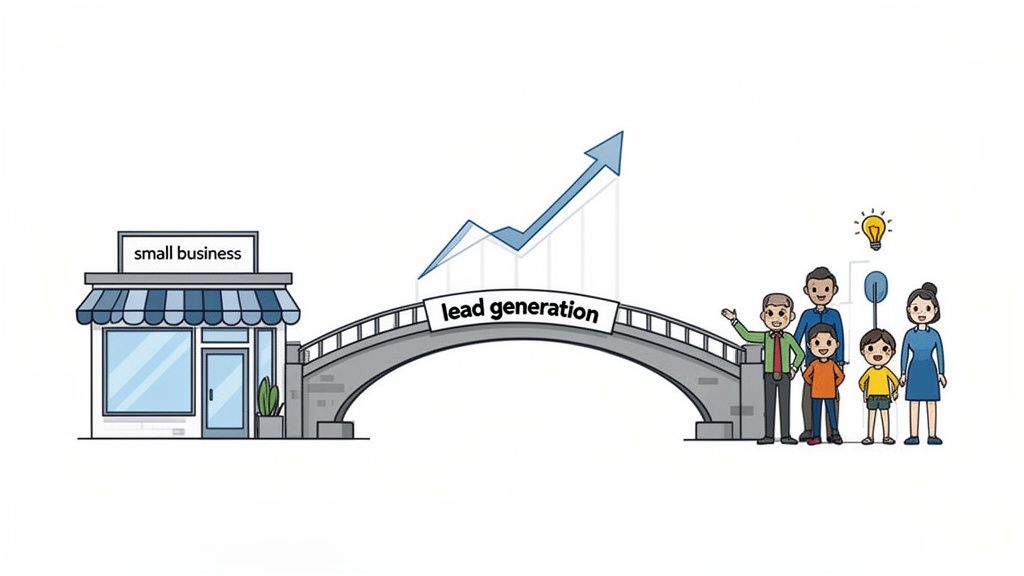
Lead generation is the engine for predictable business growth. It is the methodical process of identifying individuals who have shown an interest in your products or services, capturing their contact information, and nurturing that interest until they are ready for a sales conversation.
This is not about casting a wide net and hoping for the best. Effective lead generation is a focused system designed to build a reliable bridge between your business and your ideal customers. It turns passive observers into engaged prospects, connecting marketing activity directly to sales results. To understand the full context, it is useful to see how this fits within broader strategies for growing your online business, as it is a critical component of that puzzle.
The Commercial Purpose Of Lead Generation
At its core, what is lead generation in marketing if not a direct investment in your sales pipeline? A well-executed system moves your business away from unpredictable revenue cycles and towards a model where you can forecast and scale growth. It is about creating a consistent, reliable flow of opportunities for your sales team.
The benefits are commercial and measurable:
- More Efficient Sales Teams: Your sales team can stop wasting time on cold outreach and focus their energy on engaging with prospects who are already interested and informed.
- Lower Customer Acquisition Costs (CAC): By targeting the right people with the right message, you eliminate wasted ad spend and allocate resources where they will deliver the best return.
- Predictable Revenue Growth: A steady stream of qualified leads means you can forecast sales with greater confidence, which makes planning for investment and expansion a strategic exercise, not a guess.
- A Scalable Operation: Once you have a lead generation process that works, you can increase investment in specific channels to predictably increase the volume of incoming leads.
It is a common mistake to view lead generation as just another marketing task. It is a core business process. When implemented correctly, it underpins your entire commercial operation, from aligning sales and marketing to driving long-term profitability.
Ultimately, a strong strategy ensures your marketing budget is not just an expense; it is a direct contributor to your bottom line. Before proceeding, it is vital to be clear on our definition of a "lead." You can learn more about what are leads and why that definition is commercially critical in our detailed guide.
The Inbound Versus Outbound Playbook
To build an effective lead generation strategy, you must first understand the two core approaches: inbound and outbound. These are not competing tactics to choose between. They are two sides of the same coin, each playing a different but equally important role in growing your business.
The relevant question is not "which is better?" but "which aligns with our commercial objectives right now?"
The fundamental difference is simple: inbound pulls potential customers towards you, while outbound pushes your message to them.
Inbound Lead Generation: The Magnet
Inbound marketing is the practice of attracting potential customers by creating valuable content and experiences they are actively searching for. It functions like a powerful magnet. You publish useful blog posts, optimise your website to rank on Google (SEO), and share helpful insights on social media.
When a potential customer encounters a problem, they search online for a solution and discover your expert content. They are drawn to you because you have already provided value.
- Key Channels: SEO, content marketing (blogs, guides), organic social media, and email newsletters.
- Commercial Strengths: Builds long-term brand authority, generates high-quality leads who are already engaged, and the cost per lead tends to decrease over time.
- Strategic Trade-off: This is a long-term investment. Seeing a significant return from activities like SEO can take months, demanding consistency and patience.
Outbound Lead Generation: The Megaphone
Outbound is the more direct, proactive approach. It involves reaching out to a specific, targeted audience who may not be aware of your business or actively searching for a solution. You are taking your message directly to them.
Consider it using a megaphone to broadcast your value proposition to a carefully selected audience. To explore this further, read our full guide to understanding outbound lead generation and its practical applications.
- Key Channels: Paid advertising (Google Ads, Meta Ads), targeted email outreach, LinkedIn advertising, and direct sales calls.
- Commercial Strengths: It delivers fast, predictable results. You can launch a campaign and generate leads within days, which is ideal for testing a new offer or meeting a short-term sales target.
- Strategic Trade-off: It can be expensive as you are paying for attention. If your targeting is inaccurate or your message fails to resonate, your budget can be wasted quickly.
A truly effective strategy rarely relies on a single method. The most successful UK businesses build a hybrid model, using outbound campaigns for immediate pipeline velocity while simultaneously investing in inbound to create a sustainable, long-term asset that generates leads for years.
Choosing Your Lead Generation Channels
With numerous marketing channels available, it is easy to feel you need a presence everywhere. That is one of the fastest ways to exhaust your budget with little to show for it.
A smart lead generation strategy is not about casting the widest possible net. It is about making deliberate choices, selecting the channels that align with your commercial goals, speak directly to your ideal customer, and match your team's operational capacity.
The key is to build a balanced portfolio: a mix of channels that deliver immediate results alongside others that build long-term, sustainable assets for your business. This is the essence of what lead generation in marketing is about: turning investment into a predictable stream of opportunities.
High-Intent Channels For Immediate Impact
When you need to generate leads this month, some channels are built for speed. These are typically 'pay-to-play' platforms where you can place your message in front of a highly targeted audience almost instantly.
- Paid Search (Google Ads): This is the undisputed leader for capturing high-intent leads. You are targeting people who are actively searching on Google for the exact solution you provide. They are often further down the buying funnel and ready to take action. You can learn more about structuring these campaigns in our guide to PPC for lead generation.
- Paid Social (Meta & LinkedIn Ads): These platforms offer powerful targeting capabilities. You can pinpoint audiences based on demographics, job titles, interests, and online behaviour. LinkedIn is a powerhouse for B2B, while Meta (Facebook and Instagram) is excellent for reaching specific consumer segments.
These channels offer speed and scalability, but they require ongoing investment and expert management to maintain a profitable Cost per Lead (CPL). Think of them as the accelerator in your marketing engine.
Asset-Building Channels For Long-Term Growth
While paid channels provide immediate traction, long-term channels focus on building foundational assets that generate leads at a progressively lower cost over time. They establish your brand as a credible authority, attracting customers organically without you having to pay for every click.
Strategic lead generation is a blend of renting attention and owning it. Paid ads rent visibility for an immediate return, while SEO and content marketing build an asset that pays dividends for years. The most resilient businesses do both exceptionally well.
- Search Engine Optimisation (SEO): At its core, SEO is the process of optimising your website to rank at the top of organic search results. It is a long-term endeavour, but the result is a sustainable source of high-quality traffic from people who inherently trust search engine results more than advertisements.
- Content Marketing: Creating genuinely valuable blog posts, in-depth guides, and helpful resources does more than just attract visitors. It positions your business as a trusted expert. This content fuels your SEO efforts and provides valuable assets to share across all your other channels, nurturing potential customers throughout their decision-making process.
The UK market underscores this point. While established B2B tactics like email and LinkedIn remain strong, the adoption of paid channels has increased significantly, with both PPC and social ads now used by over 30% of SMEs.
This shift is driven by changes in buyer behaviour. Today, 73% of UK decision-makers expect the first point of contact to occur online. This highlights the power of platforms like LinkedIn, where Lead Gen Forms can achieve conversion rates up to five times higher than typical industry averages. You can explore more of these UK lead generation tactics to understand how the landscape is evolving.
To help you decide where to begin, here is a comparison of the main channels.
Comparing Key Lead Generation Channels
This table breaks down the primary lead generation channels, considering speed to impact, primary use case, and typical cost structure in the UK.
| Channel | Speed to Impact | Best For | Typical UK Cost Focus |
|---|---|---|---|
| Paid Search (PPC) | Fast (Days) | Capturing high-intent, bottom-of-funnel demand. | Pay-Per-Click (PPC) & management fees. |
| Paid Social | Fast (Days) | Building brand awareness and precise audience targeting. | Cost-Per-Mille (CPM) or Cost-Per-Click (CPC). |
| SEO | Slow (Months) | Building long-term authority and organic traffic. | Retainer-based fees for ongoing optimisation. |
| Content Marketing | Slow (Months) | Nurturing leads and establishing industry expertise. | Content creation costs (writing, design). |
| Referrals | Variable | Generating high-trust leads from existing clients. | Typically low-cost; may involve incentive programmes. |
Choosing the right mix depends on your immediate needs and long-term vision. A business requiring immediate sales might invest heavily in PPC initially, while gradually building its SEO and content assets in the background to create a more sustainable and cost-effective future.
How The Lead Generation Funnel Works
An effective lead generation plan does more than just collect contact details; it guides potential customers through a carefully planned journey. The best way to visualise this journey is as a funnel. This model helps you see how a broad audience is filtered down into genuine, sales-ready opportunities. Thinking in terms of a funnel brings commercial discipline to your marketing.
The objective is to guide people from initial awareness through to purchase. This ensures your sales team invests its time on prospects who are a good fit and ready for a business conversation. This methodical approach is what turns marketing activity into predictable revenue.
This process flow shows how different channels like SEO, paid ads, and content all contribute to the top of the funnel.
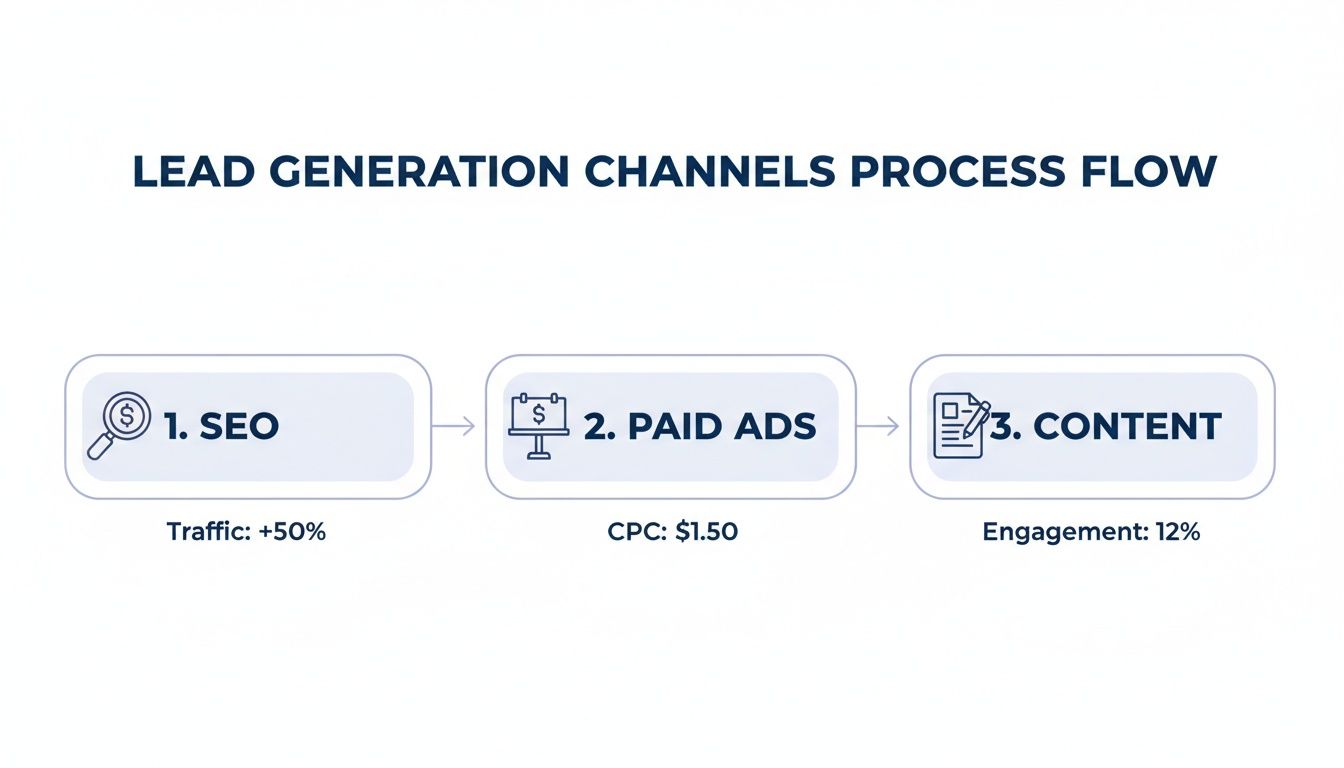
As shown, it does not matter if someone finds you through a Google search, a paid ad, or a blog post. They all enter the same strategic process, designed to qualify their interest and move them forward.
The Key Funnel Stages
The funnel is typically divided into three distinct stages, each with a clear commercial goal.
Top of Funnel (ToFu): Awareness. This is the widest part. The aim here is to attract a large, relevant audience with helpful content like blog posts or social media updates. Leads at this stage are just beginning to identify a problem; they are not yet ready to buy.
Middle of Funnel (MoFu): Consideration. Now, prospects have defined their problem and are actively evaluating different solutions. This is where you offer more detailed, solution-focused content, such as in-depth guides, webinars, or case studies, to build trust and demonstrate expertise.
Bottom of Funnel (BoFu): Decision. At the funnel's narrowest point, your prospects are ready to make a decision. The focus shifts to conversion. You will use offers like free consultations, demos, or detailed pricing to prompt them to take the final step.
MQL vs SQL: The Critical Handoff
The most important moment in the funnel is determining when a lead is ready for the sales team. This is where the distinction between a Marketing Qualified Lead (MQL) and a Sales Qualified Lead (SQL) is vital.
An MQL is someone who has engaged with your marketing but is not yet ready for a sales call. An SQL is a lead who has been vetted and is primed for a direct conversation with sales. This distinction prevents your sales team from wasting time on prospects who are still in the research phase.
Mastering this handoff is the key to an efficient sales process. Marketing's role is to nurture MQLs until their behaviour, such as requesting a demo or viewing the pricing page multiple times, indicates they have become an SQL. That is the trigger for a focused sales conversation.
Measuring Your Lead Generation Success
Marketing without measurement is guesswork. To truly understand what lead generation is from a commercial perspective, you must track its impact on your bottom line. It is too easy to get distracted by surface-level metrics like clicks and impressions, but those do not generate revenue.
To build a scalable business, you need to focus on the key performance indicators (KPIs) that draw a straight line from marketing spend to profit. These metrics are your strategic compass. They tell you what is working, what is not, and where your budget is best allocated, turning marketing activity into predictable financial results.
Core Commercial Metrics
Three metrics form the foundation of any serious lead generation analysis. For business owners and directors, mastering these is non-negotiable.
- Cost per Lead (CPL): This is the most direct measure of campaign efficiency. You simply divide your total marketing spend by the number of leads generated. A low CPL indicates you are acquiring potential customers cost-effectively.
- Customer Acquisition Cost (CAC): This metric goes a crucial step further. It calculates the total cost to acquire a paying customer, including all sales and marketing expenses. For your business model to be viable, your CAC must be lower than the lifetime value of a customer.
- Return on Ad Spend (ROAS): When running paid campaigns, ROAS is your primary profitability metric. It shows the revenue you generate for every pound spent on advertising. A 4:1 ROAS, for instance, means you are generating £4 in revenue for every £1 you invest.
The most important question to ask of any metric is, 'So what?' A CPL of £50 is neither good nor bad in isolation. Its value depends entirely on your CAC and customer lifetime value. The objective is not just to find cheap leads; it is to build a profitable, repeatable system.
Turning Data Into Decisions
Knowing your numbers is only half the task. The real value comes when you use that data to make informed decisions.
Is your CPL increasing? It may be time to refine your ad targeting or optimise your landing page to improve its conversion rate. Is your CAC too high? That could indicate an inefficiency in your sales process, or perhaps the leads from marketing are not the right fit.
By consistently monitoring these core metrics, you can identify problems early, uncover optimisation opportunities, and confidently allocate your budget to the channels and strategies that deliver the best returns for your business.
Building Your First Lead Generation Campaign
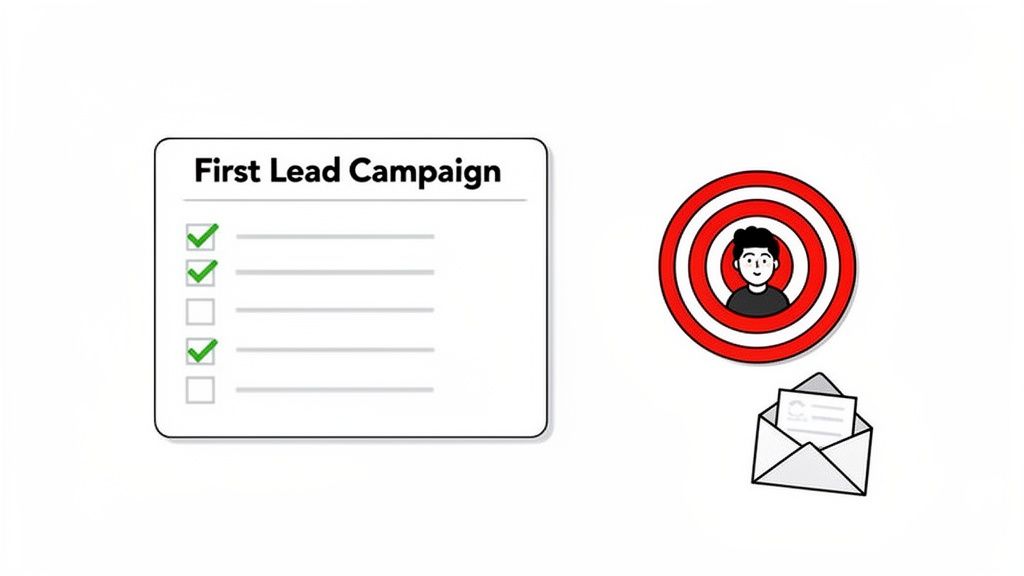
Knowing the theory is one thing; putting it into practice is another. It is time to move from what lead generation is to how you execute it, which requires a solid, commercially-minded plan. Let's walk through the essential steps to launch a foundational campaign, turning abstract concepts into a real system for attracting your ideal customer.
The goal here is not to overcomplicate things. It is about building a simple, repeatable process that generates initial results, provides invaluable market feedback, and creates a foundation you can build upon.
Step 1: Define Your Ideal Customer Profile
Before you spend a single pound, you need absolute clarity on who you are trying to reach. An Ideal Customer Profile (ICP) is a written definition of the perfect client for your business. This goes beyond vague demographics into the commercial realities of who you serve best.
Consider these questions:
- Industry and Company Size: Which sectors and business sizes derive the most value from your offering? Be specific.
- Job Titles and Responsibilities: Who is the actual decision-maker? Who holds the budget? Who do you need to influence?
- Commercial Pain Points: What real-world business problems does your service solve? More importantly, what is the tangible cost of not solving that problem?
- Buying Signals: What are they searching for online? What content do they consume that indicates they are looking for a solution like yours?
A well-defined ICP is the foundation of all your targeting, messaging, and offers. Get this right, and everything else becomes simpler.
Step 2: Create A Compelling Offer
Your offer is an exchange of value. You are asking for a prospect's contact details, and you must provide something valuable enough in return to make it a fair trade. Generic calls to action like "sign up to our newsletter" are no longer effective.
A strong lead generation offer is not about what you want to sell; it is about what your ideal customer wants to solve. It should provide immediate, tangible value that directly addresses one of their core commercial pain points.
Set aside the sales pitch for a moment and focus on creating a high-value asset they can use immediately. Good examples include:
- A detailed guide or checklist that helps them solve a common problem.
- A free tool or calculator that simplifies a complex task.
- A case study that clearly demonstrates measurable, impressive results.
- An invitation to an exclusive webinar or a live Q&A session with an expert.
Step 3: Build A Conversion-Focused Landing Page
Your landing page has a single objective: to convert visitors into leads. It must be clear, persuasive, and frictionless. Every element, from the headline to the call-to-action button, must support that one goal.
This is not just about creating an attractive page; it is a hard-working lead generation asset. Ensure it has a powerful headline, copy that focuses on benefits (not just features), social proof like testimonials or client logos, and a simple form that only asks for essential information.
While it is wise to start with a single channel like Google Ads to maintain focus, it is worth noting that the UK B2B market heavily rewards a broader approach. Research shows that companies using multiple touchpoints see conversion rates increase by 287% compared to those using only one channel. This reflects a significant shift in behaviour, with 73% of UK decision-makers now expecting the first contact from a business to be digital. The businesses adapting to this are not only generating more leads but are closing larger deals. You can explore the impact of multi-channel strategies in the UK to see the commercial advantage for yourself. This first campaign is your launchpad toward that kind of integrated system.
Got Questions About Lead Generation?
To conclude, let's address a few of the most common questions we hear from UK business owners navigating lead generation. We will provide straight, practical answers based on what actually works.
How Long Does It Take To See Results From Lead Generation?
This depends entirely on the channel you use.
- Paid Advertising: With platforms like Google Ads or Meta Ads, you can see results within days, sometimes hours. This is your best option for a quick injection of leads and for testing new offers.
- SEO: Think of this as building a valuable business asset. It is a long-term investment. Realistically, you are looking at 4-6 months of consistent effort before you see a steady stream of high-quality, organic leads. It takes time to earn trust from search engines.
The most effective approach is to use both. Secure immediate wins from paid advertising while your SEO strategy matures in the background, setting you up for sustainable, lower-cost leads in the future.
What Is The Difference Between Lead Generation And Demand Generation?
This is a critical distinction. It is easy to confuse them, but they play very different roles.
Think of it like this: Demand generation is making people thirsty. Lead generation is handing them a glass of water and getting their name in return.
You first need to create awareness and desire for what you do (demand generation). Then, you use specific tactics to capture the details of those interested individuals (lead generation). Lead generation is the direct result of a successful demand generation strategy.
How Much Should A UK Business Budget For Lead Generation?
There is no single magic number; it depends on your industry, goals, and chosen channels.
For context, a small or medium-sized UK business testing Google Ads might start with a monthly ad spend of £1,000 to £3,000. This does not include campaign management costs.
The most critical factor is not what you spend, but what you get back: your Return on Ad Spend (ROAS). A successful campaign must be profitable. Once you achieve profitability, you can confidently scale the budget because you know every pound invested generates more in return.
Building a predictable lead generation system is the engine that drives sustainable growth. If you are ready to move from guesswork to a strategy that delivers real commercial results, the team at Lead Genera can help. Get in touch today, and let's discuss building your sales pipeline together.
Categories
Do You Need Assistance With
Sign Up To Our Newsletter