


Weekly marketing wisdom you can read in 5 minutes, for free. Add remarkable ideas and insights to your inbox, once a week, by subscribing to our newsletter.
PPC
Grow with PPC Lead Gen: A Practical Guide to Predictable Leads
PPC lead generation, or ‘PPC lead gen’, uses paid online advertising to acquire contact details from potential customers. It is a direct method for gaining immediate visibility with the right audience, generating qualified enquiries on demand. This approach stands in stark contrast to waiting for longer-term organic strategies like SEO to deliver results.
What Is PPC Lead Gen and Why It Matters
Imagine opening a new storefront tomorrow on the busiest high street in your city. That is the commercial power PPC lead gen provides. It is a direct route to new customers by paying for ad placements on platforms like Google, Meta, and LinkedIn. When a user matching your customer profile clicks your ad, they are directed to a dedicated landing page built for one purpose: to convert that click into a tangible business lead.
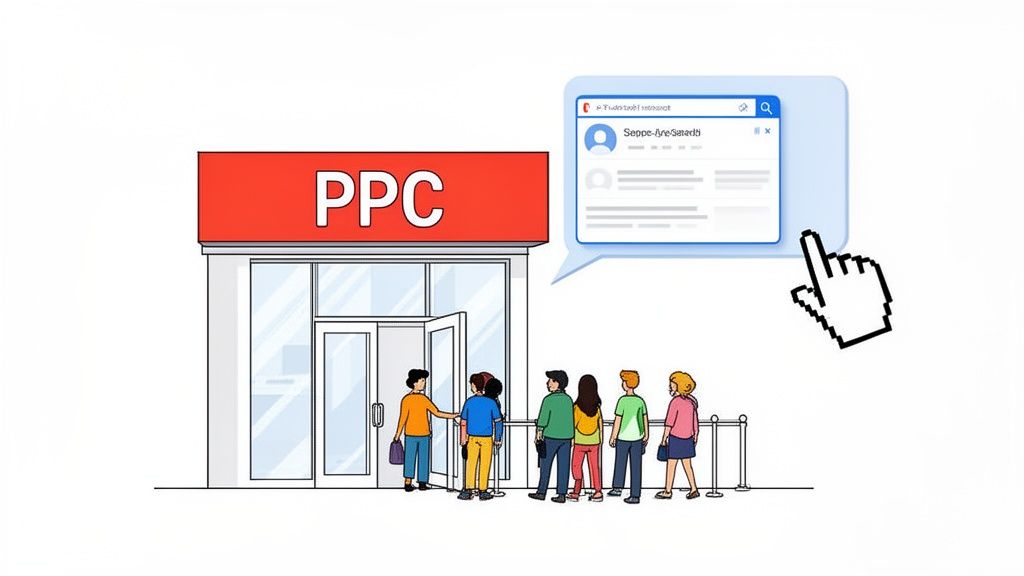
This process bypasses the months, or even years, it can take for organic SEO efforts to mature. Instead of earning your spot at the top, you strategically buy it, placing your business directly in front of people actively searching for the solutions you offer. The speed-to-market this approach affords is a significant commercial advantage.
The Strategic Value for UK Businesses
For service-based firms and SMEs seeking predictable growth, PPC lead gen is an engineered system for building a reliable sales pipeline. It is no surprise that 67% of UK B2B marketers view PPC as an essential tool for generating leads. It has become a primary engine for driving qualified enquiries.
The value extends beyond speed. A well-executed campaign delivers a stream of potential customers that can be measured and scaled. This provides:
- Predictable Lead Volume: Ad spend can be increased or decreased to directly control the number of enquiries, making sales forecasting more reliable.
- Measurable ROI: Every pound spent is tracked, creating a clear line between your advertising budget, cost per lead, and ultimately, revenue.
- Immediate Market Feedback: Testing a new service offer, marketing message, or target audience can be done quickly, providing valuable data to inform your wider marketing strategy.
The purpose of effective PPC lead gen is not merely to buy website traffic. It is a strategic investment in acquiring new customers. Success is not measured in clicks; it is measured by the volume and quality of sales opportunities that generate profitable growth.
To understand its impact fully, it helps to see where PPC fits within broader advertising strategies and examples. PPC is not a standalone tactic; it is a powerful component of a growth engine, designed to turn targeted attention into bottom-line results.
Choosing the Right PPC Platform for Your Business
Selecting the right platform for your PPC lead generation is not about chasing the largest audience. It is about identifying where your customers are and understanding their mindset when they are there. Each platform serves a different purpose, and a successful strategy aligns the channel with your commercial objectives.
Consider the user’s context. Someone searching Google for ‘emergency plumber near me’ has a different intent from someone browsing their LinkedIn feed. The first user has an urgent, immediate need. The second is in a professional context, open to ideas but not actively looking to buy. Both can be valuable, but they require distinct approaches. Getting this right is the foundation of a profitable PPC strategy.
To assist your decision-making, here is a breakdown of the primary platforms.
PPC Platform Comparison For Lead Generation
This table provides a concise overview of the four main platforms, their strengths, ideal use cases, and the typical lead intent you can expect.
| Platform | Primary Use Case | Ideal For | Typical Lead Intent |
|---|---|---|---|
| Google Ads | Capturing active search demand. | Most businesses, especially service-based and local trades. | High. Users are actively looking for a solution now. |
| Microsoft Ads | Reaching an older, often B2B, audience with less competition. | B2B, finance, legal, high-value consumer goods. | High. Similar to Google, but a different demographic. |
| Meta Ads (Facebook/Instagram) | Creating new demand and building awareness through visual ads. | E-commerce, events, visual services (e.g., design), B2C. | Low to Medium. Users are passive and need to be persuaded. |
| LinkedIn Ads | Hyper-targeting professionals by job title, industry, and company. | B2B, SaaS, high-ticket consulting, recruitment. | Medium to High, but expect a longer sales cycle. |
While this table serves as a useful starting point, superior results come from understanding the user psychology unique to each platform and leveraging its strengths.
Google Ads: Capturing Active Demand
When someone has a problem that needs solving, their first port of call is typically Google. This makes Google Ads the undisputed leader for capturing high-intent leads. It is the ideal fit for service businesses, trades, and any company selling a direct solution to a known problem.
The primary advantage here is intent. You are not convincing someone they have a problem; you are presenting the solution at the exact moment they are looking for it. This almost always results in a lower cost per lead and a shorter sales cycle compared to other platforms. If people search for what you offer, Google Ads should be your first port of call.
Microsoft Ads: Reaching a Different Audience
Often overlooked, Microsoft Ads (formerly Bing Ads) operates on the same principle as Google—search intent—but connects with a different audience. Users on this platform often skew older, are more likely to be affluent, and frequently use Microsoft’s Edge browser as the default on their work computers.
While search volume is lower than Google’s, so is the competition. This often translates into distinct advantages:
- Lower Cost-Per-Click (CPC): With fewer advertisers competing in the auction, clicks are frequently cheaper.
- Higher Quality Leads: For some B2B and high-value B2C sectors, this demographic can deliver more qualified leads with greater decision-making authority.
- Efficient Budget Allocation: It is an excellent way to capture valuable leads that your competitors are ignoring.
Neglecting Microsoft Ads is a missed opportunity. It is a commercially astute way to improve the efficiency of your advertising budget.
Meta Ads: Generating New Demand
Advertising on Meta (Facebook and Instagram) is fundamentally different. Here, you are not capturing existing demand; you are creating it. No one scrolls through their social feed hoping to find an accountant. Instead, you must interrupt their browsing with an ad that captures their attention.
This makes Meta ideal for businesses with a strong visual appeal, services that people may not know they need, or for nurturing interest in a high-value item over time. The targeting capabilities are incredibly powerful, allowing you to reach people based on their life events, interests, and behaviours. The leads may not be ready to purchase immediately, but a well-designed campaign can fill the top of your sales funnel very cost-effectively.
LinkedIn Ads: Precision B2B Targeting
For B2B lead generation, LinkedIn Ads is in a class of its own. No other platform allows for such precise professional targeting. You can build audiences based on specific job titles, company size, industry, and seniority. If your goal is to reach the Head of IT at FTSE 250 companies, this is the platform to use.
This level of precision comes at a price. The cost per click and cost per lead on LinkedIn are the highest of any platform. To be viable, your product or service must have a high customer lifetime value, where a single new client justifies the ad spend. Think of it less as a megaphone and more as a sniper rifle for reaching high-value decision-makers.
The Core Components of a High-Performing PPC Campaign
A successful PPC lead generation campaign is not a single brilliant ad; it is a finely tuned system where every component works in harmony. When all parts are synchronised, you create a reliable engine for customer acquisition. If one part is misaligned, the entire system underperforms, wasting budget on clicks that fail to convert.
Consider it like building a high-performance vehicle. You need a powerful engine (intelligent bidding), a precise navigation system (strategic targeting), and a compelling design (your ad creative). Each element is critical to winning the race for high-quality leads.
Let’s examine these three core components.
Strategic Audience Targeting
The first principle of profitable advertising is to show your ads only to people likely to become customers. Strategic targeting is the discipline of defining precisely who sees your ads, ensuring every pound of your budget is aimed at a relevant prospect. This extends far beyond basic demographics.
Effective PPC targeting involves layering multiple signals to create a clear picture of your ideal customer. This typically includes a combination of:
- Keyword Targeting: The foundation of search advertising. You bid on the exact phrases people type into Google when they are actively looking for what you sell, such as ‘commercial cleaning services Manchester’.
- Demographic Targeting: You can refine your audience by age, gender, location, and even household income, ensuring your message aligns with the right economic profile.
- In-Market Audiences: A powerful feature that allows you to target users whose online behaviour indicates they are actively researching and comparing products or services in your category. They are past initial research and are preparing to make a decision.
By combining these layers, you move from broadcasting to a crowd to having a direct conversation with a motivated buyer. This precision is what differentiates a low-cost, high-return campaign from an expensive failure.
This decision tree offers a simplified framework for choosing where to focus your initial targeting efforts.
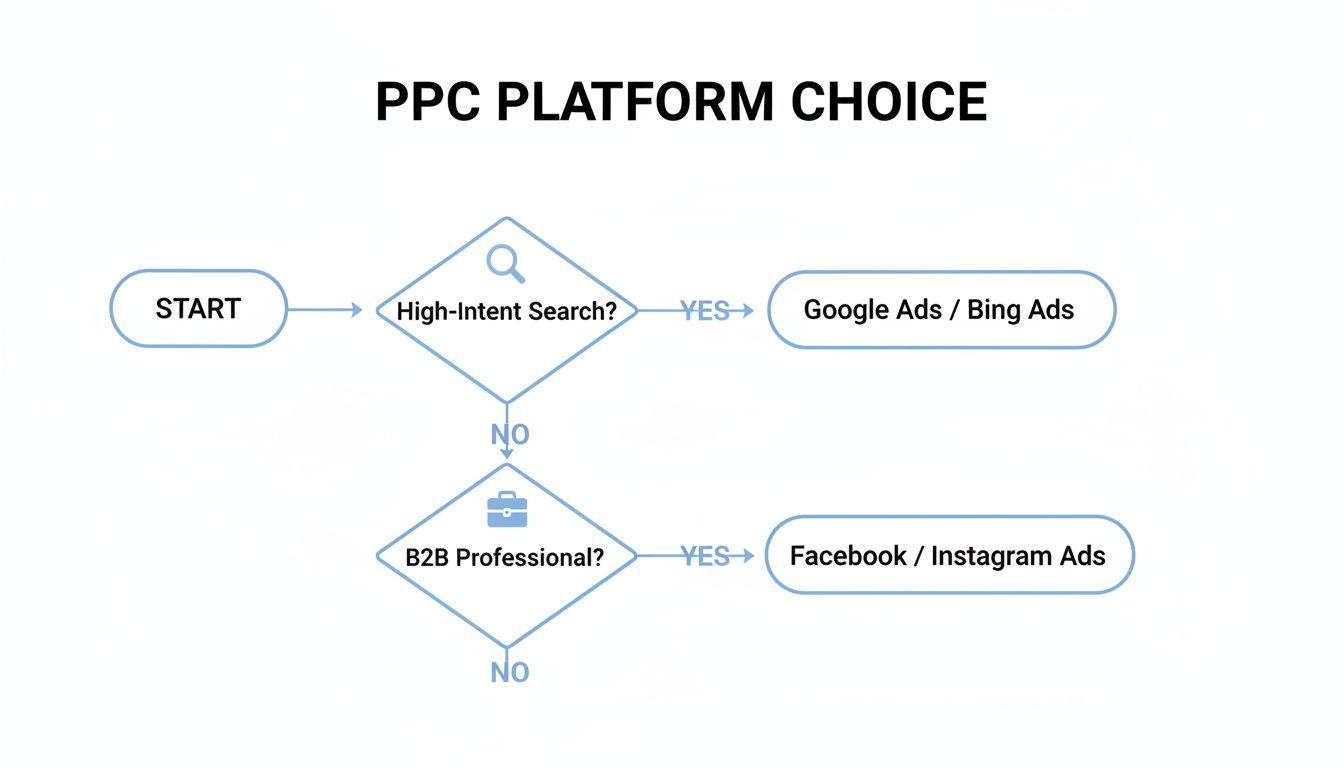
The key takeaway is that your targeting strategy must align with both user intent and the platform’s strengths to be commercially viable.
Compelling Ad Creative and Copy
Once you have identified the right audience, you must provide a compelling reason for them to click. Your ad creative, the combination of your headline, description, and any visuals, is your digital sales pitch. It has milliseconds to capture attention and communicate value.
Generic, uninspired ad copy is easily ignored. High-performing ads, however, speak directly to a customer’s challenges and position your business as the ideal solution.
A great ad does not just describe what you do; it solves a problem for the reader. It must answer the unspoken question, “Why should I choose you over your competitors?”
To achieve this, your ad copy must be:
- Relevant: It must perfectly match the search query or user’s interest. If someone searches for “emergency boiler repair,” your headline must feature those exact words.
- Benefit-Driven: Do not just list features; sell the outcome. Instead of “We use advanced software,” use “Get Your Quote in 60 Seconds.”
- Trust-Inspiring: Incorporate signals of credibility. Phrases like “Rated 5 Stars” or “10-Year Guarantee” build confidence.
- Action-Oriented: Always conclude with a clear, strong call-to-action (CTA). Tell users exactly what to do next, whether that is “Request a Free Consultation” or “Download Your Guide Now.”
This is where art meets science. The language must be persuasive, while the structure must align with platform best practices to maximise visibility and click-through rates.
Intelligent Bidding Strategies
The final component is how you pay for your ads. In the early days of PPC, bidding was entirely manual, with advertisers setting a maximum cost-per-click (CPC) for each keyword. Today, the landscape is dominated by intelligent, automated bidding strategies that are far more effective for lead generation.
Instead of focusing on securing the cheapest click, these strategies use machine learning to optimise for what truly matters to your business: conversions.
You simply provide the platform with your target Cost Per Acquisition (CPA), the maximum amount you are willing to pay for a new lead, and its algorithms work to achieve that goal. They automatically adjust your bids in real-time for each auction, directing your budget towards users most likely to convert. This significantly improves the commercial return on your ad spend.
This represents a fundamental shift from buying traffic to buying results.
Your Landing Page: The Engine of Conversion
Directing highly targeted ad traffic to a subpar landing page is one of the fastest ways to exhaust your budget. It is the equivalent of paying for a prime retail location but leaving the windows dirty and the doors locked.
Your landing page is not just another component; it is the single most important conversion asset in your campaign. This is where a promising click either becomes a valuable lead or disappears.
The user journey from your ad to the landing page must be seamless. Any friction, confusion, or mismatch between the ad’s promise and the page’s content will cause your conversion rates to fall, driving up your cost per lead.
A high-performing landing page is a purpose-built system designed for one function: conversion. It is stripped of all distractions and laser-focused on a single objective.
Core Elements of a Conversion-Focused Landing Page
To convert clicks into customers, your page must be engineered with several non-negotiable elements. Each is designed to guide the user towards taking action.
A successful landing page includes:
- A Compelling, Relevant Headline: This is the first thing a visitor reads. It must instantly confirm they are in the right place by echoing the message from the ad they clicked.
- A Clear Value Proposition: Within seconds, the user must understand what you offer and why it matters to them. It should be a concise answer to the question, “What’s in it for me?”
- Persuasive Social Proof: People trust other people. Including testimonials, client logos, case studies, or star ratings builds immediate credibility and reduces purchase anxiety.
- A Frictionless Lead Capture Form: Keep your form concise. Only ask for the essential information required to qualify and contact the lead. Every additional field increases the likelihood of abandonment.
- A Singular, Obvious Call-to-Action (CTA): Your page must have one primary goal. Whether it is “Get a Free Quote,” “Download the Guide,” or “Book a Consultation,” your CTA button should be visually prominent and unambiguous. Avoid competing offers that dilute focus.
A great landing page is not designed to win awards; it is designed to win customers. Its success is measured by a single metric: its ability to generate high-quality leads at an efficient cost.
The Commercial Impact of Landing Page Optimisation
The financial leverage gained from improving your landing page is immense. Consider this simple scenario: you spend £1,000 on ads, generating 500 clicks to a page that converts at 1%. This yields just five leads at a cost of £200 each.
Now, imagine you refine the headline, simplify the form, and add a strong testimonial. Your conversion rate increases to a modest 4%. The same £1,000 ad spend now delivers 20 leads at a much healthier £50 each.
You have quadrupled your lead volume and reduced your cost per lead by 75%, all without spending a single extra penny on advertising. This demonstrates the power of optimising your primary conversion asset. To explore this topic further, read our dedicated guide on how to build a killer lead generation landing page.
Treating your landing page as an afterthought is a strategic error that directly harms the profitability and scalability of your entire PPC campaign.
Measuring Success Beyond Clicks and Impressions
Are your PPC campaigns busy, or are they profitable? This question is central to a performance-led approach. Clicks and impressions may appear positive on a report, but they are vanity metrics that do not contribute to revenue.
The key is to shift your focus from surface-level activity to tangible business outcomes. This means moving from asking, “How many clicks did we get?” to “How much did it cost to acquire a profitable customer?” This mindset transforms how you manage your campaigns. Every pound of ad spend must be justified by its connection to your sales pipeline and, ultimately, your revenue.
Key Performance Indicators That Actually Matter
To measure what is commercially important, you must track the right Key Performance Indicators (KPIs). These are the metrics that reveal the true financial performance of your campaigns. For any serious PPC lead generation campaign, three KPIs are non-negotiable.
These are the metrics that should inform every strategic decision:
- Conversion Rate: The percentage of users who click your ad and complete the desired action, such as submitting a form. A low conversion rate is a significant red flag, indicating a problem with your landing page or a mismatch between your ad and your offer.
- Cost Per Lead (CPL): The exact amount you pay for each new enquiry. This is a clear commercial benchmark for campaign efficiency and is critical for effective budget management.
- Return On Ad Spend (ROAS): The ultimate measure of profitability. It calculates the revenue generated for every pound spent on advertising, directly linking your marketing investment to your bottom line.
Calculating Your Core PPC Metrics
Knowing these metrics is one thing; you must be able to calculate them. The formulas are straightforward. Consider a simple example: you spend £2,000 on a Google Ads campaign that generates 400 clicks and 20 new leads.
1. Calculating Conversion Rate
The formula is: (Number of Conversions / Total Clicks) x 100
In our example: (20 leads / 400 clicks) x 100 = 5% Conversion Rate.
2. Calculating Cost Per Lead (CPL)
The formula is: Total Ad Spend / Number of Leads
In our example: £2,000 / 20 leads = £100 CPL.
PPC is a top-five tactic for UK SMEs for good reason. With UK B2B campaigns on Google Ads search achieving average conversion rates of around 6.69%, our example’s 5% rate is a realistic starting point for many businesses. Discover more insights about UK lead generation tactics.
Tracking these metrics is not an accounting exercise. It is the core discipline of performance marketing. It transforms your advertising from a speculative cost into a predictable, scalable investment in new customers.
Tying It All to Revenue with ROAS
The final step is to connect your CPL to actual revenue. Suppose your sales team converts 4 of those 20 leads into new customers, and each customer has a lifetime value of £2,500. This means you have generated £10,000 in revenue from your initial £2,000 ad spend.
3. Calculating Return on Ad Spend (ROAS)
The formula is: Total Revenue from Ads / Total Ad Spend
In our example: £10,000 / £2,000 = 5x ROAS.
This means that for every £1 invested, you generated £5 in return. That is a metric that tells a powerful story to any business owner or director. It is the definitive proof that your PPC efforts are not just creating activity—they are driving sustainable growth.
Partnering With an Agency for Faster Growth
Managing a successful PPC lead generation campaign is a significant commitment. It requires constant attention, deep platform expertise, and a strategic mindset to convert ad spend into profitable growth.
For many businesses, building an internal PPC team is a long and expensive process. The most direct route to results is often to engage a specialist agency.
Viewing an agency as a cost is a common mistake; it is an investment in speed, expertise, and accountability. A dedicated growth partner brings immediate advantages that are difficult to replicate in-house, launching campaigns and generating leads far quicker than you could alone. A seasoned agency becomes an extension of your team, focused on delivering measurable results that build a predictable sales pipeline.
Why a Specialist Partner Accelerates Results
A quality PPC agency does not just manage clicks; they take ownership of the commercial outcome. Their value is demonstrated through a combination of high-level strategy and hands-on execution that directly impacts your bottom line.
They bring a level of focus that internal teams, often managing multiple marketing responsibilities, cannot match.
The core benefits include:
- Access to Expertise and Advanced Tools: You gain immediate access to a team of specialists who live and breathe paid advertising. They bring years of cross-industry experience and utilise sophisticated tools for research, bidding, and reporting that are often prohibitively expensive for a single business.
- Continuous Campaign Optimisation: PPC is not a “set and forget” channel. A dedicated agency provides constant monitoring and refinement. They continuously adjust bids, test new ad creative, and refine targeting to improve your cost per lead (CPL) and return on ad spend (ROAS).
- Strategic Scalability: When campaigns perform well, an agency knows how to scale your investment responsibly. They have the frameworks to increase your budget without compromising lead quality, ensuring your growth is both rapid and sustainable.
Choosing the right agency means finding a partner who is commercially aligned with your goals. Their success should be measured by your metrics: lead quality, pipeline value, and profitable revenue growth. They provide the strategic capability to make PPC lead gen a core driver of your business’s success.
Making the right choice is critical. To identify genuine partners, it is important to ask the right questions. Our article on 8 things to consider when hiring a PPC marketing agency provides essential guidance. This will help you find a team that functions as a true growth partner, not just another supplier.
PPC Lead Gen: Your Questions Answered
Embarking on a PPC campaign raises many practical questions. Here are straightforward answers to the most common queries we receive from business owners and marketing directors, providing the commercially grounded information you need.
How Much Should I Budget for a PPC Campaign?
There is no single correct number; the right budget depends on your industry, the value of a lead to your business, and your growth objectives.
However, for a campaign serious about achieving results, a minimum of £1,500 to £3,000 per month in ad spend, plus any management fees, is a sensible starting point. This provides sufficient budget to gather meaningful data and make informed optimisation decisions. A lower spend risks being spread too thin for the ad platforms to gather enough conversion data to optimise effectively. Your budget should not be viewed as a cost, but as a direct investment in your lead acquisition targets.
How Long Does It Take to See Results from PPC?
PPC is fast, but it is not instantaneous. You can expect to see initial leads within the first week, often within 48 to 72 hours of a campaign going live. This provides immediate feedback on whether your offer and targeting are effective.
The first month should be considered a data-gathering and calibration phase. During this time, performance is closely monitored to refine keywords, test ad copy, and adjust bids. Sustainable, cost-effective results typically begin to build from the second month onwards, once the campaign has been optimised based on real-world conversion data.
What Is a Good Cost Per Lead?
A “good” Cost Per Lead (CPL) is entirely relative to the value a customer brings to your business.
For a high-end B2B consultant closing deals worth £20,000, a CPL of £250 could be highly profitable. Conversely, for a local service business where an average job is worth £300, a CPL over £50 may not be commercially viable.
The critical question is not “What is a cheap lead?” but “What is a profitable lead?” You must work backwards from your revenue. Determine your average customer lifetime value and your sales team’s close rate. This calculation will establish your maximum viable CPL, providing a clear benchmark for success and ensuring your PPC efforts drive profit.
The most effective PPC strategies are built backwards from a commercial target. Determine what a lead is worth to your business, and that will define what you can afford to pay to acquire one. This simple shift in perspective moves you from managing spend to investing for a specific return.
Ready to build a predictable pipeline of high-quality leads? At Lead Genera, we act as your strategic growth partner, building and managing performance-led PPC campaigns designed for one purpose: to deliver measurable results. Explore our PPC management services and see how we can accelerate your growth.
Categories
Do You Need Assistance With
Sign Up To Our Newsletter