


Weekly marketing wisdom you can read in 5 minutes, for free. Add remarkable ideas and insights to your inbox, once a week, by subscribing to our newsletter.
Lead Generation
A Practical Guide to Lead Generation for Small Businesses
Effective lead generation for small businesses is not about chasing every possible prospect. It is the commercial process of identifying, attracting, and converting the right people into qualified sales opportunities. For a small business, a predictable flow of quality leads is the engine for sustainable growth.
Table of contents:
Building Your Foundation for Predictable Growth
Before spending a single pound on advertising, you must get your foundations right. This is the critical step where most small businesses go wrong. They treat lead generation as a collection of disconnected tactics rather than a cohesive system. Predictable growth is not an accident; it is engineered.
It all starts with defining your Ideal Customer Profile (ICP). Go beyond basic demographics. Who are your best customers? Think about their specific commercial pain points, not just their job title. What costly problems are they desperate to solve that you are uniquely positioned to fix? Nailing this is the difference between shouting into the void and starting a productive conversation.
Crafting an Irresistible Offer
Once you know exactly who you are talking to, the next task is to create a high-value offer that makes saying ‘yes’ a logical decision. This is not about applying a discount. It is about presenting a clear solution to the problem you have identified.
A powerful offer typically has a few key ingredients:
- A Clear Outcome: What tangible result will they get? Think “Reduce invoicing time by 50%“.
- Low Perceived Risk: How can you make the decision feel safe and easy? This could be a free consultation, a limited-time trial, or a detailed case study download.
- High Perceived Value: The solution must feel far more valuable than the time or money they are investing.
The goal is to solve a genuine problem so effectively that your offer becomes the logical next step for your ideal customer. It should feel less like a sale and more like helpful advice.
Establishing the Essential Commercial Setup
With a defined target and a compelling offer, the final piece of the foundation is your operational setup. Your website, for instance, is not a digital brochure; it is your most important lead generation asset. Every page, button, and form should be designed with one goal in mind: conversion. As part of this, understanding SEO for small businesses in the UK is crucial for turning your site into a long-term source of inbound enquiries.
To build a strong foundation, it is vital to first understand what lead generation is in sales and how to achieve predictable B2B growth. This insight lays the groundwork for all your future marketing efforts.
Finally, you must have tracking and analytics in place to measure what actually matters. This means looking beyond vanity metrics like website traffic and focusing on commercially relevant numbers: lead volume, lead quality, and cost per acquisition. This data creates the feedback loop you need to refine your strategy, cut wasteful spending, and scale what works. Getting this groundwork right is the bedrock of any scalable and profitable lead generation system.
Choosing the Right Lead Generation Channels
With so many marketing channels available, it is easy to feel overwhelmed. Pick the wrong one, and you can burn through your budget with little to show for it. I have seen it happen.
The secret is not chasing the latest shiny object. It is about making a calculated decision based on your specific business goals, how quickly you need results, and the resources you have. This is not about guesswork; it is about a commercially-grounded framework for finding platforms that will deliver a tangible return.
For most UK small businesses, the choice usually boils down to a handful of core channels. Each has its own pros and cons, depending on what you are trying to achieve. The framework below shows how this choice fits into a bigger picture; it all starts with knowing who your customer is and what you can offer them that is genuinely valuable.
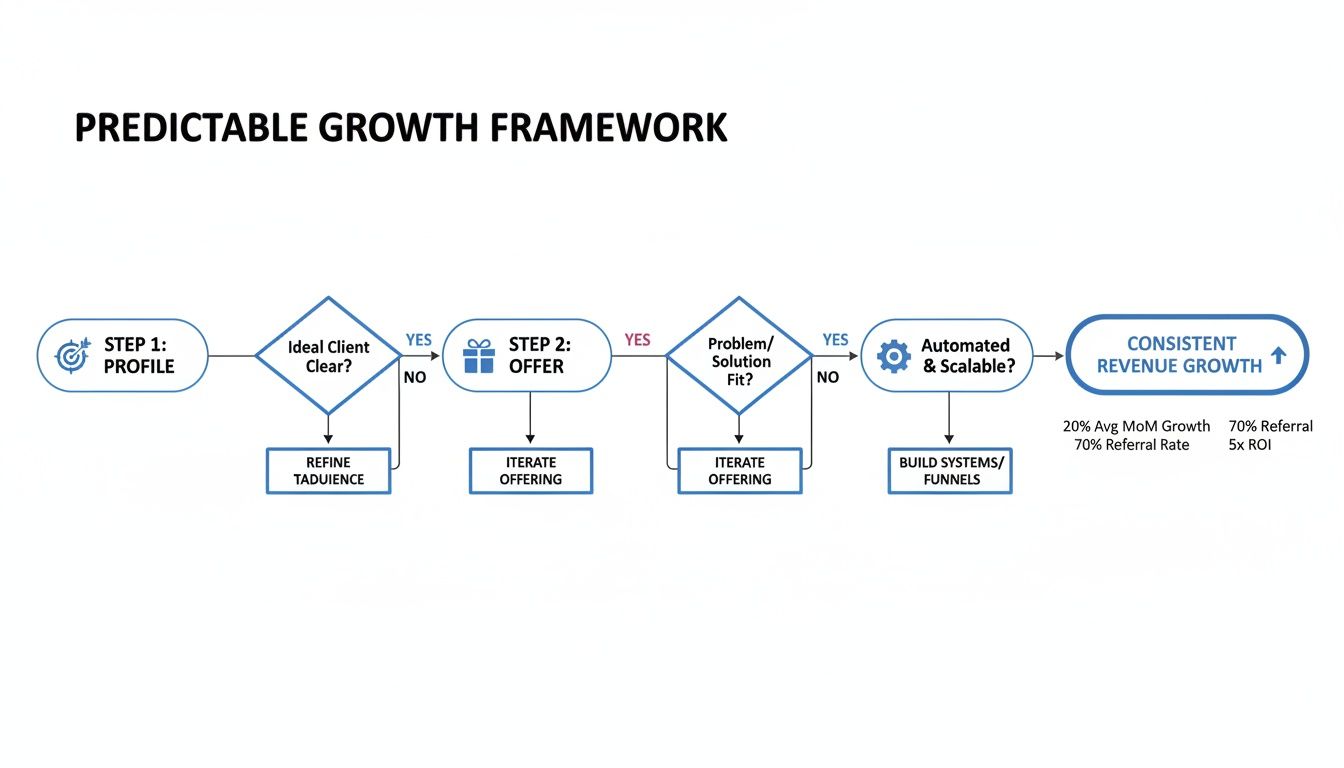
As you can see, choosing a channel is not a decision you make in a vacuum. It flows directly from a rock-solid understanding of your customer and the value you bring.
Evaluating the Primary Channels
Let’s break down the main contenders from a small business owner’s perspective. We will look at each one based on how fast it works, what it costs, and the quality of leads it typically generates. This is more than a list of pros and cons; it is a strategic look at where to place your budget.
Lead Generation Channel Comparison for UK Small Businesses
To make things clearer, here is a quick-glance table comparing the top channels. Think of this as your cheat sheet for deciding where to start.
| Channel | Speed to Impact | Typical Cost Per Lead (CPL) | Best For |
|---|---|---|---|
| Paid Search (Google Ads) | Very Fast (24-48 hours) | £25 – £150+ | Businesses solving an urgent, known problem (e.g., emergency plumbers, solicitors). |
| Paid Social (Meta & LinkedIn) | Fast (a few days) | £10 – £80+ | B2C with visual products (Meta) or B2B targeting specific job roles (LinkedIn). |
| SEO | Slow (6-12+ months) | Low (once established) | Building a long-term, sustainable asset for almost any business. |
| Email Marketing | Immediate (with a list) | Very Low | Nurturing existing leads from other channels and driving repeat business. |
This table provides a solid starting point, but let’s dive into the specifics of each to understand the trade-offs.
Paid Search (Google Ads)
Google Ads is all about intent. It puts your business in front of people at the exact moment they are searching for a solution you offer. That is its superpower.
- Speed to Impact: Incredibly fast. You can have a campaign up, running, and generating leads within 48 hours.
- Lead Quality: Usually very high. These people have already identified they have a problem, which means more qualified conversations for you.
- Commercial Use Case: Perfect for businesses that solve a known, pressing issue. Think of an emergency electrician, a divorce solicitor, or software that fixes a specific business problem. If you need leads now, this is your most direct path.
But that speed and quality come at a price. Competition for the best keywords can be fierce, pushing up your cost-per-click. It requires constant attention and optimisation to remain profitable. For a deeper dive, read our guide on using PPC for effective lead generation.
Paid Social (Meta & LinkedIn Ads)
Unlike search, paid social targets people based on who they are and what they are interested in, not what they are actively looking for. You are creating demand, not just capturing it.
- Speed to Impact: Fast. You can launch a campaign in a day and start seeing results within a week.
- Lead Quality: It varies. The leads are often “colder” because you are interrupting their scrolling. Success here is all about grabbing their attention with great creative and a strong, low-risk offer.
- Commercial Use Case: Fantastic for B2C businesses with products that look great in photos or videos (Meta) and for B2B companies wanting to reach people with specific job titles or in certain industries (LinkedIn).
The key trade-off with paid social is volume versus quality. You can often generate many leads for a lower cost, but you must have a solid process in place to nurture them until they are ready to buy.
Search Engine Optimisation (SEO)
SEO is the long game. It is the strategic work of optimising your website to rank at the top of Google’s organic results for your most important keywords.
- Speed to Impact: Slow. You have to be patient; it generally takes 6-12 months to see significant, commercially meaningful results.
- Lead Quality: Very high. Just like with paid search, you are capturing people with clear intent, but organic rankings often come with a higher level of trust.
- Commercial Use Case: This is a foundational investment for almost any business. While it will not deliver leads tomorrow, a good SEO strategy builds a powerful, compounding asset that generates “free” leads for years, making you less reliant on paid ads.
Email Marketing
Your email list is one of the only marketing assets you truly own. It is a direct line to your audience, completely independent of any platform’s algorithm changes.
For UK SMEs, email marketing consistently proves to be one of the most effective tactics. It is a direct, reliable way to build relationships and drive sales. This channel shines when it comes to nurturing leads you have gathered from other sources.
By sending valuable content, like newsletters, case studies, or exclusive offers, you build trust and stay top-of-mind. It is how you turn lukewarm prospects from your social media campaigns into genuinely qualified sales opportunities.
Executing High-Impact Campaigns That Convert
You have picked your channels. Now it is time for the real work: execution. This is where your strategy turns plans into a tangible pipeline of qualified leads. A good campaign is not just about running an advert; it is a finely-tuned system built to attract, engage, and convert your ideal customer as efficiently as possible.
The goal here is to move from theory to action. We will focus on the elements that deliver results: compelling ad copy that connects, landing pages that are built to convert, and simple lead capture processes that make it easy for prospects to say yes.

Writing Ad Copy That Speaks to Your Customer
Think of your ad copy as the first handshake. Its only job is to get the right person to click by speaking directly to their most pressing problem. Generic, feature-heavy copy is a sure way to be ignored. The copy that works connects on both an emotional and a practical level.
Stop thinking about what you do and start talking about the outcome you deliver. Instead of “We offer accountancy services,” try “Tired of wasting hours on bookkeeping? Get your weekends back.” The second version addresses a real pain point and promises a tangible benefit.
To get this right, every advert needs to:
- Address a Specific Pain Point: Start by showing you understand the problem your ideal customer is facing.
- Present a Clear Solution: Directly connect your offer to solving that specific pain.
- Include a Strong Call to Action (CTA): Tell them exactly what to do next. “Download Your Free Guide,” “Book a 15-Minute Demo,” or “Get a Free Quote.” Be direct and leave no room for guesswork.
Remember, clarity always beats cleverness. Your prospect needs to understand your value proposition in seconds.
Designing Landing Pages Built for Conversion
They have clicked your advert. Now they are on your landing page. This is not your homepage. A landing page has one job: to convert that visitor into a lead. It is a focused sales tool, not a digital brochure.
A classic mistake small businesses make is sending paid traffic straight to their homepage. This dilutes the user’s focus and tanks conversion rates because the journey is not specific to what they clicked on.
An effective landing page must maintain the “scent” of the advert. The headline, messaging, and offer should all feel like a seamless continuation of the promise made in the ad. If your ad promises a guide on “5 Ways to Reduce IT Costs,” the landing page headline must reflect that exact promise. Anything else creates a jarring disconnect and people will simply leave.
Here are the key elements of a high-converting landing page:
- A Compelling Headline: It must grab their attention and confirm they are in the right place.
- Benefit-Driven Copy: Use bullet points to clearly list the outcomes they will get.
- Social Proof: Include testimonials, client logos, or case study snippets to build trust.
- A Simple Lead Capture Form: Only ask for what you absolutely need.
If you want to go deeper on this, read our guide on how to build a killer lead generation landing page.
Optimising Your Lead Capture Forms
Your form is the final hurdle. Every extra field you add creates friction and makes it less likely a prospect will complete it. Your mission is to make this as quick and painless as possible.
Start with the bare essentials: name and email address. For many B2B offers, adding “Company Name” is also fine. Whatever you do, resist the urge to ask for a phone number unless it is critical for your sales process. It can slash your form completions by as much as 50%.
Think about the value exchange. Are you offering a comprehensive, data-packed white paper? You might get away with asking for more information. A simple one-page checklist? Keep the form just as simple. The data you request should always feel proportional to the value of what you are giving away.
Structuring Campaigns for Performance and Clarity
How you organise your campaigns in platforms like Google Ads or LinkedIn has a massive impact on your ability to manage, measure, and improve them. A messy, chaotic structure is a fast track to wasted money and useless data.
A logical structure usually looks like this:
- Campaign: This is the top level. Organise it by a service or product line (e.g., “Commercial Cleaning Services” or “Residential Security Systems”).
- Ad Group: Inside each campaign, break things down into specific themes or keywords (e.g., “Office Cleaning London” or “CCTV Installation”).
- Ads & Keywords: Within each ad group, you have tightly related keywords and ads that are hyper-relevant to those search terms.
This granular approach means that when someone searches for “office cleaning,” they see an ad specifically about office cleaning, which takes them to a landing page all about office cleaning. This perfect alignment between keyword, ad, and landing page is the secret to a high Quality Score in Google Ads, which means lower costs per click and better ad positions for you. It turns your campaigns from a jumbled mess into a highly organised, efficient lead generation machine.
Spreading Your Bets: Why a Multi-Channel Approach is Non-Negotiable
Relying on a single marketing channel is one of the riskiest things a small business can do. You are putting all your eggs in one basket. If that channel suddenly fails, perhaps due to an algorithm tweak or soaring ad prices, your entire stream of new leads could vanish overnight. Going multi-channel is not a “nice-to-have”; it is a fundamental part of building a robust, scalable sales pipeline.
Think of it as creating a seamless customer journey. People rarely convert the first time they see you. They might see your advert, visit your website, check you out on LinkedIn, and maybe read a review before they consider getting in touch. Being present across multiple platforms builds the familiarity and trust you need to turn a flicker of interest into a proper lead.
Why Multiple Touchpoints Are the New Standard
The days of sealing a deal with a single cold call or a one-off email are long gone, especially in the B2B world. Decision-makers today are savvier and expect to encounter a brand several times before they will even consider engaging. It is all about showing up where your ideal customers spend their time, reinforcing your message in a way that feels genuinely helpful, not just another sales pitch.
The data supports this. UK decision-makers have firmly embraced digital, with a massive 73% expecting the first contact to come through digital channels, not a phone call. The payoff for meeting them there is huge. Companies that use multiple touchpoints see conversion rates jump by as much as 287% compared to those sticking to a single channel.
A simple example? Pairing email outreach with smart LinkedIn activity can boost response rates by 34% over using email alone. You can find more data behind this in our guide to lead generation statistics and what they mean for 2025.
This shift means your lead generation for small businesses cannot be a series of disconnected actions. It needs to be an orchestrated effort, where each channel makes the others work harder.
Practical Ways to Make Your Channels Work Together
Getting started with a multi-channel approach does not have to be a complex, drawn-out affair. The key is to create simple, logical links between your platforms that gently guide people along their path to purchase.
Here are a few real-world examples of what this looks like in action:
- Retargeting Website Visitors on Social Media: Someone lands on your “Services” page but does not fill out your contact form. That is a clear signal of interest. You can then show them a targeted advert on LinkedIn or Meta that features a relevant case study or a glowing testimonial. It is a soft, valuable nudge that brings them back into your world.
- From a LinkedIn Connection to an Email Nurture: You connect with a promising prospect on LinkedIn. Instead of hitting them with a sales pitch straight away, you send a quick, helpful follow-up message. A few days later, you can shift the conversation to email by offering a high-value piece of content, like an industry report or an invite to a webinar. This is how you build a professional relationship.
- Making Paid Search and SEO Work in Tandem: Let’s say your Google Ads campaign is generating immediate leads for “commercial boiler repair”. At the same time, your SEO work is building long-term authority around topics like “commercial heating maintenance tips”. A user might click your ad today, but later find your useful blog post through a search, cementing your expertise in their mind. When they need you next, you are the obvious choice.
When you use tactics like these, you create a system where every channel gives the others a boost. Your paid ads bring in instant traffic and data that you can use to refine your SEO strategy. Your content builds trust, which in turn makes your social media engagement far more effective.
Creating a Cohesive Customer Journey
Ultimately, a multi-channel strategy is about seeing your marketing from your customer’s perspective. They do not think in terms of “paid ads” or “email campaigns”; they just see your brand. A disjointed experience, where your messaging or offers change wildly from one platform to another, creates confusion and kills trust.
To avoid this, ensure your core message, branding, and offers are consistent everywhere. The promise you make in a Google Ad must be the exact same one they find on your landing page and in any follow-up emails. This consistency is what separates businesses with a stalled pipeline from those enjoying predictable, scalable growth. It turns a collection of separate tactics into a powerful, unified system that guides prospects from awareness to conversion far more effectively.
Leveraging LinkedIn for B2B Lead Generation
For many B2B small businesses in the UK, LinkedIn is not just another social network; it is a goldmine for high-value leads. When used properly, it gives you a direct line to decision-makers, letting you skip the usual gatekeepers and build genuine professional relationships. It is where your ideal clients are right now, actively discussing the very problems you solve.
The trick is to treat LinkedIn as a strategic asset, not just a digital noticeboard for company updates. Real success comes from a smart blend of organic authority-building and sharply targeted paid campaigns. This is not about spamming connection requests; it is about turning the platform into a predictable pipeline for your business.
Optimising Your Professional Presence
Before you even think about outreach or running ads, you need to get your own house in order. Think of your personal profile and company page as your digital shopfronts. They must be optimised to convert, clearly explaining who you help and the problems you solve for them.
Start with your personal profile. Your headline needs to be more than just a job title; it should be a value proposition. Ditch “Managing Director at ABC Solutions” for something like, “Helping UK Manufacturers Reduce Operational Waste | Lean Process Consultant.” This immediately flags you as relevant to your ideal customer.
Your company page plays a vital supporting role. It needs to be:
- Complete and Professional: Fill out every section with consistent branding and clear, benefit-driven messaging.
- A Content Hub: Use it to share valuable industry insights, case studies, and articles that prove your expertise.
- A Trust Signal: Encourage your employees to link their profiles to the page. This builds social proof and extends your organic reach.
Building Authority With a Content Strategy
Content is the engine of your organic lead generation on LinkedIn. By consistently sharing insightful, helpful content, you build authority and naturally attract your ideal clients. The goal is to become a trusted voice in your niche. That way, when a prospect has a problem, you are the first person they think of.
A practical content strategy involves a mix of formats to keep your audience engaged. You could share text posts discussing common client pain points, create simple graphics that explain a complex process, or record short videos offering a quick, valuable tip. The key is consistency and relevance.
Do not just post about your services. The content that works best is genuinely helpful. Share your expertise freely to show your value long before you ever ask for a sale. This builds trust and makes the eventual pitch feel like a natural next step.
For a deeper dive into platform-specific strategies, it is worth reading up on LinkedIn for B2B Lead Generation.
Using Paid Campaigns and Lead Gen Forms
While your organic efforts build long-term authority, paid LinkedIn Ads give you immediate, targeted reach. You can target prospects with incredible precision based on their job title, industry, company size, and even specific skills. This ensures your budget is only spent reaching your ideal customer profile.
One of the most powerful tools in LinkedIn’s advertising arsenal is the Lead Gen Form. These forms cleverly pre-populate with a user’s profile data, removing the friction of them having to type everything out. This one simple feature makes a huge commercial difference.
In fact, LinkedIn is a powerhouse for UK B2B lead generation, with 89% of marketers using it for this exact purpose. Its Lead Gen Forms achieve an impressive 13% average conversion rate; that is over five times higher than the typical 2.35% you would see on a website landing page. This data shows just how effective a well-run LinkedIn campaign can be for service businesses looking for a scalable inbound pipeline. By combining a strong organic presence with surgically targeted paid campaigns, you can transform LinkedIn from a simple networking tool into a reliable source of qualified leads.
Measuring Success and Optimising for Growth
Launching a campaign is just the start line. Real, sustainable growth comes from a constant feedback loop: measuring what is working, understanding why it is working, and then making smart, gradual improvements. If you skip this part, you are just guessing with your budget.
This is not about getting lost in spreadsheets or chasing dozens of metrics that just look good on paper. It is about a relentless focus on the handful of numbers that actually put money in your bank account. This is how you shift your marketing spend from a cost centre to a predictable, scalable investment in your company’s future.
Moving Beyond Vanity Metrics
It is all too easy to be distracted by numbers like clicks, impressions, and follower counts. They might give you a vague sense of direction, but they do not pay the bills. Clicks are not customers. Impressions do not equal revenue.
To measure success in a way that matters to your bottom line, you have to connect the dots between your marketing activity and real sales. These are the numbers that tell you if your lead generation for small businesses is actually working.
Your main goal should be to figure out exactly what it costs to acquire a new customer, and whether that cost is profitable. Everything else is just noise.
The Three Key Metrics That Matter
For most small businesses, you can boil down success to three critical key performance indicators (KPIs). If you can get a grip on these, you will have a clear view of your performance and a solid framework for making better decisions.
- Cost Per Lead (CPL): This is the most straightforward. Take your total campaign spend and divide it by the number of leads you generated. A CPL of £50 simply means it costs you £50 every time someone raises their hand and shows interest. Tracking this tells you which channels are the most efficient at starting those initial conversations.
- Lead-to-Customer Conversion Rate: This metric is all about lead quality. Of all the leads you generate, what percentage actually turn into paying customers? If you generate 100 leads and 10 of them buy from you, your conversion rate is 10%. This number is vital for forecasting and understanding the true value of each marketing channel.
- Return on Ad Spend (ROAS): This is the ultimate measure of profitability. It tells you exactly how much revenue you are generating for every pound you spend on advertising. Spend £1,000 on a campaign that brings in £5,000 in sales, and your ROAS is 5x. This is the figure that proves your marketing is an investment, not an expense.
Creating a Simple Optimisation Loop
Once you have this data, you can build a powerful feedback loop to constantly sharpen your campaigns. The process is simple: measure, analyse, adjust.
Let’s say you notice your Google Ads campaign has a great, low CPL, but the lead-to-customer conversion rate is terrible. That is a big clue that your ads are attracting the wrong crowd. The fix might be to tighten up your ad copy or keyword targeting to be far more specific, pre-qualifying people before they even click.
On the other hand, perhaps your LinkedIn campaign has a high CPL but an incredible conversion rate. This tells you you are reaching the right people, but it is costing you a significant amount. Here, the adjustment could be to test different ad formats or offers to see if you can bring that initial cost down without harming lead quality. This is what data-informed growth looks like: turning your marketing into a reliable engine for new business.
At Lead Genera, we specialise in building and fine-tuning these data-driven growth engines for small businesses. If you are ready to stop guessing and start building a predictable pipeline of high-quality leads, get in touch with our team today.
Categories
Do You Need Assistance With
Sign Up To Our Newsletter