


Weekly marketing wisdom you can read in 5 minutes, for free. Add remarkable ideas and insights to your inbox, once a week, by subscribing to our newsletter.
Marketing Consultancy
Choosing a Performance Based Marketing Agency for Predictable Growth
A performance based marketing agency works on a simple, powerful principle: you pay only for tangible results. Forget fixed monthly retainers for ambiguous activity. Here, the agency’s fee is directly tied to hitting pre-agreed targets, like a specific number of qualified leads, booked appointments, or sales.
Table of contents:
Defining the Performance Based Model
Think of a performance based marketing agency less like a traditional supplier and more like a specialist, commission-only sales function for your business. Their success is your success. This model fundamentally changes the dynamic of financial risk, shifting it from you, the client, onto the agency’s shoulders. If they do not deliver, they do not earn their full fee.
This approach forces an intense focus on what actually grows a business: driving measurable results that directly strengthen your sales pipeline and increase revenue. The conversation moves away from vanity metrics like impressions or clicks and zeroes in on hard commercial KPIs like Cost Per Lead (CPL) or Cost Per Acquisition (CPA).
A true performance partnership is built on shared risk and mutual accountability. It ensures your marketing budget is an investment in predictable growth, not just an operational expense with uncertain returns.
The Core Philosophy: Accountability
The fundamental difference between a performance agency and a standard one is accountability. Traditional retainer models often bill for time and activity, meaning you pay whether the campaign succeeds or fails. A performance model, by contrast, aligns the agency’s financial success directly with your business goals.
This creates a powerful dynamic. The agency is commercially incentivised to be efficient, strategic, and relentless in its optimisation efforts. They must treat your marketing spend as if it were their own because, in a very real sense, their profit depends on it. This results-driven mindset is becoming essential for UK businesses that demand a clear, demonstrable return on every pound spent. To grasp this fully, it helps to understand the difference between Brand vs Performance Marketing and how each contributes to growth.
Why This Model Is Gaining Traction
UK business owners and directors are demanding greater efficiency and predictability from their marketing investments. The performance-based approach is a compelling solution, de-risking marketing expenditure and providing a clearer path to scalable growth.
Here is why it is so attractive:
- Financial Security: You minimise the risk of investing capital into unproven strategies, as payment is conditional on success.
- Clear ROI: The link between spend and return is direct and transparent, making it far easier to justify budgets and measure tangible impact.
- Strategic Alignment: The agency ceases to be a mere supplier and becomes a true growth partner, fully invested in achieving the outcomes that matter most to your bottom line.
This focus on measurable outcomes is at the heart of effective marketing. You can learn more about the principles driving this in our guide to what is direct response advertising, a cornerstone of performance-based strategies.
How Performance Marketing Payment Models Work
When you engage a performance based marketing agency, it is crucial to understand how they are remunerated. This is not your typical flat monthly retainer. Instead, these models tie the agency’s income directly to specific, tangible results. It is a simple, powerful concept: it ensures everyone is aligned and that you are paying for outcomes, not just effort.
Each payment structure has its own commercial implications. Selecting the right one depends on your business model, sales cycle, customer value, and what constitutes a “win”. There is no single correct answer; the objective is to find a framework that minimises your risk while fostering a genuine partnership.
This decision tree outlines the fundamental choice: do you retain a traditional agency model that bills for time and tasks, or do you commit to a performance model driven purely by results?
As the visual shows, the primary driver for choosing a performance agency is the need for direct, accountable results linked inextricably to your investment. With that in mind, let’s examine the common payment models you will likely encounter.
To provide clarity, let’s look at the most common models side-by-side.
Comparing Performance Marketing Payment Models
| Model | Best For | Primary Benefit | Key Consideration |
|---|---|---|---|
| Cost Per Lead (CPL) | Businesses with a sales team ready to convert inbound enquiries. | Predictable lead generation costs; straightforward to budget and scale. | Lead quality criteria must be rigidly defined to avoid paying for unsuitable prospects. |
| Cost Per Acquisition (CPA) | Businesses that can accurately track sales back to marketing activity. | The ultimate risk reduction; you pay only for actual customers. | Requires a high degree of trust and sophisticated sales tracking systems. |
| Revenue Share (Rev-Share) | E-commerce or high-growth businesses focused on customer lifetime value. | Creates a true partnership; the agency is motivated to find high-value customers. | Demands complete transparency and the sharing of sales and revenue data. |
| Hybrid | Testing new channels or balancing risk between client and agency. | Blends the stability of a retainer with the incentive of performance pay. | The retainer/performance split must be carefully balanced to incentivise results. |
Each of these models has its place. Your task is to determine which aligns best with your commercial reality and your appetite for risk.
Cost Per Lead (CPL)
The Cost Per Lead model is arguably the most straightforward structure. You agree on a fixed price for every qualified lead the agency delivers. This is an excellent model for companies that require a consistent stream of new prospects to maintain a full sales pipeline, particularly common in B2B and service-based industries.
The key to a successful CPL arrangement is a robust, mutually agreed-upon definition of a “qualified lead.” This must be established at the outset and embedded in your agreement. You might specify criteria such as company size, job title, interest in a specific service, or geographic location.
- Best For: Companies with a dedicated sales team who can act on inbound enquiries and manage them effectively.
- Primary Benefit: Predictable costs. You know exactly what you will pay for a set number of prospects, which simplifies budgeting.
- Commercial Consideration: If the lead quality definition is ambiguous, you risk paying for a high volume of low-quality contacts that waste your sales team’s time.
Cost Per Acquisition (CPA)
Cost Per Acquisition takes the arrangement one crucial step further down the funnel. With a CPA model, you pay the agency only when a lead becomes a paying customer. This is also known as Cost Per Sale (CPS).
For you, the client, this model offers the lowest risk. The agency absorbs all the upfront cost and risk of the marketing campaigns. They are compensated only when they generate actual revenue for your business. This arrangement requires a high degree of trust and sophisticated tracking to attribute sales back to specific marketing campaigns.
The demand for this level of accountability is increasing. Across the UK, the advertising agency sector has seen revenues grow at a compound annual rate of 5.6% through to 2025-26, with a projected value of £45.4 billion. This is largely driven by businesses demanding a measurable return on their spend.
If you wish to examine the mechanics, we have a detailed guide that breaks down how to start calculating and optimising your Cost Per Acquisition.
Revenue Share (Rev-Share)
The revenue share model represents the deepest possible partnership. Here, the agency earns an agreed-upon percentage of the revenue generated from the customers they acquire for you. This is a popular model in e-commerce and fast-growing businesses where customer lifetime value (LTV) is the primary metric.
With a revenue share agreement, the agency is no longer just a supplier. They become a direct stakeholder in your success. Their growth is tied directly to yours.
This structure provides a powerful incentive for the agency to find not just any customers, but high-value customers who will spend more with you over the long term. The prerequisite? It demands complete transparency. The agency requires access to your sales and revenue data to calculate what they are owed.
Hybrid Models
In practice, many agencies use hybrid models that combine elements from different structures. A common approach is a smaller fixed retainer plus a performance-based bonus. This provides the agency with operational cash flow while still heavily incentivising them to exceed your targets.
- Base Retainer + CPL/CPA: A modest fixed fee covers strategy and account management, while additional payments are triggered by leads or sales. It is an effective way to balance risk, especially when testing new channels.
- Tiered Performance Bonuses: The agency earns a larger fee or a higher percentage as they surpass certain performance thresholds. For example, the CPL might decrease as lead volume increases, rewarding the agency for achieving efficiencies at scale.
Choosing the right model is a strategic decision. It requires a clear understanding of your business goals and an honest discussion with a potential agency partner to arrive at a structure that is mutually beneficial and fuels predictable, profitable growth.
Let’s move beyond payment models. The real conversation is about what a performance partnership does for your business. When you partner with a performance based marketing agency, you fundamentally change the nature of your marketing investment. Marketing ceases to be an expense on your profit and loss statement and becomes a direct investment in profitable growth.
This is a significant shift, creating tangible advantages visible on the balance sheet, not just in a high-level marketing report.
The most immediate benefit is a dramatic improvement in budget efficiency. In a traditional setup, it is easy to waste a significant portion of marketing spend on channels or tactics that fail to deliver. A performance partnership forces a ruthless focus on what works because the agency has skin in the game. Every pound must be effective.
This creates a powerful, continuous cycle of improvement. The agency is financially motivated to test, learn, and optimise to find the most efficient path to customer acquisition. This is not just about tweaking a campaign for a better Return on Ad Spend (ROAS); it is about building a more resilient, cost-effective growth engine for your entire business.
Unlocking Scalable and Predictable Growth
One of the biggest challenges for any growing business is scaling without costs spiralling out of control. A performance model provides a clear framework for doing just that. Because your marketing costs are tied directly to results—such as new leads or sales—your investment scales in perfect harmony with your growth.
You suddenly have a predictable, manageable financial model. You can increase your budget with confidence, knowing the additional spend will generate a proportional increase in results. This removes guesswork from the equation and provides a stable foundation for forecasting revenue and planning your next strategic move.
- Direct Cost-to-Outcome Link: You only invest more when you are getting more back, creating a self-funding growth cycle.
- Reduced Financial Risk: The model significantly de-risks expansion. If you want to test new markets or channels, you are protected from paying for campaigns that do not perform.
- Clearer Forecasting: When you can predict lead and sales volumes, you can create far more accurate revenue projections and plan resources more effectively across the business.
Gaining Specialist Expertise Without the Overheads
Hiring, training, and retaining a top-tier in-house team of specialists in platforms like Google Ads, Meta Ads, and SEO is a significant undertaking, both operationally and financially. A performance based marketing agency provides instant access to this deep expertise without the heavy overheads of salaries, benefits, and equipment.
You gain a team that is not only expert in its field but is also commercially driven by your success. This is a crucial distinction. They are not just managing campaigns; they are strategic partners accountable for delivering a specific commercial outcome.
The real value of a performance partnership lies in shared accountability. When your agency’s bottom line is directly tied to your results, their focus sharpens, and a true alliance is formed.
Fostering a Data-Driven Commercial Culture
Working with a performance partner often has a positive ripple effect, instilling a culture of measurement and accountability that extends beyond the marketing department. Every decision is scrutinised through the lens of data and its impact on the bottom line. This intense focus naturally helps to align your sales and marketing teams around a common set of goals and metrics.
This is particularly relevant in the current UK market. A March 2025 industry report noted that specialist agencies are seeing 7.3% growth precisely because businesses are demanding more value for their money. With only 42% of businesses satisfied with their PPC efforts, there is a clear need for expert partners who provide transparent, results-driven support. You can examine the data in this analysis on how specialist agencies are finding growth in the 2025 agency sector.
Adopting this data-first approach ensures your marketing efforts are never just activity. They become a systematic, measurable force driving your business forward.
Potential Risks and How to Mitigate Them
While the promise of paying only for results is incredibly compelling, it is not a panacea. Like any business partnership, performance-based marketing comes with its own set of potential pitfalls. Acknowledging these risks upfront is not a red flag; it is the mark of a mature, strategic partner.
A great performance based marketing agency will not only be aware of these challenges but will have robust processes in place to address them from day one. Understanding these issues yourself empowers you to ask the right questions and structure an agreement that protects both your investment and your brand.
The Threat of Low-Quality Leads
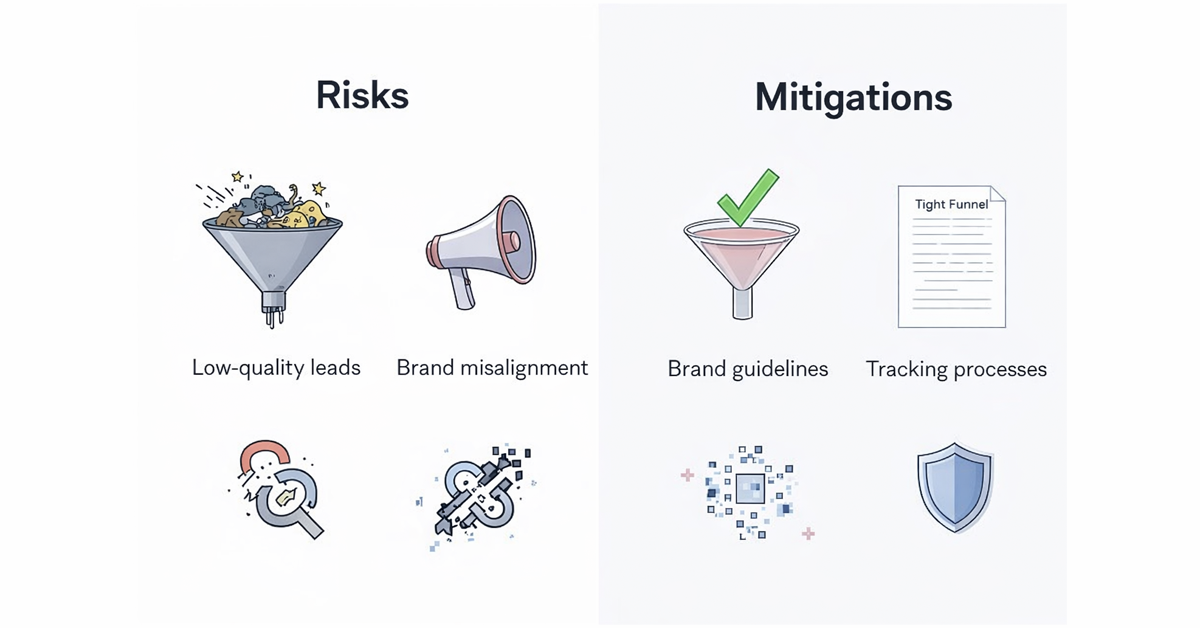
This is perhaps the most common risk, especially with a Cost Per Lead (CPL) model. When an agency’s remuneration is tied directly to the number of leads generated, there is a natural temptation to cast the net as wide as possible. The result can be a flood of enquiries that clog your sales pipeline and drain your team’s morale.
This occurs when the definition of a “lead” is left vague. Your sales team ends up wasting valuable time pursuing prospects who are a poor fit, are not ready to buy, or lack the necessary budget.
Mitigation Strategy
The solution is to be granular from the outset with a watertight Service Level Agreement (SLA). This document must be agreed upon before any campaign spend begins. It is where you will precisely define what a Marketing Qualified Lead (MQL) and a Sales Qualified Lead (SQL) look like for your business.
Your SLA should outline specific, non-negotiable criteria:
- Demographics: Are you targeting specific job titles, company sizes, or industries? List them.
- Firmographics: Do you only serve businesses with a certain turnover or in a particular geographic area? Define it.
- Behavioural Triggers: What actions signal genuine intent? This might be requesting a demo or downloading a specific buyer’s guide.
- Exclusion Criteria: Be equally clear about what a lead is not. This could include students, job applicants, or contacts from competitor companies.
By defining these details, you remove ambiguity. You and your agency are now pursuing the exact same goal: leads that have a genuine probability of becoming profitable customers.
Potential for Brand Misalignment
In the relentless pursuit of clicks and conversions, an agency might be tempted to use aggressive or off-brand tactics. This could manifest as clickbait-style ad copy, exaggerated claims, or targeting that does not align with your company’s values.
While these methods might inflate numbers in the short term, they can cause lasting damage to your brand’s reputation and erode the trust you have worked hard to build. Your brand is your most valuable long-term asset; it should never be sacrificed for a fleeting spike in metrics.
Mitigation Strategy
Pre-empt this issue by providing your agency partner with comprehensive brand guidelines at the start of the engagement. This must be more than just your logo and colour palette. It should cover your tone of voice, core messaging pillars, and overall market positioning.
Establishing a clear creative approval process is non-negotiable. This ensures that no ad, landing page, or email goes live without your team’s sign-off, guaranteeing consistency and protecting your brand integrity.
This collaborative process does not need to impede progress. It simply creates a framework that allows the agency to be agile while ensuring their creative output aligns perfectly with your long-term vision.
How to Choose the Right Agency Partner
Selecting the right performance based marketing agency is a critical commercial decision, not just a procurement exercise. The distinction between a true growth partner and a tactical supplier is defined by their strategic depth, commercial acumen, and operational transparency. A poor choice can lead to wasted budget and missed opportunities. A rigorous evaluation process is essential.
You are seeking an agency that functions as an extension of your own team—one that is as focused on your sales pipeline and profitability as you are. This requires looking beyond polished sales presentations to understand their processes and what truly drives them.
Scrutinise Their Track Record and Case Studies
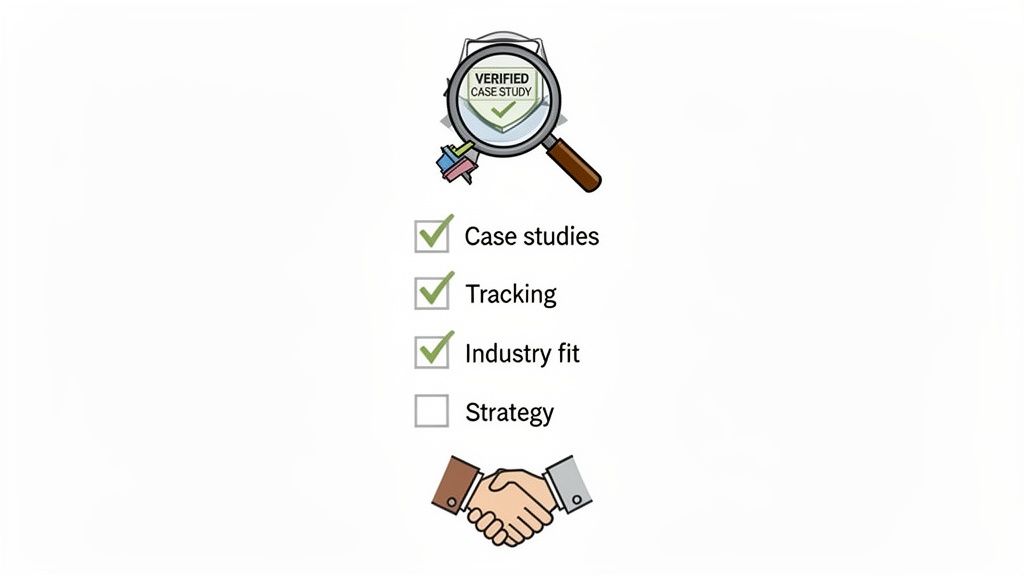
Any credible agency will have case studies, but your responsibility is to probe deeper. Glossy testimonials are one thing; hard evidence of tangible, commercial results that mirror your own goals is another entirely.
When reviewing their past work, ask challenging questions:
- What was the specific problem? Find examples where they solved a problem similar to yours, whether it was high lead costs, poor lead quality, or an inability to scale.
- What was the baseline? Real results require a starting point. Ask for the “before” data, such as the initial Cost Per Lead (CPL) or monthly lead volume.
- What were the commercial outcomes? Vague claims like “increased brand awareness” are a significant red flag. You need hard numbers, such as a 35% reduction in CPL, a 50% increase in qualified appointments, or a specific Return on Ad Spend (ROAS).
- Can I speak with a current or past client? A confident agency with strong client relationships will not hesitate.
Assess Their Strategic and Commercial Acumen
A top-tier performance agency is a strategic partner first and a tactical executor second. In your initial conversations, pay close attention to the questions they ask you. Are they delving into your business model, sales cycle, and customer lifetime value? Or are they jumping straight to discussing channels and tactics?
A genuine partner will want to understand the mechanics of your commercial reality before proposing a solution. They should challenge your assumptions and bring fresh strategic ideas to the table, not just passively agree with everything you say. This is one of the most critical considerations when hiring a PPC marketing agency or any performance-focused partner.
Evaluate Their Tracking and Reporting Capabilities
In performance marketing, data is paramount. The agency’s ability to track results with precision and report on them clearly is completely non-negotiable. Without robust tracking, attribution is merely guesswork, and you have no reliable way of knowing what is actually working.
An agency that cannot clearly explain its tracking methods or provides vague, surface-level reports is a major risk. True performance partners embrace transparency because their results speak for themselves.
Ask to see a sample report. It should be clear, commercially focused, and simple enough for a non-expert to understand. Most importantly, it must connect marketing activities directly to business outcomes like leads, pipeline value, and cost per acquisition.
Define Success and Failure Together
Before you sign an agreement, ensure you both have a crystal-clear, shared understanding of what success looks like. Equally important is discussing how you will manage periods of underperformance.
Ask them directly:
- “What does a successful first 90 days look like to you?”
- “What is the plan if we do not hit the agreed targets in a given month?”
- “What level of communication and involvement do you require from our team?”
A confident partner will have clear answers. They will talk about communication cadences, optimisation processes, and how you will solve problems collaboratively. This conversation builds a foundation of accountability and ensures you are entering the partnership with your eyes open, ready to build a predictable engine for growth.
Your Next Steps to Predictable Growth
Deciding to hire a performance based marketing agency is a significant commercial move. You are consciously shifting away from paying for activity and investing directly in tangible results like qualified leads and sales. This is not just a different payment method; it is a powerful way to de-risk your marketing budget and build a predictable engine for growth.
Success, however, depends on finding a partner, not just a contractor. The right agency does not just execute tasks. They become a strategic ally who shares the risk, welcomes accountability, and is fixated on the metrics that impact your bottom line. They should feel like an extension of your own team, as invested in your profitability as you are.
Define Your Commercial Objectives
Before you begin your search for an agency, the most important work is internal. You must be absolutely clear on what success looks like for your business. This internal clarity is non-negotiable; it is the foundation of any strong performance partnership.
Start by defining your core commercial targets:
- Target Cost Per Lead (CPL): What is the maximum you can afford to pay for a qualified lead while maintaining healthy profit margins?
- Desired Lead Volume: How many qualified leads does your sales team require each month to achieve its revenue goals?
- Sales Conversion Rate: On average, what percentage of qualified leads does your team convert into paying customers?
Establishing these figures first provides a solid framework for evaluating potential partners. It means you can enter initial conversations knowing precisely what you need, making it much easier to identify the agencies that can realistically deliver.
Initiate a Strategic Consultation
Once your commercial goals are defined, use the checklist from the previous section to create a shortlist of suitable agencies. Now, it is time to move beyond their website and case studies and have a proper, strategic conversation.
Approach this as a consultation, not a sales call. It is your opportunity to assess whether they truly understand your business model and can bring strategic value from the first conversation. A real performance partner will be eager to understand your objectives and begin mapping out a commercially-sound plan to deliver the predictable, scalable growth you need.
Your Questions Answered
When considering a performance based marketing agency, it is natural to have practical questions. Here are answers to some of the most common queries from business owners and directors, delivered from a straightforward, commercial perspective.
What Is the Typical Contract Length?
Contract length varies and is typically linked to the complexity of the marketing strategy. For a straightforward lead generation campaign on a single channel, such as Google Ads, you might find agencies offering flexible rolling monthly agreements. This provides agility but may not be suitable for strategies that require time to build momentum.
For more involved work, such as multi-channel campaigns or strategies that include SEO, a 6-12 month contract is standard. This is not about locking you in; it is about providing sufficient time for the strategy to deliver results. The agency needs this runway to gather data, test, optimise, and demonstrate a real impact on your bottom line. A longer agreement helps build a proper partnership, allowing the agency to deliver sustainable, long-term growth.
Do I Need a Minimum Marketing Budget?
While not every agency will mandate a rigid minimum spend, a certain budget is practically necessary. This is less about the agency’s fees and more about the need to generate statistically significant data. Without enough data, any attempt to optimise campaigns is effectively guesswork.
Think of your budget as the fuel. It needs to be sufficient for your agency partner to run proper tests, learn what your audience responds to, and then allocate funds to winning tactics. Investing too little is likely to yield inconclusive results, wasting everyone’s time.
A small budget might generate a few clicks or leads, but it will not be enough to gather the data needed to refine targeting, creative, and landing pages. Any credible agency will work with you to establish a realistic starting budget based on your industry’s typical advertising costs and your specific objectives.
How Is Lead Quality Tracked and Ensured?
This is a critical point, especially when paying on a Cost Per Lead (CPL) model. Ensuring high-quality leads is not left to chance; it is a systematic process that uses a combination of technology and clear agreements to filter out unsuitable prospects and align marketing with your sales team’s requirements.
It typically involves several key components working in concert:
- Tracking Pixels and CRM Integration: These are the technical elements that connect a user’s journey from an ad click to an entry in your CRM. This provides a clear line of sight on where every lead originated.
- Call Tracking: For businesses that receive a high volume of telephone enquiries, dynamic phone numbers are used. This allows calls to be attributed directly back to specific campaigns, so you know which marketing efforts are generating valuable prospects.
- The Service Level Agreement (SLA): This is arguably the most important element. Before any budget is spent, we agree on a detailed SLA. It explicitly defines what a “qualified lead” looks like for your business—criteria such as company size, job title, or specific actions taken. This ensures we are all aligned on the same target.
Ready to build a predictable growth engine with a partner who shares your commercial goals? Lead Genera acts as an extension of your team, delivering measurable results without the risks of traditional agency models. Explore our performance-led marketing services today.
Categories
Do You Need Assistance With
Sign Up To Our Newsletter