


Weekly marketing wisdom you can read in 5 minutes, for free. Add remarkable ideas and insights to your inbox, once a week, by subscribing to our newsletter.

SEO
Unlock SEO for Lead Generation: Elevate Your Lead Funnel
Effective SEO for lead generation is not just about climbing Google’s rankings. It is the process of fine-tuning your website to attract visitors who are ready to engage, and then converting that interest into qualified business leads.
This is a significant step up from simply chasing keywords. It is a strategic approach that transforms your website from a digital brochure into a reliable, 24/7 engine for commercial growth.
Table of contents:
Moving Beyond Rankings to Revenue
For too long, the conversation around SEO has been bogged down by technical jargon and vanity metrics. Business leaders hear about rankings, domain authority, and organic traffic, but these terms often feel disconnected from what matters: lead volume, sales pipeline, and revenue.
It is time to reframe the discussion.
Strategic SEO is not a siloed marketing activity; it is a core commercial function built to fuel predictable business growth. When executed correctly, it becomes your most dependable and cost-effective channel for generating high-quality leads. Unlike paid ads, where visibility vanishes the second you stop paying, a well-optimised website is an asset that works for you around the clock.
The Shift from Traffic to Commercial Outcomes
The fundamental flaw in many SEO campaigns is an obsession with traffic volume. Attracting more visitors is part of the puzzle, but it is a means to an end, not the end goal itself.
A thousand visitors who are not looking for your solution are commercially worthless. Ten visitors with a clear problem that you can solve are immensely valuable.
This is the heart of using SEO for lead generation. The focus moves from broad, high-volume keywords to specific, high-intent search terms that signal a person is close to making a decision. It is about quality over quantity, every time.
A successful SEO strategy is not measured by its position on Google, but by its impact on your sales ledger. The ultimate goal is to generate a consistent flow of qualified enquiries that your sales team can convert into new business.
Aligning SEO with Your Buyer’s Journey
To make this happen, every SEO decision must align with the buyer’s journey. This means understanding the questions your prospects ask at each stage, from first realising they have a problem to choosing a supplier.
When you create content and optimise pages that answer these specific queries, you change your website from a passive brochure into a powerful sales tool.
This approach ensures you appear in those critical moments when a potential customer is actively looking for expertise. It builds trust and positions your business as the go-to authority, making the sales process smoother. When a lead comes through your website, they are not a cold prospect; they are already educated, engaged, and interested in your offer.
Learn more by exploring our detailed breakdown of what customer acquisition cost truly entails and how to optimise it.
Connecting Your Customer Journey to High-Intent Keywords
Effective SEO for lead generation does not start when you publish content. It begins much earlier, with a solid, commercially-minded understanding of your ideal customer and their challenges. Chasing keywords with high search volumes may increase traffic, but it rarely benefits your sales pipeline. The real value is in targeting the search terms that signal a person is ready to make a purchase.
This requires a shift in thinking. It is not just about what people search for, but understanding why they are searching. This is where mapping keywords to the different stages of the B2B buying journey is crucial. It is the secret to attracting a decision-maker instead of a casual researcher.
This flowchart shows the strategic shift from simply chasing traffic to the commercial goals of generating leads and, ultimately, revenue.
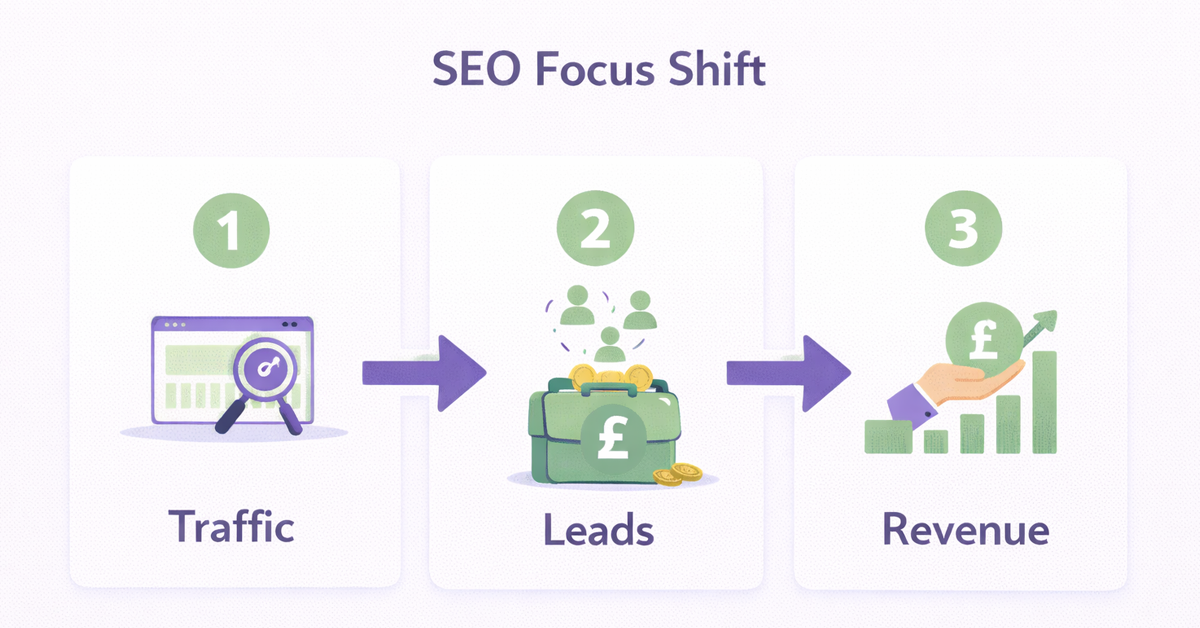
Traffic provides the initial opportunity. But the true measures of a successful campaign are the qualified leads it produces and the revenue that results.
Differentiating Informational and Commercial Intent
Imagine a UK-based consultancy that sells business process automation services. A prospect at the beginning of their journey might search for something broad like ‘what is business process automation’. This is an informational keyword. It may attract some traffic, but these visitors are likely students, academics, or individuals conducting preliminary research. They are a long way from making a purchase.
Contrast that with a search for ‘business process automation consultant London’. This is a commercial-intent keyword, and it is entirely different. The searcher has identified their problem, knows they need a consultant, and has specified their location. This search indicates a clear intent to engage a supplier.
The cornerstone of SEO for lead generation is prioritising keywords that capture prospects in the decision-making phase. While informational content is valuable for building authority, your primary commercial focus must be on the terms that precede a buying decision.
When you get this right, the quality of your leads improves significantly. The enquiries you receive are from people who have done their research and are actively evaluating their options. This simplifies the job for your sales team; they spend less time educating prospects and more time closing deals.
Building Your Keyword Universe
To develop a keyword strategy that generates leads, you need to think like your customer. Start by brainstorming the specific problems your service solves and the exact language your customers use to describe these problems.
Here is a simple framework for finding high-intent keywords:
- Problem-Aware Keywords: These often contain phrases like “how to fix,” “improve,” or “streamline.” For our consultancy example, this could be “how to improve accounts payable workflow.”
- Solution-Aware Keywords: These individuals know what kind of solution they need. They will use words like “software,” “platform,” “agency,” or “consultant.” An example is “accounts payable automation software for SMEs.”
- Provider-Aware Keywords: These are bottom-of-the-funnel searches. People are comparing options and will use brand names or qualifiers like “best,” “top,” or “near me.”
In the UK’s competitive B2B market, SEO is a powerful tool. It delivers an average ROI of 702% for SaaS companies and is responsible for 44.6% of all B2B revenue, double any other channel. You can explore the research behind these figures to understand its full impact.
Once you have a solid list of potential keywords, the next task is to map them to specific pages on your website. This is a critical step that ensures every page has a clear commercial purpose. If this is new to you, our guide on what keyword mapping is explains how it works in practice. This disciplined approach will turn your website from a simple brochure into a reliable lead generation machine.
Creating Content That Converts Searchers into Leads
You have pinpointed the high-intent keywords your prospects are using. The next step is to build content that not only answers their questions but also guides them toward becoming a lead. In SEO for lead generation, content is more than blog posts. It involves creating strategic assets designed to capture a prospect’s details.
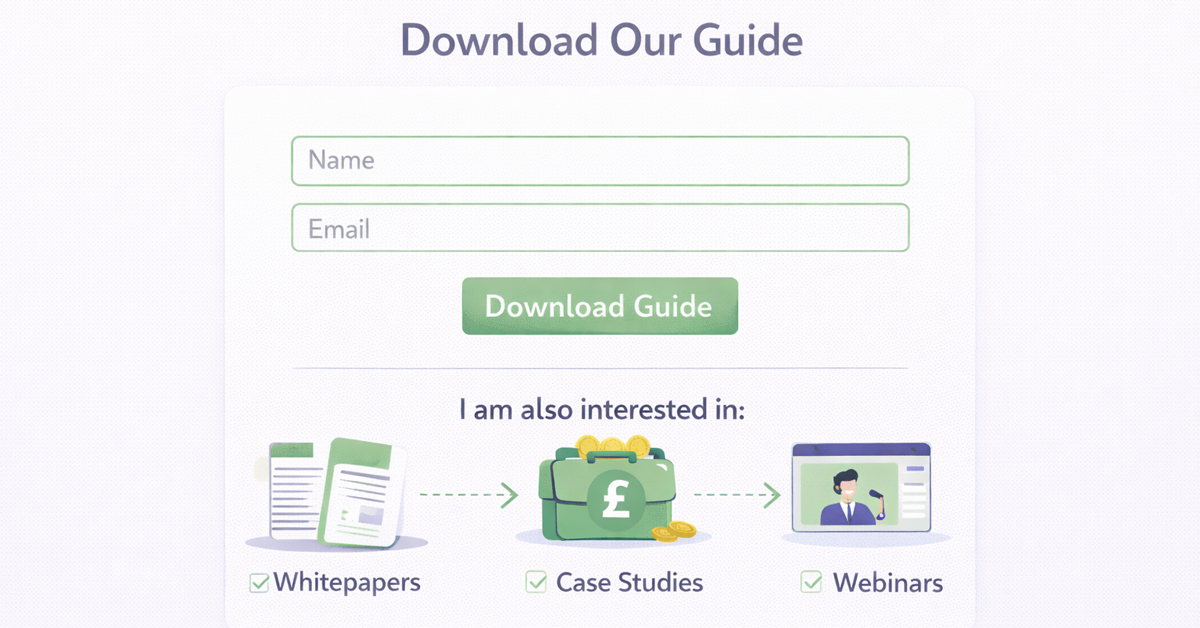
The process is built on a fair value exchange. Your content needs to be so insightful and useful that a potential customer feels providing their name and email is a worthwhile trade. This is how your website evolves from a passive information library into an active, lead-generating system.
Matching Content Formats to the Buyer Journey
Different content formats are effective at different stages of the buying cycle. Someone starting their research (top-of-funnel) needs education, while someone close to a decision (bottom-of-funnel) is looking for proof and validation. Selecting the right format is critical for maximising conversion rates.
Consider these high-impact content types:
- In-depth Guides and Whitepapers: These are perfect for tackling complex problems. They immediately position your business as an expert and are excellent for capturing mid-funnel leads who are actively evaluating their options.
- Case Studies: Nothing builds trust faster than social proof. A detailed case study showing how you solved a similar problem for another company is incredibly persuasive for bottom-of-funnel prospects.
- Webinars and Video Content: Webinars allow you to explore a topic in depth and interact directly with your audience. They are highly effective for demonstrating complex services and capturing engaged, high-quality leads.
- Calculators and Diagnostic Tools: Interactive tools, like an ROI calculator, provide instant, tangible value. They give a prospect a powerful reason to provide their contact information.
Here is a breakdown of which content formats work best at each stage of the buyer journey.
Content Formats for Different Buyer Journey Stages
| Buyer Stage | Objective | High-Impact Content Formats | Lead Capture Method |
|---|---|---|---|
| Awareness | Educate & attract a broad audience | Blog posts, infographics, checklists | Newsletter sign-up, social follow |
| Consideration | Provide in-depth solutions & build trust | In-depth guides, whitepapers, webinars | Form to download resource or register |
| Decision | Prove value & overcome final objections | Case studies, free trials, consultations | Form for demo, quote, or trial access |
This strategic approach is essential. In the UK, B2B lead generation is powered by content. 91% of companies report that content marketing brings in more leads than traditional outbound methods. Furthermore, over 60% of marketers identify inbound strategies like SEO as their primary source for top-quality leads.
Structuring Content for Conversion
Creating the asset is only half the battle. The landing page where it resides needs to be ruthlessly optimised to secure the download or sign-up. This is no place for distractions. Forget multiple navigation links; the page must have one single, clear goal.
A high-converting landing page almost always includes:
- A Compelling Headline: It must communicate value and connect directly with the visitor’s pain point.
- Concise, Benefit-led Copy: Use bullet points. Summarise exactly what the user will gain. Focus on the outcomes, not just the features of the content.
- A Clear Call-to-Action (CTA): Use strong, action-focused language. “Download Your Guide” is much better than a passive “Submit.”
- A Simple Form: Only ask for what you absolutely need. Every extra field will reduce your conversion rate. A name, company, and email are often sufficient to start a conversation.
A landing page is a specialist tool, not a generalist webpage. Its sole purpose is to convert a visitor into a lead. Every element, from the headline to the form fields, must work together to achieve that single commercial goal.
By treating your content as a library of targeted lead generation tools, you can build a system that attracts, engages, and converts prospects across their entire decision-making journey. This is what transforms your SEO from a passive traffic-driving exercise into an active, measurable contributor to your sales pipeline.
Nailing On-Page and Technical SEO for Commercial Growth
You have mapped out your strategy and planned your content. Now it is time to execute. The focus shifts to ensuring every page on your website is technically sound and perfectly tuned to turn search traffic into business leads.
This is the point where on-page and technical SEO stop being a simple box-ticking exercise. They become a direct driver of commercial growth. These optimisations are the critical bridge between getting a visitor to your site and convincing them to take the next step. If done correctly, you will not only climb the search rankings but also create a better user experience that guides people smoothly towards becoming a lead.
Your Shop Window: Optimising Page Titles and Meta Descriptions
Think of your page titles and meta descriptions as your digital shop window. For most people, this is the first thing they will see from your brand in the search results. Their only job is to secure the click over your competitors.
To make them work for lead generation, you need to incorporate the commercial-intent keywords you identified earlier. A title like “Expert Business Process Automation Consultants | London & UK” does this perfectly. It immediately qualifies the service and the location, speaking directly to someone actively looking to hire.
The meta description must then support this with a short, punchy, benefit-led summary. Do not just list what you do; focus on the outcome for the client. Something like, “Our London-based consultants help you streamline workflows and reduce operational costs. Get a no-obligation consultation today.” This combination boosts your click-through rates and pre-qualifies traffic before they even land on your site.
Building Pages That Are Designed to Convert
Once someone clicks through, the page they land on has one job: convert. Every element, from the headline to the button text, needs to be engineered to push the user towards a specific action, whether filling out a form, booking a call, or downloading a guide.
A truly conversion-focused page is built on clarity and performance.
- Lightning-Fast Page Speed: In a competitive world, speed is essential. A slow-loading page creates a frustrating experience and will send visitors back to Google. Studies confirm that even a one-second delay can significantly reduce conversion rates.
- Mobile-First Design: A large amount of B2B research now happens on mobile phones. Your pages must look and function perfectly on any screen size. Buttons need to be easy to tap and forms must be simple to complete on a smaller screen.
- A Clear Information Hierarchy: Use proper headings (H1, H2, H3) to give your content a logical structure. This is not just for search engines; it helps users scan the page, find what they need quickly, and moves them towards conversion with less friction.
Turning Technical Jargon into Commercial Results
Technical SEO can sometimes feel abstract, but its impact on lead generation is very real. Certain technical elements directly influence how search engines perceive your expertise and, crucially, how well your pages convert visitors into prospects.
Technical SEO is not just about keeping Google happy. It is about methodically removing every barrier that could stop a qualified prospect from becoming a lead. A fast, secure, and well-structured site is a powerful sales tool.
Here are a couple of practical examples:
- Schema Markup for Services: Implementing service schema is like giving Google a cheat sheet for your business. It summarises what you offer, your service area, and can even pull in customer reviews. This can lead to “rich snippets” in the search results, making your listing stand out and building trust before anyone clicks.
- Strategic Internal Linking: A smart internal linking structure does more than help search engine crawlers find your pages. It creates clear pathways for your users, guiding them from an educational blog post to a high-converting service page. This process nurtures them along their journey and keeps them on your site, increasing the chance of conversion.
By tying these on-page and technical fundamentals directly to your goal of SEO for lead generation, you ensure every bit of time and effort contributes to a healthier sales pipeline.
For a more detailed breakdown, our complete technical SEO checklist provides a useful deep dive.
Building Authority with Local SEO and Strategic Link Building
Generating high-quality leads from SEO is not just about your website’s content. It is also about building your online reputation and, for most UK businesses, becoming the go-to provider in your local area. This is where a sharp focus on both Local SEO and strategic link building pays dividends.
For any service-based business, local visibility is vital. When someone searches for a solution “near me,” they have an immediate need. Capturing that moment is one of the fastest ways to fill your pipeline with high-intent leads who are ready to engage.
Dominating Local Search with Google Business Profile
Your Google Business Profile (GBP) is the cornerstone of your local SEO efforts. It is arguably your single most important asset for capturing local search traffic. A properly optimised profile does more than put you on the map; it builds immediate trust and gives potential customers a direct way to contact you.
Getting your GBP right is a game-changer for local lead generation in the UK. Businesses appearing in the “local 3-pack” receive 126% more traffic and 93% more actions (like calls and website clicks) than those ranked lower. You can discover more insights about generating local leads to see the commercial impact this can have.
Here is a practical checklist for GBP optimisation:
- Complete and Accurate Information: Ensure your business name, address, phone number (NAP), and opening hours are identical everywhere: your site, GBP, and all online directories. Consistency is crucial.
- Service & Product Listings: Be specific. Detail every service you offer, using the keywords your customers would search for. This helps Google connect your profile to specific local queries.
- High-Quality Photos and Videos: Showcase your team, completed work, and premises. It personalises your business and provides real-world proof of your quality.
- Regular Google Posts: Use this feature to share company news, special offers, or recent projects. It signals to Google and customers that your business is active.
- Proactively Manage Reviews: Encourage satisfied customers to leave a review. Then, respond to every single one, good or bad. This social proof is incredibly powerful in local search.
Earning Authority Through Strategic Link Building
While local SEO is excellent for capturing immediate demand, strategic link building builds the long-term authority that underpins your entire SEO strategy. A backlink is a link from another website to yours. To Google, these act as votes of confidence, signalling that your site is a credible, trustworthy source of information.
The goal, however, is not to accumulate hundreds of low-quality links. That is an outdated tactic that can lead to penalties. Modern link building is about earning placements on relevant, authoritative sites in your industry.
A single backlink from a respected industry journal or a well-known local business partner is worth more than a hundred links from low-quality directories. The focus must be on quality and relevance, not quantity.
It is best to think of it as digital PR. When another trusted voice in your space points to your website, it boosts your site’s overall authority and sends valuable referral traffic. These visitors are often highly qualified because they arrive with an implied recommendation from a source they already trust.
This process directly supports lead generation by:
- Improving Keyword Rankings: Higher domain authority helps all your pages rank better for their target keywords, increasing organic visibility.
- Driving Qualified Referral Traffic: A link from a relevant blog post can send prospects who are actively researching solutions directly to your website.
- Building Brand Credibility: Being featured on reputable sites cements your status as an expert, which can help shorten the sales cycle.
By combining a meticulously managed local presence with a targeted link-building strategy, you create a powerful system. You capture immediate, local demand while building the long-term authority needed to compete for high-value national keywords. The result is a consistent, reliable flow of high-quality leads.
Measuring SEO Success with Commercial KPIs
To get real buy-in for your SEO efforts, you must shift the conversation away from rankings and organic traffic. While those numbers have their place, they do not tell the full story, especially not the one that matters to leadership.
What matters is the bottom line. Success is not about hitting #1 on Google; it is about turning that visibility into a predictable pipeline of qualified sales opportunities. That is the only way to prove the strategic worth of SEO and secure the budget needed for growth.
Ditch the Vanity Metrics
Many SEO reports are filled with ‘vanity metrics’. These are numbers that look impressive in a presentation but offer zero insight into commercial performance. High traffic figures or a handful of top keyword rankings are meaningless if they do not translate into leads and revenue.
To measure what matters, you need to focus on performance KPIs that directly connect your SEO activity to sales outcomes. This creates accountability and provides a clear framework for demonstrating a genuine return on investment.
The true measure of an SEO campaign is not its search ranking, but its contribution to the sales pipeline. Every metric you track should answer one simple question: “Is this driving profitable business growth?”
Comparing Vanity Metrics vs Performance KPIs for SEO
It is easy to get bogged down in data that feels important but does not drive decisions. The key is to distinguish between metrics that make you feel good (vanity) and those that show you are making money (performance). This table breaks down the difference.
| Metric Type | Example | Why It’s a Vanity Metric | What to Measure Instead (Performance KPI) |
|---|---|---|---|
| Visibility | Keyword Rankings | Ranks fluctuate and do not guarantee relevant traffic or conversions. You can rank #1 for a term that brings zero business value. | Marketing Qualified Leads (MQLs) from Organic |
| Traffic | Total Organic Sessions | High traffic does not equal quality traffic. 10,000 irrelevant visitors are worse than 100 highly qualified ones. | Organic Traffic Conversion Rate |
| Engagement | Bounce Rate / Time on Page | These can be misleading. A user might find an answer quickly and leave (a ‘good’ bounce) or spend ages on a confusing page. | Cost Per Organic Lead |
| Authority | Domain Authority (DA) | This is a third-party, predictive metric from Moz. It is a useful guide but has no direct impact on revenue or leads. | Lead-to-Close Rate (from Organic) |
Ultimately, performance KPIs give you a direct line of sight from your SEO activities to the health of the business, a conversation every stakeholder understands.
The KPIs That Truly Matter
To prove the commercial impact of your SEO, you need to track metrics that bridge the gap between marketing activity and business results. The secret is integrating your website analytics with your CRM system. Without that connection, you are guessing.
Here are the core performance KPIs you should be measuring:
- Total Organic Leads: The raw number of new leads generated directly from organic search. This is your top-of-the-funnel volume measure.
- Organic Traffic Conversion Rate: The percentage of visitors from organic search who take action and become a lead. This is a crucial indicator of traffic quality and website persuasiveness.
- Cost Per Organic Lead: Organic traffic is not ‘free’. Calculate this by dividing your total investment in SEO (content, tools, salaries) by the number of organic leads generated. This lets you compare its efficiency against paid channels.
- Lead-to-Close Rate (from Organic): The most important metric. What percentage of leads from search eventually become paying customers? Tracked in your CRM, this is the ultimate measure of lead quality.
By focusing on these outcome-driven KPIs, you can report on SEO performance in a language that business leaders understand and respect. This cements SEO’s value not as a marketing cost, but as a strategic investment in predictable, long-term growth.
Got Questions About SEO for Leads? We’ve Got Answers
To wrap up, let’s tackle a few of the most common questions from business leaders when they are considering SEO for lead generation. Here are the practical, no-fluff answers.
How Long Does SEO Take to Generate Leads?
This is always the first question, and the only honest answer is: it depends. While you can sometimes see quick wins within the first 90 days, building a reliable, predictable lead generation machine with SEO is a long-term strategy.
Realistically, you should expect to see meaningful traction and a consistent flow of leads within 6 to 12 months. The timeline is affected by several factors: the competitiveness of your industry, your starting point (a new site versus one with history), and the consistency of your investment in content and technical improvements.
Is SEO or PPC Better for Lead Generation?
This is not an either/or question. They are different tools for different jobs, and they work best when used together.
-
PPC (Pay Per Click): This is your tool for speed. It delivers immediate visibility and leads. It is often used to test new offers, target specific keywords, and generate enquiries quickly. The downside? The moment you stop paying, your visibility disappears.
-
SEO: This is about building a long-term, sustainable asset. It takes longer to gain momentum, but over time, the leads it generates usually have a much lower cost per acquisition. The authority and traffic you build are yours to keep.
A smart strategy uses PPC to secure crucial short-term wins while SEO builds the foundation for more profitable, long-term growth.
How Do You Measure the Quality of SEO Leads?
Lead quality is everything. A high volume of poor-quality leads is a waste of time. The key is to track leads beyond the initial form submission. This requires connecting your website analytics to your CRM.
Once that connection is made, you can measure what matters to the business:
- Marketing Qualified Leads (MQLs): Of all leads from organic search, how many meet your basic criteria?
- Sales Qualified Leads (SQLs): How many of those MQLs does the sales team accept as genuine opportunities?
- Lead-to-Close Rate: What percentage of your organic leads become paying customers?
- Pipeline Value: What is the total commercial value of all sales opportunities generated by SEO?
When you track these metrics, you are not just discussing traffic and rankings; you are proving the direct commercial impact of your SEO efforts.
Ready to turn your website into a predictable source of high-quality leads? We build performance-led SEO strategies designed for commercial growth. Get in touch today to discuss your goals.
Categories
Do You Need Assistance With
Sign Up To Our Newsletter