


Weekly marketing wisdom you can read in 5 minutes, for free. Add remarkable ideas and insights to your inbox, once a week, by subscribing to our newsletter.
Sales
Lead Generation Sales Funnel: A Practical Guide to Building Your Growth Engine
A lead generation sales funnel is a structured journey for potential customers. Instead of hoping people find you and decide to buy, a funnel provides a clear, predictable path from discovering your brand to becoming a qualified sales opportunity. It is a core system for any business that wants sustainable, scalable growth.
Understanding the Lead Generation Sales Funnel
At its heart, a sales funnel maps the customer journey from a prospect who is vaguely aware of a problem to an engaged lead ready for a sales conversation. This is not marketing theory; it is a practical system built to bring efficiency and predictability to your revenue generation.
Without a defined funnel, marketing activities often lack connection and purpose. You might generate website traffic, but none of it converts into tangible enquiries. A well-designed funnel connects every touchpoint, ensuring each step builds on the last to create commercial momentum.
Why a Funnel is Non-Negotiable for Growth
Relying on an inconsistent trickle of inbound leads is a significant business risk. A properly constructed lead generation funnel transforms this uncertainty into a reliable engine for growth.
Here is why it is so critical:
- Improved Lead Quality: The funnel acts as a natural filter. It nurtures and qualifies prospects, so your sales team invests time with individuals who are a strong commercial fit for your offer.
- Increased Sales Efficiency: When leads are pre-qualified and informed, your sales team wastes less time on unproductive conversations. They can focus on closing deals, which directly lowers your customer acquisition cost.
- Predictable Revenue: By measuring conversion rates between stages, you can forecast your sales pipeline with greater accuracy. Marketing shifts from an unpredictable expense to a measurable investment in growth.
- Better Return on Investment (ROI): A systematic approach clearly shows which channels and tactics are working. You can allocate budget to high-performing activities and eliminate wasteful spend, maximising the return on every pound invested.
The diagram below provides a classic visualisation of this journey, from initial awareness right through to a conversion action.
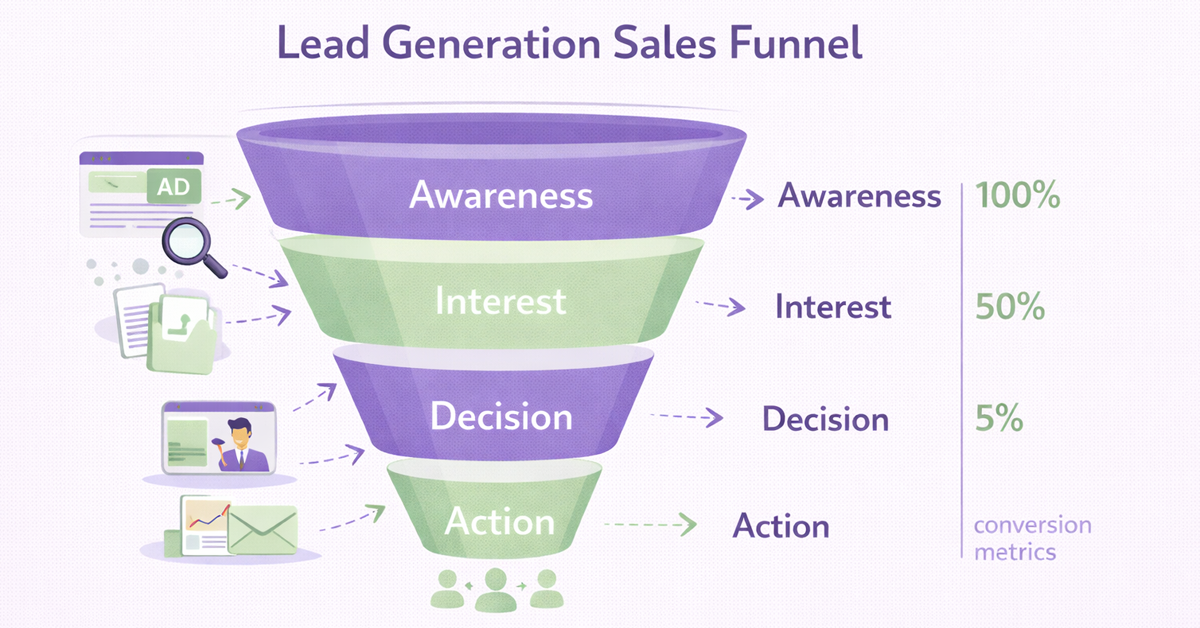
A large, broad audience is gradually refined into a smaller, more focused group of high-quality prospects. Each stage demands a different strategy to guide them smoothly toward becoming a valuable lead. For a deeper dive into the fundamentals, our guide on what lead generation is in marketing is an excellent starting point.
Stage 1: Attracting High-Intent Prospects
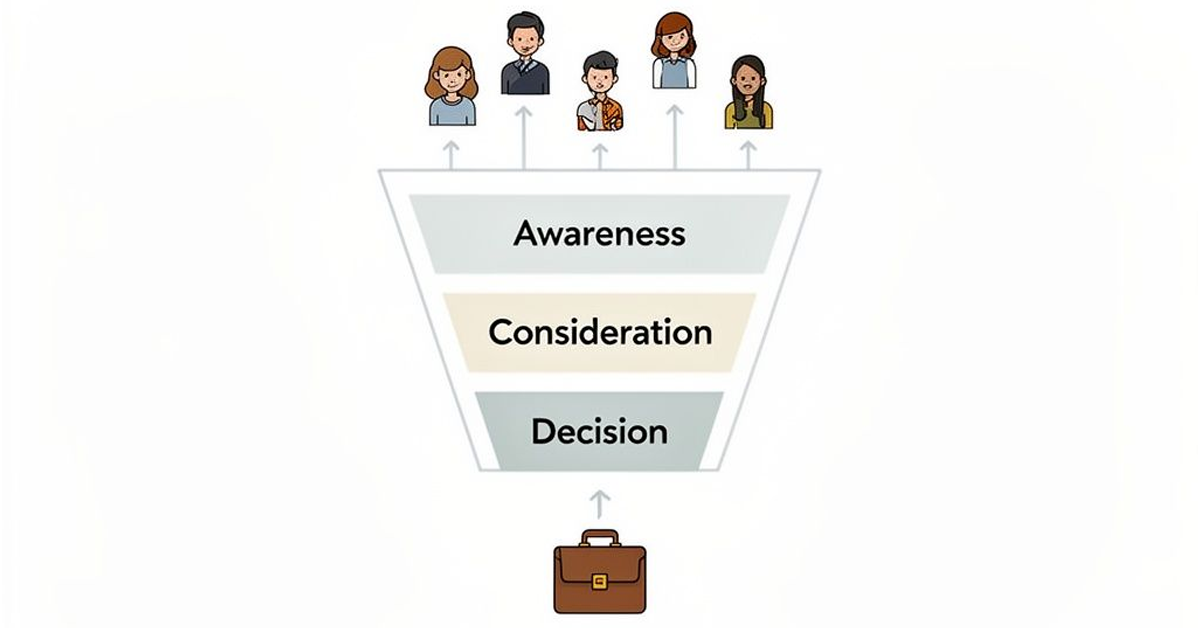
The top of your sales funnel, the awareness stage, is about more than driving traffic. It is about attracting the right traffic: prospects with a genuine, commercially viable need for your solution. This first step dictates the quality of every lead that follows, making it the most critical part of your entire lead generation funnel.
A common mistake is casting the net too wide, chasing high website visitor numbers that never convert into sales. The objective here is different. We want to attract individuals who are already problem-aware and actively seeking a solution. This creates a much more efficient and profitable customer journey.
Driving Commercial Interest with SEO
At this stage, Search Engine Optimisation (SEO) must target commercial intent, not just informational keywords. While a blog post answering a broad question might get clicks, a page targeting a “buy-now” keyword will attract visitors who are much closer to making a purchase decision.
The strategy revolves around identifying and ranking for keywords that signal a clear need. Consider the exact phrases your ideal customer would type into Google when they are ready to buy or enquire:
- “Emergency plumbing services near me”
- “Best accounting software for small businesses UK”
- “Hire a B2B marketing consultant”
By focusing on these high-intent phrases, you ensure the traffic landing on your site is already pre-qualified. These users are not just browsing; they are actively searching for the solution you provide. It is a strategic move that dramatically improves lead quality from the very first click.
Capturing Demand with Paid Advertising
Paid advertising on platforms like Google Ads and Meta Ads gives you the power to intercept motivated prospects with precision. Unlike SEO, which can take time to gain momentum, paid campaigns can attract high-intent prospects almost immediately.
A Google Search campaign, for example, can place your business at the top of the results at the exact moment someone is searching for your service. It is the digital equivalent of being in the right place at the right time.
A well-structured paid media campaign is less about interruption and more about providing a timely solution. The key is to align your ad copy and landing page with the user’s search intent, ensuring a seamless and relevant experience that encourages them to take the next step.
Similarly, Meta Ads (Facebook and Instagram) can be used to target users based on their job roles, interests, and online behaviours that strongly suggest they fit your ideal customer profile. To execute this effectively, you will want to explore a range of tactics, including proven lead generation ideas which can be adapted for most industries.
Establishing Authority with Valuable Content
While direct commercial tactics are vital, you also need to build trust and authority. This is achieved through high-value content that addresses your audience’s initial pain points and questions. This content serves a dual purpose: it supports your SEO efforts and positions your brand as a credible expert.
Effective top-of-funnel content typically includes:
- In-depth Guides: Comprehensive articles that solve a specific problem for your audience.
- Original Research: Reports or industry studies that offer unique insights.
- Explainer Blog Posts: Clear, detailed posts that break down complex topics relevant to your services.
This content attracts prospects in the early research phase, allowing you to capture their attention before your competitors. By providing genuine value upfront, you begin building a relationship based on trust, not just a transaction. If you want to explore this further, our article on how PPC lead generation works offers valuable insights.
Ultimately, success in this first stage comes from a blended approach. When you combine targeted SEO, precise paid advertising, and authoritative content, you create a powerful system for attracting a steady stream of high-quality prospects into your lead generation sales funnel.
Stage 2: Converting Traffic Into Tangible Leads
Once you have relevant traffic arriving on your website, the next objective is to convert that anonymous traffic into identifiable leads. This is the middle of the funnel, where you transition from broadcasting a message to beginning a one-to-one dialogue. Your main goal is to earn enough trust that a prospect willingly provides their contact details in exchange for something of genuine value.
This stage is not about a hard sell. It is about demonstrating expertise and the ability to solve their problems. By offering high-value resources, known as lead magnets, you give prospects a compelling reason to engage. When they do, it signals they are more than a casual browser; they are actively seeking a solution.
Designing High-Value Lead Magnets
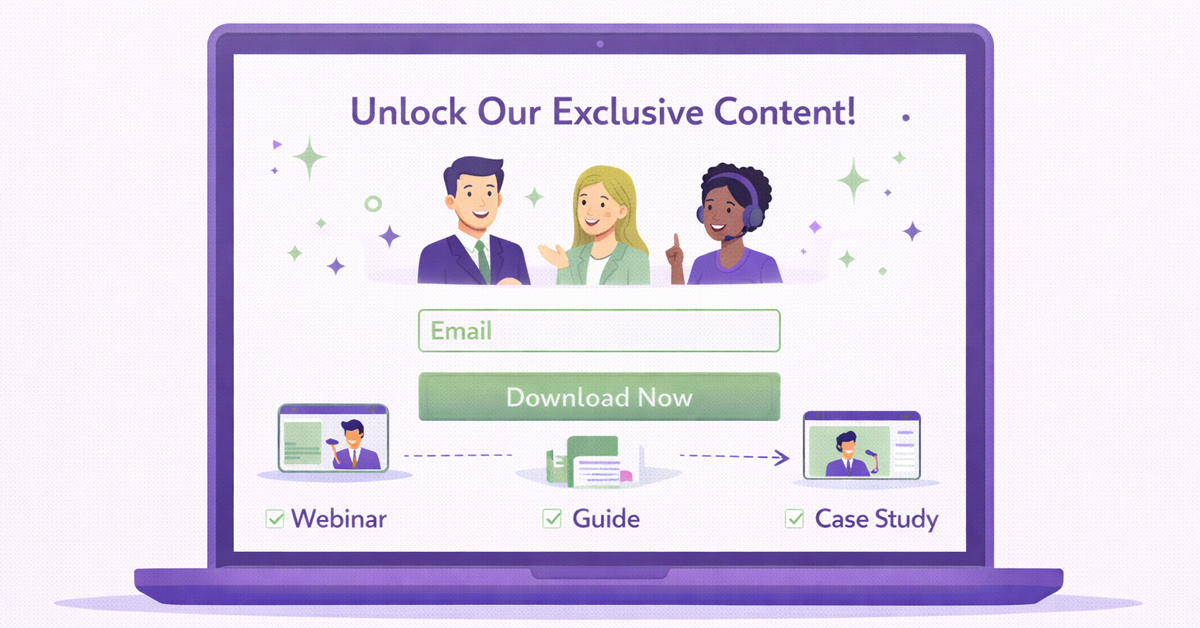
A lead magnet is the cornerstone of your mid-funnel conversion strategy. It needs to be so valuable that your ideal customer would consider paying for it, yet you offer it for free in return for their details. The most effective lead magnets solve a specific, pressing problem for your audience.
A few proven examples include:
- Detailed Webinars: Offer a live or on-demand session that explores a complex topic. This showcases your expertise and allows for direct engagement.
- Insightful Case Studies: Nothing is more powerful than real-world proof. Show how you have helped similar businesses achieve measurable results.
- Practical Guides or Checklists: Create an actionable resource that helps a prospect solve an immediate problem. This positions you as a helpful, knowledgeable partner from the outset.
The key is to match the lead magnet to the prospect’s stage in their journey. They already know they have a problem; now they are evaluating the best way to solve it.
Engineering High-Converting Landing Pages
Your lead magnet is only as effective as the landing page it sits on. This is not just another page on your website; it is a dedicated conversion tool with a single, clear objective: to persuade the visitor to download your resource.
An effective landing page eliminates all distractions. There should be no main navigation, no links to other content, and no competing calls to action. Every element, from the headline to the form, must reinforce the value of your offer and guide the user towards converting. For a practical walkthrough, see our guide on how to build a killer lead generation landing page.
A successful landing page makes the value exchange feel effortless and logical. It clearly communicates the benefit of the offer, builds trust with social proof like testimonials, and features a simple, frictionless form that respects the user’s time.
The form is a critical element. Only ask for the information you absolutely need at this stage. A long, complex form will cause a significant drop in conversion rates. Often, a name and email address are sufficient. You can always gather more details later in the process.
Adopting Multi-Channel Nurturing Strategies
Obtaining a name and email is just the beginning. Now you must nurture that relationship to build credibility and move a prospect from being interested to being invested. A coordinated, multi-channel approach is incredibly effective. Multi-channel lead generation is set to transform UK sales funnels, with companies using multiple touchpoints seeing 287% higher conversion rates than those sticking to a single channel. This is crucial, as 73% of UK decision-makers now expect a digital-first approach.
This might involve an automated email sequence that delivers more useful content, followed by a personalised connection request on LinkedIn. This blend of automated efficiency and a human touch deepens the relationship and keeps your brand front of mind. As you refine your strategies, you might also explore options like hiring virtual assistants for telemarketing to actively engage with prospects. By proving your value at every turn, you build the trust needed to reach the final decision-making stage.
Stage 3: Converting Qualified Leads into Customers
This is the final, commercially critical stage of the funnel. This is where highly qualified, engaged leads become paying customers. They understand their problem, and they have identified you as a strong contender to solve it. Your objective now is to provide the final piece of assurance they need to commit.
The conversation shifts at this point. You move away from broad, educational content and towards specific, commercial details. It is less about the “what” and “why,” and more about the “how” and “when.” Every communication should be focused on answering their final questions, addressing any lingering doubts, and proving the return on investment they will achieve by choosing you. The goal is to make the decision to buy feel logical and straightforward.
Crafting Compelling Commercial Offers
To secure a final commitment, your offers must be compelling and perfectly timed. This is not about offering discounts; it is about presenting tangible business solutions that directly address their pain points and demonstrate clear, immediate value.
Some of the most effective offers at this stage include:
- Free Consultations or Audits: A one-on-one session with an expert is incredibly powerful. It allows you to understand their specific challenges and outline a tailored solution, building immense trust and showcasing your expertise.
- Live Product Demonstrations: If you sell software or a technical product, a customised demo is non-negotiable. It transforms your product from a list of features into a working solution for their specific problems.
- Strategic Proposals: A detailed, bespoke proposal is a powerful sales tool. It should clearly outline the scope, timeline, and, most importantly, the expected ROI, giving the decision-maker a solid business case to approve.
These high-touch interactions are vital for closing deals, especially in B2B environments where decisions often involve multiple stakeholders.
Arming Your Sales Team for Success
Your sales team needs the right tools to handle objections and build a compelling financial case. You must equip them with assets that provide the social proof and hard data needed to justify the investment.
At this final stage, your goal is to make the decision to buy feel both logical and safe. Assets like ROI calculators and strong client testimonials replace uncertainty with confidence, directly addressing the core concerns of any commercial decision maker.
Key assets for closing include:
- ROI Calculators: An interactive tool where a prospect can input their own numbers and see the potential financial return is a game-changer. It reframes the conversation from “cost” to “investment.”
- Client Testimonials and Case Studies: Hearing from a similar company that has already achieved excellent results with your help is highly persuasive. These stories provide crucial third-party validation and reduce perceived risk.
- Comparison Sheets: In a competitive market, a clear, honest comparison sheet showing how you stack up against alternatives can be a significant advantage. It simplifies the research process for your prospect and highlights your unique strengths.
Getting this stage right is critical. Recent analysis reveals a sobering reality for UK businesses: on average, just 13% of B2B leads ever convert into opportunities, and a mere 6% of those opportunities close into sales. This underlines the need for targeted, persuasive assets to prevent leaks in the funnel.
Ensuring a Frictionless Conversion Experience
Finally, do not let a poor website experience undermine your hard work. When a prospect is ready to commit, the process must be completely frictionless. A confusing form, a slow-loading page, or a hidden “contact us” button can be enough to kill the deal.
Your key conversion points, such as contact forms or “request a demo” pages, must be optimised for simplicity. Keep forms short, make calls to action clear and prominent, and ensure the page loads instantly on any device. Every piece of friction you add increases the likelihood that your valuable, sales-ready lead will go elsewhere.
Measuring The Metrics That Actually Matter
A lead generation funnel without measurement is just guesswork. To turn your funnel from a diagram into a predictable revenue engine, you must track the right data. This is not about vanity metrics like website traffic or social media followers; it is about focusing on the Key Performance Indicators (KPIs) that directly measure business growth.
Analysing this data allows you to diagnose problems, identify bottlenecks, and allocate your budget effectively. By measuring performance at each stage, you can move from assumption to informed decision-making, systematically improving lead quality and profitability.
Top of Funnel: Awareness Stage Metrics
At the top of the funnel, the objective is to attract a relevant audience efficiently. The metrics you monitor here should measure the volume, quality, and cost of the audience you are acquiring.
-
Cost Per Click (CPC): A fundamental metric for any paid advertising. CPC tells you exactly how much you pay each time someone clicks your ad. Monitoring it helps you manage your budget and ensure you are not overpaying for traffic.
-
Click-Through Rate (CTR): This is the percentage of people who see your ad or search result and click on it. A strong CTR indicates that your messaging is relevant and resonating with your target audience.
-
Traffic Quality: This is assessed by analysing metrics like bounce rate and average time on page for traffic from different channels. If visitors from a specific ad campaign land on your site and leave immediately, it is a clear sign that the traffic quality is poor, even if the volume is high.
Middle of Funnel: Consideration Stage Metrics
Once a user is on your site, the focus shifts to converting that anonymous visitor into an identifiable lead. The metrics here are purely focused on the performance of your lead capture assets.
Your landing page is the single most important conversion tool in the middle of your funnel. Its performance dictates the overall efficiency of your marketing spend. Even a small improvement in its conversion rate can have a huge impact on your cost per lead.
-
Landing Page Conversion Rate: This is the most important metric at this stage. It is the percentage of visitors who land on your page and complete the desired action, such as filling out a form. It directly measures the persuasiveness of your offer and page design.
-
Cost Per Lead (CPL): This is where marketing activity meets financial reality. CPL calculates the total cost of a campaign divided by the number of leads it generated. This figure is crucial for understanding the financial viability of your lead generation funnel.
Bottom of Funnel: Conversion Stage Metrics
At the bottom of the funnel, the metrics become purely commercial. You are no longer measuring clicks or downloads; you are evaluating whether your efforts are generating revenue. These metrics connect your marketing spend directly to business outcomes.
-
Customer Acquisition Cost (CAC): This metric takes CPL a step further. It calculates the total sales and marketing cost required to acquire a new customer. For a business to be sustainable, its CAC must be significantly lower than the lifetime value of a customer.
-
Return on Investment (ROI): The ultimate bottom line. ROI calculates the total revenue generated from your marketing efforts against the cost. A positive ROI is the final confirmation that your funnel is delivering profitable growth.
To bring this together, it is useful to see which metrics align with each stage of the journey. This helps you focus on what is important at any given moment and diagnose problems more effectively.
Essential Funnel Metrics by Stage
| Funnel Stage | Key Performance Indicator (KPI) | Why It Matters |
|---|---|---|
| Awareness (Top) | Click-Through Rate (CTR) | Shows if your ads and headlines are compelling enough to grab attention. |
| Awareness (Top) | Cost Per Click (CPC) | Measures the cost-efficiency of your paid channels in driving initial traffic. |
| Consideration (Middle) | Landing Page Conversion Rate | Directly measures how effective your offer and page are at creating leads. |
| Consideration (Middle) | Cost Per Lead (CPL) | Tells you the real-world cost to generate a single lead from your campaigns. |
| Conversion (Bottom) | Customer Acquisition Cost (CAC) | Calculates the total cost to get a paying customer, a vital health metric. |
| Conversion (Bottom) | Return on Investment (ROI) | The ultimate measure of profitability for your entire marketing and sales effort. |
By maintaining a dashboard with these KPIs, you move from “I think this is working” to “I know where we are winning and where we need to improve.” It is the foundation for building a truly predictable and scalable growth engine for your business.
Using Technology to Optimise Your Funnel
A modern lead generation sales funnel is not a static blueprint. It is a dynamic system that requires constant attention and improvement to perform optimally. Technology provides the tools to move away from guesswork towards data-driven decisions that create a significant commercial advantage. It helps enhance performance, boost efficiency, and ultimately extract more value from your entire pipeline.
Fine-Tuning with Conversion Rate Optimisation
This is where Conversion Rate Optimisation (CRO) is applied. CRO is the systematic process of improving your website and landing pages to increase the percentage of visitors who take a desired action. It is a structured, evidence-based approach to making your funnel more effective at every step.
Instead of making changes based on intuition, CRO requires you to form a hypothesis, test it, and measure the results. This could mean:
- A/B Testing Landing Pages: Testing two versions of a landing page against each other to see which headline, call-to-action button, or layout generates more leads.
- Refining User Flow: Analysing how users navigate your website to identify and remove points of friction that cause them to abandon their journey.
- Optimising Forms: Adjusting the number of fields or the design of your lead capture forms to make them easier to complete, thereby boosting submission rates.
The real value of CRO is that it forces you to let customer behaviour guide your decisions. Every test provides clear, quantitative feedback, allowing you to make small, incremental improvements that compound over time, steadily driving down your Cost Per Lead.
The Impact of AI and Automation
Artificial intelligence and automation are practical tools you can use now to add intelligence and efficiency to your funnel. In the UK B2B market, businesses that have embraced AI-driven lead generation are seeing a typical 2.8x increase in qualified leads within the first quarter. Furthermore, their conversion rates are increasing by 35-45% compared to traditional methods. These tools handle complex, repetitive tasks, freeing up your team to focus on high-value activities. You can get more insights into how UK SMEs are using AI for lead generation on shapethemarket.com.
Here is where they can make a real difference:
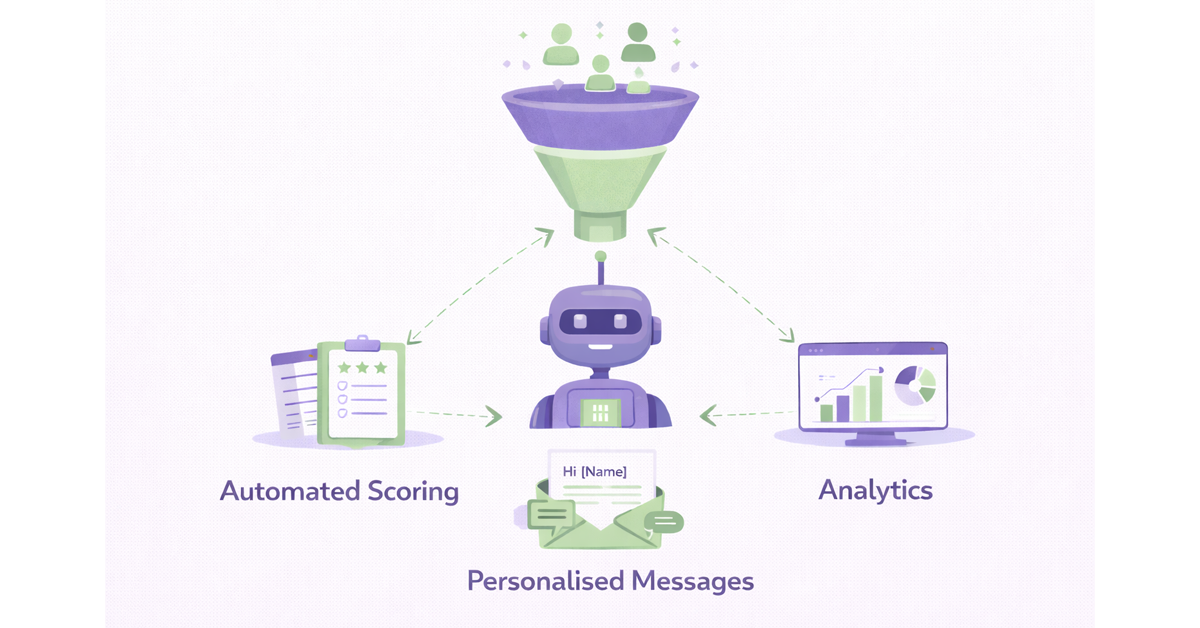
- Automated Lead Scoring: AI algorithms can analyse a prospect’s behaviour, such as the pages they visit or content they download, to automatically score and prioritise the leads most ready to buy. This ensures your sales team always focuses on the hottest opportunities.
- Personalised Nurturing: Automation enables you to send highly personalised email and content sequences at scale. These systems can trigger specific messages based on a lead’s actions, ensuring the right message is delivered at the right time.
- Predictive Analytics: More advanced systems can analyse historical data to predict which leads are most likely to convert, helping you allocate sales resources with greater accuracy.
By integrating these technologies, you transform your sales funnel from a simple pathway into a smart, self-optimising system built to drive predictable and profitable growth.
Frequently Asked Questions
When building a lead generation sales funnel, several practical questions often arise. Here are some of the most common queries from business owners, with direct answers to help you move forward with clarity.
How Long Does It Take to Build a Funnel?
A basic funnel can be established relatively quickly. Setting up initial campaigns with a simple landing page and lead magnet can be done in a few weeks. However, achieving significant, predictable results takes time.
Realistically, you should allow for three to six months to fully optimise the system. This timeframe provides enough data to test different channels, refine messaging, and identify which assets generate the best leads for the lowest cost.
What Is a Realistic Budget for a Sales Funnel?
There is no single answer; the budget depends on your industry, target audience, and growth ambitions. As a starting point, a modest initial budget might be in the £1,500 to £3,000 per month range. This would typically cover ad spend and the creation of core assets like content and landing pages.
For more aggressive growth, you might invest £5,000 to £10,000+ per month. The important mindset is to view this as an investment, not a cost. The entire focus should be on the return, specifically your cost per lead and customer acquisition cost.
The most strategic approach is to start with a contained budget. Prove the model works by achieving a positive ROI, then confidently scale your investment based on real-world performance data. This minimises risk and provides a clear path to growth.
What Are the Most Common Pitfalls to Avoid?
Many businesses make the same mistakes when first building a lead generation funnel. Being aware of them can save you significant time and money.
- Ignoring the Middle of the Funnel: It is easy to focus all efforts on driving traffic. Many businesses neglect to create compelling lead magnets or nurturing sequences to keep prospects engaged. This results in high visitor numbers but very few actual leads.
- Poor Sales and Marketing Alignment: When marketing and sales teams operate in silos, performance suffers. Marketing may generate leads that are a poor fit, or the sales team may not follow up effectively. In either case, valuable opportunities are lost.
- Setting It and Forgetting It: A funnel is not a one-time project. It is a living system that requires constant monitoring and optimisation. You must consistently test and refine it based on performance data to maintain its effectiveness and profitability.
Addressing these practical points from the start will help you build a robust system that delivers tangible results for your business.
Ready to build a high-performance lead generation sales funnel that delivers predictable growth? The team at Lead Genera specialises in creating and optimising commercial funnels that turn marketing spend into measurable revenue. Let’s discuss your growth strategy today.
Categories
Do You Need Assistance With
Sign Up To Our Newsletter