



Weekly marketing wisdom you can read in 5 minutes, for free. Add remarkable ideas and insights to your inbox, once a week, by subscribing to our newsletter.
SEO
How Much Does SEO Cost in the UK?
How much does SEO cost? Let’s get straight to it. A typical monthly retainer in the UK can be anywhere from £750 for a small local business to over £10,000 for a national enterprise. The final figure depends on your commercial goals, the competitiveness of your market, and how quickly you need to see a return.
Table of contents:
The True Cost of SEO: A Straightforward Breakdown
Thinking about SEO as just another marketing cost is a common mistake. A much smarter way to look at it is as a strategic investment in your website’s ability to attract the right kind of customers and generate predictable revenue.
Unlike paid ads, where the traffic vanishes the second you turn off spending, a solid SEO strategy builds long-term, compounding value. It is an asset that grows over time.
So, the real question is not “how much does SEO cost?” but rather, “what level of investment is required to hit our specific business goals?” A local plumbing company trying to get more calls from its neighbourhood has completely different needs to a B2B software firm competing across the country. Their investment levels, and the work involved, will naturally be worlds apart.
From Cost Centre to Growth Engine
To budget properly, you must connect the investment directly to business outcomes. That means ditching vanity metrics and focusing on what actually impacts your bottom line.
A commercially-focused SEO strategy should be obsessed with:
- Lead Quality and Volume: Attracting prospects who are actively looking for what you sell and are far more likely to convert.
- Sales Pipeline Value: Consistently filling your pipeline with high-intent enquiries, taking pressure off your outbound sales team.
- Improving Acquisition Costs: Over time, SEO almost always delivers a lower customer acquisition cost compared to other channels. You can learn more about this by understanding what customer acquisition cost is and how to calculate it.
Typical Monthly SEO Investment in the UK
To give you a clearer picture, here is a table outlining realistic monthly budget ranges. This should help you quickly see where your business might fit.
| Business Type | Typical Monthly Budget (GBP) | Primary Commercial Focus |
|---|---|---|
| Small Local Business | £750 – £1,500 | Dominating the local map pack, generating phone calls and enquiries. |
| Growth-Focused SME | £1,500 – £4,000 | Regional/national growth, increasing lead volume, outranking key competitors. |
| National B2B/E-commerce | £4,000 – £7,500 | Driving qualified pipeline value, increasing market share, content leadership. |
| Enterprise/Competitive Market | £7,500 – £15,000+ | Market domination, complex technical SEO, multi-channel integration. |
These are guide figures. The right investment for you will always depend on your unique situation, but this gives you a solid starting point for any conversation.
The infographic below illustrates how SEO investment and strategy scales with business size and ambition.
As you can see, the focus shifts from simple local visibility for smaller businesses right through to market domination for large enterprises. The budget and the work involved grow to match those ambitions.
To understand the true cost of SEO, it helps to see how it stacks up against other digital marketing channels. This expert guide on Paid Search vs. Organic Search provides excellent context. It is essential reading for anyone trying to build a balanced marketing plan that drives growth.
Decoding Common SEO Pricing Models
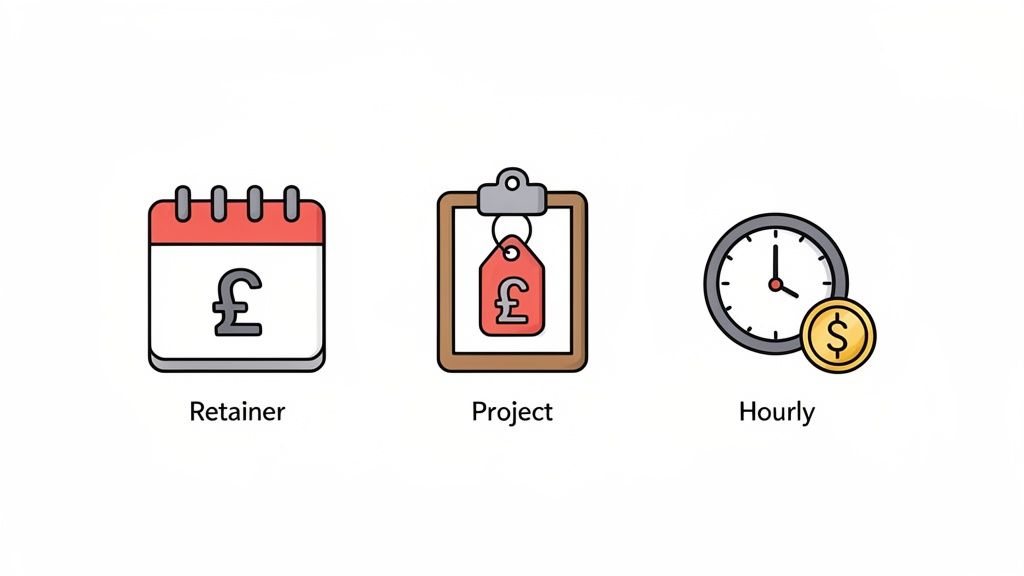
To make a confident investment, you first need to understand how SEO services are priced. When you start receiving proposals, you will notice they fall into one of three categories. Each has its place, but only one is built for steady, long-term business growth.
Understanding the difference is crucial. It helps you look past the price tag and assess if the proposal aligns with your commercial goals. This way, you can find a partner focused on delivering real outcomes, not just ticking off a list of tasks.
The Monthly Retainer Model
The monthly retainer is the industry standard for any business serious about growth, and for good reason. SEO is not a one-off job; it is a continuous cycle of technical optimisation, content creation, authority building, and strategic adjustments. A retainer fuels this ongoing effort.
Think of it like maintaining a high-performance vehicle. You would not service it once and expect it to run perfectly forever. It needs constant fuel, regular maintenance, and occasional upgrades to stay ahead of the competition. A monthly retainer provides the resources to proactively manage your website as a valuable, lead-generating asset.
This model is your best option for:
- Sustained Growth: Building lasting organic visibility and creating a reliable pipeline of inbound leads.
- Competitive Markets: Staying on top of algorithm updates and keeping pace with your competitors.
- Strategic Partnership: Allowing your SEO partner time to understand your business, so they can identify growth opportunities you might miss.
A retainer is not just a payment; it is a commitment to a strategic partnership. It shifts the relationship from a simple transaction to a shared mission, focused on accountability and measurable results that impact your bottom line.
The Project-Based Fee Model
A project-based fee makes sense for specific, clearly defined tasks with a definite start and end point. This model works well when you have a one-off problem that does not need ongoing management, offering a fixed price for a fixed scope of work.
The main downside is that it is reactive, not proactive. As soon as the project is finished, the work stops. This can be a false economy, especially if root problems need constant attention to maintain performance and drive growth.
Common examples of project-based SEO include:
- Technical SEO Audits: A one-off deep dive to find foundational issues with your website.
- Website Migrations: Handling the complex SEO requirements when moving to a new domain or platform.
- Penalty Recovery: A focused effort to identify and fix the cause of a Google penalty.
This model is effective for addressing specific issues, but it is no substitute for a continuous growth strategy.
The Hourly Consulting Rate Model
Hourly consulting gives you access to high-level strategic advice when you need it. You are paying for an expert’s time to help solve a specific problem, review your strategy, or train your in-house team. Rates vary, but you are typically looking at £100 to £300+ per hour, depending on the consultant’s experience.
This approach can be useful for businesses that already have a team handling day-to-day execution but need senior expertise to ensure they are on the right track. It provides targeted advice without the commitment of a full retainer.
The drawback is that the consultant is not there to do the work. The value of their advice depends entirely on your team’s ability to implement it effectively. It is a model for strategic direction, not hands-on delivery. For most businesses that need tangible results, a retainer that combines strategy with execution delivers far more commercial value.
SEO Investment for Local and Small Businesses
For tradespeople, local service businesses, and high street shops, effective SEO is not about chasing vanity metrics. It is the difference between a quiet phone and a steady stream of local customers. This is about dominating your service area and achieving measurable results that increase revenue. A smart investment connects you with high-intent buyers searching for your services right now.
It all boils down to driving the actions that matter: phone calls, contact form submissions, and footfall. A results-focused local campaign is built on a solid foundation, designed to capture those moments when a potential customer needs you most. When mapping out your marketing budget, it is helpful to view this ongoing investment alongside foundational costs, like determining how much a website costs for a small business, to get the complete picture.
What a Local SEO Campaign Includes
A local campaign is highly specific. It is not about ranking for broad keywords; it is about winning valuable ‘near me’ searches that signal immediate buying intent. The goal is to make your business the most visible, most trusted option in your area.
Core activities in a commercially grounded local SEO strategy typically include:
- Google Business Profile (GBP) Optimisation: Think of this as your digital storefront. A fully optimised profile, complete with regular posts, positive reviews, and accurate information, is essential for appearing in the local map pack, which often generates the best leads.
- Localised On-Page SEO: This means refining your service and location pages with geographically specific keywords, such as “emergency plumber in Norwich” instead of just “plumber.” It is a subtle but crucial difference.
- Citation Building and Management: Ensuring your business name, address, and phone number (NAP) are listed consistently across reputable online directories builds trust with search engines and cements your local authority.
- Local Link Building: Earning links from other local businesses, community groups, or local news outlets sends powerful signals to Google that you are a genuine, prominent player in your town or city.
Translating Investment into Local Revenue
The cost of local SEO is rising as more businesses recognise its value. In the UK market of 2026, small and local businesses can expect monthly retainer costs from £500 to £1,200. This is a significant increase from the £300 to £800 range seen in 2024, reflecting fierce competition and the need for more sophisticated strategies.
The return on this investment is measured in booked appointments and new customer revenue. An effective local SEO campaign does not just increase website traffic; it makes the phone ring and fills your pipeline with qualified, ready-to-buy customers from your immediate service area.
Ultimately, this investment is about creating a predictable flow of work. By systematically boosting your local visibility, you become less reliant on inconsistent word-of-mouth referrals or expensive, short-lived advertising. You are building a sustainable asset that generates leads month after month, turning your website into a reliable engine for local growth. Our guide on affordable SEO services for small business offers more practical advice.
Scaling SEO for Growth-Focused Businesses
You have established a strong local presence and are now looking to expand. When a business targets regional or national markets, the SEO game changes completely. Local SEO is about owning your immediate territory; scaling up is about strategically capturing market share in a much larger, more competitive arena. This requires a greater investment and a more sophisticated strategy.
For ambitious SMEs and B2B companies, SEO becomes the core of lead generation, tasked with building a reliable pipeline of high-value inbound enquiries. The focus shifts from simply being found to creating a dominant brand presence that consistently helps your sales team exceed its targets.
The Expanded Scope of a Growth Campaign
Moving to this next phase means going beyond the basics of local SEO. The work becomes more intensive, data-driven, and commercially focused, tackling the challenges of competing at a higher level. This is where a simple checklist approach fails and genuine strategic thinking is required to win.
A growth-oriented SEO campaign must integrate several critical components:
- In-Depth Technical Audits: A full-scale technical audit is essential at this stage. It uncovers hidden issues with your site’s architecture, crawlability, and indexing that could be hindering your growth. Fixing these problems ensures your website provides a solid foundation for all other activity.
- Strategic Content Marketing: At this level, content is not just about producing blog posts. It is about creating valuable assets that answer your ideal customer’s biggest questions, establishing your business as the go-to authority in your field. This includes in-depth guides, white papers, and detailed case studies designed to attract, educate, and convert serious prospects.
- Digital PR and Authority Building: To compete nationally, you need a much stronger digital footprint. Digital PR helps achieve this by earning high-quality backlinks from respected industry publications and news sites. These links are powerful signals of trust and authority to search engines, directly boosting your ability to rank for competitive, high-value keywords.
Linking Advanced Tactics to Commercial Objectives
Every one of these advanced tactics must be tied directly to a core business goal. You do not conduct a technical audit for its own sake; you do it to improve conversion rates and ensure every part of your marketing budget is working as hard as possible. Strategic content is not created to rank for random terms; it is crafted to attract C-suite decision-makers.
The goal here is to build an inbound lead generation system that is both reliable and scalable. As your investment increases, the predictability of your lead flow should too. This allows for more accurate sales forecasting and provides the confidence to plan for future growth.
The investment required reflects this much larger scope. For medium-sized UK businesses aiming for regional or national reach, monthly retainers are climbing. Research shows that in 2026, companies in this bracket are investing between £1,500 and £4,000 per month for a comprehensive campaign. This increase from previous years is driven by the need for deep technical expertise, scaled-up content production, and authoritative digital PR, especially in competitive sectors like finance or professional services. It is worth exploring more about these pricing trends to understand the market landscape.
Ultimately, investing at this level is about future-proofing your business. By building a powerful organic presence, you create a sustainable competitive advantage. You are not just renting traffic from ad platforms; you are building a valuable business asset that will generate leads and revenue for years, strengthening your market position and fuelling long-term, profitable growth.
Enterprise SEO for Highly Competitive Markets
When you operate in a fiercely competitive space like finance, insurance, or B2B SaaS on a national or international scale, SEO ceases to be just another marketing channel. It becomes a core business function, essential for both growth and defence. The investment at this level is significant, but it directly reflects the complexity and scale of the competitive landscape.
Success in these arenas demands a far more sophisticated strategy than standard SEO. You are not just trying to rank for a few keywords; you are battling for market share against established giants with deep pockets and vast resources. This is where SEO moves from a tactic to a strategic imperative, integrated with your wider business goals.

What Drives Enterprise SEO Costs
The budget for an enterprise campaign is dictated by the sheer scope and intensity of work required to gain a competitive edge. This is not about simple on-page tweaks. This is about executing large-scale, multi-faceted strategies that deliver a measurable commercial impact across the organisation.
Key drivers pushing up the investment include:
- Multi-Site and International SEO: Managing the complexities of multiple websites, subdomains, or country-specific domains is a technical challenge. It demands meticulous oversight to handle issues like hreflang tags, canonicalisation, and crafting localised content strategies.
- Advanced Technical Optimisation: Enterprise websites are often vast and complex. Optimising their performance involves deep dives into site architecture, log file analysis, crawl budget management, and improving core web vitals at a massive scale.
- Large-Scale Authority Building: To compete at the top, you need a powerful authority profile. This involves strategic digital PR campaigns, securing high-value media placements, and creating industry-leading content assets that naturally attract authoritative backlinks.
Justifying the Investment with Commercial Returns
The financial commitment for enterprise SEO is substantial. Recent market analysis shows that enterprise and highly competitive UK industries in 2026 are commanding SEO budgets of £5,000 to £20,000+ per month, a significant increase from previous years. This is fuelled by the demands of multi-site strategies, international targeting, and extensive content operations, with sectors like insurance and B2B SaaS often needing dedicated teams. You can explore more about these SEO pricing trends to get a better feel for the evolving market.
At the enterprise level, SEO investment is measured against its ability to defend and increase market share, generate high-value leads for complex sales cycles, and build a powerful brand asset that delivers a long-term competitive advantage.
Choosing the right partner is therefore critical. You need more than a tactical supplier; you need a strategic partner who can manage complexity and be accountable for results. They must understand the commercial landscape, navigate the technical challenges, and translate a major investment into a substantial, predictable return. Get it right, and the engagement delivers not just rankings, but sustainable revenue growth and a fortified position in your market.
Choosing the Right SEO Partner for Your Business
Selecting an SEO provider is a critical business decision. Get it right, and you gain an extension of your team who is accountable for tangible growth. Get it wrong, and you will not only waste your budget but potentially harm your online reputation for years.
The conversation needs to shift from “how much does SEO cost?” to “who can deliver the best commercial return?”.
Real value is born from strategic alignment. A partner worth considering will be more interested in your business model, sales cycle, and profit margins than your current keyword list. If their first questions are about your business objectives rather than just rankings, you are on the right track. This focus on outcomes is what separates a true growth partner from a simple supplier.
Assessing a Potential Partner’s Approach
When vetting potential partners, look for a commercially-minded approach. They should be able to clearly explain how their SEO activities will translate into qualified leads and, ultimately, more revenue. A vague promise to “improve your SEO” is not enough.
You need to demand a clear, logical line connecting their strategy to your bottom line.
A transparent partner will be open about their process. They will provide regular, meaningful reports that go beyond vanity metrics like traffic. Crucially, they should be able to explain the ‘why’ behind their recommendations, helping you understand the strategic thinking involved.
Here are a few key areas to investigate:
- Commercial Focus: Are they talking about lead quality, pipeline value, and cost per acquisition? Or are they stuck on traffic and rankings?
- Strategic Depth: Can they show you how SEO will integrate with your other channels, like paid ads or content marketing?
- Reporting and Accountability: Is their reporting easy to understand and focused on the numbers that matter to your business? Do they take ownership of the results?
If you are weighing up different options, our guide on how to choose a digital marketing agency offers a deeper framework to help you decide.
Critical Questions and Red Flags
During initial conversations, the questions you ask are as important as the ones they ask you. Be ready to push past the polished sales pitch. A confident, experienced consultant will welcome tough questions and give you straight, logical answers.
A focus on guaranteed rankings is the biggest red flag in the industry. No one can guarantee a specific Google ranking. A credible partner will instead guarantee a commitment to a robust, transparent process designed to achieve your commercial goals.
Be wary of any provider who:
- Promises #1 Rankings: This is an outdated, misleading sales tactic. It ignores how complex and dynamic search algorithms are.
- Offers Unusually Low Prices: Very cheap SEO often means they are cutting corners or using risky tactics that can get you penalised by Google.
- Lacks Transparency: If they are secretive about their methods or cannot explain their strategy in plain English, it is time to walk away.
- Focuses on Vanity Metrics: A partner obsessed with rankings over revenue does not share your primary goal: business growth.
Ultimately, choosing the right partner is about investing in a long-term relationship. It needs to be built on trust, accountability, and a shared vision for achieving sustainable business growth.
Got Questions About SEO Costs? We Have Answers.
To clear things up, here are some straightforward answers to the questions we hear most often from business owners weighing up their SEO investment. This should give you a realistic idea of what to expect.
How Long Does It Take to See Results from SEO?
Let’s be clear: SEO is a long-term strategy, not a quick fix. While technical foundations can be sorted fairly quickly, you should realistically expect to see proper traction and a noticeable impact on leads and traffic within four to six months.
The real value of SEO is how it compounds over time. Think of it as building an asset for your business. The consistent effort you put in now builds a reliable lead generation machine that keeps working for you long after the initial push.
Is SEO More Cost Effective Than PPC Advertising?
This is a common question. They are both powerful, but they play different roles. Pay Per Click (PPC) ads are excellent for instant visibility, perfect if you are testing a new offer or need to drive traffic immediately. SEO, on the other hand, is about building long-term, organic traffic that you do not have to pay for with every click.
Over the long term, a solid SEO strategy almost always wins on cost per acquisition. This is because you are creating a lasting asset. The initial investment continues to pay dividends for years, generating high-quality leads without you having to constantly fund an ad platform.
What Are the Biggest Red Flags in an SEO Proposal?
It is vital you know how to spot a poor proposal, so you do not waste your money or, worse, get penalised. Be very wary if you see any of the following.
Here are the warning signs that should raise concerns:
- Guaranteed #1 Rankings: This is the oldest and most misleading promise in the industry. Anyone guaranteeing a specific rank on Google is being dishonest. The algorithms are far too complex and change constantly for anyone to make that claim.
- A Lack of Transparency: If a provider is vague about their methods or cannot explain their strategy in plain English, it is a major red flag. It suggests either a lack of expertise or the use of risky, outdated tactics.
- Unrealistically Low Pricing: If it sounds too good to be true, it is. Rock-bottom prices often mean you are getting automated, ineffective, or outright harmful work that could do serious damage to your website. Proper strategic work requires experienced professionals, and that comes with a realistic price tag.
- Focus on Vanity Metrics: A proposal that dwells on rankings and traffic figures without tying them back to what matters, which is lead quality and revenue, misses the point. The goal of SEO is to grow your business, not just to top a chart.
At Lead Genera, we build SEO strategies that make commercial sense and deliver a clear return on investment. If you are ready to stop chasing vague promises and start building a dependable pipeline of high-quality leads, let’s have a proper chat about how we can help you grow. Find out more at https://leadgenera.com.
Categories
Do You Need Assistance With
Sign Up To Our Newsletter