


Weekly marketing wisdom you can read in 5 minutes, for free. Add remarkable ideas and insights to your inbox, once a week, by subscribing to our newsletter.

Lead Generation
A Guide to Demand Generation Agencies
Demand generation agencies are strategic partners in building a predictable revenue engine. Instead of just chasing immediate sales, they work to create awareness, credibility, and a genuine desire for your solutions over time. This approach ensures a consistent flow of high-quality, engaged prospects ready for a sales conversation.
Understanding the Role of Demand Generation Agencies
Let’s cut through the jargon. A demand generation agency doesn’t just find leads; it creates a market that actively seeks you out.
Consider this: would you rather your team cold calls a long list of names, or fields enquiries from a queue of genuinely interested people? That strategic shift is what these agencies deliver, and it has profound implications for your bottom line.
Traditional lead generation often focuses on the bottom of the funnel, capturing people already aware of their problem and actively looking for a solution. While important, relying on this alone leads to an inconsistent pipeline and fierce competition for the same small pool of buyers. A demand generation agency takes a broader, more sustainable view.
The Full-Funnel Approach
These agencies operate across the entire buying journey, from someone’s first awareness of a problem right through to the final purchase. Their main goal is to build a solid foundation for long-term, predictable growth by making your brand the obvious choice, long before a buying decision is on the table.
This involves several key activities:
- Building Awareness: Making your target market realise that the problem you solve even exists.
- Establishing Credibility: Positioning your company as a trusted authority and the go-to expert in your industry.
- Creating Desire: Nurturing that initial interest and clearly showing the value of your solution, so prospects want to work with you specifically.
This full-funnel strategy tackles the core business problem of an unreliable pipeline filled with low-quality, unengaged leads. By warming up the entire market, you become far less reliant on costly, high-pressure sales tactics.
The real value of a demand generation agency is its ability to turn marketing from a cost centre into a predictable revenue driver. It is about engineering a system where growth is a consistent output, not a sporadic event.
Demand Generation vs Lead Generation
It’s important to clarify the distinction between these two terms. They are related, but their goals and the commercial outcomes they produce are quite different.
Lead generation is a subset of demand generation. It is the tactical component focused on capturing contact information. Demand generation is the overarching strategy that makes your lead generation efforts more effective and efficient in the first place. Our guide on demand generation vs lead generation explores this commercial distinction in more detail.
Ultimately, a demand generation agency’s role is to ensure your sales team spends its time talking to informed, motivated prospects. This directly boosts sales efficiency and the overall value of your pipeline. The breadth of tactics involved is vast, as seen in resources that cover topics like 10 Creative Ways To Generate Leads For Your Marketing Agency.
The Core Services of a High-Performance Agency
A top-tier demand generation agency acts as a growth partner, not a list of suppliers. Their services are not delivered in isolation; they are woven together to build momentum across the entire buyer’s journey, turning vague interest into a tangible sales pipeline. They do not just complete tasks; they take ownership of commercial results.
This visual maps out the typical flow an agency creates, guiding a prospect from first realising they have a problem to actively wanting your specific solution.
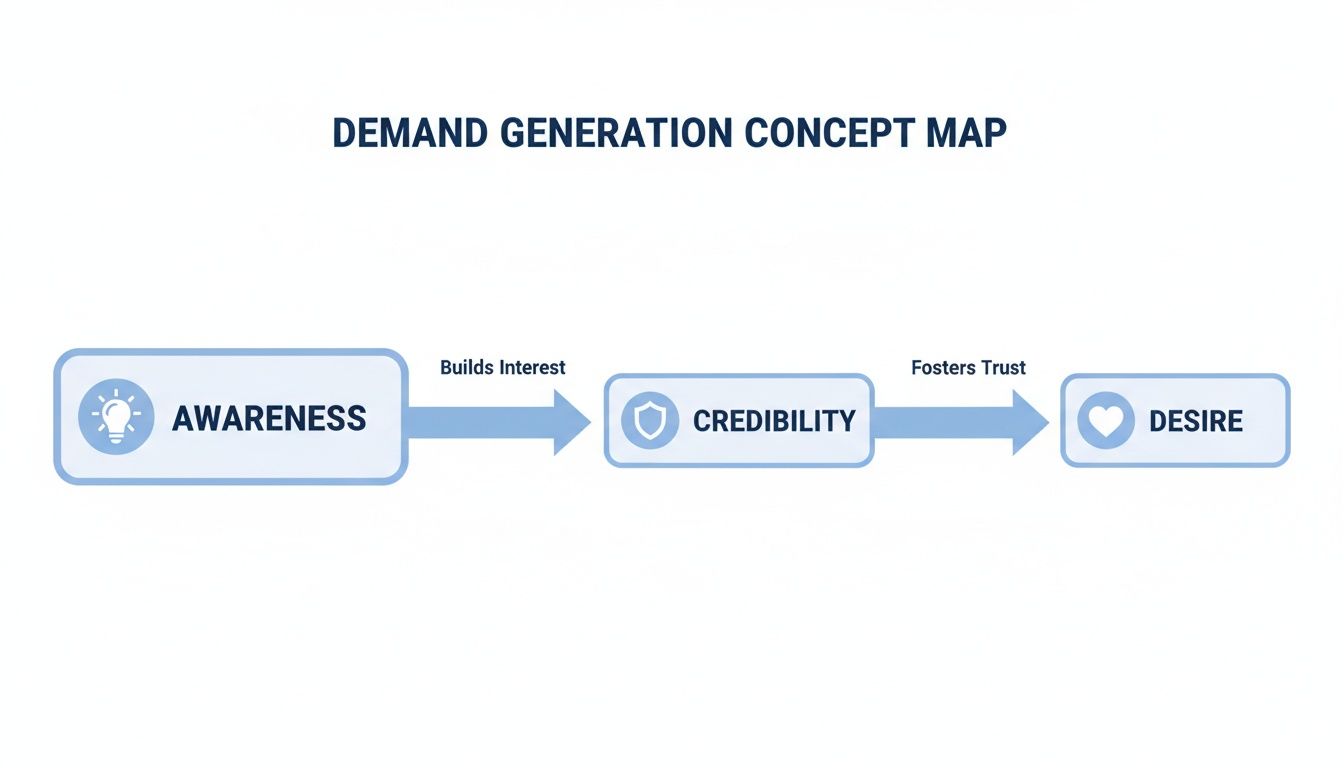
It’s a deliberate process. Trust is built and value is proven at every step, ensuring that by the time a prospect speaks to your sales team, they are already convinced of your expertise.
Full-Funnel Content Strategy
Demand generation cannot exist without quality content. It’s the foundation. A professional agency will develop content that addresses your audience’s challenges at every stage, not just when they are ready to buy.
This means creating thought-leadership articles, detailed guides, and webinars for the early awareness stage. This is followed by assets like case studies and deep-dive product comparisons for the consideration stage. The goal is simple: become the go-to resource in your space, making your brand the obvious answer to their problem. For a deeper look, our guide to content marketing services provides a comprehensive overview.
Strategic Paid Media
This is not about chasing cheap clicks or vanity metrics. Strategic paid media for demand generation is about building and educating a specific audience over time. It’s precision work, not a volume game.
A skilled agency uses platforms like Meta and LinkedIn to place valuable content in front of the right people, warming up cold audiences and capturing initial interest. They then use retargeting to nurture that interest, guiding prospects toward a decision with increasingly relevant messages. This method improves lead quality and reduces your customer acquisition cost over the long term.
Commercial SEO
SEO in this context is about capturing your future customers, not just those ready to buy today. The agency will target informational keywords that people use at the beginning of their research when they are still trying to understand their problem.
This approach builds a reliable, sustainable source of organic traffic from people just starting their journey. By answering their initial questions, you establish your authority and ensure your brand is the first one they think of when it’s time to make a decision. It’s a long-term play that creates a predictable, low-cost pipeline.
A truly strategic agency integrates these services seamlessly. SEO insights inform the content strategy, which fuels paid media campaigns, all driving traffic to a website optimised for conversion. It is a closed-loop system designed for growth.
The UK marketing agencies market, in which these specialised services operate, is valued at approximately £23.75 billion in 2025 and is set to grow substantially. This growth is driven by businesses seeking expert partners to build these exact kinds of efficient, scalable marketing systems.
When Is the Right Time to Hire an Agency?
Deciding when to engage a demand generation agency is a major strategic decision, not a reactive one. It’s about spotting the business triggers that indicate you are ready for a more structured, scalable approach to growth.
Many companies make the mistake of waiting until the lead pipeline has completely dried up. The optimal time to invest is when you have a solid foundation to build upon.
Telltale Signs You’re Ready for an Agency
Hitting a growth plateau is a classic sign. Perhaps your existing channels, like organic search or word-of-mouth referrals, have served you well but are now delivering diminishing returns. You are putting in the same effort, but the pipeline isn’t growing as it used to. That is a clear signal you need to diversify and open up new streams of opportunity.
Another key indicator is feedback from your sales team. Are they consistently complaining about lead quality? If they spend most of their time educating prospects from scratch or struggling to close deals, it points to a problem at the top of the funnel. A good agency can fix this by warming up prospects long before they speak to a salesperson, ensuring they arrive informed and interested.
Do Not Hire an Agency Without This
Onboarding an agency is an accelerator, not a magic fix. To get a real return on your investment, your own business must be in order first.
This starts with a crystal-clear Ideal Customer Profile (ICP). An agency cannot create demand if you are not certain who your best customers are.
You also need to be ready to handle an increase in high-quality enquiries. If your sales process is inefficient or your team is already stretched, pouring more leads into a leaky bucket will only create bigger problems. You need the operational capacity to turn newfound interest into actual revenue.
Engaging a demand generation agency is a strategic investment to scale a proven business model. It’s about taking what works and applying a disciplined, expert process to make it work at a much larger scale, driving predictable revenue growth.
The demand for these services is significant. In 2025, the UK marketing agencies sector is valued at around £19.5 billion, and that is expected to jump to over £24.5 billion by 2030. This growth is fuelled by businesses that understand the value of a sustainable inbound pipeline. If you are interested in the figures, you can explore detailed market analysis on Mordor Intelligence.
So, when should you seriously consider it? Think about hiring an agency when:
- You are launching a new product into a crowded market and need to create impact from day one.
- Your sales cycle is long and complex, and you need to keep prospects engaged with multiple touchpoints over time.
- You have achieved product-market fit but lack the specialised in-house marketing expertise to scale customer acquisition.
These moments are key turning points where the expertise of a demand generation agency can unlock your next stage of growth.
How to Choose the Right Agency Partner
Choosing a demand generation agency is a significant commercial decision that goes far beyond reviewing a portfolio. You are not just buying a service; you are engaging a strategic partner who will be responsible for building your future revenue pipeline. Get it right, and you can transform your growth. Get it wrong, and you face wasted budgets and missed opportunities.
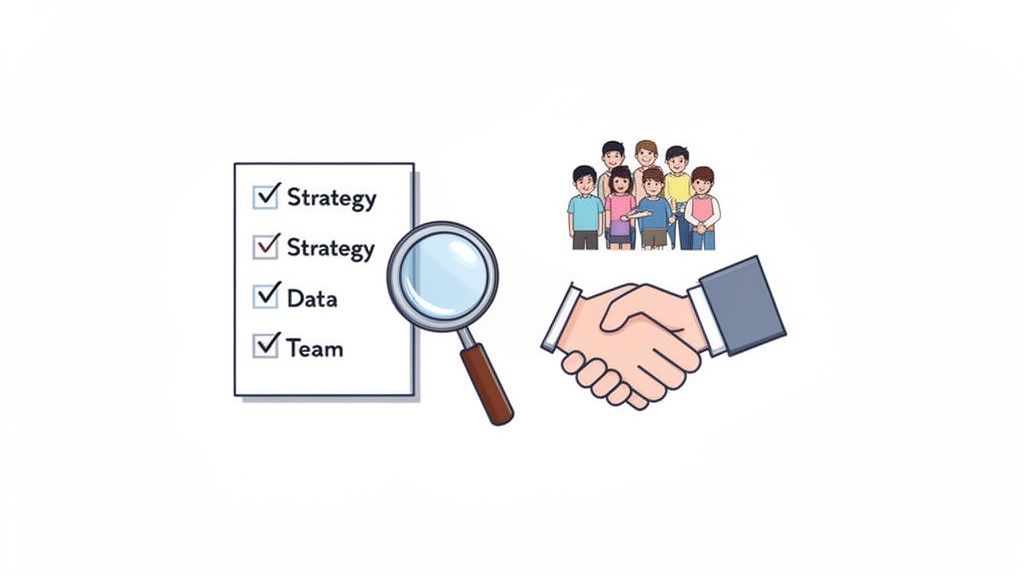
The market is crowded, making it vital to look past slick presentations. The UK’s digital agency sector—the engine for demand generation—is expected to reach revenues of £20.4 billion by 2025. With more than 8,500 agencies operating in 2024, you need a robust evaluation process to find a genuine partner.
Assess Their Strategic Depth
A real partner thinks commercially, not just tactically. The first few conversations should feel less like a sales pitch and more like a senior strategy session. They should ask probing questions about your business long before mentioning their own solutions.
Listen carefully to see if they dig into your:
- Unit Economics: Are they asking about your Customer Acquisition Cost (CAC) and Lifetime Value (LTV)? An agency that cares about profitable growth needs these figures.
- Sales Cycle: How long does it take to close a deal? Where do prospects typically drop off? This shows they’re thinking about pipeline velocity, not just lead volume.
- Ideal Customer Profile (ICP): Do they challenge your assumptions or just accept them? A strong partner will want to validate your ICP with real data.
If an agency launches straight into discussing channels like SEO or paid ads without this commercial context, it is a major red flag. They are a tactical supplier, not a strategic partner.
Scrutinise Their Approach to Data and Reporting
Glossy dashboards packed with vanity metrics like impressions, clicks, and website traffic are designed to look impressive, but they often mask a lack of genuine commercial impact. A high-performance agency focuses on the numbers that connect to revenue.
The single most important question you can ask an agency is: “How will you measure your contribution to our sales pipeline and revenue?” Their answer will tell you everything you need to know about their commercial maturity.
A competent agency will report on:
- Marketing Qualified Leads (MQLs) and Sales Qualified Leads (SQLs): This proves they understand the distinction and can deliver leads your sales team will value.
- Pipeline Value: How much potential revenue have their marketing activities generated?
- Cost Per SQL: This is a much more powerful metric than cost per lead, as it measures the real cost of generating a sales-ready opportunity.
Insist on Meeting the Delivery Team
During the sales process, you will often meet an agency’s senior directors. However, they are rarely the people who will be working on your account day-to-day. It is crucial to meet the actual team members—the strategist, the paid media manager, the content writer—who will be responsible for delivering results.
This is your opportunity to gauge their experience, assess their communication style, and see if they have a genuine grasp of your industry. It also protects you from the classic “bait and switch” where the A-team wins the business, but a junior team delivers it. Understanding the seniority and stability of the team is a core part of your due diligence. For more on this, our article on the benefits of hiring a digital marketing consultant dives deeper into the value of hands-on experience.
Measuring Success with KPIs That Actually Matter
When you partner with a demand generation agency, it is easy to get distracted by vanity metrics. Impressions, clicks, and follower counts look good in a report, but they do not pay the bills. The real measure of success comes from commercial outcomes that directly grow your pipeline and increase profitability.
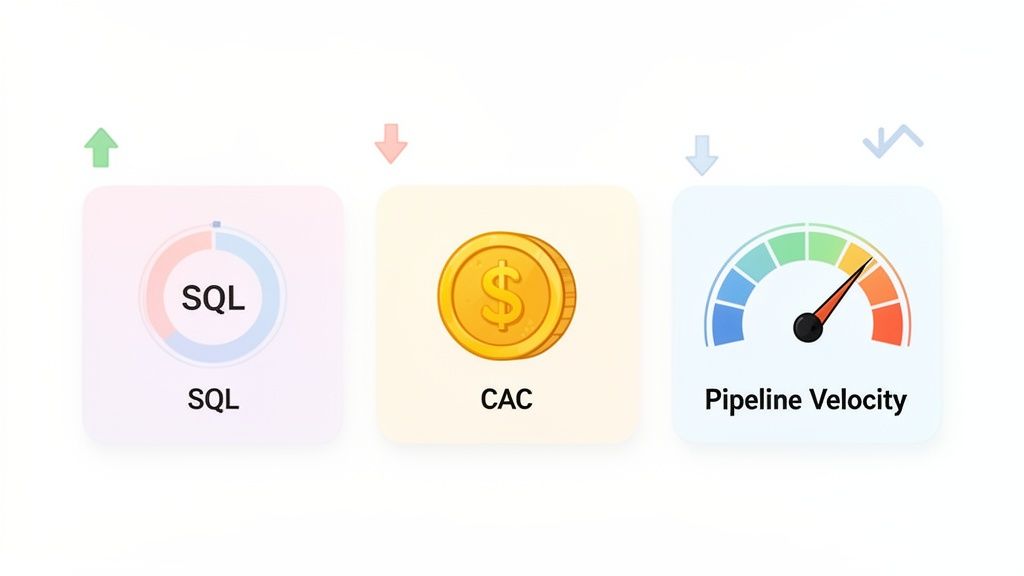
A proper growth partner will focus your attention on Key Performance Indicators (KPIs) that connect marketing activity to revenue. This isn’t just a marketing task; it’s a joint effort where marketing and sales teams operate from the same playbook, tracking progress together to prove the return on investment.
From Top-Funnel Noise to Commercial Clarity
The best demand generation agencies insist on tracking metrics that show genuine business momentum. It is about moving past the noise at the top of the funnel and zeroing in on the critical moments where interest turns into a real sales opportunity. For instance, when it comes to social media, it is vital to measure social media ROI to connect activity to actual business results.
Here are the core KPIs that truly matter:
- Sales Qualified Leads (SQLs): This is the gold standard. An SQL is not just any lead; it’s a prospect your sales team has personally vetted and confirmed is a high-quality, genuine opportunity. Tracking this ensures marketing is delivering leads that sales are confident to pursue.
- Customer Acquisition Cost (CAC): This metric answers a simple question: how much does it cost, across both sales and marketing, to acquire one new customer? A successful agency will focus on reducing this number over time, making your entire growth engine more profitable.
- Marketing-Sourced Revenue: This is the ultimate proof that your investment is paying off. It measures the total revenue from new deals that can be traced directly back to marketing efforts, giving you a crystal-clear picture of your return.
A focus on commercially relevant KPIs creates a culture of accountability. When an agency’s success is tied directly to your pipeline growth and revenue, their strategic recommendations will always be grounded in what drives the business forward.
Measuring Pipeline Health and Velocity
Beyond lead quality and the revenue they generate, you also need to understand how efficiently your sales pipeline is operating. A pipeline full of stagnant leads is just as problematic as one full of low-quality ones. This is where pipeline velocity comes into play.
Pipeline velocity measures how quickly leads move through your sales process, from the first touchpoint to a closed deal. A skilled agency will build nurturing strategies that educate prospects and address their objections, accelerating their journey and shortening the sales cycle. This not only brings in revenue faster but also makes your sales team more efficient.
Frequently Asked Questions
When business leaders consider engaging a demand generation agency, a few common questions always arise. Here are some direct answers to help you decide if it is the right move for your business.
What is the typical cost of a demand generation retainer in the UK?
There is no single price, as the investment depends on the scope of work, its complexity, and the level of expertise required. That said, most UK agency retainers fall into one of three brackets.
- For smaller businesses or foundational work (£3,000 – £5,000/month): This is a solid starting point. It typically buys a focused strategy on one or two core channels, such as building out content and SEO or running highly targeted paid media campaigns.
- For mid-sized businesses ready to scale (£5,000 – £12,000/month): At this level, you are investing in a proper multi-channel strategy. This allows an agency to integrate services like paid ads, SEO, content creation, and marketing automation to build a more robust growth engine.
- For larger enterprises or those with aggressive growth targets (£12,000+/month): This budget supports a fully integrated, multi-disciplinary team. This means a sophisticated, full-funnel strategy complete with advanced analytics and in-depth reporting to drive serious, predictable growth.
The best way to think about this is not as a cost, but as an investment in building a reliable revenue machine. Any agency worth engaging will be able to connect its fees directly to commercial outcomes, like the value of the pipeline they are building.
How long does it take to see results?
Demand generation is a long-term strategy, not a quick fix. You will likely see encouraging early indicators within the first 90 days, such as increased website engagement or a rise in marketing qualified leads (MQLs).
However, the tangible impact on your bottom line takes longer to build.
You should expect to see consistent, predictable pipeline growth and a measurable effect on revenue within three to six months.
This timeframe gives the agency sufficient time to gather data, test and refine campaigns, and build the audience momentum needed for sustainable results. Rushing this process usually leads to wasted ad spend and a focus on low-quality leads, which defeats the purpose of the strategy.
What is the real difference between demand generation and inbound marketing?
This question comes up frequently. The two are related and share some tactics, but their strategic focus is fundamentally different.
Inbound marketing is about attracting customers. The goal is to create valuable content and experiences (like blogs or SEO) so that when people are actively looking for a solution, they find you. It is excellent for capturing existing demand.
Demand generation, on the other hand, is a broader, more proactive strategy. It does not just wait for people to come looking; it goes out and creates new demand. It includes all those inbound tactics but also layers on paid and outbound strategies to make your ideal customers aware they have a problem in the first place, and positions you as the obvious solution.
In short, inbound is a crucial piece of the puzzle, but it is just one part of a complete demand generation strategy.
Ready to build a predictable revenue engine for your business? The team at Lead Genera acts as your dedicated growth partner, building and executing commercially-focused demand generation strategies that deliver measurable results. Explore our services and get in touch today.
Categories
Do You Need Assistance With
Sign Up To Our Newsletter