



Weekly marketing wisdom you can read in 5 minutes, for free. Add remarkable ideas and insights to your inbox, once a week, by subscribing to our newsletter.
Marketing Consultancy
The Essential Guide to Finding a Digital Marketing Agency for Startups
Think of a specialist digital marketing agency for startups as a growth engine, not just another line item on your balance sheet. Its purpose is to provide the strategy, systems, and commercial accountability required to build a predictable lead generation machine. The goal is turning limited resources into measurable outcomes: higher lead quality, a stronger sales pipeline, and profitable growth.
Table of contents:
Why a Specialist Agency Is a Startup’s Strategic Asset

Startups operate under intense commercial pressure. Every pound spent must deliver a return. While founders and early teams are experts in their product or service, they rarely possess the deep, specialised skills needed to engineer scalable growth in a competitive market. This is where partnering with the right agency becomes a decisive advantage.
The objective is not simply ‘doing marketing’. It is about building a systematic, data-driven engine that consistently acquires high-value customers. A specialist agency brings that system to the table from day one, allowing you to bypass the costly and time-consuming process of trial and error.
The Strategic Advantage Beyond Task Execution
Hiring a single in-house marketer is rarely the solution. It is unrealistic to expect one person to be a genuine expert in SEO, paid advertising, conversion rate optimisation (CRO), and web development. An agency provides immediate access to a full team of senior specialists for a fraction of the cost of hiring them individually.
This strategic partnership delivers several key advantages:
- Speed to Impact: Agencies arrive with proven frameworks and processes, enabling them to launch campaigns and generate actionable data quickly. In the startup environment, this speed is critical.
- Commercial Accountability: The right partner disregards vanity metrics like ‘likes’ or ‘impressions’. Their focus is on business outcomes. All reporting and strategy are tied directly to commercially relevant KPIs, such as Cost Per Lead (CPL) and sales pipeline value.
- Unbiased Strategic Oversight: An external partner offers an objective perspective on what is working and what is not. This is crucial for avoiding emotional decision-making and ensures your strategy remains ruthlessly focused on commercial goals.
A common startup error is treating marketing as a disconnected list of tactics. A genuine growth partner connects every action, from the copy on a Google Ad to the user journey on a website, back to a single objective: generating a predictable pipeline of qualified leads.
Bridging the Knowledge and Resource Gap
As a founder, your focus should be on product development and running the business. A dedicated digital marketing agency for startups bridges the gap between having a great product and getting it in front of the right customers, profitably. They bring the tools, data, and hard-won experience needed to make intelligent decisions that fuel sustainable growth.
This is why exploring the benefits of hiring a digital marketing consultant is a sound decision for any ambitious startup. The right agency becomes an extension of your team, providing the strategic horsepower required to master customer acquisition and turn marketing spend into a reliable source of revenue.
Core Services Your Startup Needs to Drive Growth
When assessing a digital marketing agency, do not be swayed by a long list of services. You need a partner who understands that for a startup, every action must lead directly to revenue. Marketing for its own sake is a luxury you cannot afford. Each service must be a precision tool designed for commercial impact.
The entire focus should be on building a system for predictable growth, not just executing a series of disconnected tasks. Let’s break down the core services that actually move the needle and show how they contribute to your bottom line.
A good agency does not just do things; it generates specific, valuable outcomes for your startup.
Essential Agency Services and Their Commercial Impact
| Service | Primary Function | Direct Commercial Impact |
|---|---|---|
| Paid Advertising | Drives immediate, targeted traffic using channels like Google and Meta Ads. | Quickly validates market assumptions and generates a predictable flow of sales-ready leads at a controlled cost. |
| SEO | Builds long-term organic visibility and authority in search engines. | Lowers customer acquisition costs over time by creating a sustainable source of high-intent, inbound leads. |
| Web Design & Dev | Creates the central conversion asset for all marketing and sales activities. | Maximises lead capture and conversion rates, turning website visitors into tangible business opportunities. |
| Content Marketing | Establishes expertise and builds trust by providing valuable information. | Nurtures prospects through the buying journey, building a loyal audience that is easier and cheaper to convert. |
This table frames how you should think about an agency’s offering. It is not about the activity itself but the result it is engineered to produce. Now, let’s explore the three most critical services in more detail.
Paid Advertising: Scalable Lead Acquisition
Paid advertising on channels like Google Ads and Meta Ads is your growth accelerator. For a startup, it is the fastest way to test assumptions, reach specific customer segments, and start generating qualified leads almost immediately. This is not about vanity metrics; it is about acquiring data and customers at a controllable cost.
A performance-led agency will use paid media to:
- Validate Product-Market Fit: Drive targeted traffic to landing pages, fast. You will see which messages resonate and which fall flat, allowing you to iterate quickly.
- Generate High-Quality Leads: Use sophisticated targeting to reach decision-makers who are actively looking for a solution like yours.
- Optimise for Profitability: Obsessively track metrics like Cost Per Lead (CPL) and Return On Ad Spend (ROAS) to ensure every pound invested generates a positive return.
This rapid feedback loop is invaluable for a startup. You need to move fast and find a scalable acquisition channel; this is how you do it.
Search Engine Optimisation: Building a Long-Term Asset
Search Engine Optimisation (SEO) is about building a sustainable, long-term asset for your business. It is the strategic counterpart to paid ads. When you stop paying for ads, the leads stop. A strong SEO presence, however, can generate a steady stream of high-quality inbound leads for years. It is how you become an authority in your space, building trust with potential customers before they even contact you.
For a startup, a commercially-focused SEO strategy is not about ranking for everything. It is about:
- Attracting High-Intent Traffic: Reaching people searching for keywords that demonstrate purchase intent, not just informational queries. Clicks are irrelevant; conversions are what matter.
- Reducing Customer Acquisition Costs: Over time, leads from organic search are significantly cheaper than paid ones. This directly improves profitability and operational efficiency.
- Building a Defensible Advantage: A top position in search results is difficult for competitors to displace. It provides a genuine, lasting market advantage.
Executed correctly, SEO transforms your website into a powerful lead generation asset that works for your business 24/7.
Conversion-Focused Web Design and Development
Your website is the heart of your digital marketing operation. It is not an online brochure; it is your primary sales tool and the central hub where all traffic is converted into business. A digital marketing agency specialising in startups understands that web design must be driven by data and commercial goals, not just aesthetics.
This is critical in the UK’s competitive digital advertising market. A website that does not convert is a liability.
A conversion-focused website is engineered to:
- Maximise Lead Capture: Every element, from the headline to the contact form button, is optimised to guide visitors towards taking a valuable action.
- Enable Sales and Marketing: It must integrate seamlessly with your CRM and other tools, creating a smooth system for nurturing leads from first click to sale.
- Scale with Your Business: It needs a solid technical foundation that can handle increased traffic and new features as you grow, avoiding costly rebuilds.
Ultimately, a good agency delivers a website that acts as a high-performance growth engine, ensuring the valuable traffic you generate from ads and SEO does not go to waste. This holistic approach also means leveraging social media, where an agency must be proficient with tools digital marketing agencies use for Instagram Reels analysis to maximise performance. To learn more about building the strategic foundation, read our guide to content marketing services.
How to Identify the Right Agency Model for Your Startup
Selecting a digital marketing agency is a critical commercial decision. Not all agencies are created equal, and choosing a model that misaligns with your goals is a fast way to drain your budget with no results. To make an informed choice, you must understand the different ways agencies operate.
Founders face a spectrum of options, each with trade-offs in cost, strategic input, and accountability. You need clarity on what you are buying. Are you paying for deliverables, a niche skill, or a strategic partner who shares ownership of your outcomes? The answer determines who you should hire.
For any founder weighing their options, this is essential reading: a founder’s guide to outsourcing digital marketing. It provides a clear framework for choosing the right partner model.
The High-Volume Production Line
First is the ‘High-Volume/Low-Touch’ model. These are the factories of the agency world, built for efficiency and offering standardised packages at an attractive price. They excel at executing specific, repeatable tasks like writing a set number of blog posts or managing a simple ad campaign.
The advantage is low cost. The trade-off is a lack of deep strategic thinking. Your business is one of many on a conveyor belt, and the focus is on output, not on interrogating your unit economics or challenging your customer acquisition strategy. This can work for simple, commoditised tasks but rarely provides the strategic ownership a startup needs to scale effectively.
The Deep-Dive Specialist
Next is the ‘Specialist’ or ‘Boutique’ agency. These firms are masters of a single discipline, possessing market-leading expertise in one area, such as technical SEO for SaaS or Meta Ads for e-commerce. They bring a level of skill that is almost impossible to find and afford in-house.
The upside is unparalleled expertise. If you have a well-defined problem and the internal strategic direction to manage them, a specialist can be transformative. The drawback is their narrow focus. They will solve their piece of the puzzle brilliantly but will not necessarily connect it to the wider commercial picture. For a startup still defining its growth engine, this siloed approach can lead to disjointed efforts that fail to produce a meaningful result.
This decision tree helps visualise how to match your primary objective, whether building a long-term asset, generating immediate leads, or converting existing traffic, with the right core service.
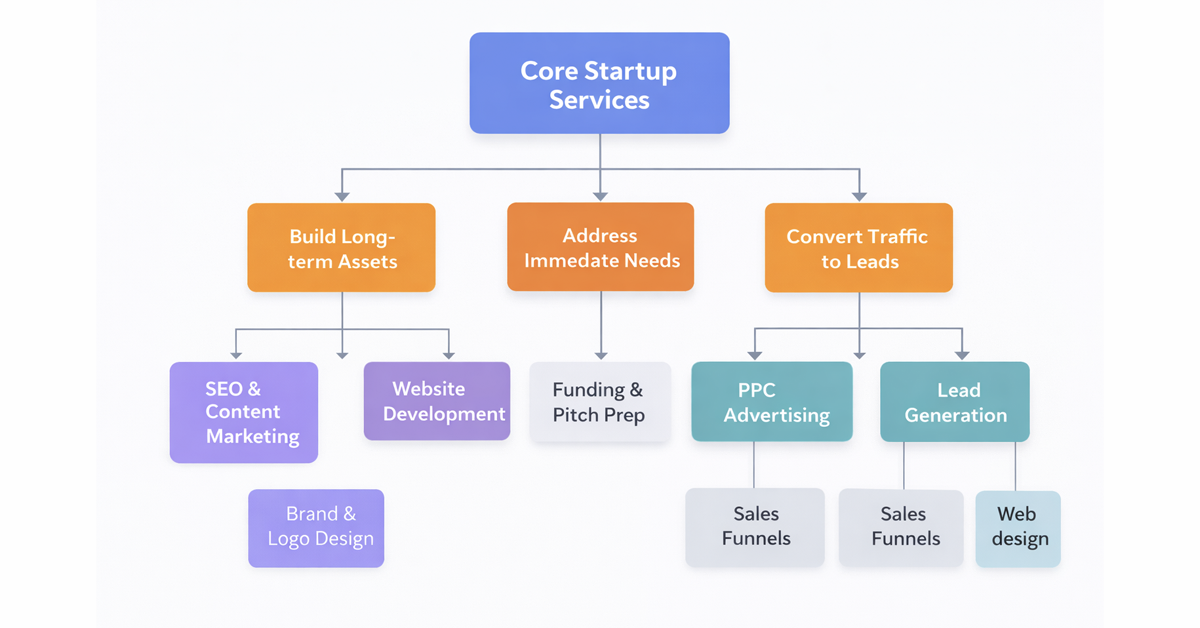
As shown, your immediate business goal dictates which marketing lever to pull first. This ensures your investment is directly tied to a specific, tangible outcome.
The Performance-Led Growth Partner
Finally, there is the ‘Performance-Led Growth Partner’. This model is the rarest and, for most ambitious startups, the most valuable. A true growth partner operates as an extension of your leadership team, taking shared ownership of your commercial outcomes. Their focus is not on delivering a list of services but on engineering a predictable system for growing your revenue.
A true growth partner is defined by the questions they ask. They will not just ask about your ad budget; they will ask about your customer lifetime value, your sales cycle, and your profit margins. Their success is intrinsically linked to yours.
This model is built on two pillars: strategic ownership and accountability.
- Integrated Strategy: They connect the dots between SEO, paid ads, and your website, ensuring every activity serves a unified commercial goal.
- Outcome-Focused Reporting: Vanity metrics are ignored. All reports and discussions are framed around business KPIs that matter, like lead volume, cost per acquisition, and pipeline value.
- Proactive Leadership: They do not wait for instructions. They bring ideas, challenge your thinking, and guide your strategy based on hard data and real-world experience.
While this model requires a greater investment, the return is strategic clarity and a direct, measurable impact on revenue. For startups serious about building a scalable business, finding a genuine growth partner is non-negotiable. Making the right choice is fundamental, and understanding the nuances of working with a B2B digital marketing agency is key to starting the relationship correctly.
Your Vetting Checklist for Choosing an Agency Partner

Choosing a digital marketing agency is a critical commercial decision. A successful partnership will accelerate your growth. A poor one will burn through precious cash and time. To make the right choice, you must look past polished sales presentations and scrutinise a potential partner’s strategic thinking, reporting integrity, and operational processes.
This is not about finding the cheapest agency or the one with the most impressive client list. It is about finding a team that understands your commercial reality and has a proven ability to build a scalable lead generation machine. A real growth partner is obsessed with your success; this checklist is designed to help you identify them.
Assessing Strategic Depth
Any agency can list tactics like SEO or paid ads. A true strategic partner will want to understand the mechanics of your business before proposing a solution. Their initial questions are a significant indicator of their approach.
Are they asking about your business model, customer lifetime value (LTV), and target cost per acquisition (CPA)? If not, you are likely speaking with a ‘delivery’ agency, not a strategic one.
Look for these signs of genuine strategic capability:
- They ask about your unit economics: A performance-focused agency must know your profit margins to build campaigns that are profitable, not just active.
- They challenge your assumptions: A good partner will not simply agree with you. They will question your ideas and offer an objective, data-informed perspective.
- They talk about the entire funnel: Their strategy should draw a clear line from top-of-funnel awareness to bottom-of-funnel sales, demonstrating a credible path to revenue.
If an agency’s proposal is a list of deliverables (e.g., ‘four blog posts per month’) without tying them to commercial outcomes (e.g., ‘to drive qualified leads at a target CPL of £50’), it is a major red flag. You are hiring for results, not just activity.
Understanding Their Reporting and KPIs
Reporting reveals an agency’s true priorities. Vanity metrics like impressions, clicks, or follower counts are easy to inflate but have no bearing on a startup’s financial health. You must confirm their focus is on key performance indicators (KPIs) that directly map to business growth.
Take SEO, for example. It is a critical channel for UK startups, yet research shows only 41% of businesses have a formal SEO strategy. A good agency must articulate exactly how they will turn an SEO investment into a profitable stream of inbound leads, going far beyond simple traffic numbers. You can explore UK digital marketing statistics on localiq.co.uk to see the scale of the opportunity.
Your potential partner’s reporting should be built around metrics that matter:
- Lead Quality and Volume: How many marketing-qualified leads (MQLs) and sales-qualified leads (SQLs) were generated?
- Cost Per Lead (CPL): What was the average cost to acquire a qualified lead from each channel?
- Return on Ad Spend (ROAS): For every pound invested in paid ads, how much revenue was generated?
- Pipeline Value: What is the total potential value of the sales opportunities created by their marketing?
When reviewing sample reports or discussing their approach, demand specifics. Ask how they measure success and how their reports will inform your business decisions. If the answers are vague, move on.
Evaluating Their Process and Communication
A brilliant strategy is useless without a robust process for execution. How an agency onboards clients, manages projects, and communicates progress is as important as the marketing itself. A chaotic process leads to missed deadlines, misaligned expectations, and wasted capital.
As you speak with them, get a clear sense of their operational rhythm:
- Onboarding: Do they have a structured plan to get up to speed on your business, market, and customers?
- Communication: How often will you meet? Who is your primary point of contact? What tools do they use to manage projects?
- Accountability: How do they respond when a campaign underperforms? Do they take ownership and present a data-backed plan for correction?
An experienced digital marketing agency for startups will have transparent, efficient processes that build confidence and ensure alignment from day one. This operational backbone is the engine that drives consistent, predictable results.
Understanding Agency Pricing Models and What to Expect
Deciphering agency pricing can be confusing, but for a startup where every pound counts, understanding the main models is essential.
The objective is not to find the cheapest option. The goal is to find a pricing structure that aligns with your growth stage and commercial objectives. A transparent agency will explain why they use a particular model and how it supports the delivery of your required outcomes.
A clear structure eliminates unexpected costs, creates accountability, and allows for predictable budgeting, transforming the relationship from a simple client-supplier transaction into a genuine partnership geared for mutual success.
A Startup’s Guide to Agency Pricing Models
Each pricing model has its place, depending on your goals, timeline, and cash flow management. This table outlines the common models to help you determine the best fit for your startup.
| Pricing Model | How It Works | Best For | Key Consideration |
|---|---|---|---|
| Monthly Retainer | A fixed monthly fee for an agreed scope of work, access to the team, and ongoing activities. | Long-term, compounding activities like SEO, content marketing, and ongoing lead generation programmes. | Provides budget predictability and allows the agency to plan strategically for sustained growth. |
| Project-Based | A one-off, fixed price for a specific deliverable with a clear start and finish, like a website build. | Well-defined projects with a finite scope. Ideal for acquiring a tangible asset without a long-term commitment. | The scope must be meticulously detailed upfront to prevent “scope creep” and additional costs. |
| Performance-Based | The agency’s fee is tied directly to hitting specific metrics, such as cost-per-lead or a percentage of revenue. | Activities with short sales cycles and easily trackable conversions, such as some PPC campaigns. | Can incentivise a focus on lead quantity over quality. This is a significant risk and rare for comprehensive marketing. |
| Hybrid Model | A combination of a modest monthly retainer plus a performance-related bonus or commission. | Aligning long-term strategy with short-term results. The retainer covers foundational work; the bonus incentivises key wins. | Strikes an effective balance, ensuring the agency is focused on both building assets and hitting commercial targets. |
The right choice depends entirely on matching the payment structure to the specific marketing function you need to fulfil.
Monthly Retainer
This is the standard model for most ongoing, strategic marketing work like SEO, content marketing, or full-funnel lead generation. You pay a fixed fee each month for an agreed scope of work and dedicated expertise.
This model is effective because it provides the stability for an agency to plan long-term. They can dedicate consistent time to building marketing assets, such as organic search rankings or a content library, that appreciate in value over time. For the startup, it means predictable costs and continuous progress.
- Best for: Long-term strategic initiatives like SEO, comprehensive demand generation, and ongoing campaign management where consistent effort drives cumulative results.
- Typical UK Cost: Retainers for a specialist digital marketing agency for startups typically range from £2,000 to £7,000+ per month, depending on the scope and complexity of the work.
Project-Based Pricing
For a specific, one-off task with a clear start and end date, project-based pricing is the correct model. It is standard for deliverables like a new website build, a branding package, or a deep-dive market research project. A fixed price is agreed for the entire project before work commences.
The primary advantage is cost certainty, which is crucial for a startup managing its cash flow. The main risk is scope creep. Ensure the project brief is exceptionally detailed to avoid disputes or unexpected invoices.
- Best for: One-time projects with a finite scope, such as website design and development, branding, or complex tracking system setups.
- Typical UK Cost: A conversion-focused startup website build generally starts around £5,000 and can increase to £25,000+ for more complex platforms.
Performance-Based Models
This model directly links agency payment to results, such as a fee per qualified lead or a percentage of revenue from their campaigns. On the surface, it appears to be a low-risk option for a startup.
In practice, a purely performance-based model is rare for comprehensive marketing. It is only viable for activities with short sales cycles and simple tracking, like certain types of paid advertising. Be wary of any agency promising to work entirely on a “pay for results” basis. It can create an incentive to chase a high volume of low-quality leads, which wastes your sales team’s time.
The most effective partnerships often use a hybrid model: a modest retainer to cover strategic oversight and a performance component to align incentives. This ensures the agency is focused on both long-term asset building and short-term commercial wins.
How to Build a Successful Agency Partnership

Hiring a top-tier digital marketing agency for startups is a critical first step, but it is only half the battle. The most successful partnerships are collaborative, requiring commitment from both sides. To maximise the return on your investment, you must become an excellent client.
This requires a change in mindset. Do not view the agency as a supplier; see them as an extension of your growth team. True performance is achieved through shared ownership, transparent communication, and a mutual focus on commercial objectives.
Define Your Commercial Goals First
Before signing a contract, you must be explicit about what you need to achieve in commercial terms. An agency can build a powerful engine, but you must provide the destination. Vague goals like “more traffic” or “better brand awareness” are insufficient.
Your objectives must be specific, measurable, and tied directly to your bottom line.
- Specify Lead Volume: “We need to generate 40 sales-qualified leads per month within six months.”
- Set Cost Parameters: “Our target cost per qualified lead must be under £75 to maintain profitability.”
- Define Success Metrics: “Success is achieving a 4:1 return on ad spend by the end of Q3.”
When you provide these concrete targets, your agency can engineer a strategy designed from day one to achieve them.
Create a Single Point of Contact
For a partnership to operate efficiently, communication must be streamlined. Appointing a single, dedicated point of contact within your startup is non-negotiable. This person becomes the central hub for all communication, feedback, questions, and approvals.
This structure prevents mixed messages and ensures the agency receives clear, decisive direction. It allows your agency team to move faster, test ideas with less friction, and maintain momentum without being delayed by internal debates or slow sign-offs.
The success of an agency partnership is directly proportional to the quality and timeliness of client feedback. An agency works with the information it has; providing swift, honest, and detailed feedback on lead quality is the fuel for optimisation.
Integrate Your Agency into the Business
The most valuable insights, the ones that unlock significant growth, often come from treating your agency as part of your internal team. Do not keep them at arm’s length.
Invite them to key internal meetings. Allow them to hear discussions about business strategy, sales performance, and product development. When an agency understands the wider commercial context, such as the challenges your sales team faces or feedback from new customers, they can fine-tune their marketing strategy with greater precision.
This deep integration enables them to be proactive, not just reactive. They can anticipate market shifts, identify new opportunities, and ensure every marketing pound is aligned with your business’s real-world goals. This is what transforms a good partnership into a formidable growth engine.
Frequently Asked Questions
Partnering with a digital marketing agency is a significant step for any startup. It is natural to have questions. Here are some of the most common commercial queries we receive, with direct, practical answers to guide your decision-making.
How soon can we expect to see results?
This depends on the strategy. For immediate impact, a focused paid advertising campaign can begin generating qualified leads within days. It is an excellent way to get rapid market feedback and start filling your sales pipeline.
Conversely, organic strategies like SEO are a long-term investment. You should expect to see initial positive signals within 3-4 months, but significant, commercially meaningful growth in traffic and leads typically builds from the 6-12 month mark. A good agency will be transparent about this, setting clear expectations for both short-term wins and the long-term assets you are building.
What is a realistic marketing budget for a startup?
There is no single answer, but a sensible approach is to separate the agency management fee from your ad spend. For a comprehensive strategy, a UK startup should budget a minimum of £2,000 – £5,000 per month for agency expertise. Your paid media budget is a separate cost and can be scaled based on performance.
It is critical to remember this is an investment, not a cost. The purpose of the budget is to generate a return that is a multiple of the initial spend, whether measured in pipeline value or direct revenue.
Should we hire in-house or use an agency?
For most early-stage startups, engaging an agency is almost always the more capital-efficient choice. It is extremely rare for a single in-house marketer to possess the deep, specialist skills required across SEO, paid ads, conversion rate optimisation, and other critical disciplines.
Working with an agency provides immediate access to an entire team of senior experts for a fraction of the cost of hiring them individually. This allows you to leverage top-tier expertise when you need it most, without the long-term commitment and overheads of full-time employees.
Ready to build a predictable growth engine for your startup? The team at Lead Genera acts as an extension of your business, delivering strategic ownership and measurable results. Schedule your free growth consultation today.
Categories
Do You Need Assistance With
Sign Up To Our Newsletter