


Weekly marketing wisdom you can read in 5 minutes, for free. Add remarkable ideas and insights to your inbox, once a week, by subscribing to our newsletter.
PPC
PPC Lead Generation: A Strategic Guide to Driving Growth
PPC lead generation is the practice of using paid advertising channels, like Google or Meta Ads, to capture the contact details of potential customers. It is a direct, measurable method for filling your sales pipeline with prospects who have actively shown interest in your services.
Table of contents:
Building a Strategic Foundation for PPC Success
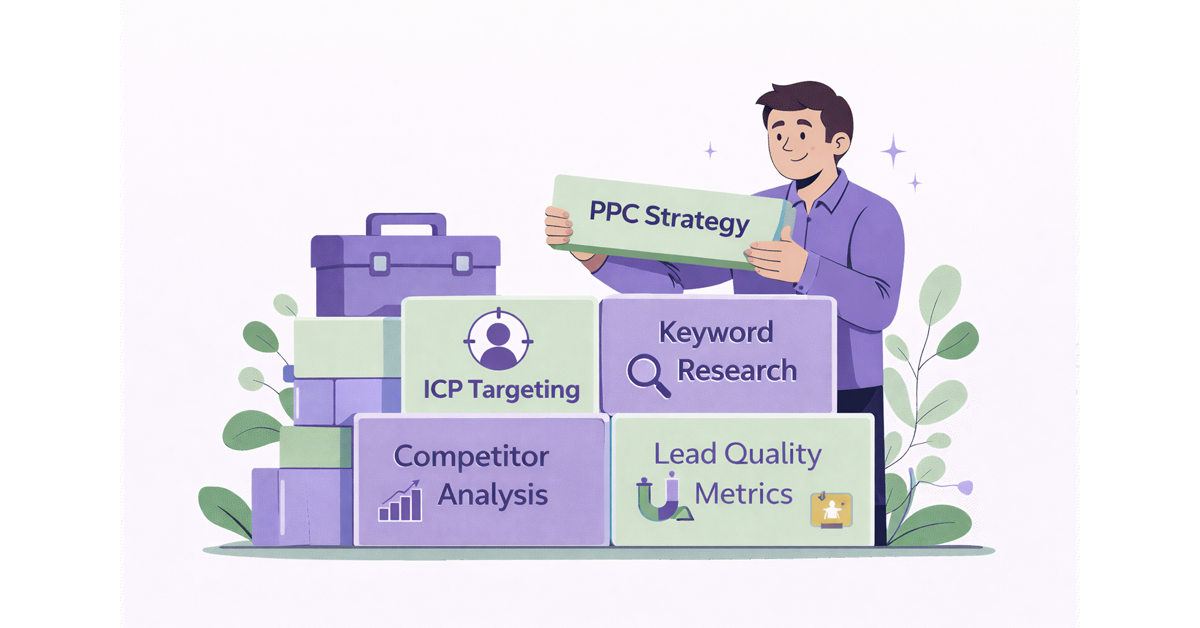
Before you spend a single pound on ads, it is critical to understand that successful PPC is built on a solid strategic foundation, not just clever tactics. The most common reason businesses achieve poor returns is that they jump straight into launching campaigns without this essential groundwork. This approach is a fast track to wasted ad spend, low-quality leads, and significant frustration.
This foundational stage is about replacing guesswork with data-driven clarity. It ensures every decision, from writing ad copy to setting budgets, is deliberate, measurable, and directly tied to your business goals. The aim here is to attract the right prospects, not just any website traffic.
Define Your Ideal Customer Profile
In today’s market, generic demographic targeting is insufficient. You need to develop a detailed Ideal Customer Profile (ICP) that reflects the commercial reality of your best customers. This means digging deeper than age and location to truly understand their business challenges and motivations.
A strong ICP should answer critical questions:
- What specific operational or financial pain points drive them to look for a solution like yours?
- What are their buying triggers? What event typically precedes their search?
- Who is involved in making the final decision, and what does each stakeholder care about?
- What outcomes are they trying to achieve? Is it increased revenue, cost savings, or better efficiency?
Building this profile forces you to adopt your customer’s perspective, which is the secret to crafting messaging that resonates and solves a real problem. For a deeper dive, review our complete guide on creating a strategy for lead generation.
Conduct Commercially Focused Keyword Research
Effective keyword research for lead generation is about uncovering commercial intent, not just chasing high traffic volumes. You must pinpoint the exact search terms your ideal customer uses when they are ready to buy, not just when they are browsing for information.
Think in terms of problems and solutions. A prospect might search for “how to reduce manufacturing downtime” long before they search for “industrial automation consultants.” Targeting both is valid, but you must understand the journey from being problem-aware to solution-aware. Use your tools to analyse keywords for their likely position in the buying cycle, not just their search volume.
To execute this correctly, it is helpful to understand the role of artificial intelligence in marketing, as many modern tools use it to uncover these intent signals.
Set Commercially Grounded Objectives
Your campaign goals must be tied directly to tangible business outcomes. Vague objectives like “get more leads” are useless for measuring success. Instead, you need to define what success looks like with precise, measurable targets.
A strong objective connects your marketing activity to genuine pipeline value. For example: “Generate 50 qualified sales appointments per month at a cost per appointment under £250, resulting in a 3x return on ad spend within six months.”
This level of clarity provides a firm benchmark against which to judge all campaign performance. It aligns marketing efforts with sales needs and ensures every pound spent is accountable for driving revenue.
The table below summarises the core strategic components you need to establish before launching any PPC lead generation campaign.
Key Pre-Campaign Strategic Pillars
| Strategic Pillar | Objective | Key Output |
|---|---|---|
| Ideal Customer Profile | To gain a deep understanding of your most valuable customers. | A detailed document outlining pain points, buying triggers, and decision-maker roles. |
| Keyword Research | To identify search terms with high commercial intent. | A tiered list of keywords mapped to different stages of the buying journey. |
| Competitor Analysis | To understand what rivals are doing and find gaps in the market. | A report on competitor messaging, ad spend, and landing page strategies. |
| Commercial Objectives | To set clear, revenue-focused goals for the campaign. | Specific KPIs like Cost Per Lead (CPL), Cost Per Acquisition (CPA), and target ROI. |
Getting these pillars right from the start is non-negotiable. This structured approach is why PPC has become a top-five tactic in the UK B2B landscape, with over 30% of SMEs now ranking it highly for delivering measurable results. When executed correctly, top performers in professional services can see conversion rates as high as 4.60%.
Choosing the Right Channels and Setting Budgets
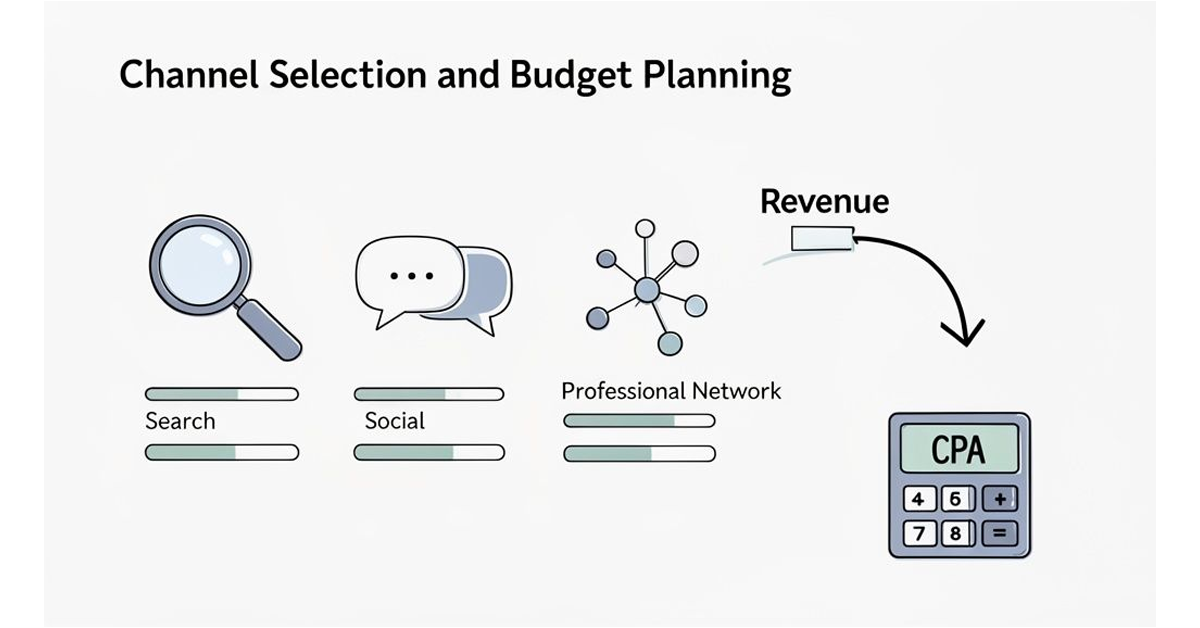
This is where strategy meets execution. Picking the right PPC channels is a strategic move that dictates who you reach, how much you pay, and the quality of leads you generate. Not all platforms are created equal, especially for lead generation. The goal is to invest where buying intent is at its peak, making every pound work as hard as possible.
A common mistake is spreading a budget too thinly across every available channel. This is a certain way to achieve mediocre results everywhere. You are far better off starting with one or two core platforms, giving them enough budget to gather meaningful data, and mastering them before considering expansion.
Aligning Platform with Commercial Intent
You must understand the mindset of the user on each platform. Are they actively looking for a solution, or are they scrolling through a social feed? This distinction is the key to effective PPC lead generation.
-
Google Search Ads: This is your frontline for capturing high-intent demand. When someone types “commercial accountants in Manchester” into Google, they have a problem and need it solved now. Google Ads places you right there at that exact moment of need.
-
Meta Ads (Facebook & Instagram): Think of Meta Ads as a tool for creating demand, not just capturing it. You cannot target by keyword, but you can target by sophisticated demographic, interest, and behavioural data. It is ideal for services with a strong visual element or when you need to reach niche professional audiences who may not be actively searching yet.
-
LinkedIn Ads: For B2B, LinkedIn Ads is often in a league of its own. The ability to target people by their exact job title, company size, industry, and seniority is incredibly powerful. The cost per click is usually higher, but the lead quality can be so superior that it becomes the most efficient choice for high-value B2B services.
The most commercially aware UK B2B companies understand this. They often allocate 35-40% of their PPC budget to LinkedIn to tap into its powerful professional targeting. Another 30-35% typically goes to Google Search to capture immediate, problem-solving demand. As some of these PPC marketing benchmarks and insights show, this kind of strategic split makes commercial sense.
Calculating a Realistic Starting Budget
Do not guess your budget. A proper budget is grounded in commercial reality. It works backwards from your revenue goals and what you can afford to pay to acquire a new client, your cost per acquisition (CPA).
First, determine what a new client is worth. If a client has a lifetime value of £5,000 and you are willing to spend 10% of that to acquire them, your target CPA is £500.
Next, what is your lead-to-client conversion rate? If you close one deal for every ten qualified leads, you can afford to pay up to £50 per lead (£500 CPA / 10 leads).
Your budget is simply the number of leads you need multiplied by your maximum allowable cost per lead (CPL). If your goal is 20 new leads per month at a maximum CPL of £50, your starting budget is £1,000 per month.
This simple calculation turns your budget from a blind expense into a strategic investment with a clear, measurable expected return.
Allocating Your Budget for Maximum Impact
Once you have a total monthly figure, you need to decide how to allocate it. When launching a new campaign, the smartest move is to allocate based on intent.
Here is a practical way to start:
- 70% to Google Search: Invest the bulk of your budget in capturing low-hanging fruit: people already looking for your services. It is the quickest way to get leads in the door and prove the campaign works.
- 30% to LinkedIn or Meta: Use the remainder to test a demand-generation platform. This lets you build brand awareness and start conversations with people who fit your ideal customer profile but are not actively searching.
This balanced approach allows you to secure immediate wins while planting seeds for future growth. Once data starts coming in, you can adjust these percentages. If LinkedIn brings in excellent leads at a good price, shift more budget there. This agile approach is what optimisation is all about.
Crafting Compelling Ads and High-Conversion Landing Pages
An effective PPC campaign requires two elements working in perfect harmony: the ad that grabs attention and the landing page that converts that click into a solid lead. Get one right without the other, and you are simply wasting money for a high cost per lead. The entire journey, from seeing your ad to submitting their details, must feel smooth, logical, and persuasive.
Think of your ad copy as the first handshake. It must speak directly to the prospect’s problem, using language they would use themselves. Forget vague, corporate jargon; it gets ignored. The ads that truly work are direct, highlight a clear benefit, and address the core pain point you identified when building your customer profiles.
Writing Ad Copy That Drives Action
The purpose of your ad is not just to get any click; it is to get the right click from the right person. Pre-qualifying your audience with specific, crystal-clear messaging is the secret to improving lead quality. Avoid clickbait at all costs and focus on clarity and value.
Your ad needs to work as one cohesive unit:
- Headline: Your headline must mirror the user’s search query as closely as possible. If they typed “emergency commercial plumber,” your headline should reflect that back at them. It provides instant confirmation they are in the right place.
- Description: This is your chance to differentiate. Why should they choose you? Is it your 24/7 availability? Your fixed-price guarantee? Your specialist expertise? This is where you build your case and stand out from the competition.
- Call to Action (CTA): Be specific. Ditch the generic “Learn More” and use action-oriented language that sets a clear expectation. “Get a Free Quote,” “Book a Consultation,” or “Download Your Guide” tells the user exactly what will happen next.
Your ad is the opening line of a conversation. It must be compelling enough to make someone pause, read, and feel that clicking through is the next logical step to solving their problem.
Designing Landing Pages Built to Convert
Once someone clicks your ad, you are only halfway there. The landing page is where the real conversion happens. Its sole job is to turn that visitor into a lead. Many businesses make the classic mistake of sending expensive PPC traffic to their generic homepage, a significant conversion killer.
A dedicated landing page must be a focused, distraction-free environment. Remove the main navigation menu, social media icons, and any other links that might tempt the visitor to leave before completing your form.
The golden rule of a high-conversion landing page is message match. The headline, copy, and offer on your page must directly reflect the promise made in your ad. Any disconnect creates confusion and doubt, which is the fastest way to make someone click the back button.
Your landing page is not a brochure; it is a specialised sales tool built for a single purpose. To build a page that delivers, you need to understand what drives conversions. For a much deeper dive, you can learn more about how to build a killer lead generation landing page in our dedicated guide.
Key Components of a Winning Landing Page
To get the most from your PPC budget, your landing pages need several key elements working together. Each one plays a part in building trust and gently guiding the user towards the conversion goal.
Here are the absolute must-haves:
- A Compelling Headline: This should be the very first thing a visitor sees, and it must instantly reassure them they have landed in the right spot. It should echo the main benefit promised in your ad.
- Persuasive, Scannable Copy: Nobody reads long blocks of text online. Use short paragraphs, bullet points, and bold text to make your most important information stand out. Always focus on the benefits for the customer, not just your features. Answer their one burning question: “What’s in it for me?”
- Social Proof and Trust Signals: This is vital for building credibility. Include testimonials, client logos, case study results, or industry awards. These signals reduce the perceived risk of providing personal details.
- A Frictionless Lead Capture Form: Keep it simple. Only ask for the information you absolutely need. A long, complicated form is a major roadblock. For an initial enquiry, a name, email, and phone number is usually sufficient.
- A Strong, Clear Call to Action: Your CTA button needs to stand out visually and use commanding, action-oriented language. Reinforce the value they are getting on the button itself, such as “Get My Free Audit Now.”
By weaving these elements together, you create a seamless and persuasive experience that turns expensive clicks into valuable sales opportunities, directly boosting your return on ad spend and driving real business growth.
Implementing Robust Tracking and Attribution
Attempting to optimise a PPC campaign without rock-solid tracking is pure guesswork. You cannot improve what you do not measure. Investing in paid ads without a proper measurement framework is like flying blind. It is a fast track to wasted spend, low-quality leads, and an inability to prove your marketing is making a difference.
The real goal is to build a closed-loop system. This means we need to connect every pound of ad spend directly to the leads it generates, assess the quality of those leads, and ultimately trace it all the way to the revenue it brings into the business. It is the only way to make smart, data-driven decisions that grow the bottom line.
The Technical Essentials of Measurement
Setting up tracking can sound technical, but the core concepts are straightforward. At its heart, it is about placing small pieces of code, often called pixels or tags, on your website. These tags fire whenever a user completes a key action, such as submitting a contact form, and send that information back to the ad platform.
This allows platforms like Google and Meta to understand which ads and keywords are driving conversions. This data is the lifeblood of your campaign, feeding the platform’s algorithms so they can find more people who resemble your best customers. For a detailed walkthrough, our comprehensive guide on how to set up conversion tracking in Google Ads breaks it down.
This simple infographic illustrates the basic PPC conversion flow, from the moment a user sees your ad to when they become a lead.
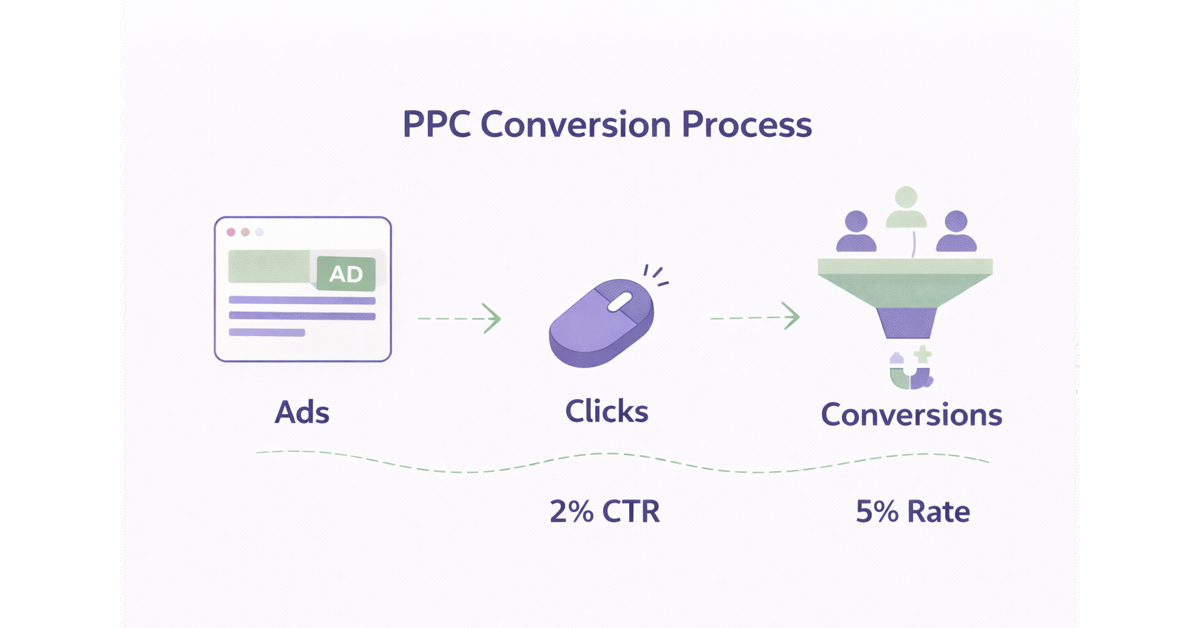
As you can see, every stage is a critical point for measurement, connecting the first ad impression to the final conversion.
Beyond the Basics: UTMs and CRM Integration
While platform conversion tracking is non-negotiable, it only provides part of the picture. For a truly forensic view of performance, you need to dig deeper. This is where Urchin Tracking Module (UTM) parameters come in.
UTMs are simple tags added to the end of your destination URLs. They act like signposts, telling your analytics software (like Google Analytics) exactly where a user came from. This allows you to distinguish traffic from different campaigns, ad groups, or even individual ads, giving you a precise map of what is working and what is not.
The next level is integrating your ad platforms directly with your Customer Relationship Management (CRM) system.
By connecting your CRM, you stop measuring just ‘leads’ and start measuring ‘sales-qualified leads’ and ‘customers’. This crucial link provides the commercial context needed to calculate true Return on Ad Spend (ROAS).
For PPC lead generation, this integration is a game-changer. It means you can finally see which campaigns are not just generating form fills, but are producing leads that your sales team can actually close.
Tracking Offline Conversions
A significant hurdle for many service-based businesses is that the real conversion often happens offline. Someone might fill out a form on your website today but only become a paying client after a phone call and a proposal a week later.
To close this gap, you need to connect your online and offline worlds. Here are two practical ways to do it:
- Call Tracking: Dynamic call tracking software assigns a unique phone number to each user visiting your site from a PPC campaign. When they call, the system attributes that call back to the specific keyword and ad that brought them there.
- Offline Conversion Uploads: Most ad platforms, including Google Ads, let you upload data about offline events. You can take a list of leads from your CRM that turned into customers and upload it, telling the platform which clicks resulted in actual revenue.
Putting these methods in place completes the feedback loop. It ensures every conversion, whether it happens online or off, is correctly attributed, giving you the complete picture of your campaign’s commercial impact.
To make this clearer, here is a breakdown of the core tracking components every lead generation campaign needs.
Essential Tracking Components for PPC
This table outlines the key tracking methods, their purpose, and how they directly contribute to better campaign results.
| Tracking Method | Purpose | Key Metric Improved |
|---|---|---|
| Conversion Pixels/Tags | Measures on-site actions (form fills, downloads) and feeds data back to the ad platform. | Cost Per Acquisition (CPA) |
| UTM Parameters | Identifies the specific source, campaign, and ad that drove website traffic and leads. | Campaign ROI Analysis |
| CRM Integration | Connects online leads to offline sales data to track lead quality and final revenue. | Return on Ad Spend (ROAS) |
| Call Tracking | Attributes phone call leads back to the specific PPC campaigns that generated them. | Lead-to-Sale Conversion Rate |
| Offline Conversion Uploads | Informs ad platforms which clicks led to actual customers, improving algorithmic bidding. | Lead Quality & CPA |
Each of these elements plays a vital role. By combining them, you move from simply counting clicks to understanding the true commercial value of your advertising.
Optimising Campaigns for Performance and Scalability
Launching your campaign is just the starting point, not the finish line. The real work, the part that separates a profitable growth machine from a short-term cash burn, is the ongoing, data-led optimisation. This is where you analyse performance, refine your approach, and turn a promising start into a predictable engine for new business.
Too many businesses fall into the “set and forget” trap. They get their ads live and only check in sporadically. This approach is a guaranteed way to waste money and miss significant opportunities. Real performance comes from treating your campaigns as living assets that need constant attention and intelligent adjustments based on data.
The goal is to create a tight feedback loop: performance data comes in, and that data informs your every move. This lets you double down on what is working, cut what is not, and systematically improve the return on every pound you spend.
Data Analysis That Drives Decisions
Effective optimisation starts with knowing which metrics actually matter. It is easy to get distracted by vanity metrics like clicks and impressions, but they do not pay the bills. For a serious PPC lead generation campaign, you must focus on the metrics directly tied to business outcomes.
These are your true north stars for campaign health:
- Cost Per Lead (CPL): This is your most immediate measure of efficiency. It tells you exactly how much you are paying for each enquiry. The goal is to constantly push this number down without sacrificing lead quality.
- Return On Ad Spend (ROAS): This is the ultimate measure of profitability, calculating how much revenue you generate for every pound spent on ads. A strong ROAS is the clearest signal that your campaign is delivering genuine business value.
- Lead-to-Sale Conversion Rate: This often requires input from your sales team, but it is absolutely critical. It reveals what percentage of PPC leads are turning into paying customers, giving you the real picture of lead quality.
By keeping a close eye on these core KPIs, you can move beyond simple performance reporting and start making strategic decisions that directly impact your bottom line.
The A/B Testing Discipline
You should never assume your first attempt at ad copy or a landing page is the best it can be. A/B testing (or split testing) is the disciplined process of testing one variable at a time to see what truly resonates with your audience. It is about replacing guesswork with hard data.
Start by testing the elements that will have the biggest impact first. You would be surprised how small changes can lead to significant jumps in performance.
Here is a simple framework to get you started:
- Test Ad Headlines: Your headline is the first thing people see. Try testing different angles, perhaps one focused on a key benefit versus one that highlights a pain point. Or a question versus a direct statement.
- Test Ad Descriptions: Experiment with different value propositions or calls to action. Does mentioning a “24-hour response” generate more leads than a “free consultation”? There is only one way to find out.
- Test Landing Page Elements: Once an ad is performing well, turn your attention to the landing page. Test your main headline, the text on your call-to-action button, or even the number of fields in your contact form.
The golden rule of A/B testing is to only change one element at a time. If you change both the headline and the CTA at once, you will never know which change was responsible for the uplift.
This methodical approach lets you make small, incremental gains that compound over time, steadily improving your conversion rates and driving down your CPL.
Scaling Successful Campaigns Intelligently
So, you have a campaign that is consistently delivering high-quality leads at an acceptable cost. The natural next step is to scale it up. But scaling is not as simple as just increasing the budget. If done carelessly, you can quickly damage performance and watch costs spiral.
Intelligent scaling is about expanding your reach without compromising efficiency or lead quality. It requires a careful, measured approach.
Here are a few proven strategies for scaling your PPC efforts without breaking them:
- Gradual Budget Increases: Do not make sudden, drastic changes to your budget. Increase your daily spend in small increments, perhaps 15-20% at a time, and monitor performance closely. This gives the platform’s algorithm time to adjust without destabilising the campaign.
- Expand Keyword Targeting: Look for new opportunities by moving from very specific exact match keywords to broader match types. You can also research new, related search terms that you are not currently targeting.
- Layer on New Audiences: If you are finding success on one platform, think about how you can reach similar people elsewhere. You could create lookalike audiences based on your existing converters or explore new interest and demographic targeting options.
By scaling methodically, you can grow your lead volume and revenue in a controlled, profitable way. This is how you turn your PPC lead generation efforts from a simple marketing tactic into a cornerstone of your business growth strategy.
Your PPC Lead Generation Questions, Answered
Even the best-laid plans raise questions. When it comes to PPC lead generation, we have heard them all. Here are the answers to some of the most common queries, based on our experience running campaigns.
How Long Until I See Results?
This is always the first question, and the only honest answer is: it depends. Clicks and impressions can start appearing within hours of your campaign going live. But real, meaningful results, such as a consistent stream of quality leads, take more time.
You should plan for an initial testing and optimisation phase of at least 30 to 90 days. This is a crucial learning period. It gives the platform’s algorithms enough data to understand who your ideal customers are. It also gives you time to A/B test your ads, tweak landing pages, and adjust bidding based on what the early data is telling you.
While you will likely see some leads come through immediately, the real prize is building a predictable, profitable system. That requires patience.
How Much Should I Spend on PPC?
There is no magic number. Your budget should be rooted in your business goals, not guesswork. The best approach is to work backwards from what you want to achieve.
First, determine your customer lifetime value (LTV) and what you are willing to pay to acquire a new customer (your target Cost Per Acquisition, or CPA). From there, you can work out a maximum you can afford to pay for each lead (your Cost Per Lead, or CPL).
A simple way to frame your starting budget is:
(Target number of monthly leads) x (Maximum acceptable CPL) = Starting monthly budget.
For instance, if you are aiming for 20 leads a month and you know you cannot pay more than £75 per lead to remain profitable, your starting budget is £1,500 per month.
This calculation turns your ad spend from a blind expense into a measured investment with a clear, expected return. As data comes in, you can fine-tune this figure based on actual performance.
What Is a Good Cost Per Lead?
A “good” CPL is entirely specific to your industry, the value of your service, and your sales cycle. A £250 CPL might be a disaster for a local tradesperson, but it could be an absolute bargain for a B2B consultancy where a single client is worth £20,000.
Do not get hung up on chasing generic industry benchmarks. The only numbers that truly matter are your own. A CPL is “good” if it allows you to acquire customers profitably.
For context, some UK data suggests CPLs for professional services hover around £232, while manufacturing can be significantly higher. Your job is to understand your own profit margins and optimise towards a CPL that delivers a healthy Return On Ad Spend (ROAS). Ultimately, your internal profitability is the only benchmark that really counts.
Ready to turn your ad spend into a predictable pipeline of high-quality leads? At Lead Genera, we build and manage performance-focused PPC campaigns that deliver measurable business growth. Learn more about our strategic approach to PPC.
Categories
Do You Need Assistance With
Sign Up To Our Newsletter