


Weekly marketing wisdom you can read in 5 minutes, for free. Add remarkable ideas and insights to your inbox, once a week, by subscribing to our newsletter.

Lead Magnets
What is a Lead Magnet? A Guide to Converting Website Visitors
A lead magnet is a free, valuable resource you offer to potential customers in exchange for their contact details, typically their email address. It is a foundational element of modern lead generation. This simple exchange turns anonymous website visitors into identifiable prospects by offering them a solution to a specific problem they are facing right now.
Table of contents:
What Is a Lead Magnet in Practice?
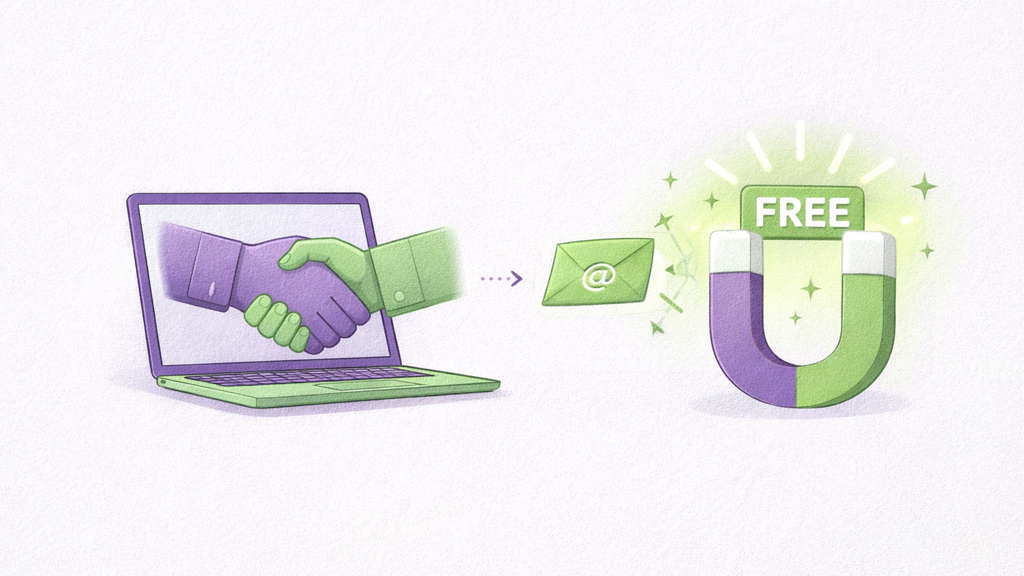
Think of it as a digital handshake. Instead of approaching someone and immediately asking for their details, you are initiating a conversation by providing something genuinely useful. This exchange is powerful; it builds trust and instantly positions your business as a credible expert.
For business owners and marketing leaders, the objective is not just to build an email list. It is about starting a relationship with individuals who have actively demonstrated an interest in your area of expertise. This is the first, crucial step toward building a predictable and scalable sales pipeline.
The Core Value Exchange
A successful lead magnet operates on a straightforward principle: you solve a small, specific problem for free. In doing so, you earn the opportunity to make contact with that person again. This is not just a gesture; it has a direct commercial impact.
- It qualifies interest: Someone downloading a guide on lowering their cost per lead is clearly focused on marketing efficiency.
- It demonstrates expertise: A well-constructed resource shows you possess deep knowledge, which builds confidence in your brand.
- It generates high-intent leads: These are not cold contacts. They are individuals who have actively sought out your knowledge.
Essentially, a lead magnet is any valuable piece of content given away in exchange for contact information. This is often referred to as gated content, as the user must provide their details to unlock access.
To help you understand the concept, we have broken down the key characteristics of a great lead magnet in the table below.
| Component | Description | Why It Matters Commercially |
|---|---|---|
| High Value | The content must offer a genuine, tangible solution or insight that your audience is actively seeking. | It positions your brand as an authority and creates a positive first impression, making future sales conversations more effective. |
| Specificity | It should solve a very specific problem for a specific audience, rather than being broad and generic. | Specificity attracts higher-quality leads who are more likely to be a good fit for your core products or services, improving sales efficiency. |
| Instant Gratification | The resource should be delivered immediately, allowing the user to get the promised value right away. | This builds trust and reinforces that your business delivers on its promises, which is key for long-term customer relationships and lifetime value. |
| Easy Consumption | The format should be easy to digest, such as a checklist, a short guide, or a template. | If the prospect can achieve a quick win from your content, they are more likely to see the value in your paid offerings. |
Understanding these components is the first step to creating a resource that does not just get downloads but actually starts valuable commercial conversations.
By focusing on solving a prospect’s immediate challenge, a lead magnet transforms marketing from an interruption into a welcome solution. This shift is fundamental to improving lead quality and reducing acquisition costs.
Ultimately, this value-first approach is what separates your business from competitors who are simply promoting their products. It lays the groundwork for a smoother sales process, ensuring your team is talking to informed prospects who are already warmed up to your brand.
Why Lead Magnets Are a Strategic Asset for Growth
A lead magnet should be viewed as more than just a free download. It is a cornerstone of an intelligent, commercial marketing system. In a crowded market, you cannot just ask for an email address and expect a response. A well-designed lead magnet changes the dynamic, turning a simple request into a valuable exchange. This shift has a direct, measurable impact on business growth.
By offering a specific solution for a problem your audience has, you achieve several objectives at once. First, you cut through the online noise. Instead of another sales pitch, you are providing a focused resource that speaks directly to a particular audience, capturing their attention immediately.
It also means you begin to pre-qualify your leads. Someone who downloads a guide on improving their return on ad spend is not just a random visitor. They are a potential customer who is actively looking for the solutions your business provides. This helps ensure your sales team spends its time on commercially relevant conversations.
Driving Down Costs and Increasing Lead Quality
Using lead magnets strategically has a significant effect on two key business metrics: the quality of your leads and your cost per lead (CPL). Because the offer is highly specific, it naturally attracts a more relevant audience, filtering out those who are not a good fit for your services. This focus on quality over quantity is what makes your sales pipeline far more efficient.
A lead magnet acts as a sorting mechanism for your audience. It ensures that the leads entering your funnel are not just numerous, but are also commercially relevant and primed for a sales conversation.
This process naturally reduces your CPL. Instead of spreading your marketing budget to attract a wide, unqualified audience, you are focusing your investment on prospects who are far more likely to become customers. For any director focused on ROI, this is a significant advantage. You can explore this concept further in our detailed guide on what customer acquisition cost is and how to calculate it.
The Commercial Impact of Targeted Offers
The numbers from the UK market highlight the power of this approach. For B2B service companies, websites without a lead magnet often struggle with low conversion rates. Recent figures show desktop visitors convert at just 1.84% and mobile visitors at 3.83%.
However, when you introduce a targeted lead magnet such as an industry report or a practical toolkit, those numbers can jump to 4.7% on desktop and 7.73% on mobile. That is a performance increase of 155.43% and 101.82%, respectively.
Ultimately, a lead magnet turns your website from a passive brochure into an active lead generation asset. It builds a predictable system for acquiring new customers, reduces wasted marketing spend, and strengthens your entire sales process.
Choosing a Lead Magnet That Actually Delivers Results
Selecting the right lead magnet is not about choosing the most elaborate format. It is a strategic decision that directly impacts your lead quality and sales efficiency. The key is to align your offer with your audience’s most pressing problems and their stage in the buying journey. A resource that solves a specific, urgent issue will always outperform a generic one.
A good starting point is to review successful gated content examples for inspiration. The real skill is matching the format to what your prospect is trying to achieve. Are they just becoming aware of a problem, or are they already comparing potential solutions? The answer to that question dictates what you should offer.
Matching Format to Funnel Stage
Different types of lead magnets are designed for different purposes. Understanding this allows you to build a system that naturally guides individuals from initial interest through to purchase.
- Top of Funnel (Awareness): Checklists & Templates
These are excellent for prospects who are just starting to research an issue. They deliver a quick, tangible win and are very easy to digest. An example would be a “10-Point Website SEO Health Checklist”; it provides instant value and positions you as a helpful expert without a significant time commitment. - Middle of Funnel (Consideration): Webinars & Ebooks
At this stage, your prospects are actively evaluating their options. A detailed ebook or a well-structured webinar allows you to explore a topic in greater depth, showcasing your expertise and building trust. This type of content does not just provide answers; it educates leads on how to think about their problem, gently guiding them towards your strategic approach. - Bottom of Funnel (Decision): Case Studies & Consultations
When someone is close to making a decision, they need proof and reassurance. A robust case study demonstrating how you achieved results for a similar company can be incredibly persuasive. Offering a free consultation then provides a high-intent lead with a direct and simple way to engage with your sales team.
Lead magnets are a cornerstone of effective B2B lead generation in the UK, especially for companies looking to build a reliable sales pipeline. Research indicates that 23% of B2B marketers now rely on high-value resources like ebooks and webinars to attract the right kind of prospects.
The diagram below breaks down how a carefully chosen lead magnet feeds directly into your primary business objectives.
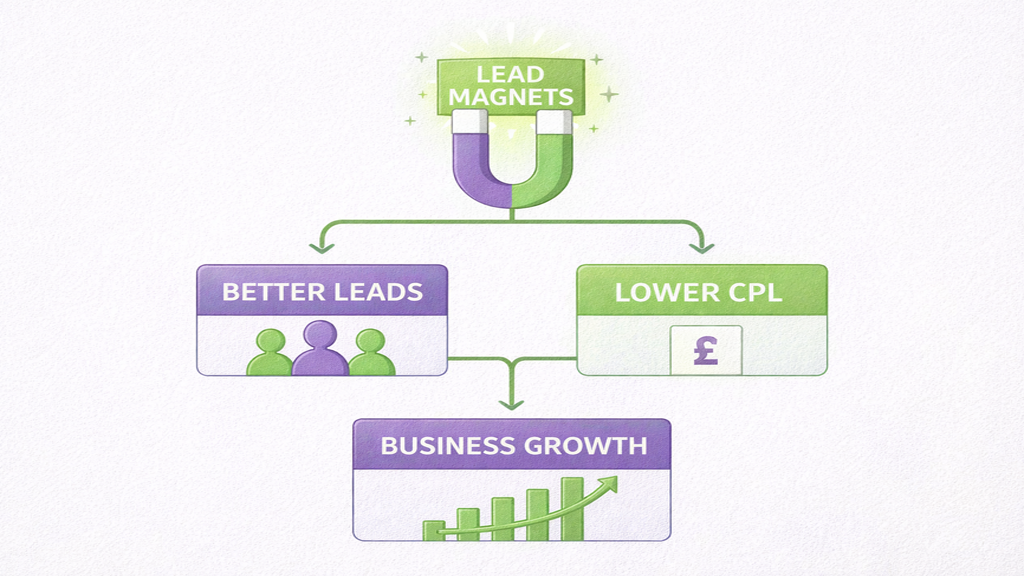
It is clear that the objective is to attract better quality leads and reduce your cost per acquisition. When you achieve both, you are on the path to sustainable business growth.
The real power of a lead magnet comes from its specificity. When you solve a precise problem, you do not just attract a more relevant audience; you also create the perfect opportunity to introduce your core services.
Of course, even the best lead magnet requires an effective landing page. The entire page, from the design and copy to the sign-up form, must be built for one purpose: conversion. It needs to make the value you are offering crystal clear. To explore this further, read our guide on how to build a killer lead generation landing page.
How to Create a High-Converting Lead Magnet
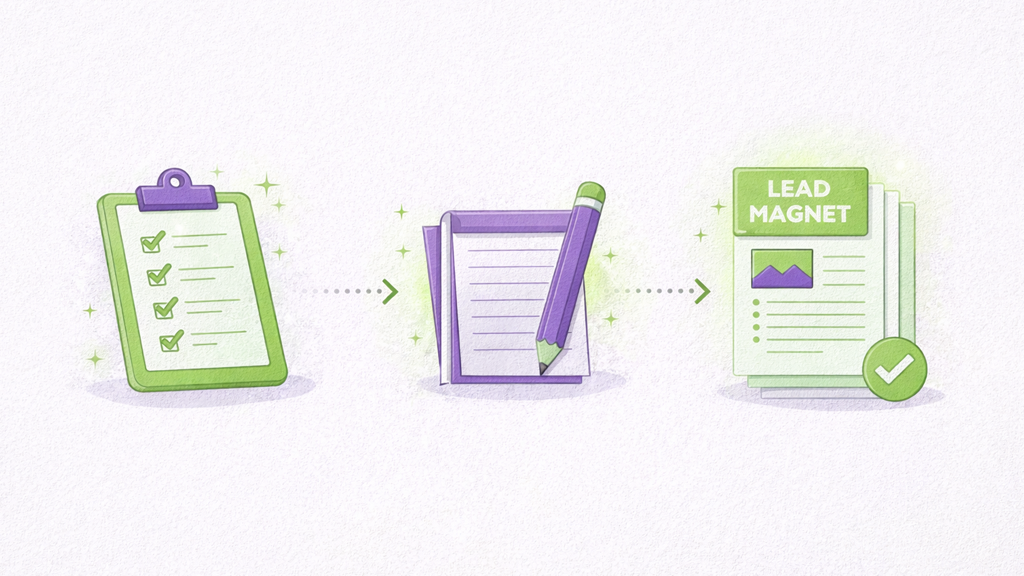
Creating a lead magnet that generates high-quality leads is not a matter of guesswork. It is a deliberate process that starts and ends with solving a real problem for a specific audience. The goal is not just to get another download; it is to attract prospects who are a genuinely strong fit for your business.
A truly effective lead magnet is born from a deep understanding of your ideal customer. What is the one issue that is a constant challenge for them? The single roadblock they cannot seem to overcome? Your job is to focus on one of these urgent pain points and build your resource around it.
When you do this, your marketing shifts from a generic broadcast to a focused solution. You start attracting people who are actively looking for answers, which makes them infinitely more valuable than random website traffic.
The Four-Step Framework for Creation
To create something that delivers real commercial value, follow this straightforward, four-step framework. Each stage is designed to ensure your final resource is not only useful for your audience but also aligns perfectly with your business objectives. Getting this right leads to better quality leads and a shorter sales cycle.
- Pinpoint a Specific, Urgent Problem
First, identify a single, high-value problem that your ideal client is struggling with. You must be specific here. Instead of a vague “Guide to Marketing,” offer a “Checklist for Reducing Your Google Ads CPL in 30 Days.” That kind of specificity is what makes a lead magnet irresistible because it promises a targeted, fast solution. - Create a Clear, Actionable Solution
Your lead magnet must deliver on its promise. Whether it is a template, guide, or checklist, it must give the user a clear path to a quick win. The content needs to be practical and easy to implement, leaving them feeling capable and viewing you as a credible expert. This is your opportunity to demonstrate your expertise without giving away your entire strategic playbook. - Design It Professionally
The presentation of your lead magnet reflects on your brand’s quality. Use your company branding, ensure the layout is clean and easy to follow, and present everything in a professional format. A poorly designed PDF can undermine the value of excellent content and damage your credibility before a conversation has even begun. - Craft a Compelling Landing Page
This is the critical conversion point. Your landing page must have a single objective: to convince the visitor to download your resource. Use a clear, benefit-focused headline, concise copy that explains the value, and a simple form. Every element should guide the user towards that one action to maximise the conversion rate and your return on effort.
By focusing on solving one problem exceptionally well, your lead magnet acts as a powerful qualifier. It attracts prospects who already value your expertise, making them more receptive to your core services and significantly increasing their lifetime value.
Strategic Distribution for Your Lead Magnet
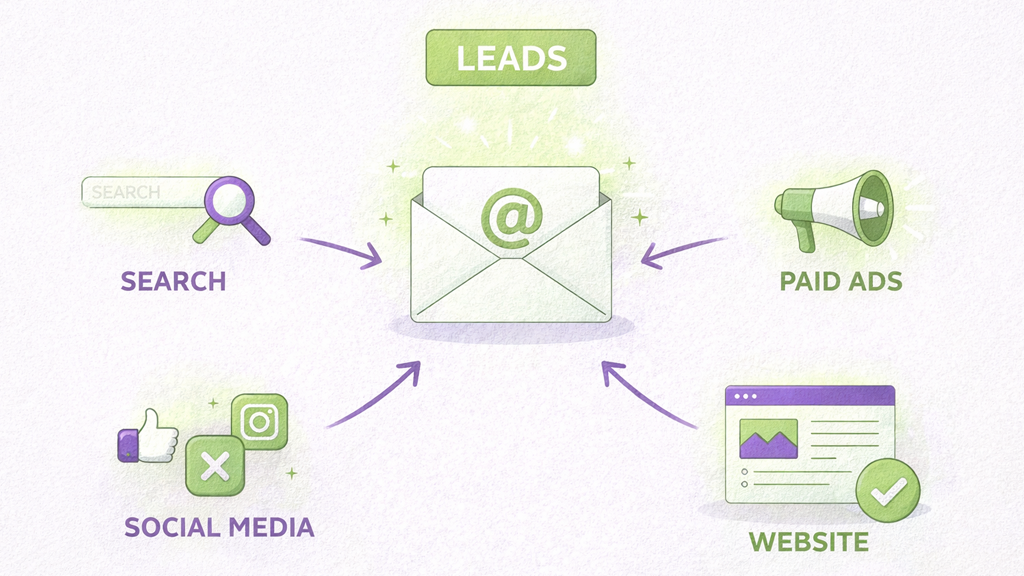
Creating a brilliant lead magnet is a great start, but it is only half the battle. A fantastic resource is useless if your ideal customers never see it. Getting your lead magnet in front of the right people is what turns it from a simple document into a reliable engine for generating qualified leads.
Too many businesses place a link on their website and hope for the best. This passive approach is not sufficient. To make a real impact, you need to actively promote your resource across multiple channels, meeting your prospects where they already are.
The aim is to create a system where every channel works together to drive high-quality sign-ups, not just empty clicks. It is about matching the channel to the audience to get the best possible return on your marketing investment.
Integrating Lead Magnets into Paid Advertising
Paid advertising platforms like Google Ads and Meta Ads are excellent for distributing your lead magnet. They allow you to target people with incredible precision, based on what they are searching for, their demographics, and their online behaviour. It provides a direct line to a high-intent audience.
- Google Ads: You can set up campaigns that target users actively searching for solutions your lead magnet offers. For example, a campaign for a “DIY SEO Checklist” could target keywords like “how to improve website ranking,” capturing prospects at the exact moment they need help.
- Meta Ads (Facebook & Instagram): These platforms are perfect for reaching specific professional roles or individuals with particular interests. A case study on financial planning for SMEs could be aimed directly at business owners, directors, and financial managers in the UK.
Paid ads are about buying qualified attention. Instead of waiting for prospects to discover you, you are proactively putting your valuable resource right in their path. This can dramatically accelerate your lead generation.
Leveraging SEO and Content Marketing
Your SEO and content strategy should work hand in hand with your lead magnet. Think of your high-performing blog posts and articles as prime real estate for promoting your free resource.
A well-optimised blog post that ranks for relevant search terms can be a steady, long-term source of traffic. By adding a call-to-action for a related lead magnet within the post, you give engaged readers a natural next step to take. This turns your helpful content into a direct conversion tool.
Capitalising on Email and Other Channels
Email remains a powerhouse in B2B marketing for a reason. For UK B2B marketers, email strategies that include lead magnets are a top channel for generating new business.
Recent surveys show that while 23% of UK SMEs use content syndication, email marketing powered by assets like webinars and checklists remains one of the most effective ways to nurture and convert prospects. You can find out more in the comprehensive UK agency growth report.
Promoting a new lead magnet to your existing email list is a great way to re-engage your audience and segment them based on their interests. Do not forget your own website either; placing your lead magnet on key pages like your homepage or relevant service pages ensures it gets the visibility it deserves.
Measuring and Optimising Lead Magnet Performance
Distributing your lead magnet is a positive first step, but the job is not finished. If you want it to become a reliable engine for business growth, you cannot simply set it and forget it. You must keep a close eye on its performance.
This means tracking the right data, understanding what the numbers mean for your bottom line, and continuously refining your approach to achieve better results. Your lead magnet should be seen not as a static document, but as a living part of your marketing system. Without measurement, you are simply guessing.
Key Metrics for Commercial Impact
To determine what is actually working, you need to track a few core metrics. These numbers provide the commercial context you need to make intelligent decisions and prove that your marketing spend is delivering a return. They shift the conversation from “we got a few downloads” to “we generated profitable new business.”
Focus your attention on these three areas:
- Landing Page Conversion Rate: This is the percentage of visitors who sign up for your lead magnet. A low rate could indicate a weak headline, unconvincing copy, or a disconnect between your ad and your offer.
- Cost Per Lead (CPL): To calculate this, divide your total campaign spend by the number of leads you generated. This metric is crucial for managing your budget and ensuring your lead acquisition is cost-effective.
- Lead-to-Customer Rate: This is the most important metric of all. It tells you what percentage of the people who downloaded your resource actually became paying customers. A high download count with a low customer rate indicates you are attracting the wrong audience.
A lead magnet is only successful if it attracts prospects who eventually buy from you. The lead-to-customer rate is the ultimate measure of ROI, connecting your marketing efforts directly to revenue growth.
A Framework for Continuous Improvement
Once you know your baseline numbers, the real work of optimisation begins. This involves methodically testing different elements to see what changes drive better commercial outcomes.
The most effective way to do this is with A/B testing. You create two versions of a landing page, showing each to half of your audience, to test one variable at a time. For instance, you could test different headlines, calls-to-action, or even slight variations of the offer itself.
This data-driven approach removes guesswork from the equation. It allows you to systematically improve performance, ensuring your lead magnet delivers the maximum possible impact over time.
Your Lead Magnet Questions Answered
We receive many questions about lead magnets, especially from business owners who are new to the concept. Let’s clarify some of the most common queries to help you get started with confidence.
How Long Should My Lead Magnet Be?
This is a classic case of quality over quantity. Forget about page count and focus on delivering real, immediate value. A simple one-page checklist that solves a pressing problem is always more effective than a 50-page ebook that is never read.
The best lead magnets provide your potential customer with a quick win. You should aim for something they can digest and use in under 10 minutes. This demonstrates respect for their time and quickly builds trust in your expertise.
Can I Use More Than One Lead Magnet?
Yes, and you absolutely should. The most successful lead generation strategies do not rely on a single, one-size-fits-all approach. Instead, they use a range of lead magnets designed for different types of customers or individuals at different stages of the buying journey.
For instance, you could have:
- An awareness-stage checklist for people at the top of the funnel who are just beginning their research.
- A decision-stage case study for those at the bottom of the funnel who are ready to buy and need proof that you deliver results.
How Much Should I Spend Creating a Lead Magnet?
The cost will depend on the format you choose, but it does not have to be expensive. Your biggest investment here is not money, but time and strategic thought. It is about taking the time to truly understand a customer’s problem and creating a clear, valuable solution for them.
A well-designed template or a focused guide can often be created in-house with very little financial outlay. The return you get from attracting even a few high-quality leads will easily outweigh the time it took to create.
Ultimately, your focus should always be on the quality of the insight you are sharing. A resource that genuinely helps a potential customer is one of the most powerful and cost-effective marketing tools you can have.
Ready to build a lead generation system that delivers measurable results? The team at Lead Genera specialises in creating and promoting high-converting lead magnets that fuel business growth. Get in touch to see how we can help you build a predictable sales pipeline.
Categories
Do You Need Assistance With
Sign Up To Our Newsletter