


Weekly marketing wisdom you can read in 5 minutes, for free. Add remarkable ideas and insights to your inbox, once a week, by subscribing to our newsletter.
Marketing Consultancy
How to Grow Business Online with a Step-by-Step Roadmap
Online growth isn’t a side project anymore. In the UK, e-commerce sales reached £221 billion in 2023, up 7.8% year on year and accounting for 27.8% of total retail sales according to Wix’s summary of UK small business marketing statistics. If your business still treats digital as an add-on, you’re already behind how customers research, compare, and buy.
That doesn’t mean you need to chase every platform, publish endless content, or burn cash on ads with no plan. It means you need a commercial roadmap. One that starts with who you want to reach, moves into the right channels, turns your website into a sales asset, and keeps improving through measurement.
If you want to know how to grow business online, the answer is simpler than most advice makes it sound. Pick a market. Clarify your offer. Focus your channels. Fix your website. Track what matters. Repeat.
Why Online Growth Is Essential for SMEs
The UK market has already made the decision for you. Buyers are online, comparisons happen fast, and trust is built before anyone fills in a form or picks up the phone.

For small and medium-sized businesses, online growth matters because it improves three things that usually hold them back offline. Reach, sales efficiency, and scalability. A strong digital presence lets a local firm compete beyond word of mouth. It also gives prospects a way to validate you before speaking to sales.
Being online is not the same as having a strategy
A website alone won’t grow the business. A neglected LinkedIn page won’t either. Plenty of firms are visible online and still generate weak leads because their message is vague, their channels are unfocused, and their site doesn’t convert.
That’s why a structured plan matters more than activity.
A practical starting point is to look at a broader digital marketing strategy for small businesses and then strip it back to what fits your commercial goals. Most SMEs don’t need more tactics. They need better priorities.
Practical rule: If a marketing activity doesn’t help you attract the right buyer, move them closer to enquiry, or improve conversion, it’s probably noise.
The real cost of doing nothing
Many owners still delay digital investment because they think online growth is too technical, too crowded, or too expensive. That’s the wrong read.
The bigger risk is drifting. While you rely on referrals alone, competitors improve search visibility, capture demand through paid media, and build websites that answer objections before a prospect ever speaks to them. They shorten the sales cycle while you’re still waiting for the next introduction.
What actually drives online growth
The businesses that grow online usually get the basics right first:
- Clear positioning so buyers understand what you do and why it matters
- Focused channels so budget isn’t spread thinly
- Conversion-led website structure so traffic has somewhere useful to go
- Measurement discipline so decisions come from evidence, not guesswork
Online growth rewards consistency and commercial discipline. That’s good news for SMEs, because you don’t need a giant budget to compete. You need a plan you can execute properly.
Defining Your Target Audience and Value Proposition
Most online growth problems start before the first campaign goes live. The issue isn’t Google Ads, SEO, or email. It’s that the business hasn’t made a clear decision about who it wants to win.
If you’re too broad, your messaging becomes forgettable. If your offer is vague, every channel gets harder and more expensive.
Start with your best customers, not your ideal fantasy clients
Don’t build audience profiles from guesswork. Use the clients you already serve well.
Review recent customers and look for patterns such as:
- Buying trigger what pushed them to act
- Commercial value which accounts generated strong revenue or repeat work
- Speed to close which enquiries moved quickly through the pipeline
- Fit with delivery which customers your team can serve well and profitably
For B2B firms, segment by industry, company size, buying role, and urgency. For service businesses, segment by geography, service need, margin, and decision speed.
A solicitor, a managed IT provider, and a commercial cleaning company all need leads. They should not sound the same online.
Build audience segments you can actually market to
You don’t need a glossy persona document. You need segments that help you write better pages, run smarter ads, and qualify leads faster.
Use a simple framework.
Segment by commercial relevance
Create groups based on who is most likely to buy and most valuable to serve.
For example:
- High-intent buyers already know the problem and want a supplier now
- Problem-aware buyers know something isn’t working but need guidance
- Low-priority browsers are researching casually and shouldn’t dominate your spend
That distinction matters. High-intent buyers respond to direct service pages, pricing clarity, and strong proof. Problem-aware buyers often need stronger education, objection handling, and follow-up.
Capture pain points in plain English
Interview customers, sales staff, and account managers. Ask what prospects say before they buy, why they hesitate, and what alternatives they compare.
Write the answers in customer language, not marketing language.
Good examples:
- We need more qualified enquiries, not more traffic
- Our current website looks fine but doesn’t generate leads
- We’ve tried ads before and wasted money
- We need a supplier who can move quickly and take ownership
Weak examples:
- We deliver operational excellence
- We provide solutions
- We deliver market-leading synergy
That kind of copy says nothing.
Buyers don’t care how polished your wording sounds. They care whether you understand their problem and can solve it.
Write a value proposition that passes the five-second test
A value proposition should answer this immediately. Why should this buyer choose you instead of doing nothing, choosing a competitor, or handling it internally?
If it takes a paragraph to explain, it’s too soft.
Use this structure:
- Who you help
- What problem you solve
- How you solve it
- Why your approach is commercially better
A rough example for a B2B service business might be:
You help UK manufacturers generate qualified sales conversations by combining search visibility, paid demand capture, and conversion-focused landing pages that reduce wasted spend.
That’s not elegant copy yet, but it’s clear. Clarity wins.
If your proposition feels woolly, this guide on how to write a value proposition is worth reading and applying properly.
Test the proposition before you scale spend
Don’t assume the message works because you like it. Put it under pressure.
Quick validation methods
- Sales call review listen for repeated objections and language
- Landing page test run a focused page against one audience segment
- Email outreach check which wording gets replies from the right prospects
- Search term review compare your messaging with what buyers search for
What you’re looking for is message-market fit. Do prospects recognise themselves in the problem? Do they understand the offer quickly? Do they take the next step without confusion?
Document the decisions
Many SMEs fail here. They discuss audience and messaging once, then never formalise it. Six months later, the website says one thing, ads say another, and sales pitches a third version.
Keep one working document that includes:
| Item | What to document |
|---|---|
| Primary audience | The core buyer you want more of |
| Secondary audience | Useful but lower priority segments |
| Pain points | Real objections and buying triggers |
| Value proposition | One clear core statement |
| Proof points | Results, process, credibility, specialism |
| Disqualifiers | Leads you don’t want |
That document should guide every page, campaign, and call script.
If you skip this step, the rest of your digital marketing becomes expensive trial and error.
Choosing and Prioritising Marketing Channels
Most SMEs don’t have a traffic problem. They have a focus problem.
They spread limited budget across SEO, Google Ads, Facebook, LinkedIn, email, content, maybe even print, and then wonder why nothing gains traction. If you want to grow online, pick fewer channels and run them properly.
According to the 2025 British Chambers of Commerce Digital Index, UK SMEs adopting digital marketing tools experienced a 25% average revenue uplift in 2024, with 68% reporting improved lead quality via SEO and social media as summarised by Hostinger’s small business statistics page. The takeaway isn’t “do everything digital”. It’s that well-chosen tools improve revenue and lead quality when they’re used with intent.
Quick wins versus long-term assets
Some channels can produce demand fast. Others build strength over time. Confusing the two is where frustration starts.
Fast-response channels
These are best when you need leads in the near term.
- Google Ads works when demand already exists and you need visibility now
- Paid social can generate enquiries, especially with strong offers and clear targeting
- Outbound email suits B2B firms with a defined prospect list and a sharp message
These channels give you speed, but they need disciplined targeting, landing pages, and follow-up.
Compounding channels
These take longer but improve resilience.
- SEO builds sustainable visibility for commercial searches
- Content marketing helps educate buyers and support conversion
- Email nurture improves conversion from existing leads and reactivates interest
Compounding channels usually look slower at the start because they don’t give instant gratification. That doesn’t make them optional.
Channel Comparison Overview
| Channel | Investment | Timeline | Expected ROI |
|---|---|---|---|
| SEO | Ongoing monthly investment | Longer-term | Strong when search demand and conversion intent are clear |
| Google Ads | Flexible but requires active management | Short-term | Strong for high-intent searches and urgent demand capture |
| Paid social | Flexible and campaign-led | Short to medium-term | Useful when offer, creative, and audience targeting are strong |
| Email marketing | Lower media cost but needs list quality and process | Medium-term | Strong for lead nurture, reactivation, and B2B outbound |
| Content marketing | Ongoing time and production investment | Longer-term | Best as a support channel for SEO, authority, and sales enablement |
Match channels to buying behaviour
The right channel depends on how your buyers make decisions.
If your prospects search Google when they need help, search should be a priority. If they need repeated exposure before acting, email and remarketing matter more. If your service needs explanation and trust-building, content and case-led landing pages do heavy lifting.
A useful commercial lens is this:
Use SEO when buyers know what they want
If someone searches for a specific service, SEO and paid search can capture that demand close to decision. This is usually strong for professional services, trades, software with defined use cases, and specialist B2B categories.
Use paid media when speed matters
Paid search and paid social help when you need pipeline sooner, when SEO will take time, or when you’re launching a new offer. They also generate fast feedback on messaging, audience fit, and landing page quality.
Use email when sales cycles are longer
Email often gets neglected because it’s less glamorous than paid media. That’s a mistake. For B2B businesses especially, email is effective for follow-up, lead nurture, and direct outbound when your targeting is sound.
Don’t pick channels in isolation
Channels perform better when they support each other.
A prospect might find you through Google, leave without converting, see a remarketing ad later, return to a landing page, then convert after a follow-up email. That’s normal. The channel didn’t fail because it wasn’t the final click.
This is why a joined-up approach to digital marketing for lead generation matters more than obsessing over one platform.
Commercial view: Stop asking which single channel is best. Ask which channel mix gets the right lead into a sales conversation at an acceptable cost.
A practical prioritisation model
If budget is tight, use this order.
First priority
Get one demand capture channel working. Usually that’s SEO or Google Ads, depending on urgency.
Second priority
Fix conversion on the destination page. Sending traffic to weak pages is wasteful.
Third priority
Add retention or nurture. Usually email.
Fourth priority
Expand into supporting channels once the first three are producing evidence.
This avoids a common mistake. Businesses often scale activity before they’ve proven the funnel.
What to avoid
- Vanity-led social posting with no offer, no targeting, and no path to conversion
- Content for traffic alone when the audience has low buying intent
- Underfunded multi-channel launches that spread effort too thin
- Premature channel expansion before the first one is stable
You do not need to be everywhere. You need to be present where buying intent exists and where your team can follow up properly.
Optimising Your Website for Conversions
Your website is not there to look respectable. It’s there to help someone decide whether to contact you.
If it doesn’t guide that decision, it’s underperforming.
A lot of SMEs think they have a traffic issue when they really have a conversion issue. They drive people to a site that loads slowly, confuses the user, buries the call to action, and gives no clear reason to enquire.
The first thing to fix is mobile experience. According to Startups Magazine’s article on digital pitfalls, 61% of consumers abandon sites that are difficult to access on mobile, and 40% switch to competitors. That’s brutal, but it’s accurate to how buyers behave. If your site is awkward on a phone, you’re leaking leads.
Start with the pages that make or break enquiries
Don’t begin with a full redesign unless the site is broken. Start with the pages that sit closest to conversion:
- Service pages where buyers assess fit
- Landing pages used for paid campaigns
- Contact pages where friction often kills intent
- Homepage sections that shape first impressions and direct traffic
You’re looking for friction, not beauty.
Check the essentials first
- Load speed if the page drags, people leave
- Mobile layout forms, buttons, menus, and spacing must work cleanly
- Message clarity buyers should understand your offer quickly
- Call to action every important page should tell the user what to do next
A conversion-focused site should work as a sales tool, not a digital brochure. This thinking is central to website design for lead generation.
Fix the obvious leaks before you test details
Many businesses jump straight into button colours and headline variations while ignoring bigger issues.
That’s backwards.
If your service page doesn’t explain who you help, what problem you solve, and how to take the next step, no minor test will rescue it.
The biggest conversion killers
| Problem | Why it hurts |
|---|---|
| Vague headlines | Buyers can’t tell if the page is relevant |
| Weak call to action | Interest doesn’t turn into action |
| Overlong forms | Users abandon before enquiring |
| No proof signals | Trust remains too low to convert |
| Generic stock copy | The business sounds interchangeable |
Strip out anything that doesn’t help a buyer understand, trust, or act.
Make trust visible
Conversion improves when buyers can verify credibility without effort.
That means using:
- Specific service descriptions instead of inflated claims
- Client logos or sectors served where appropriate
- Process clarity so users know what happens after enquiry
- Useful FAQs that answer genuine objections
- Straightforward contact options for different buyer preferences
Trust isn’t built by saying you’re trusted. It’s built by removing uncertainty.
Test changes in a sensible order
A/B testing is useful, but only when the fundamentals are in place.
Test bigger decisions first:
- Headline and proposition
- Page structure and CTA placement
- Form length and enquiry flow
- Supporting proof and reassurance copy
Once that’s working, test smaller details such as button text and page layout refinements.
A short explainer like this helps teams think more clearly about on-page testing and user behaviour:
A no-nonsense CRO checklist
Before you send more traffic, ask these questions
- Can a first-time visitor tell what you do within seconds
- Is the main CTA obvious without scrolling too far
- Does the mobile experience feel easy rather than cramped
- Are forms asking only for what sales needs
- Does the page reduce doubt before asking for contact details
If the answer is no, fix that first.
More traffic into a weak website doesn’t create growth. It just makes the waste arrive faster.
Implementing Data Measurement and Continuous Testing
Most businesses don’t need more dashboards. They need better discipline.
Data only helps if it changes decisions. If reports are being reviewed without action, you’re measuring activity, not improving performance.
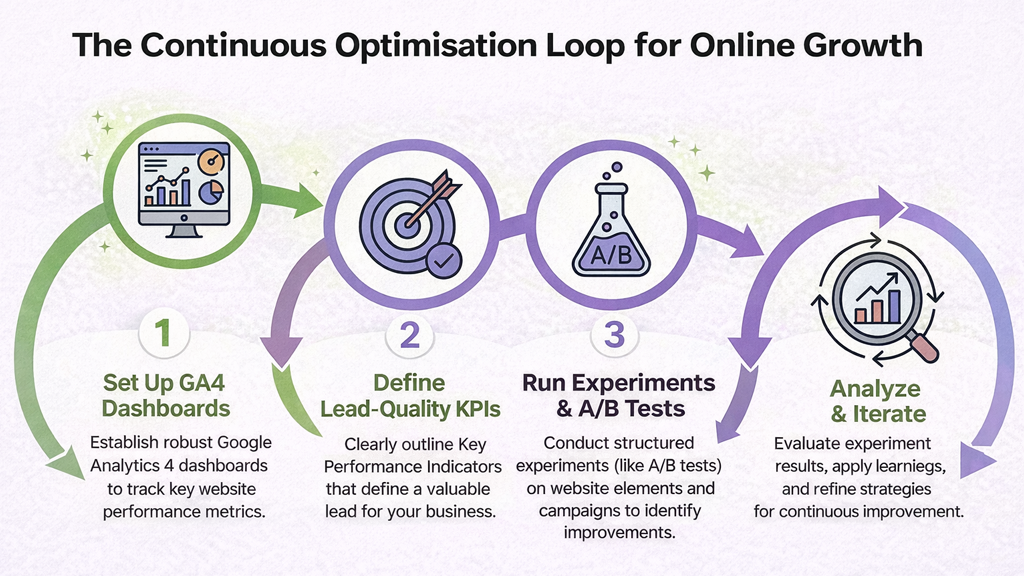
For lead generation, a steady testing cycle works better than sporadic redesigns or quarterly panic. According to Integrate.io’s review of data transformation challenge statistics, a data-driven methodology reduces failure rates by 50% compared to large-scale overhauls, with firms monitoring lead volume, CAC, and LTV:CAC through quarterly KPI reviews. That principle applies directly to online growth. Smaller, consistent improvements beat grand reinventions.
Track the metrics that affect commercial decisions
Many SMEs still spend too much time on impressions, clicks, and general traffic trends without asking whether those visits become good opportunities.
Start with a tighter set of indicators.
Core KPIs worth tracking
- Lead volume how many enquiries or booked calls you’re generating
- Lead quality whether those enquiries fit your target audience
- Customer acquisition cost what it costs to win a customer
- LTV to CAC relationship whether acquisition remains commercially sensible
- Landing page conversion rate whether traffic turns into action
These numbers should be reviewed together, not in isolation. High lead volume with weak lead quality is not a win. Low cost per click with poor conversion is not efficiency.
Build one joined-up measurement flow
Data tends to break when systems are disconnected. Ads sit in one platform, web analytics in another, CRM notes somewhere else, and nobody can see the full journey.
You need a practical flow:
Step one
Use GA4 to track page views, conversion events, traffic source, and on-site behaviour.
Step two
Pass leads into a CRM such as HubSpot so sales outcomes can be reviewed against original source and campaign.
Step three
Score or label leads based on quality. Even a simple sales-qualified versus poor-fit classification is useful.
Step four
Feed those learnings back into channel decisions, landing page changes, and targeting.
The goal isn’t perfect attribution. The goal is better decisions than you made last month.
Run experiments with a clear hypothesis
Random testing wastes time. Every test should start with a reason.
Examples:
- The headline is too broad, so more specific messaging may lift qualified enquiries
- The form asks for too much, so reducing fields may improve completions
- The landing page doesn’t match the ad promise, so tighter message alignment may improve conversion
- Organic visitors are dropping off too early, so stronger trust signals may hold attention longer
Good testing habits
- Change one meaningful variable at a time
- Record the hypothesis before launching
- Define success before reviewing results
- Ignore vanity improvements that don’t affect revenue quality
A better click-through rate means very little if the leads are poor.
Separate quick wins from structural tests
Not all testing belongs in the same bucket.
| Test type | Typical use |
|---|---|
| Quick win test | Headlines, CTA copy, form fields, hero messaging |
| Structural test | Page layout, funnel sequence, offer positioning, service page architecture |
| Channel test | New keyword themes, audience targeting, creative angle |
| Sales alignment test | Lead qualification rules, follow-up timing, handoff process |
Not every problem is a marketing problem. Sometimes the issue sits in follow-up, qualification, or offer fit.
Create a rhythm your team can sustain
A good measurement process is boring in the best way. It’s regular, documented, and tied to decisions.
A simple operating rhythm works well:
- Weekly review lead flow, obvious anomalies, and campaign issues
- Monthly assess channel contribution, landing page performance, and sales feedback
- Quarterly review broader KPIs including CAC and lead quality trends, then decide what to scale, pause, or rebuild
That rhythm keeps testing grounded in business reality. It stops teams from reacting emotionally to short-term noise while still moving fast enough to improve.
Budgeting Timelines and Real-World Examples
Budgeting for online growth should be blunt and practical. If you don’t know what the money is meant to achieve, the budget is meaningless.
The right way to think about spend is this. What needs to happen first, what can wait, and what will improve lead quality or sales velocity?
Build budget around the stage of the business
A service firm trying to generate its first steady inbound leads should budget differently from a business with an established pipeline that needs better efficiency.
Here’s a sensible way to think about it.
Early-stage or underperforming digital presence
Put money into the foundations first:
- Website improvement so traffic has a chance to convert
- One primary acquisition channel such as SEO or Google Ads
- Basic measurement setup so results can be judged properly
If the site is weak and tracking is patchy, scaling media spend is premature.
Established demand but inconsistent lead quality
Shift more budget into:
- Landing page refinement
- Better ad targeting
- Lead qualification process
- Email follow-up and nurture
This is often where hidden profit sits. Not in more traffic, but in better filtering and conversion.
Use timelines that reflect reality
Many SMEs sabotage good decisions by expecting every channel to produce on the same timescale.
That doesn’t happen.
Short-term priorities
Paid search, paid social, and outbound email can produce feedback quickly. That makes them useful for validating offer-market fit, finding traction, and generating early conversations.
Medium-term priorities
Website improvements, better landing pages, and stronger nurture sequences usually improve performance once traffic is already arriving.
Longer-term priorities
SEO, authority content, and broader organic visibility take longer. They’re still worth doing because they reduce reliance on paid acquisition and support more stable growth over time.
Budget should follow commercial intent. Spend first where a clear route to enquiry exists, then invest in channels that compound.
Real-world example one
A regional professional services firm starts with a dated website, no structured SEO, and sporadic referrals. The business owner wants more inbound leads but doesn’t have appetite for a full channel rollout.
The sensible move is not to launch everything.
They prioritise:
- rebuilding core service pages around real buyer intent
- tightening forms and calls to action
- running one paid search campaign on the highest-intent service line
- setting up clean reporting between enquiries and sales outcomes
That sequence gives fast learning and protects cash. If paid search produces relevant demand, they expand carefully. If the page converts poorly, they fix that before increasing spend.
Real-world example two
A B2B company already has web traffic and regular content output, but sales complains that leads are weak and slow to close.
The answer isn’t more blogging.
The business should examine:
- whether the content attracts the wrong intent
- whether landing pages qualify properly
- whether enquiry forms create too little commercial context
- whether nurture emails are doing enough to move interest into action
In this situation, budget often shifts away from volume tactics and into conversion, qualification, and better channel alignment.
Real-world example three
A trades business wants to grow beyond referrals in a competitive local market. The owner doesn’t need national visibility. They need a reliable local lead flow.
A smart budget would usually favour:
- strong service-location pages
- local search visibility
- paid search for urgent high-intent jobs
- a contact process built for mobile users
- review generation and proof placement across key pages
That approach keeps spend anchored in demand that can convert.
Budget pressure is real, so stage your investment
Not every SME can fund growth comfortably from operating cash. If expansion requires external finance, owners should understand their options and repayment implications before committing. The financing choice matters because growth spend only works if the business can sustain it long enough to learn and improve.
What budget decisions should trigger a change
You shouldn’t keep funding a channel just because it’s active.
Reallocate when:
- Lead quality stays poor despite messaging and targeting improvements
- Conversion remains weak after obvious page fixes
- Sales follow-up can’t keep pace with lead volume
- One channel consistently produces stronger commercial outcomes than the others
That doesn’t mean making knee-jerk cuts after a short dip. It means reviewing evidence and adjusting based on commercial performance, not habit.
The businesses that grow online usually don’t have perfect budgets. They make better sequencing decisions.
Next Steps and Strategic Takeaways
If you want to know how to grow business online, stop looking for a secret channel. Growth comes from making a few solid decisions in the right order and executing them properly.
The priorities are straightforward
Get specific about who you want
Define your audience based on fit, buying intent, and commercial value. Broad targeting creates weak messaging and wasted spend.
Sharpen the offer
Your value proposition should be obvious, relevant, and easy to believe. If buyers can’t grasp it quickly, your channels will underperform.
Choose fewer channels
Pick the routes most likely to produce commercial intent. Run them properly before expanding.
Treat the website like a sales tool
Fix mobile usability, tighten calls to action, reduce friction, and make trust easy to verify.
Measure what changes decisions
Track lead quality, conversion, CAC, and downstream sales outcomes. Then test improvements in a repeatable cycle.
A practical 90-day focus
- First month define audience, rewrite core messaging, audit your site
- Second month improve key pages and launch one primary acquisition channel
- Third month review lead quality, tighten follow-up, and test your next conversion improvement
That’s enough to create traction without turning the business into a marketing experiment.
Online growth doesn’t reward random effort. It rewards commercial clarity, consistency, and a willingness to fix what isn’t working. Start there.
If you want a hands-on partner to help turn that roadmap into a lead generation system, Lead Genera works with UK businesses on SEO, paid media, conversion-focused websites, and practical growth strategy built around measurable pipeline impact.
Categories
Do You Need Assistance With
Sign Up To Our Newsletter