


Weekly marketing wisdom you can read in 5 minutes, for free. Add remarkable ideas and insights to your inbox, once a week, by subscribing to our newsletter.
Lead Generation
Insurance Lead Generation: A Complete UK Guide
Some weeks the phone is busy and the pipeline looks healthy. Then a month later, referrals dry up, bought lists underperform, and your team starts chasing anyone with a pulse. That pattern is common in insurance lead generation, especially for UK firms trying to grow without a proper acquisition system.
The main problem usually isn’t effort. It’s structure. Too many insurance businesses rely on disconnected tactics: a bit of paid media, some networking, an old website, and a sales team forced to sort weak enquiries from serious buyers.
Predictable growth comes from treating lead generation as an operating system. That means choosing the right channels, defining what a qualified lead is, building landing pages that convert, tracking every step, and handling compliance properly from the start. When those pieces work together, insurance lead generation stops being a monthly gamble and starts becoming a controllable commercial function.
Beyond Cold Calls A Modern Approach to Insurance Leads
Cold outreach still has a place. It just can’t be the whole plan.
If your team spends most of its day dialing through poor-fit data, leaving voicemails, and manually qualifying people who were never likely to buy, you’re paying twice. First in media or list cost. Then again in wasted sales time.

What modern insurance lead generation looks like
A stronger model starts earlier in the buyer journey. Instead of waiting until someone lands on a spreadsheet, you create ways for prospects to discover you, understand your offer, and signal intent before a salesperson gets involved.
That usually means building around a few core assets:
- A clear acquisition strategy that targets one audience at a time, such as landlords, trades businesses, directors, or families reviewing life cover
- Channel-specific campaigns using Google Ads, Meta Ads, SEO, partnerships, and referral routes based on where intent is highest
- Conversion-focused landing pages built to generate enquiries, not just display information
- A qualification process that filters weak leads before they consume sales capacity
- Measurement infrastructure inside a CRM so you know what is producing pipeline, not just clicks
Practical rule: If a lead source creates activity but doesn’t create reliable revenue, it isn’t a growth channel. It’s noise.
Why old methods lose money
Traditional sales-first models break down because they ask salespeople to do marketing’s job. Agents end up educating cold contacts, checking basic eligibility, and trying to infer buying intent from thin signals.
That approach creates three commercial problems:
- Low efficiency because too much time goes into non-buyers
- Poor forecasting because lead quality varies wildly week to week
- Weak feedback loops because nobody can clearly see which source drove the eventual sale
Modern insurance lead generation fixes this by pushing clarity upstream. Better targeting, sharper messaging, stronger forms, and cleaner qualification produce a pipeline that’s easier to convert and easier to scale.
The firms that grow consistently aren’t always the loudest in the market. They’re usually the ones with a repeatable system.
Decoding Lead Quality Exclusive vs Shared and Qualified vs Unqualified
A lead isn’t automatically valuable because it exists.
In practice, insurance lead generation only works when you know exactly what kind of lead you’re buying or generating, how sales will handle it, and what margin is left after follow-up effort. Without that clarity, you can’t judge channel performance properly.
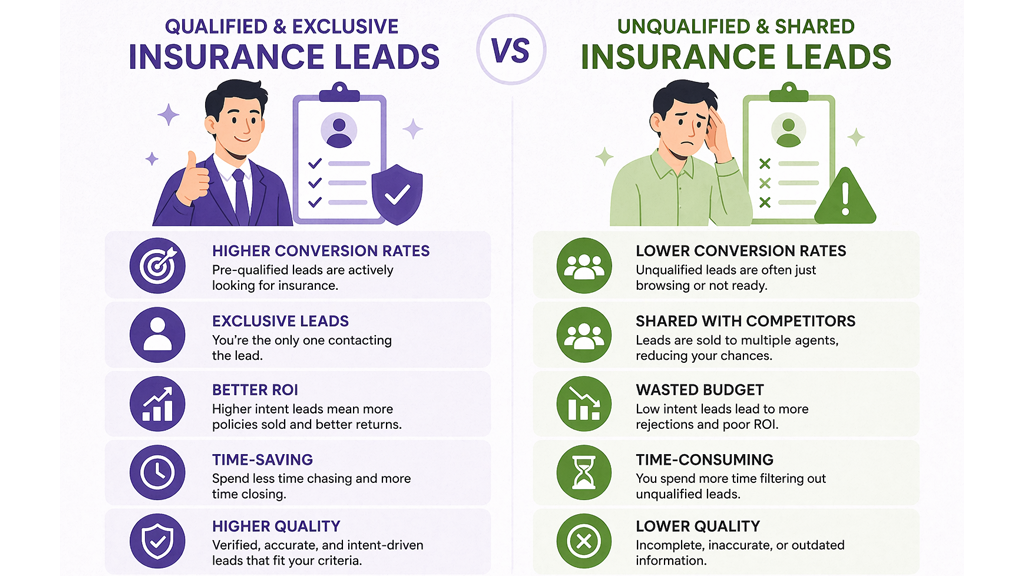
Exclusive and shared leads are different commercial products
An exclusive lead goes only to your firm. A shared lead is sold to multiple buyers. Neither is automatically right or wrong. The value depends on your process, response speed, and economics.
Here’s the practical difference:
| Lead type | Commercial upside | Main risk | Best fit |
|---|---|---|---|
| Exclusive | More control over follow-up, less direct competition | Usually higher acquisition cost | Firms with strong close rates and higher average policy value |
| Shared | Lower cost and broader volume potential | Competing calls can erode contact quality fast | Teams built for rapid response and high activity |
Exclusive leads often feel safer because your team isn’t racing three other brokers to first contact. But if your scripts, offer, and qualification are weak, paying more for exclusivity won’t rescue the economics.
Shared leads can work when operations are tight. If your team responds late, they’re almost useless.
A cheap lead that requires heavy manual qualification is often more expensive than a pricier lead that reaches an adviser ready to talk.
Qualified and unqualified are not minor labels
The bigger distinction is between unqualified enquiries and sales-qualified leads.
This is comparable to raw material versus finished stock. An unqualified form fill is raw material. It might become revenue, but only after time, filtering, and follow-up. A qualified lead has already cleared basic commercial criteria. The buyer fits your product, the need is relevant, and there is genuine willingness to engage.
That difference affects more than conversion rate. It shapes:
- Sales morale because teams lose confidence when too many leads are poor
- Forecast accuracy because pipeline stages become inflated by weak opportunities
- Operational cost because advisers spend time checking basics instead of selling
- Media decisions because weak qualification can make a decent channel look broken
A simple framework for evaluating lead quality
Before you approve any supplier or launch any campaign, define the minimum standard. For most insurance businesses, that means answering four questions:
- Fit. Does this person or business match the policies you want to sell?
- Intent. Have they shown active interest, or just downloaded something broad?
- Contactability. Can your team reach them quickly through a valid route?
- Consent. Is the lead legally usable for follow-up in the UK?
You don’t need jargon-heavy scoring models to start. You do need discipline. If marketing hands sales a pile of names without agreed criteria, the pipeline gets noisy and costs rise.
Lead quality isn’t a branding issue. It’s a profit issue.
Choosing Your Channels Where to Find High-Value Insurance Leads
Every channel can generate leads. That doesn’t mean every channel deserves budget.
The right mix depends on intent level, speed to impact, sales process, and how quickly your team can turn enquiries into policy conversations. A business writing commercial cover for SMEs should not build the same acquisition plan as one focused on life insurance or personal lines.
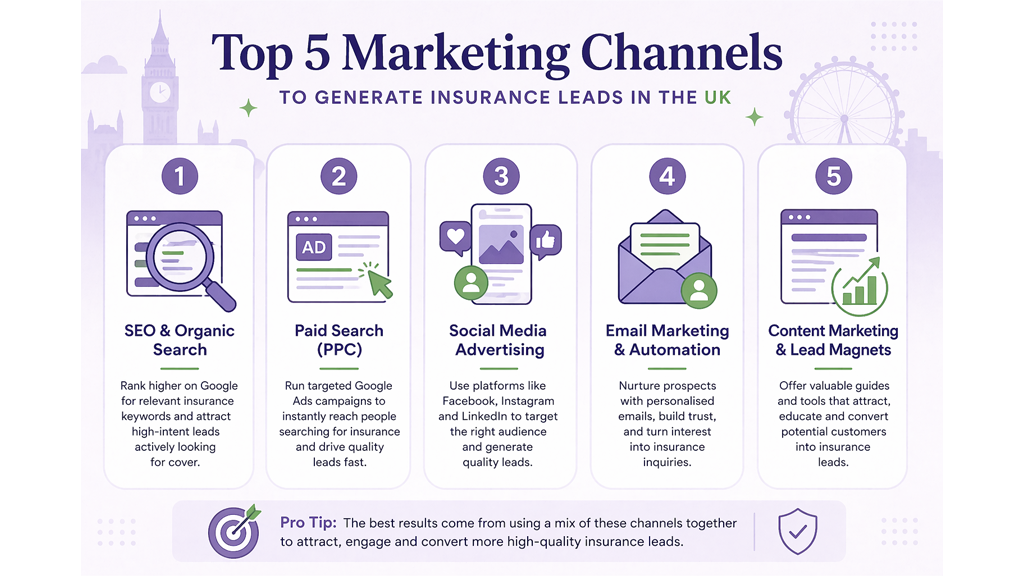
Paid search captures active intent
Google Ads remains one of the strongest channels when people already know what they need. Searches around business insurance, trades cover, indemnity, public liability, and life cover comparison tend to signal immediate commercial intent.
The upside is obvious. Prospects are actively looking. The downside is equally clear. Cost rises fast if campaign structure is loose, landing pages are generic, or you send traffic to a broad homepage.
Paid search works best when you split campaigns by product, audience, and intent level. For example, one ad group for self-employed trades, another for small employers, another for directors reviewing key person cover. Tight segmentation usually produces better lead quality because the message matches the need.
For readers researching personal protection demand, tools that help users compare life insurance options can also reveal how buyers evaluate cover online before they ever speak to an adviser.
Paid social creates demand before the search
Meta and LinkedIn aren’t usually the first place someone goes to buy insurance. They are useful for putting relevant offers in front of defined audiences before urgency peaks.
That matters when your product requires education or when the buyer doesn’t wake up planning to request a quote. Commercial insurance for growing firms often fits this pattern. So do niche policies tied to changing business risks.
Paid social is strongest when you use it to:
- Promote a specific angle tied to a recognisable pain point
- Retarget engaged visitors who didn’t enquire the first time
- Support nurture sequences with consistent message reinforcement
It is weaker when firms run broad awareness campaigns and expect immediate high-quality leads from vague creative.
SEO builds an owned acquisition asset
SEO is slower than paid media, but it compounds. A properly structured site can attract high-intent traffic month after month without paying for every click.
The UK opportunity is especially clear in regional markets. In 2025-2026, UK SME insurance demand surged 28% in East Anglia due to remote risk exposures, yet only 19% of local agents use geo-targeted SEO yielding £7.50/lead vs. a national average of £12. For firms with local relevance, that’s a strong case for location-specific content, service pages, and search campaigns built around regional intent.
If you operate in adjacent financial sectors, there are useful overlaps in how local intent converts. The thinking behind mortgage lead generation is relevant here, especially where trust, local visibility, and response speed influence enquiry quality.
SEO works best when you target commercial intent pages first. Educational content helps. Service pages close the gap between search and enquiry.
Referral networks and partnerships bring warmer opportunities
Referrals, introducers, accountants, solicitors, mortgage advisers, and trade associations can all produce high-value leads because trust is already partly established.
These channels often convert well, but they come with a limit. They’re hard to scale if the process stays informal. If you want predictable output, partnerships need structure: agreed referral criteria, clear handover rules, response SLAs, and regular review of lead quality.
Many firms make a mistake: they call a handful of warm relationships a strategy. It isn’t a strategy until it can be measured and repeated.
A practical split looks like this:
- Referral networks for trust-led growth
- Paid search for demand capture
- Paid social for audience building and retargeting
- SEO for long-term cost control
- Partnerships for niche or sector-specific access
A useful overview sits below.
Offline still works when it feeds the digital funnel
Events, breakfast networking, sector conferences, and local business groups still matter. The issue isn’t the format. It’s what happens afterwards.
Offline activity becomes commercially useful when it feeds a proper funnel:
- Contact captured cleanly
- Follow-up sent fast
- CRM updated
- Lead scored
- Sales action triggered
Without that operational layer, networking creates conversations but not pipeline visibility.
The best channel strategy isn’t about choosing one winner. It’s about assigning each channel a job, then measuring whether it performs that role profitably.
From Click to Conversion Landing Pages and Creative That Work
Most insurance campaigns don’t fail because of targeting alone. They fail because the click lands on a weak page.
A landing page should behave like a sales tool. It needs to continue the promise made in the ad, reduce uncertainty fast, and make the next step easy. If it looks like a generic brochure page, lead quality drops and cost rises.
Landing pages should remove friction, not add it
A strong insurance landing page does a few things quickly. It tells the visitor they’re in the right place, shows relevance to their situation, and gives them a simple path to enquire.
Focus on the essentials:
- Headline match that reflects the exact service or audience from the ad
- Benefit-led copy that explains what the buyer gets, not just what the policy includes
- Short forms that collect what sales needs at this stage
- Clear trust signals such as regulation information, sector relevance, or process transparency
- Visible next step so the visitor knows whether they’ll get a call, quote, or consultation
If you’re refining your own funnel, this guide on how to build a killer lead generation landing page is a useful reference point for page structure and conversion thinking.
Form strategy affects lead quality
Many firms either ask for far too much or far too little.
If the form is too long, response volume can suffer. If it’s too vague, sales gets weak enquiries and has to do the filtering manually. The answer is to collect enough information to route and prioritise, while leaving detailed underwriting questions for later in the process.
A practical approach is to ask for:
| Form element | Why it matters |
|---|---|
| Basic contact details | Gives sales a usable route to follow up |
| Policy or cover type | Helps route the lead correctly |
| Business type or customer profile | Improves fit and qualification |
| Short intent question | Reveals urgency or current need |
Conversion note: If every field doesn’t help qualification, routing, or follow-up, it probably doesn’t belong on the first form.
Creative should speak to the buyer’s context
Ad creative for insurance lead generation isn’t about being clever. It’s about relevance.
For Google Ads, relevance comes from search intent, tightly written copy, and the right landing page match. For Meta or LinkedIn, it comes from putting a familiar problem in front of the right audience with an offer that reduces uncertainty.
Creative usually performs better when it is:
- Audience-specific rather than broad
- Problem-led rather than feature-led
- Commercially clear rather than vague and brand-heavy
- Consistent with the landing page so the buyer doesn’t feel a disconnect
For B2B insurance, image and copy angles often work best when they reflect recognisable risk contexts such as contractor liability, remote work exposure, or cover gaps during growth. For personal lines and life products, clarity and reassurance tend to matter more than clever design.
Small changes can make a real difference. A sharper headline. A simpler form. Better message match. Faster mobile load speed. None of that is glamorous, but it turns traffic into pipeline.
Navigating UK Compliance GDPR and FCA in Lead Generation
Compliance is not a legal footnote in insurance lead generation. It’s part of lead quality.
If your funnel collects data in a way that sales can’t confidently use, you’ve paid to generate unusable demand. That is wasted budget before a policy conversation even begins.
Bad compliance creates direct commercial damage
The risk isn’t theoretical. UK insurance firms face GDPR fines averaging £4.2 million for marketing-related data breaches, yet only 12% of agents integrate compliant consent mechanisms into their digital funnels. This leads to an estimated 35% lead disqualification rate post-capture. Those numbers should change how you think about forms, data capture, and follow-up rules.
Most firms treat compliance as a box-ticking exercise. That mindset is expensive. A non-compliant funnel doesn’t just create regulatory exposure. It contaminates the sales pipeline with leads that look real in reporting but can’t be worked properly.
What good compliance looks like in practice
A compliant insurance lead funnel usually has a few visible traits:
- Clear consent language tied to the actual follow-up method
- Transparent data collection so the buyer understands what they’re submitting
- Proper record keeping inside the CRM for when and how consent was given
- Channel-specific follow-up rules for phone, email, and remarketing activity
- Clean supplier governance if third parties generate leads on your behalf
Many lead providers fall short concerning key compliance elements. They can deliver volume, but they can’t prove that consent, source quality, and handoff process meet UK expectations. If you’re buying leads, ask how consent is captured, stored, and passed through. If the answer is vague, walk away.
Compliance done properly improves lead quality because the buyer has made a more deliberate, documented action.
FCA and GDPR should shape the script, not just the form
Insurance firms often focus on the landing page and ignore what happens next. But the sales handoff matters just as much. Scripts, callback process, and recorded consent handling all sit inside the actual customer journey.
That matters even more for personal lines and regulated products where clarity is essential. For example, educational resources around understanding UK car insurance types and legalities can help teams think more carefully about how product explanation and legal context influence compliant communication.
A commercially strong position is simple. Build compliant funnels from the start, document every handoff, and make sure sales only receives leads that can be worked. Firms that do this protect margin, reduce wasted effort, and create more trust at first contact.
In a crowded market, trust is not soft value. It’s conversion infrastructure.
Measuring What Matters Tracking Attribution and CPL
If you can’t trace a lead from click to revenue, your reporting is incomplete.
A lot of insurance firms know their top-line lead count. Fewer know which campaign produced the enquiry, which calls turned into opportunities, which source created policies, and what acquisition cost after sales effort is included. That gap is where budget gets wasted.
Your CRM should be the source of truth
A proper CRM isn’t just a contact database. It should hold source data, campaign history, lead status, sales outcomes, and notes that help marketing and sales judge quality together.
At minimum, your setup should capture:
- Original lead source such as Google Ads, organic search, referral, or partner
- Campaign or keyword detail where possible
- Lead status changes from new enquiry to quoted, won, lost, or nurture
- Call outcomes for phone-led follow-up
- Revenue or policy value markers where your process allows it
Without that, CPL becomes a vanity metric. You may know what a form cost. You won’t know whether it produced profit.
If you’re tightening up reporting, this resource on why conversion tracking is important for lead generation campaigns is a useful starting point.
Attribution should reflect how buyers actually behave
Insurance buyers rarely move in a straight line. They search, leave, return, click an ad, open an email, call later, and ask questions before converting. If your attribution model only rewards the final click, you’ll undervalue the channels doing early persuasion.
That doesn’t mean you need a complicated analytics setup from day one. It does mean you should track enough touchpoints to answer practical questions:
| Question | Why it matters |
|---|---|
| Which channels create qualified leads? | Volume alone doesn’t justify spend |
| Which campaigns drive calls versus forms? | Different products often convert through different actions |
| How long does it take to move from enquiry to sale? | This shapes budgeting and nurture strategy |
| Where do leads stall? | Friction in handoff often kills ROI |
Predictive scoring sharpens sales efficiency
One of the most useful upgrades for insurance lead generation is predictive lead scoring. Traditional scoring often labels leads as low, medium, or high. That helps a bit, but it’s blunt. Predictive scoring gives a probability-based view of likely conversion, which is more useful for real sales prioritisation.
Predictive lead scoring offers a significant technical advantage over traditional methods by generating specific conversion probability scores. By focusing agent time on leads with a >60% conversion probability, UK SMEs in professional services can reduce time-to-productivity for new leads by 40-60%.
That matters because sales capacity is finite. If advisers work the most promising opportunities first, cost-per-acquisition improves and response quality usually rises too.
The best reporting setup doesn’t just explain what happened. It tells the team what to do next.
Track commercial outcomes, not just marketing activity
Clicks, impressions, and raw lead counts all have their place. They just shouldn’t dominate decision-making.
For most insurance firms, the most useful performance view includes:
- Cost per lead
- Lead-to-quote rate
- Lead-to-sale rate
- Speed to contact
- Policy value or pipeline value by source
- Disqualification reasons
That last point matters more than many teams realise. If leads keep failing for the same reason, the issue often sits in targeting, creative promise, form design, or compliance setup. Measurement should expose that quickly.
Good tracking doesn’t make decisions for you. It gives you enough truth to stop guessing.
Turning Leads into Pipeline Qualification and Nurture
A lead is most valuable the moment it arrives.
After that, value starts to decay. Response slows, intent fades, the buyer gets distracted, or a competitor gets there first. Insurance lead generation doesn’t end at the enquiry. It succeeds or fails in what happens next.
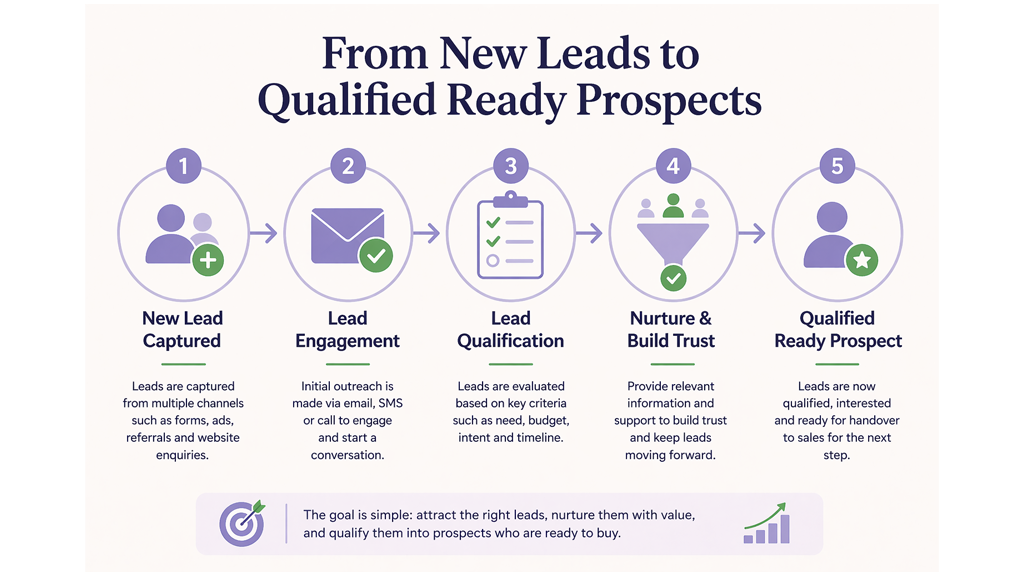
Qualification needs clear rules
Sales shouldn’t have to guess whether a lead is worth pursuing. Build simple qualification criteria that match how your business sells.
A workable framework often includes:
- Product fit based on policy type or risk category
- Customer profile such as industry, business size, or personal circumstances
- Intent signal shown by the enquiry type, wording, or requested action
- Urgency based on renewal timing, current cover gaps, or immediate need
- Compliance status so only valid, usable leads reach the team
The point isn’t to create bureaucracy. It’s to protect sales time. If a lead fails basic fit, move it to nurture or remove it. Don’t let weak enquiries clog the live pipeline.
Warm transfer can improve contact quality fast
For teams handling higher volumes, warm transfer is one of the more practical process upgrades.
The warm transfer methodology, where a call centre verifies a prospect’s identity and intent before a real-time agent transfer, reduces the time to make effective contact from a typical 15-20 minutes per cold lead down to just 3-5 minutes for a pre-qualified, warm lead according to EverQuote’s explanation of warm transfer lead handling. That process also helps capture explicit consent at handoff, which is commercially useful as well as operationally efficient.
Warm transfer isn’t right for every business. It needs telephony integration, disciplined scripting, and a lead source that justifies the operational setup. But where speed and qualification are hurting close rates, it can remove a lot of friction.
A fast handoff beats a perfect CRM note delivered two hours late.
Nurture the leads that are not ready yet
Not every lead should go straight to sales. Some need more context, better timing, or a reason to act. Ignoring them wastes acquisition spend. Chasing them too hard damages trust.
Good nurture sits in the middle. It keeps your business visible while helping the prospect move toward a decision.
A sensible nurture sequence might include:
- Immediate confirmation that the enquiry was received and what happens next
- Useful follow-up content tied to the buyer’s policy type or concern
- Timed reminders around renewal windows or known decision points
- Retargeting ads that reinforce the original message
- Sales re-entry rules when the lead takes a fresh action
Sales and marketing should share one pipeline view
Many firms still run lead generation and sales as separate systems. Marketing celebrates form volume. Sales complains about quality. Nobody owns the gap.
That problem is usually process-driven, not personal. The fix is to agree on definitions, handoff rules, response times, and disqualification reasons. Once those are aligned, the pipeline gets cleaner and campaign optimisation improves because marketing can finally see what sales values.
Strong insurance lead generation isn’t just about creating more names. It’s about moving the right opportunities into meaningful conversations while they still have momentum.
Your Action Plan for Predictable Growth
If your insurance lead generation feels inconsistent, don’t try to fix everything at once. Start by tightening the commercial fundamentals.
Priorities to tackle first
Use this as a working checklist:
- Define your ideal lead. Be specific about product fit, buyer type, urgency, and what makes a lead worth sales time.
- Audit your current sources. Separate channels that create revenue from those that only create activity.
- Review your website properly. Your site should act as a lead generation asset, not an online brochure.
- Build one high-intent landing page for a single audience or product line.
- Choose one fast channel and one compounding channel. Paid search plus SEO is often a sensible starting combination.
- Set CRM standards for source tracking, status updates, and sales outcomes.
- Check consent capture and handoff rules before scaling any campaign.
- Create a simple nurture path so slower-moving leads don’t disappear.
What to avoid
A few habits consistently weaken results:
| Mistake | Commercial impact |
|---|---|
| Buying volume without qualification standards | Sales time gets wasted |
| Sending traffic to generic pages | Conversion rate drops |
| Judging success on lead count alone | Bad channels stay funded |
| Ignoring compliance until later | Risk and disqualification rise |
| Running channels in isolation | Attribution and optimisation suffer |
There is no shortage of tactical advice online. Some of it is useful. For broader reading on generating leads for your insurance agency, it’s worth comparing external perspectives against the UK-specific reality of compliance, qualification, and channel economics.
The strategic takeaway
Insurance lead generation becomes predictable when you control the system behind it. That means better targeting, stronger pages, cleaner compliance, proper measurement, and a sales process built to respond quickly.
Most firms don’t need more tactics. They need fewer leaks.
When your acquisition, conversion, and qualification process lines up, growth stops depending on luck, referrals, or the mood of the market. It starts behaving like an engine you can manage.
If you want a practical partner to improve lead quality, tighten conversion performance, and build a more predictable pipeline, Lead Genera helps UK businesses turn marketing into a measurable growth system.
Categories
Do You Need Assistance With
Sign Up To Our Newsletter