


Weekly marketing wisdom you can read in 5 minutes, for free. Add remarkable ideas and insights to your inbox, once a week, by subscribing to our newsletter.
Content Marketing
Content Marketing Strategy for B2B: A Practical Guide to Commercial Growth
An effective content marketing strategy for b2b is not built on creative ideas; it is built on commercial outcomes. It is a structured plan to create and distribute valuable content that directly fuels lead generation, improves sales team efficiency, and grows your pipeline by solving your ideal customer’s most significant business challenges.
Table of contents:
Build Your Strategy on a Commercial Foundation
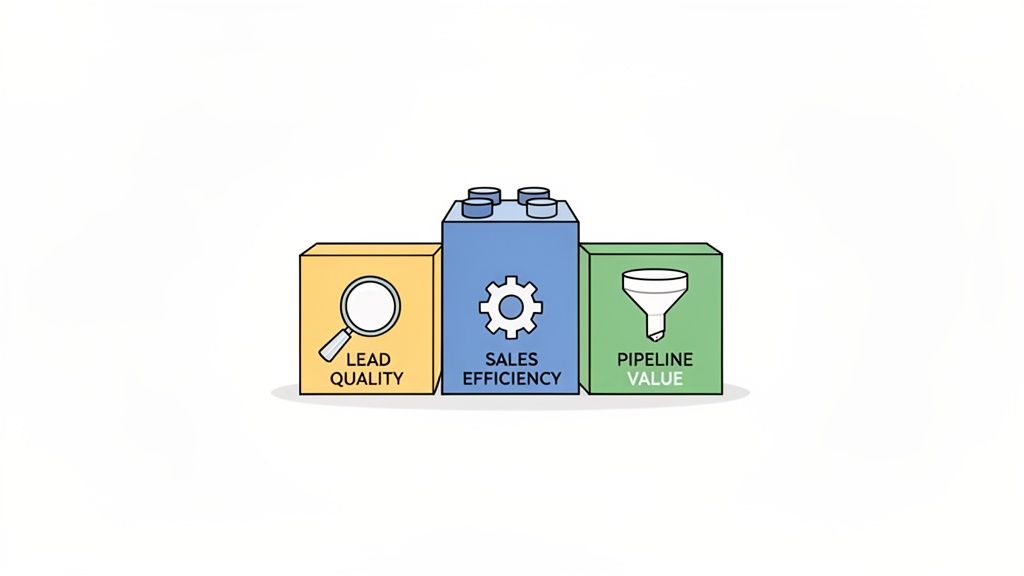
Before writing a single word, your B2B content strategy must be anchored in solid commercial ground. This is not about brainstorming blog titles. It is about aligning every piece of content with tangible business results. The objective is to create content that not only attracts traffic but actively generates high-quality leads and provides your sales team with the tools they need.
Too many businesses create content for its own sake, measuring success with vanity metrics like page views or social media likes. A performance-led approach is different. It measures success by the impact on the sales pipeline. Every article, case study, and webinar must have a clear commercial purpose.
Define a Commercially Viable ICP
The foundation of this approach is a deep, commercially focused understanding of your Ideal Customer Profile (ICP). This goes beyond basic demographics like job titles or company size. A robust ICP is built on the commercial realities your target customers face every day.
You must dig past surface-level pain points to uncover the real business challenges, the triggers that drive purchasing decisions, and the internal politics they must navigate. What operational bottlenecks are they trying to fix? What financial pressures are keeping them awake at night? Who do they need to convince to sign off the budget for a solution like yours?
Answering these questions helps you understand the business case behind their needs. For example, a Head of Operations at a logistics firm is not just looking for “efficiency software.” They are trying to reduce fleet downtime that costs their company £50,000 a month. That is the commercial context your content must address. For more on this, our guide on creating a comprehensive strategy for lead generation offers greater depth on aligning marketing with these core business drivers.
Strategic Takeaway: Your ICP is not just a person; it is a collection of business problems and financial imperatives. If you cannot articulate the commercial pain your ICP is feeling in pounds and pence, your content will never connect with the decision-makers who control the budget.
Translate Business Problems into Content Pillars
Once you have a clear picture of your ICP’s commercial world, the next step is to translate their problems into content pillars. These pillars are the core strategic themes your content will address repeatedly, positioning your services as the logical solution. Think of them as the framework for your entire content marketing strategy for B2B, ensuring everything you publish is relevant and purposeful.
Avoid generic pillars like “Industry Trends” or “Product Features.” You need to focus on outcome-oriented themes.
- Weak Pillar: “Logistics Technology”
- Strong Pillar: “Reducing Fleet Operational Costs”
- Weak Pillar: “Project Management Tips”
- Strong Pillar: “Improving Project Profitability for Agencies”
Each pillar should map directly to a significant business challenge your ICP is facing. For instance, under the “Reducing Fleet Operational Costs” pillar, you could create content on topics like “A 5-Step Framework for Auditing Fuel Spend” or “Calculating the ROI of Predictive Maintenance Software.”
This approach guarantees that every piece of content serves a strategic purpose. It speaks directly to your reader’s commercial interests, proves you understand their world, and naturally positions your company as a credible partner that can deliver measurable results. This is how content ceases to be a marketing expense and becomes a powerful sales-enabling asset.
Map Content Across the Entire Buying Journey
A common mistake is pouring the entire content budget into top-of-funnel blog posts. This may generate a temporary increase in traffic, but the sales pipeline remains empty. The reason is simple: this approach ignores the individuals who are actually ready to discuss business.
A content strategy that only chases awareness is a strategy that fails to deliver commercial value.
To build a revenue-driving system, you must think like your customer and create content for every stage of their buying journey. It is about being the expert resource whether they are just identifying a problem, actively comparing vendors, or trying to secure budget approval.
For a great overview of how to track these interactions, this guide on customer journey analytics is a fantastic resource.
Aligning Content to Buyer Intent
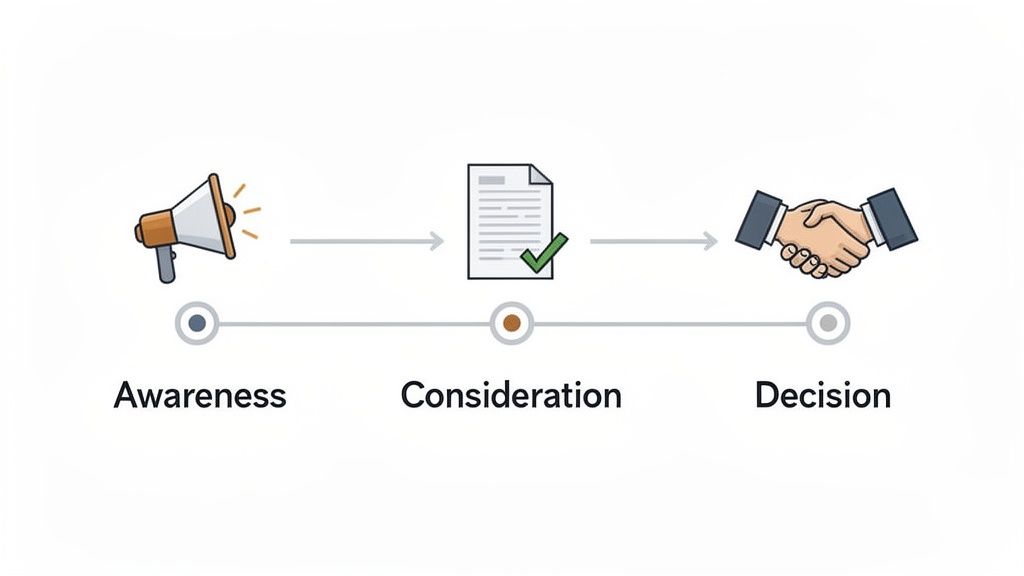
The B2B buying journey is rarely linear, but it can be broken down into three core phases: Awareness, Consideration, and Decision. Each signals a different level of intent, and your content needs to be engineered to match it precisely. Our guide to developing a buying persona is a great starting point for understanding what your audience needs at each stage.
- Awareness Stage: The prospect is experiencing the symptoms of a problem but may not have a name for it. They are looking for educational content that helps them understand their challenge. Your job is to be the trusted advisor who frames the conversation and introduces your brand as an authority.
- Consideration Stage: Now, they have defined their problem and are actively researching how to solve it. They are evaluating different solutions, methodologies, and vendors. Your content here needs to build trust and demonstrate how you solve their problem more effectively than anyone else.
- Decision Stage: The prospect has a shortlist and is seeking final validation to make a choice. They need content that removes risk, justifies the cost, and makes selecting your solution the easiest decision they will make all week. This is where your content directly fuels the sales process.
Here is a simple framework matching content formats to each stage of the B2B buying journey. Use it as a reference for deciding what to create next.
B2B Buyer’s Journey Content Matrix
| Buying Stage | Buyer’s Goal | Effective Content Formats | Commercial KPI |
|---|---|---|---|
| Awareness | Understand a problem or opportunity. | Blog Posts, Infographics, Thought Leadership Articles, Educational Videos, Social Media Content. | Website Traffic, Keyword Rankings, Social Engagement, Newsletter Subscribers. |
| Consideration | Evaluate different solutions and vendors. | Case Studies, Webinars, White Papers, Comparison Guides, Product Feature Sheets. | Marketing Qualified Leads (MQLs), Gated Content Downloads, Webinar Registrations. |
| Decision | Validate a final choice and justify the purchase. | Product Demos, ROI Calculators, Free Trials, Implementation Plans, Customer Reviews. | Sales Qualified Leads (SQLs), Demo Requests, Trial Sign-ups, Conversion Rate. |
Using a matrix like this ensures you have assets ready for every conversation, guiding prospects smoothly from initial interest to a final, confident purchase.
Practical Content Mapping for Commercial Impact
Let us translate this into a practical plan. Mismatching your content format to the buyer’s stage is a certain way to waste time and budget. A high-level thought leadership article will not close a deal, just as a pricing sheet will not attract someone who does not yet recognise their problem.
Strategic Takeaway: You are not just creating individual pieces of content. You are building a connected system of assets designed to guide a prospect from mild curiosity to a signed contract. Each piece should be a signpost, pointing them to the next logical step.
This strategic focus is clear when you look at how UK businesses are investing. The days of “spray and pray” are over. Today, 46 per cent of UK B2B marketers expect their budgets to increase, and that money is being channelled into specific, high-impact areas. Video content (61 per cent) and thought leadership (52 per cent) are at the top of the list, showing a clear drive to engage prospects meaningfully across the entire funnel.
Here is a practical breakdown of the most effective assets for each stage:
- Awareness Content (Educate and Engage):
- Insightful Blog Posts: Address your audience’s biggest questions and pain points.
- Thought Leadership Articles (on LinkedIn): Share a strong, unique perspective on industry trends.
- Educational Videos: Simplify complex topics and make them shareable.
- Consideration Content (Build Trust and Demonstrate Expertise):
- Detailed Case Studies: Nothing builds trust like demonstrating you have already solved the same problem for a similar business.
- Webinar Recordings: Offer a deep dive into a specific topic that showcases your team’s expertise.
- Comparison Guides: Objectively compare your solution against the alternatives.
- Decision Content (Convert and Enable Sales):
- ROI Calculators: Provide your internal champion with the figures they need to build a solid business case.
- Implementation Checklists or Plans: Show them exactly what happens after they sign, removing any fear of the unknown.
- Product Demos and Trials: Let them experience the solution and see its value for themselves.
When you map your content this way, you create a seamless journey. You are always there with the right answer at the right time, building trust and guiding prospects toward becoming valuable customers.
Engineer a High-Performance Distribution Engine
Creating excellent content that speaks directly to your ideal customer’s commercial pain points is only half the battle. Without a systematic, robust method for getting that content in front of them, even the most insightful asset will deliver no business impact.
The old ‘publish and pray’ approach is a complete waste of resources.
A high-performance distribution engine is not about blasting links into the void. It is about strategically placing your content on the channels where your target decision-makers already spend their time. The goal is to build a repeatable process that consistently gets your expertise seen by the right people at the right moment.
For most UK businesses, that conversation starts and ends with one platform: LinkedIn.
Mastering LinkedIn as Your Primary B2B Channel
The data is clear. A staggering 96 per cent of UK B2B marketers use LinkedIn as their main channel for content distribution. It is not just for sharing company news; 89 per cent use it for lead generation, and 62 per cent confirm it produces qualified leads for their business.
As some excellent research shows, a B2B content strategy in the UK that does not lean heavily on LinkedIn is simply not commercially viable.
To make LinkedIn work effectively, you need a multi-layered approach that goes beyond posting from the company page.
- Company Page as a Content Hub: Treat your company page as the official library for your best, most polished content. This is where you house case studies, white papers, and webinar announcements. It is your brand’s official voice.
- Employee Advocacy for Authentic Reach: Your team members have far more reach and credibility than your brand page ever will. Encourage key people, especially in sales and leadership, to share content with their own perspective. A simple post like, “Our new article on reducing fleet costs has an excellent framework on page 3. The key takeaway for me was…” adds a human touch and taps into their valuable personal networks.
- Targeted Engagement in Niche Groups: Identify and actively participate in the LinkedIn Groups where your ideal customers congregate. Do not just drop links. Answer questions, offer genuine advice, and only share your content when it adds real value to an ongoing conversation.
This combination transforms a passive online presence into an active, lead-generating machine.
Integrating SEO, Email, and Paid Amplification
While LinkedIn is the heavyweight, a truly effective distribution engine is a multi-channel system. Your blog, email newsletter, and targeted paid advertising must work in concert to achieve maximum reach and return on your investment.
Each channel has a specific role. Your blog, driven by SEO, is your long-term lead generation asset. It works 24/7 to capture organic search traffic from prospects who are actively seeking the solutions you provide. This is the home for your comprehensive pillar posts and in-depth guides.
Your email newsletter is for nurturing the audience you have already earned. It is a direct line to your most engaged contacts. Use it to share your latest articles, offer exclusive insights, and drive registrations for events.
Strategic Takeaway: Stop thinking of content creation and distribution as separate tasks. A piece of content is only complete once it has been systematically shared across channels designed to reach, engage, and convert your target audience.
Finally, paid amplification is the accelerator. Platforms like LinkedIn Ads or Google Ads allow you to guarantee your best content reaches a laser-focused audience. You can target by job title, industry, and company size, ensuring your budget is spent getting your case study in front of the exact decision-makers you need to influence.
Maximising ROI Through Strategic Repurposing
Creating a high-value pillar piece of content requires a serious investment of time and expertise. To see a positive return, you must extract maximum value from it. This is where content repurposing becomes a commercial necessity, not just a clever tactic.
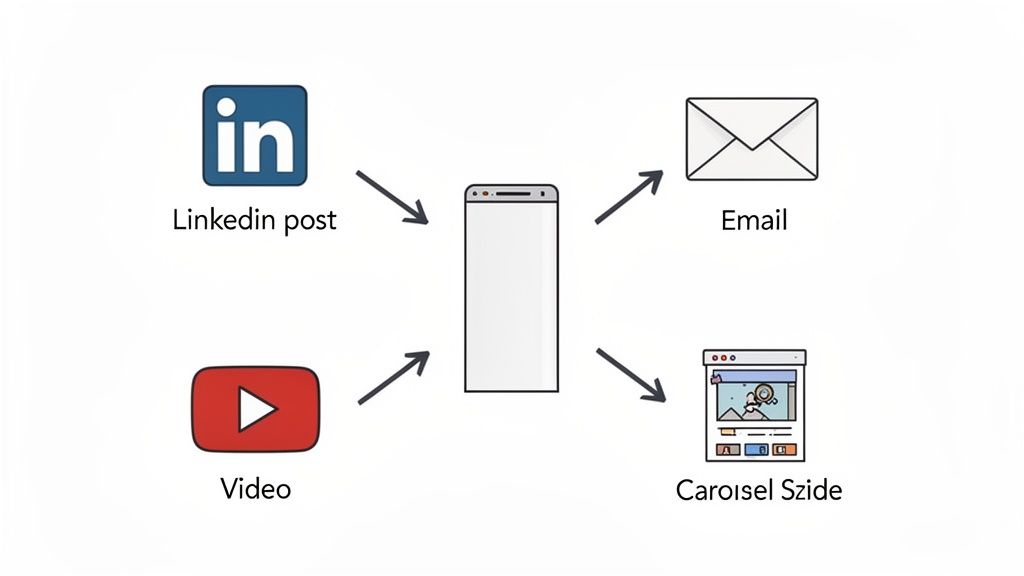
The concept is simple: take one large piece of content and break it down into smaller assets tailored for different channels. This extends the lifespan and reach of your core message without requiring you to start from scratch each time. For a deeper dive, check out our guide on repurposing content to extend the lifespan of your marketing assets.
Here is what that looks like in practice:
- Start with a Pillar Piece: A substantial, 2,000-word blog post on “How to Reduce Operational Inefficiencies in Manufacturing.”
- Create a Video Script: Extract the main points and turn them into a 5-minute educational video for YouTube and your website.
- Design a LinkedIn Carousel: Extract 5-7 key statistics or steps from the article and create a sharp, visually engaging carousel post.
- Write a Newsletter: Summarise the core argument in your next email, driving traffic back to the full article on your site.
- Draft Social Snippets: Create a handful of short text posts for LinkedIn, each focusing on a single, powerful tip from the original piece.
This systematic workflow multiplies the impact of your initial effort, keeping your brand visible and delivering value across multiple touchpoints, all from one foundational piece of work.
Use AI and Analytics to Determine What Works
A strategy based on “gut feel” is a fast track to a wasted budget. For repeatable, scalable growth, every decision must be backed by data. This is where AI and analytics cease to be buzzwords and become your most important tools for driving commercial results.
Relying on intuition leads to inconsistent outcomes and wasted effort. A data-driven feedback loop, however, allows you to identify what works, why it works, and how to do more of it. Your content stops being a creative gamble and becomes a predictable engine for lead generation.
Using AI for a Smarter Content Strategy
The role of generative AI in content marketing now extends far beyond drafting blog posts. For a smart B2B business, its real power is in strengthening the strategic process, making your team faster and more effective at every stage.
Think of AI less as a content writer and more as a junior strategist or a tireless research assistant. It can analyse search data, pinpoint the exact questions your customers are asking, and help you structure content outlines built on genuine audience demand. You no longer have to guess what your audience wants to read; you can build content that directly answers what they are already asking.
Here are a few practical ways to implement this:
- Audience Insight Mining: Use AI tools to scan online forums, review sites, and social media conversations to find the exact language your ideal customers use to describe their problems.
- Data-Driven Ideation: Input a competitor’s article into an AI tool and ask it to identify content gaps or unanswered questions. You will know exactly how to make your content superior.
- Structured Outline Generation: Request an SEO-optimised outline for a target keyword, complete with H2s, H3s, and a list of frequently asked questions to include.
This approach ensures that before a human writer begins, the content is already strategically sound and aligned with both user intent and your commercial goals. As search continues to evolve, getting this right is non-negotiable. It is crucial to learn how to optimize content for AI search to ensure your content is visible.
Measuring What Matters: Commercial KPIs
Once your content is live, analytics takes over. The key is to look past vanity metrics like page views or social media likes. While they might feel good, they tell you nothing about commercial impact. A performance-focused strategy tracks metrics that tie directly to revenue.
This shift towards data is becoming the norm. Across the UK, the use of generative AI for content tasks has grown significantly, with over 72 per cent of B2B marketers now using these tools. This push for efficiency is coupled with a focus on measurement; 30.55 per cent of UK marketers state that data analytics directly informs their best strategies, leading to better ROI. This data-first mindset is essential for tracking engagement that influences the sales pipeline.
Strategic Takeaway: Your analytics dashboard should tell a commercial story. If you cannot draw a clear line from a piece of content to a tangible business outcome, you are measuring the wrong things.
Focus your reporting on these commercially relevant KPIs:
- Content Conversion Rate: Of all the people who read an article, what percentage takes the next valuable step, such as downloading a resource or booking a demo? This is the ultimate test of your content’s persuasiveness.
- Cost Per Lead (CPL): Track the resources invested in creating and distributing content and measure it against the leads it generates. This gives you a CPL, allowing you to compare content efficiency against other channels like paid ads.
- Content-Influenced Pipeline: Use your CRM to track how many open sales opportunities have engaged with specific content assets. This demonstrates your content’s role in nurturing leads and supporting the sales team.
By monitoring these KPIs, you create a powerful feedback loop. The data shows which topics, formats, and distribution channels are driving real business. This allows you to double down on what works and confidently justify every penny of your content marketing investment.
Launch Your 90-Day Action Plan
A strategy without a clear execution plan is just an idea. While a documented strategy is a good start, consistent, focused action is what truly drives results.
This is a pragmatic, 90-day launch plan designed to get your B2B content marketing engine running and delivering tangible results quickly. We will focus on high-impact activities that build a solid foundation while generating quick wins.
The goal is to move from theory to reality, building momentum that proves the value of your content marketing from day one.
Month 1: Foundations and Quick Wins
The first 30 days are about getting your house in order and capitalising on your easiest opportunities. Before you create anything new, you must establish a baseline for measurement and extract more value from what you already have. This approach builds momentum and provides immediate data to work with.
Here is where to focus:
- Implement Correct Tracking: Stop operating blind. Ensure Google Analytics 4 is installed and correctly configured to track key conversions like contact form submissions or demo requests.
- Run a ‘Quick Wins’ Audit: Analyse your existing content to find your top 10-15 blog posts. Look for articles that already receive some traffic or are ranking for relevant keywords on the second or third page of Google.
- Refresh and Relaunch: Update these high-potential posts with current statistics, add new insights, sharpen the on-page SEO, and include a compelling call-to-action. Then, relaunch them as if they are new.
- Start a Simple LinkedIn Series: Begin a consistent, weekly thought leadership post on LinkedIn. Keep it simple; it could be a ‘Myth-Busting Monday’ or a ‘Friday Framework’. The key is consistency, not complexity.
By the end of Month 1, you should have a clear view of your website’s performance and have measurably improved the lead-generation capability of your existing content. The focus is on optimising what you already have.
Month 2: Build a Content Rhythm
With the foundations set, Month 2 is about starting content production. This is where you shift from optimising the past to building the future of your content marketing strategy for B2B. The focus is on creating a repeatable workflow for producing and distributing high-value content.
The timeline below shows how you can structure an efficient content workflow, from the initial idea through to performance analysis.
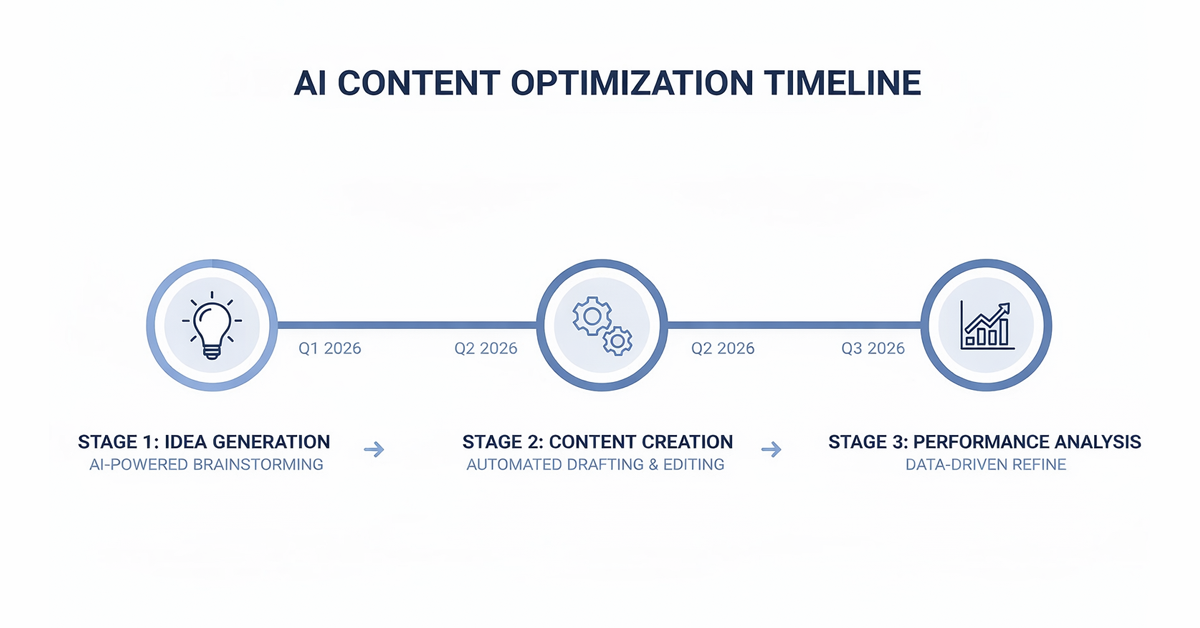
This structured process ensures that every piece of content is strategically planned, efficiently created, and rigorously measured for performance.
Your key actions this month:
- Publish Two Pillar Posts: Based on your content pillars, create two substantial, in-depth articles that solve a major pain point for your ideal customer. Think ultimate guides or deep-dive tutorials.
- Repurpose Everything: Turn each pillar post into at least three smaller assets. A LinkedIn carousel, a short video script, and a series of social media tips are excellent starting points.
- Launch Your Newsletter: If you do not have an email newsletter, now is the time. Send out your first two editions, sharing your new pillar content and offering exclusive insights.
- Systemise Employee Advocacy: Make it easy for your team to share new content. Create a simple process and provide them with pre-written copy to share with one click.
Month 3: Analyse, Learn, and Optimise
The final month of your launch plan is about analysing the data to determine what is working. You now have two months of baseline data and one month of performance from your new content. It is time to separate what you think works from what the data proves works.
The goal is to refine your approach for the next 90 days.
- Dig into Your KPIs: Review your analytics. Which articles drove the most qualified leads? Which distribution channels had the best engagement? What was your cost per lead?
- Get Qualitative Feedback: Talk to your sales team. Did they use any of the new content? Did any prospects mention a particular blog post on a call? This is where the real insights lie.
- Plan Your Next 90-Day Sprint: Using your findings, decide which topics and formats to focus on next. Refine your editorial calendar with themes and ideas that have proven they can generate commercial interest.
By following this 90-day plan, you will have moved from a document to a functioning, lead-generating content engine. You will have a clear workflow, real-world data, and the insights needed to make smarter decisions for predictable, long-term growth.
To give you a clearer overview, here is how the entire 90-day plan breaks down.
90-Day B2B Content Marketing Launch Plan
| Phase (Month) | Core Focus | Key Actions | Success Metric |
|---|---|---|---|
| Month 1 | Foundation & Quick Wins | Set up analytics/tracking, conduct ‘quick wins’ content audit, refresh/relaunch top 10-15 posts, launch a weekly LinkedIn series. | +15% increase in leads from existing content; baseline performance metrics established. |
| Month 2 | Content Rhythm & Production | Publish 2 pillar posts, repurpose each into 3+ assets (e.g., carousel, video), launch bi-weekly newsletter, systemise employee advocacy. | 2 high-value pillar assets published; 6+ repurposed assets distributed; newsletter list growth. |
| Month 3 | Analysis & Optimisation | Review KPIs (leads, engagement), gather qualitative feedback from the sales team, analyse channel performance, plan the next 90-day sprint. | Clear data on top-performing content/channels; data-backed plan for the next quarter. |
This structured plan provides a clear roadmap, ensuring that your efforts are focused, measurable, and build upon each other month after month.
Frequently Asked Questions
Once you have the blueprint for your content marketing strategy for b2b, practical questions often arise. Here are direct answers to the most common queries we hear about budgeting, proving value, and setting up your team for success.
How Much Should a Business Budget for B2B Content Marketing?
There is no single figure. Your budget will depend on your business goals, market competitiveness, and in-house resources.
As a general guideline, many businesses allocate between 5% and 15% of their total marketing budget to content. However, this is just a starting point.
A more strategic approach is to work backwards from your revenue targets.
- Define your lead target. Determine how many qualified leads content needs to generate each month.
- Calculate your Cost Per Lead (CPL). Analyse your other marketing channels to establish a realistic CPL for your industry. For example, if your target CPL is £150 and you need 20 leads per month, this gives you a monthly budget of £3,000.
- Allocate the budget. This £3,000 would cover writing, design, video production, and any paid promotion required to hit that 20-lead target.
This method frames your budget as a direct investment in revenue, shifting the conversation from “how much are we spending?” to “what return are we generating?”.
How Can I Prove the ROI of Content Marketing?
To prove the return on your content, you must look beyond vanity metrics like page views. Your leadership team cares about the sales pipeline, not website traffic. The key is to connect the dots between a prospect consuming your content and them entering the sales process.
Here are the metrics that matter:
- Content-Sourced Leads: Use tracking tools to identify exactly how many new leads originated directly from a piece of content, for example, by downloading a guide and becoming a CRM contact.
- Content-Influenced Pipeline: Speak with your sales team. Find out which articles, case studies, or webinars they use to advance deals. If a prospect reads three of your case studies before signing a contract, that is a win influenced by content.
- Lead-to-Customer Conversion Rate: Compare the conversion rate of leads from content to those from other channels. If your content is effective, it should attract higher-quality prospects who convert into customers at a better rate.
The bottom line: The clearest way to prove ROI is by demonstrating that leads who engage with your content become customers faster, and at a higher value, than those who do not.
Building a high-performance content marketing strategy for b2b requires more than a plan; it demands relentless focus and expert execution. If you are looking for a partner to build a content engine that delivers a predictable pipeline of qualified leads, Lead Genera can help. Get in touch to discuss your growth goals.
Categories
Do You Need Assistance With
Sign Up To Our Newsletter