


Weekly marketing wisdom you can read in 5 minutes, for free. Add remarkable ideas and insights to your inbox, once a week, by subscribing to our newsletter.
Lead Generation
How to Generate Leads From LinkedIn for B2B Growth
Before sending a single connection request, you must turn your LinkedIn profile from a CV into a lead-generating asset. It is the foundation of your entire strategy on the platform.
When a prospect lands on your profile, you have one opportunity to make a credible first impression. An unfocused or self-serving profile will repel them. A profile built with commercial intent, however, builds immediate authority and becomes the command centre for all your activity.
Your profile is a dedicated landing page. Its primary job is not to list your accomplishments, but to qualify visitors, demonstrate your value, and guide the right people towards a conversation. It must immediately answer their unspoken question: “What’s in it for me?”
Table of contents:
Build Your Profile for Commercial Impact
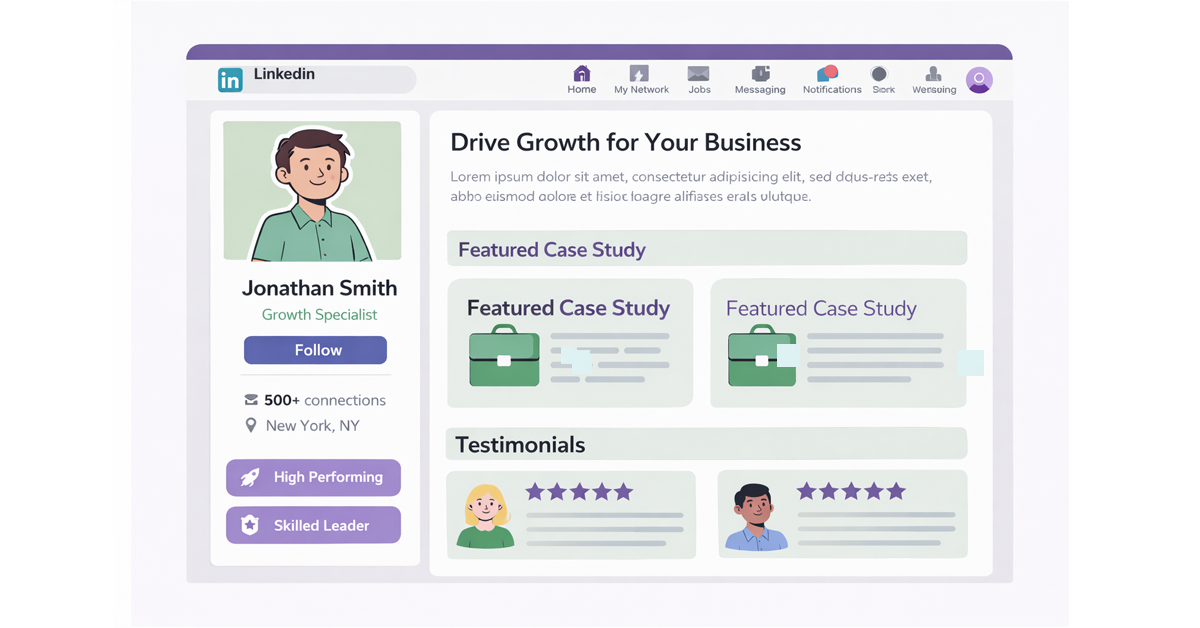
Craft a Client-Focused Headline
Your headline is the most critical text on your profile. It follows you everywhere on the platform, appearing in search results, comments, and connection requests. Most professionals waste this space with a generic job title like “Managing Director” or “Sales Manager”. This tells people what you are, not what problem you solve.
A powerful headline is always client-centric. It must capture your ideal customer’s attention by speaking directly to their business pains or commercial goals.
-
Instead of: “Founder & CEO”
-
Try: “Helping B2B Tech Founders Secure Their Next Funding Round with Proven Go-To-Market Strategies”
-
Instead of: “Marketing Consultant”
-
Try: “Driving Predictable Pipeline Growth for UK Manufacturing Firms Through Targeted Demand Generation”
The difference is significant. One is a label; the other is a value proposition that instantly attracts and qualifies the right audience. This simple change makes your efforts to generate leads from LinkedIn far more efficient.
Write an ‘About’ Section That Converts
Once your headline has secured their interest, your “About” section must build the case for a conversation. This is not the place for a third-person biography. It should be a direct, persuasive narrative that connects your prospect’s problems to your solutions.
A simple, effective structure is:
- The Hook: Start with a bold statement or a question that addresses your prospect’s primary pain point.
- The Problem: Demonstrate that you understand their challenges. This builds empathy and proves you are familiar with their commercial environment.
- The Solution: Explain how you help businesses overcome these specific issues. Frame your services as the clear path to their desired outcome.
- The Proof: Add credibility with a key statistic, a short client quote, or a mini case study. For example, “We helped a similar firm reduce its cost per lead by 35% in six months.”
- The Call to Action: Tell them exactly what to do next. Make it a low-friction action, such as booking a discovery call or downloading a relevant guide.
Your summary is not about you. It is about what you can do for your future client. Every sentence should be written through the lens of the value and commercial results you deliver.
Use the Featured Section as a Lead Magnet
The “Featured” section is prime real estate on your profile, yet many people leave it blank. Think of it as your portfolio, designed to provide instant value and capture interest. Ignoring it is a significant missed opportunity.
Strategically, this section should be a hub for your best lead magnets and proof points. You can effectively turn your profile into a resource that nurtures prospects 24/7.
- Showcase a powerful case study detailing how you solved a specific problem for a client, focusing on measurable business outcomes.
- Link to a high-value guide or white paper that your ideal clients would find genuinely useful.
- Feature a client testimonial video to add social proof and a human touch to your claims.
By making these foundational changes, you shift your profile from a static page into an active, strategic asset. This groundwork is essential for anyone serious about improving their Social Selling Index and building a predictable sales pipeline.
Find High-Value Prospects with Systematic Targeting
Once your profile is optimised for conversion, it is time to find the right people to connect with. Sending random connection requests is a waste of time and can damage your professional reputation. The goal is to build a precise, qualified list of prospects before you begin outreach. This ensures every effort is aimed at individuals who are a genuine fit for your services.
You must shift from a high-volume, scattergun approach to a high-quality, targeted one. LinkedIn’s scale is both an asset and a liability. In early 2025, the platform had 47.6 million users in the UK, covering 68.6% of the population. This user base grew by 15.4% in one year, giving you incredible access to decision-makers. It also makes it easy to get lost in the noise.
Choosing Your Prospecting Toolkit
For finding prospects, LinkedIn offers two main options: the standard search function and the more powerful Sales Navigator. While the free search is adequate for casual networking, any business serious about generating consistent leads will quickly reach its limits.
Sales Navigator is built specifically for prospecting. It is packed with advanced filters that allow for incredibly granular targeting. This is not just a convenient feature; it is a strategic advantage that directly improves lead quality and the efficiency of your sales process.
Here is a breakdown to help you decide which is right for you.
LinkedIn Search vs Sales Navigator Core for Prospecting
This table compares the key prospecting features in LinkedIn’s free search and the paid Sales Navigator Core subscription to help you determine which suits your business needs.
| Feature | LinkedIn Free Search | LinkedIn Sales Navigator Core |
|---|---|---|
| Monthly Searches | Limited (around 300 per month) | Unlimited |
| Advanced Filters | Basic (Job Title, Industry, Location) | Extensive (Company Headcount, Seniority, Years in Role, Posted Content Keywords) |
| Lead Lists | No dedicated feature | Yes, create and save targeted lead lists |
| Lead Recommendations | None | Yes, suggests similar prospects based on your saved leads |
| InMail Credits | None | 50 per month for outreach to non-connections |
| Boolean Search | Limited support | Full support for complex queries |
| Alerts & Updates | Basic job change alerts | Advanced alerts on lead and account activity |
Ultimately, if you are building a scalable system to generate leads from LinkedIn, investing in Sales Navigator is a logical business decision. The precision it offers provides a significant commercial advantage.
Mastering Advanced Search Filters
The strategic value of Sales Navigator lies in how you can combine multiple filters to create hyper-specific lead lists. When you move beyond basic criteria like job title and industry, you can pinpoint individuals who match your ideal customer profile with accuracy.
Here are a few commercially powerful filters to use:
- Company Headcount: Focus on businesses of the right size, from start-ups to established enterprises.
- Seniority Level: Go straight to decision-makers such as Directors, VPs, or C-level executives and bypass gatekeepers.
- Years in Current Role: An excellent filter for identifying newly appointed leaders, who are often more open to implementing new solutions.
- Posted Content Keywords: This filter is invaluable. It helps you find prospects who are actively discussing the exact problems your business solves.
Imagine you run a software firm. You could target “Heads of Operations” at UK logistics companies with 50-200 employees, who have been in their role for less than a year and have recently posted about “supply chain efficiency.” That level of detail is impossible with the standard search.
The objective is to build a list so targeted that every person on it represents a potential high-value conversation. This disciplined approach dramatically increases your connection acceptance and reply rates, ultimately lowering your cost per lead.
Using Boolean Search for Surgical Precision
To refine your targeting further, you need to become proficient with Boolean search operators. These simple commands, typed directly into the keyword field, act as logic filters, allowing you to include or exclude specific terms.
The most useful operators are:
- AND: Narrows your search. “Marketing AND automation” will only show profiles containing both terms.
- OR: Broadens your search. “Director OR founder” will show profiles with either title.
- NOT: Excludes specific terms. “Sales NOT assistant” is effective for filtering out junior roles.
- Quotation Marks “”: Searches for an exact phrase, such as “Head of Digital Marketing”.
Combining these filters and operators transforms prospecting from a vague search into a surgical operation. By creating and saving these highly defined searches, you build a dynamic pipeline of ideal prospects. This ensures your outreach efforts are always focused on the people who matter to your business.
If you are running paid campaigns alongside organic activity, read our guide on making the best use of LinkedIn audience targeting to ensure perfect alignment.
Craft Outreach Messages That Get Replies
You have built a targeted list of prospects. Now comes the stage where most people fail: the outreach. Generic, copy-pasted messages are the fastest way to be ignored. They waste your time and can actively damage your professional reputation.
Effective outreach is not about sending a sales pitch; it is about starting a genuine conversation. Position yourself as a helpful consultant, not a salesperson. This requires a thoughtful, multi-touchpoint strategy that builds trust before you ask for anything. The goal is to create messages that feel personal and offer immediate value, demonstrating respect for their time.
This simple workflow is the foundation, ensuring you are only communicating with the right people from the start.

By following this process, your outreach becomes highly efficient because every message is directed at someone who is a strong potential fit.
The Connection Request: Your First Impression
Your connection request note is your digital handshake. As your first direct interaction, it must be effective. The default “I’d like to add you to my professional network” is lazy. It signals a lack of effort and is a wasted opportunity.
Your mission is to be memorable and provide a compelling reason to click ‘Accept’.
The best requests are brief, personalised, and never contain a sales pitch. Find a relevant point of common ground and lead with that. It shows you have done your research, which instantly sets you apart.
- Reference shared content: “Hi Sarah, I saw your recent post on supply chain logistics; your point about last-mile delivery was spot on. I would be glad to connect and follow your insights.”
- Mention a mutual connection or group: “Hi David, I noticed we’re both in the ‘UK Marketing Leaders’ group and have enjoyed your contributions. I am always keen to connect with other experienced marketers.”
This simple act of personalisation can transform your acceptance rates.
The Multi-Touchpoint Value Sequence
Once they accept, the real work begins. The classic mistake is to immediately send a direct message with your pitch. This is the quickest route to being ignored or removed.
Instead, implement a patient, value-driven sequence that builds rapport over several days. This approach warms up the conversation naturally and builds a foundation of trust before you hint at business.
Your initial outreach should focus entirely on giving value and starting a conversation. The commercial discussion can only happen after you have earned the right to have it. This patient approach is fundamental to generating high-quality leads from LinkedIn.
A simple yet effective sequence could look like this:
- The Thank You & Initial Value: Within 24 hours of connecting, send a brief thank-you message. Reference something specific from their profile again, then offer a genuinely useful resource with no strings attached, such as a relevant industry report, a helpful article, or a link to a useful tool.
- The Follow-Up Engagement: A few days later, find one of their recent posts and leave a thoughtful comment. Go beyond “great post”. Add to the conversation, ask an intelligent question, or share a related perspective. This keeps you on their radar in a non-intrusive way.
- The Gentle Pivot to Business: After demonstrating value over a few more days, you can carefully steer the conversation towards a commercial context. Frame your question around their world, not your product. For example: “Seeing that you’re the Head of Operations at [Company], I was curious how your team is navigating the current challenges with [Common Problem].”
Why Personalisation Is Non-Negotiable
The data from UK B2B marketers is clear: personalised strategies are essential. LinkedIn is ranked as the top channel for high-quality leads by 40% of marketers, delivering an average conversion rate of 6.3%.
Personalised connection requests see acceptance rates as high as 67%. When you pair LinkedIn outreach with email, you can see 34% higher response rates than with email alone. A thoughtful, human approach is a commercial imperative, not just a preference.
Use Content to Build Authority and Attract Inbound Leads

Sending connection requests and direct messages is only one side of a successful LinkedIn strategy. The other, more powerful side, is pulling leads towards you by becoming a recognised voice in your industry. A smart content plan turns you from a salesperson into a trusted authority.
When your ideal clients repeatedly see you sharing genuine, helpful insights, you stop being just another vendor and become a resource. This dual approach of proactive outreach and valuable content makes prospects infinitely more receptive when you do reach out. Your name is already familiar and associated with expertise.
Develop Your Core Content Pillars
Posting randomly is a recipe for being ignored. You need structure. Start by defining three to five core content pillars. These are the big-picture topics you want to own, and they should map directly to the problems you solve for your clients.
For a B2B marketing consultant, the pillars might be:
- Pipeline Generation for SaaS Firms
- Marketing Automation Workflows
- Measuring and Proving Marketing ROI
Every post you create should link back to one of these pillars. This simple system keeps your messaging consistent, reinforces your expertise, and removes the daily challenge of deciding what to post.
Choose High-Impact Content Formats
Not all content is created equal, especially when your goal is to start commercial conversations. For B2B services, some formats are more effective at showcasing your expertise and encouraging engagement.
- Insightful Text-Only Posts: Perfect for sharing a strong opinion, a brief story from experience, or a question that encourages reflection. Their direct feel makes them personal and excellent for sparking debate in the comments.
- Document Carousels (PDFs): Carousels are an excellent format for breaking down a complex idea or a step-by-step process into digestible slides. They position you as a teacher and keep people engaged, which the LinkedIn algorithm favours.
- Short, Actionable Videos: You do not need a production studio. A simple one or two-minute video from your phone, sharing a specific tip or debunking a common myth, is incredibly powerful. It puts a face to your name and demonstrates your expertise dynamically.
Mixing these formats keeps your feed fresh and caters to different learning preferences. This is a key part of a wider strategy, which you can read more about in our guide on content marketing for lead generation.
The Commercial Value of Engagement
Publishing your own content is only half the battle. The other half is strategically engaging with content from others. This is one of the most underrated lead generation tactics on the platform.
When you leave thoughtful, insightful comments on posts from key prospects or industry influencers, you achieve several objectives at once. You get your name in front of their network, you prove your expertise on a relevant topic, and you build a relationship without being sales-focused.
A valuable comment is a mini-piece of content in itself. It should add to the conversation, offer a new perspective, or ask an intelligent question. A simple “great post” adds no value and is easily ignored.
This activity keeps you top-of-mind. When you eventually send a connection request or follow up with a message, you are not a stranger. The prospect already recognises your name from the value you added, which changes the dynamic from a cold pitch to a warm conversation.
Measure What Matters to Improve Your ROI
Investing time and energy in LinkedIn without tracking the return is commercially unsound. To build a predictable, scalable lead generation system, you must look past vanity metrics like profile views and focus on the numbers that feed your sales pipeline.
You cannot improve what you do not measure. By tracking a few key performance indicators (KPIs), you create a powerful feedback loop. You will quickly see what resonates with your audience and can fine-tune your strategy for maximum impact. This is the difference between occasional success and a sustainable system for growth.
Key Performance Indicators for Outreach
Think of your outbound prospecting as a funnel. Tracking the conversion rate at each stage is key to spotting weaknesses in your process. If results are not meeting expectations, the data will show you exactly where the problem lies.
The most critical metrics to monitor are:
- Connection Acceptance Rate: The percentage of connection requests that are accepted. If it is below 20%, it is a strong sign that your targeting is off or your connection message is not personalised enough.
- Message Reply Rate: This tracks how many new connections reply to your first follow-up message. A low number here usually means your opening message is too sales-focused or fails to offer immediate value.
- Positive Reply Rate: Not all replies are good replies. This metric filters out “no thanks” responses and tracks the percentage of replies that are positive or neutral, showing genuine interest in a conversation. It helps you gauge real engagement.
- Meetings Booked: This is the ultimate goal of your outreach. Tracking the number of qualified sales meetings booked from your LinkedIn activity draws a straight line from your efforts to tangible business opportunities.
Your LinkedIn activity is a funnel. A high connection rate but a low reply rate points to a problem with your messaging, not your targeting. Analysing each stage helps you pinpoint exactly what needs fixing.
Building a Simple Tracking Framework
You do not need complex software to start. A simple spreadsheet is sufficient to track your KPIs and see what is working. Set it up to log your activity each week and review the numbers monthly to identify trends.
Your tracking sheet should include columns for:
- Week/Month
- Connection Requests Sent
- Connections Accepted
- Initial Messages Sent
- Replies Received
- Positive Replies
- Meetings Booked
With this raw data, calculating your key conversion rates is straightforward. This weekly habit ensures accountability and provides the insights needed to make smart, strategic adjustments.
Tying Metrics to Commercial Outcomes
These numbers are powerful because they connect directly to your bottom line. For UK businesses, this data-driven approach is critical. Multi-channel strategies that include LinkedIn see conversion rates increase by 287% compared to single-channel efforts.
With 79% of B2B marketers agreeing that LinkedIn is a strong source for leads, optimising your process is not optional. You can find more of the latest UK marketing statistics at Our Own Brand.
By improving your connection and reply rates, you directly increase the number of conversations you start. By refining your messaging to boost the positive reply rate, you improve the quality of those conversations. It is a systematic way to book more meetings, build a healthier sales pipeline, and achieve a better return on the time you invest in the platform.
Frequently Asked Questions About LinkedIn Lead Generation
Understanding the finer points of using LinkedIn for lead generation can be challenging. Here, we tackle the most common questions from business owners and marketing leaders, providing clear, practical answers.
How Much Time Do I Need to Commit?
Consistency is more important than intensity. A major effort once a month is ineffective. A small, focused daily habit is what works.
Aim for 20 to 30 minutes of focused activity each day. This time should not be for mindless scrolling. Use it for high-value tasks: send a few well-researched connection requests, reply to ongoing messages, and leave insightful comments on posts from your target prospects. This simple daily routine builds momentum and delivers results.
Is LinkedIn Sales Navigator Worth the Cost?
For any B2B business that relies on a steady stream of new leads, the answer is yes. The free version of LinkedIn is suitable for maintaining a network, but Sales Navigator is a professional prospecting tool designed to provide a commercial edge.
Its advanced search filters are the main benefit. They allow you to be incredibly specific in a way the standard search cannot match. You can find people based on their company’s size, seniority, recent job changes, or even keywords from content they have shared.
This precision means you build better lead lists from the start, making your entire outreach process more efficient and profitable. If you are serious about generating quality leads on LinkedIn, consider Sales Navigator a core part of your toolkit, not an optional extra.
What Is the Biggest Mistake People Make?
The single biggest mistake is attempting a hard sell immediately. Sending a connection request or a first message that is a sales pitch is a guaranteed way to be ignored. It is impersonal and shows a lack of research.
Remember, your first goal is not to make a sale; it is to start a conversation. You must earn the right to talk business by building rapport first.
Your first few interactions should demonstrate a genuine interest in them and their work. Share a useful article, mention a post they wrote, or ask an intelligent question. This patient, value-first approach positions you as a helpful expert, not just another salesperson, and significantly boosts your chances of getting a reply.
Should I Focus on My Personal Profile or My Company Page?
Your personal profile is your number one tool for organic lead generation. People connect with, trust, and buy from other people, not from a company logo. Your profile is where you build your professional reputation, share your expertise, and have the human conversations that lead to business.
The Company Page has a different but vital role. It is your brand’s home base on LinkedIn, essential for credibility, sharing company news, and, most importantly, running LinkedIn advertising campaigns.
A simple way to differentiate them is:
- Personal Profile: For building relationships and conducting one-to-one conversations.
- Company Page: For building brand credibility and running paid advertising campaigns.
For proactive, day-to-day lead generation, your personal profile is where you should consistently invest your time.
Your LinkedIn strategy is a critical component of your growth engine. At Lead Genera, we specialise in building and executing data-driven lead generation campaigns that deliver a predictable pipeline of qualified sales opportunities. Discover how we can help you achieve measurable results.
Categories
Do You Need Assistance With
Sign Up To Our Newsletter