


Weekly marketing wisdom you can read in 5 minutes, for free. Add remarkable ideas and insights to your inbox, once a week, by subscribing to our newsletter.
Lead Generation
How to Generate B2B Leads: A Strategic Playbook for Growth
Generating a predictable pipeline of B2B leads comes down to a clear, commercially grounded formula: understand exactly who you are selling to, deliver genuine value before asking for a sale, and be visible where your ideal customers are already looking for solutions.
This represents a fundamental shift away from outdated, interruptive sales tactics. The goal is to build an integrated system that attracts prospects with valuable insight (inbound marketing) while proactively engaging the right accounts at the right time (targeted outbound). This positions your business as the logical choice when a prospect is ready to engage.
Table of contents:
The Commercial Reality of Modern B2B Lead Generation
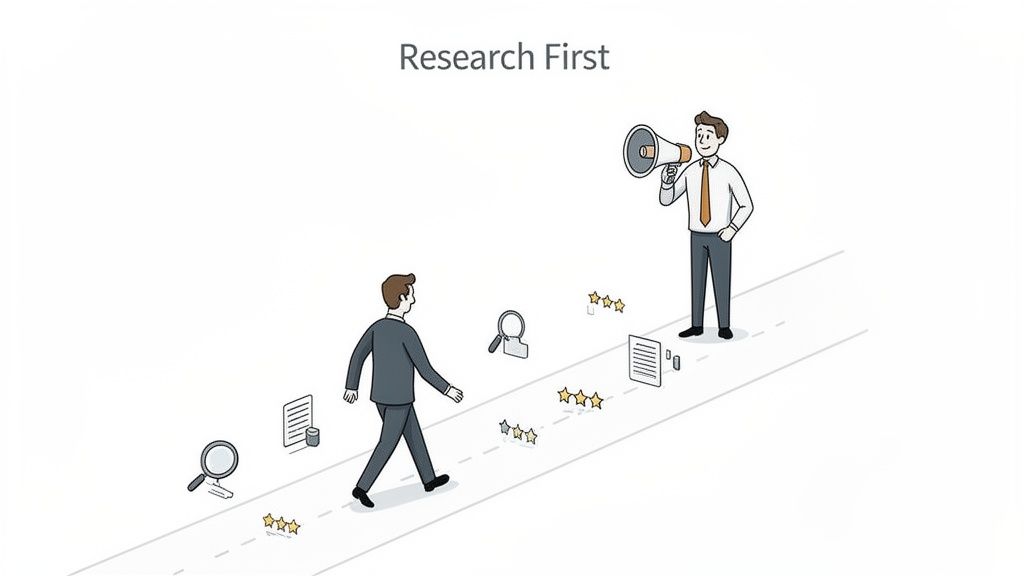
Before discussing tactics, we must acknowledge a critical shift in the market. The modern B2B buyer is in control. They conduct the majority of their research, comparison, and evaluation long before they are willing to speak with a salesperson.
This is not a passing trend; it has profound implications for how you generate revenue. Data shows that UK B2B buyers complete approximately 70% of their purchasing journey before contacting a potential supplier. Furthermore, a remarkable 81% have already selected a preferred vendor by the time they initiate contact.
These figures demand a change in approach. You can find further analysis on the modern buyer’s journey at whitehat-seo.co.uk, but the strategic takeaway is clear: high-volume, scattergun tactics are no longer commercially viable. Your strategy must focus on building trust and demonstrating expertise much earlier in the decision-making process.
This means that generating B2B leads cannot be a series of disconnected activities. It requires a cohesive system, engineered to influence prospects during their independent research phase.
The Four Pillars of a Performance-Led Strategy
To build a sales pipeline that is both predictable and profitable, your entire approach must be built on four strategic pillars. Each is essential for navigating the modern buyer’s journey and ensuring every pound of marketing spend delivers a measurable return.
A successful B2B lead generation system can be broken down into these core components, each with a clear commercial objective.
| Pillar | Description | Key Objective |
|---|---|---|
| Strategy | Your strategic framework. It defines precisely who you target (your ICP), the specific commercial problem you solve, and how you position your offer to differentiate in a crowded market. | Ensure all marketing investment is focused, efficient, and aligned with your most profitable customer segments. |
| Channels | The pathways used to reach your audience. A strategic mix of inbound (SEO, content) and outbound (email, LinkedIn, paid advertising) is essential for building awareness and capturing active demand. | Achieve visibility wherever your ideal customers are seeking solutions. |
| Conversion | The operational core, focused on turning anonymous website visitors and prospects into qualified leads. This involves engineering your website and landing pages into efficient conversion assets, not just digital brochures. | Maximise the volume of qualified leads from your existing website traffic and marketing campaigns. |
| Measurement | You cannot optimise what you do not measure. This requires tracking commercially relevant metrics like Cost Per Lead (CPL) and lead quality to inform strategic decisions. | Drive profitable growth by scaling what works and eliminating inefficient spend. |
Each pillar supports the others. A robust strategy is ineffective without the right channels, and the best channels fail if your website cannot convert the resulting traffic. Executing all four effectively creates a lead generation engine that consistently fuels business growth.
Define Your Ideal Customer and High-Value Offer
Before launching any campaign or writing a single line of advertising copy, the foundational work of lead generation begins. It starts with a commercially focused, almost forensic understanding of your best customers and the business problems that drive their decisions.
Failure at this stage results in wasted marketing spend, targeting businesses that were never a viable commercial fit.
The first critical step is to develop your Ideal Customer Profile (ICP). An ICP is not a vague description of a company’s size or sector. It is a strategic document defining the specific characteristics of businesses that derive the most value from your services, making them the most profitable to acquire.
This process ensures every marketing pound is directed at prospects who are a perfect operational and commercial fit. For a solid overview of this and other essential tactics, EmailScout offers a comprehensive guide on how to generate B2B leads for predictable growth.
Building a Practical Ideal Customer Profile
A robust ICP moves beyond generic firmographics to explore the real-world context of your target accounts. The most effective starting point is to analyse your existing best customers: those who are profitable, easy to service, and achieve exceptional results with your product or service.
Identify the common threads that connect them:
- Firmographics: What is their typical annual revenue? How many employees do they have? Are they concentrated in specific UK regions, such as the Midlands or the South East?
- Technographics: What software or technology stack are they currently using? This can provide critical insights into their operational maturity and potential integration needs.
- Behavioural Triggers: What events typically precede their need for a solution like yours? This could be a recent funding round, the appointment of a key executive, or market expansion.
- Business Pains & Objectives: What specific operational or financial challenges are they trying to solve? Are they focused on cost reduction, market share growth, or navigating new regulatory requirements?
Answering these questions forces a crucial shift in perspective. You move from thinking about what you sell to focusing on the tangible business outcomes you deliver. This is the foundation of all effective B2B marketing.
From ICP to Irresistible Offer
With your ICP clearly defined, the next task is to craft a high-value offer, often called a ‘lead magnet’, that directly addresses their specific pain points. This is not a sales brochure. It must be a genuinely useful resource or tool that provides immediate value in exchange for their contact information.
The key is to create a direct link between the offer and the problem. It should feel like the logical first step toward solving a challenge your ICP is actively facing. To explore this further, read our guide on segmenting your target market.
Real-World Examples in Action
Let’s make this tangible with two scenarios for UK service businesses.
Scenario 1: A B2B Commercial Cleaning Company
- ICP: Facilities managers at multi-site office buildings in London, managing over 50,000 sq. ft. Their primary challenge is unreliable service and unpredictable monthly costs.
- Weak Offer: “Download our company brochure.”
- Strong Offer: “Use Our Instant Quote Calculator: Get a Customised Cleaning Estimate for Your London Office in Under 60 Seconds.” This directly addresses their need for cost clarity and is tailored to their specific role and location.
Scenario 2: A Cybersecurity Consultancy
- ICP: IT Directors at UK financial services firms with 100-500 employees. Their main challenge is preparing for new industry compliance standards and demonstrating their security posture to the board.
- Weak Offer: “Sign up for our newsletter.”
- Strong Offer: “Free GDPR & Financial Compliance Checklist: A 20-Point Audit to Assess Your Firm’s Security Readiness.” This provides immediate, actionable value that helps them perform their job more effectively.
In both examples, the strong offer is a tool, not just content. It solves a small piece of their problem for free, establishing your firm as a credible expert and creating a natural pathway to a commercial conversation. This strategic alignment transforms marketing activity into a predictable pipeline of high-quality leads.
Engineering a Website Built to Convert
Many businesses treat their website as a digital brochure. It looks professional and contains company information, but it fails to perform a commercial function. This is a significant missed opportunity. Your website should be your most effective salesperson, a conversion-focused asset engineered to turn visitors into leads.
Every individual who lands on your site from a paid advert, Google search, or social media post represents an investment of time and money. If your website fails to engage them and they leave, that investment is lost. A conversion-focused website is not about aesthetics; it is a strategic system designed to generate a return on every click.
This means every element, from the headline to the footer, must have a clear purpose. The user journey should be intuitive, removing friction and making it simple for your ideal customer to understand your value and take the next step.
The Anatomy of a High-Converting Landing Page
Whether it is your homepage or a dedicated campaign page, the principles of conversion remain the same. These pages are the frontline of your lead generation efforts and they must perform. An effective page contains several non-negotiable elements.
- A Crystal-Clear Value Proposition: Your headline must instantly answer the visitor’s primary question: “Is this for me?” It must clearly state what you do, who you help, and the primary benefit you deliver. You have approximately three seconds to achieve this.
- Compelling Social Proof: B2B buyers are risk-averse. They need to see that you are a credible, trustworthy partner. Case studies, client logos, testimonials, and industry awards are powerful signals that build confidence.
- Frictionless Forms: Keep contact forms as concise as possible. Only request the absolute minimum information required to qualify and contact a lead. Every additional field increases the likelihood of abandonment.
- A Powerful Call-to-Action (CTA): Be direct. Tell visitors exactly what you want them to do next. Use clear, action-oriented language like “Get Your Free Quote” or “Book a Discovery Call,” not a passive word like “Submit.” Your CTA button should be visually prominent and logically placed.
A well-optimised website does not just look professional; it functions as a predictable lead generation asset. Every improvement, from simplifying a form to adding a new case study, has a direct and measurable impact on your pipeline value and cost per acquisition.
Beyond the Landing Page: Technical Performance Matters
While on-page content is critical, the underlying technical health of your website plays a major role in its ability to convert. Poor technical performance creates a frustrating user experience, causing qualified prospects to leave before they even see your offer.
For example, integrating tools like AI-powered support solutions can provide visitors with instant answers and guide them through their journey, significantly boosting conversion rates.
Consider these commercial realities:
- Website Speed: A slow website is a lead generation killer. A one-second delay in page load time can cause conversions to fall dramatically. Visitors from paid ads are particularly impatient and will not wait for a sluggish site to load.
- Mobile Optimisation: Over half of all B2B web traffic now originates from mobile devices. If your site is difficult to use on a smartphone, you are alienating a huge portion of your potential market. A responsive design is not a ‘nice-to-have’; it is essential.
- Clear Navigation: If users cannot find what they are looking for, they cannot make a decision. Your navigation menu should be simple and logical, guiding users effortlessly to key pages such as services, case studies, and contact information.
Auditing your current site against these principles is the first step. For a deeper analysis, read our detailed advice on how to optimise your website for lead generation. By addressing these foundational issues, you can often achieve a significant increase in lead volume and quality without increasing your advertising budget.
Mastering Inbound and Outbound Lead Channels
Once your strategy is defined and your website is optimised to convert, the next step is to drive relevant traffic. This is where your lead generation channels come into play: the pathways you build to reach your ideal customers. To create a resilient and predictable sales pipeline, you need a strategic mix of both inbound (attracting prospects) and outbound (proactively reaching out) methods.
Relying on a single channel is a significant commercial risk. A Google algorithm update could decimate your organic traffic. A change in email deliverability standards could halt your outreach. A multi-channel strategy, by contrast, creates a more robust system where different activities support and reinforce one another.
Architecting Your Inbound Strategy
Inbound lead generation is a long-term strategy. The core principle is to create so much value through content and visibility that you become the default choice when your ideal customer begins their search for a solution. It is an investment in building authority and capturing active buyer demand.
The three pillars of a robust inbound strategy are:
-
Foundational SEO: This is not about ranking for vanity keywords. It is about systematically optimising your website to appear for the commercial search terms your ideal customer uses when they have a problem. Think “commercial cleaning services for London offices,” not “cleaning tips.”
-
Content Marketing: This is your engine for building trust. By creating genuinely useful content, such as in-depth guides, practical checklists, and detailed case studies, you answer your prospects’ questions before they are even asked. This positions your firm as a credible authority, not just another vendor.
-
LinkedIn for Brand Building: Use LinkedIn as more than a sales platform. Share genuine insights and participate in industry conversations. Consistently posting valuable content establishes your brand as a go-to resource, building crucial familiarity and trust with key decision-makers.
Executing Targeted Outbound Campaigns
While inbound marketing is excellent for capturing existing demand, outbound marketing allows you to create it. It is a proactive approach, focused on reaching specific, high-value accounts that match your ICP. When executed correctly, it is a powerful method for initiating valuable sales conversations.
Your most effective outbound channels will likely be:
-
Strategic Email Outreach: This is not spam. It involves sending highly personalised, relevant messages to a carefully curated list of contacts. The focus must be on solving a specific pain point, not just pitching your service.
-
Performance-Led Paid Ads: Platforms like Google Ads and Meta Ads allow you to place your message in front of a precise audience, quickly. The key is a relentless performance mindset, constantly optimising campaigns for Cost Per Lead (CPL) and Return On Ad Spend (ROAS).
-
Targeted LinkedIn Prospecting: Beyond brand building, LinkedIn is an exceptional tool for direct outreach. A well-crafted, personal connection request or InMail message can open doors to senior decision-makers who are otherwise difficult to reach.
B2B Lead Generation Channel Comparison
Choosing the right channels can be a challenge. This table provides a strategic overview of the most common options for UK SMEs, outlining their primary use case, typical cost, and expected time to impact.
| Channel | Primary Use Case | Typical Cost Per Lead (CPL) | Time to Impact |
|---|---|---|---|
| SEO | Capturing high-intent organic search traffic. Building long-term authority. | £20 – £150+ | 6-12 months |
| Content Marketing | Building trust and authority. Educating prospects and nurturing leads. | Varies (content cost) | 3-6 months |
| Paid Search (PPC) | Generating immediate, high-intent leads from active searchers. | £50 – £250+ | 1-4 weeks |
| Paid Social (LinkedIn/Meta) | Precise audience targeting and demand creation. Brand awareness. | £40 – £200+ | 2-6 weeks |
| Cold Email Outreach | Proactively targeting specific high-value accounts (ABM). | £150 – £500+ | 4-8 weeks |
| LinkedIn Prospecting | Direct outreach to senior decision-makers. Personalised engagement. | £100 – £400+ | 2-8 weeks |
The optimal mix depends entirely on your specific goals, budget, and how quickly you need to see a return on investment.
The Power of an Integrated Multi-Channel Approach
The greatest results are achieved when you stop viewing these channels as separate silos and start integrating them into a single, cohesive system. This integrated approach delivers a significant uplift in both the quality and volume of your leads.
Imagine running a LinkedIn Ad campaign targeting IT Directors at financial firms. Simultaneously, your sales team follows up with personalised emails and connection requests to individuals who engage with those ads. You are creating multiple touchpoints, reinforcing your message, and building familiarity from different angles.
The data supports this unequivocally. Within the UK B2B market, a multi-channel lead generation approach can increase conversion rates by as much as 287% compared to a single-channel strategy. Simply combining email with LinkedIn outreach can deliver 34% higher response rates than email alone. You can discover more UK-based lead generation insights and see the full commercial impact for yourself.
A siloed approach is inefficient. A prospect who sees your helpful content on LinkedIn is far more likely to open your follow-up email. The success of each channel is magnified by the others.
The diagram below illustrates a simple but effective flow for converting website visitors into qualified leads. It shows the vital steps of building trust with social proof, gathering information with a frictionless form, and driving a decision with a clear call-to-action.
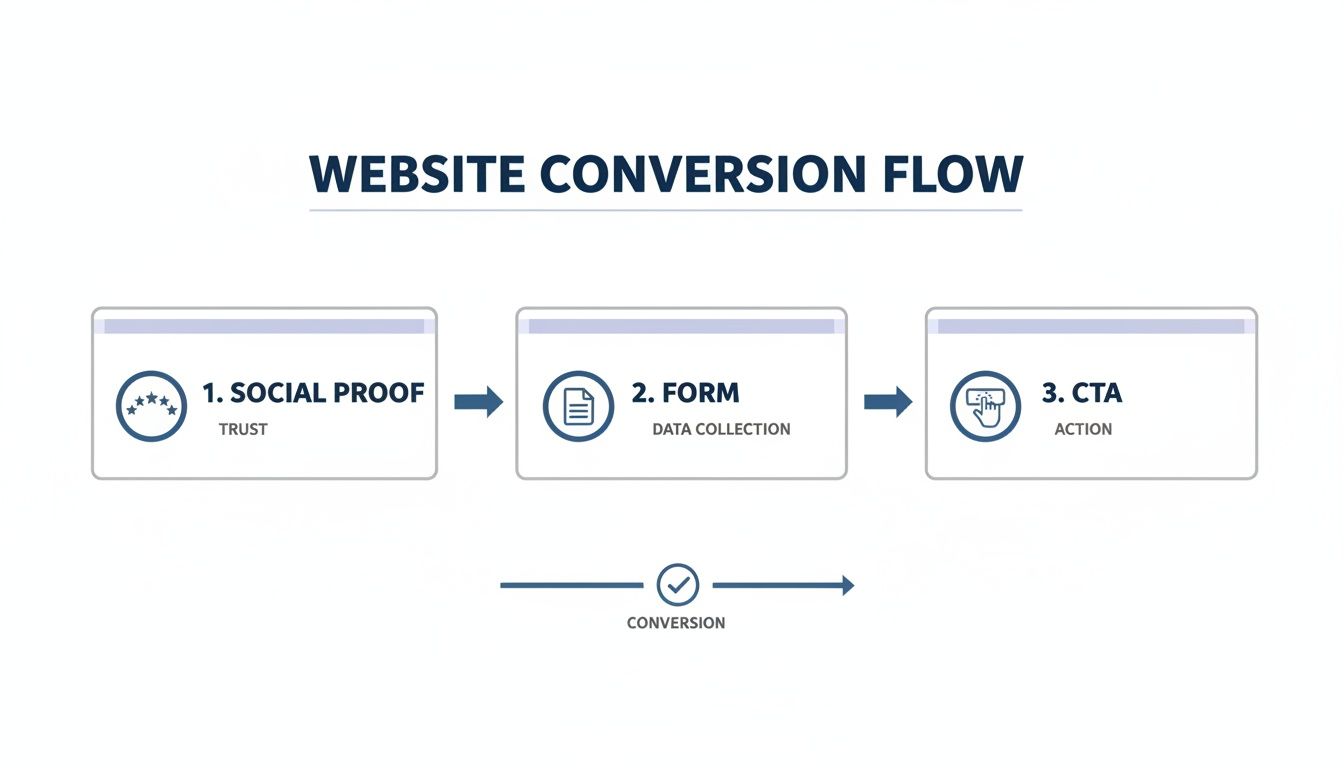
This visualises how every element on your landing page must work in harmony to guide a prospect seamlessly from initial interest to becoming a genuine lead for your sales team.
Building Your B2B Pipeline on LinkedIn
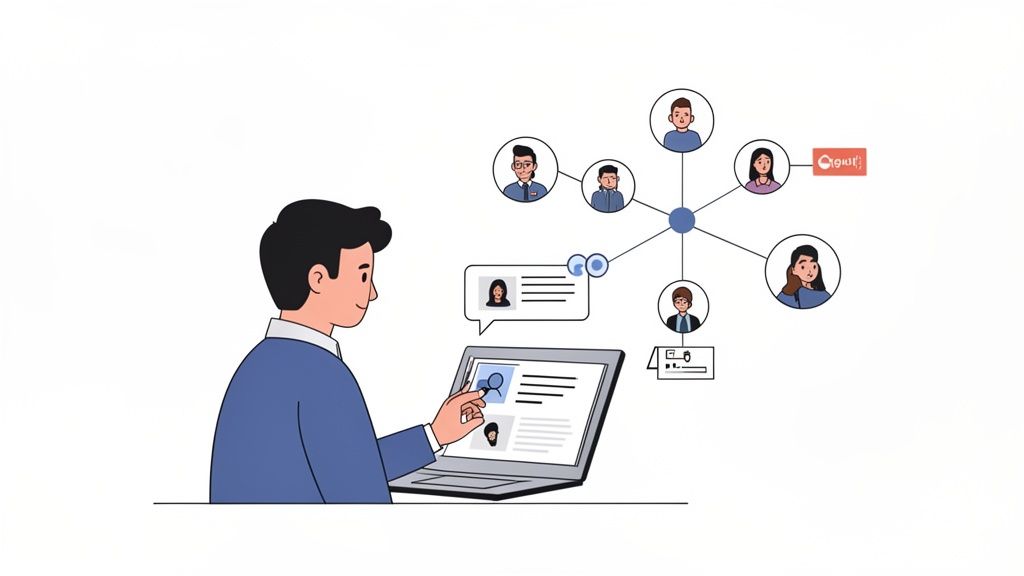
For any B2B business operating in the UK, LinkedIn is no longer optional. It has evolved from a simple networking site into a core channel for identifying and securing high-value commercial opportunities.
To execute effectively, however, you must distinguish between two different objectives: brand awareness and direct lead generation.
Brand awareness is a long-term play. You post insightful content, participate in industry discussions, and build authority over time. The goal is to become the first name that comes to mind. Direct lead generation, in contrast, is about proactively initiating conversations with specific decision-makers who fit your ideal customer profile. The most effective strategies integrate both.
Moving Beyond Basic Profile Optimisation
A complete profile is the bare minimum. To generate leads, you must be intentional, focusing on adding value with every action. Your focus should shift from what your profile says to what your actions accomplish. The objective is to establish yourself as a credible expert who genuinely understands your prospects’ challenges.
This requires discipline in a few key areas:
- Crafting Personalised Connection Requests: Generic, automated requests are ignored. An effective request is concise, references a shared interest or connection, and provides a clear, non-salesy reason why connecting is beneficial.
- Engaging in Relevant Groups: Identify the LinkedIn Groups where your ideal customers are active. Do not simply post links to your own content. Answer questions, offer advice, and contribute to conversations to build genuine authority.
- Creating Content for Your ICP: Your posts should speak directly to the pain points of your Ideal Customer Profile. Frame your expertise as a solution to their problems, not a pitch for your services.
Data for UK B2B marketers validates this approach. 80% use LinkedIn, and 82% report it as their most successful social channel. However, it is not a quick win. On average, only 13% of leads convert into opportunities, a process which takes 84 days. This underscores the importance of getting the initial engagement right.
A Strategic Approach to LinkedIn Ads
While organic activity builds long-term reputation, LinkedIn Ads act as an accelerator. They allow you to target prospects with surgical precision. This is not about boosting posts; it is about running performance-focused campaigns designed for a measurable return.
The platform’s key advantage is its detailed targeting. You can build audiences based on:
- Job Title and Seniority: Engage decision-makers directly.
- Company Size and Industry: Ensure your budget is only spent on businesses that are a good commercial fit.
- Specific Skills or Group Memberships: Target individuals based on their professional interests.
The objective of a LinkedIn Ads campaign is not just clicks. It is to acquire qualified leads at a profitable Cost Per Lead (CPL). Success requires disciplined budget control and a constant focus on optimising your Return on Ad Spend (ROAS).
Measuring What Matters on LinkedIn
To treat LinkedIn as a serious lead generation channel, you must track its commercial impact. Ignore vanity metrics like likes and shares. The only numbers that matter are those that directly affect your sales pipeline. We have written a more extensive guide on generating leads on LinkedIn that explores this in greater detail.
You should be tracking:
- Lead Volume: How many qualified leads did LinkedIn generate this month?
- Lead Quality: What percentage of those leads became sales-qualified opportunities?
- Cost Per Lead (CPL): For paid ads, what was the cost to acquire each lead?
- Pipeline Contribution: What is the total value of the sales pipeline generated from LinkedIn activity?
By focusing on these metrics, you transform LinkedIn from a social networking task into a predictable and scalable source of revenue for your business.
Measuring Performance to Optimise for Growth
Generating B2B leads is not a ‘set and forget’ activity. To build a pipeline that is both predictable and profitable, you must implement a robust system for measuring what is working and what is wasting budget.
Focusing on vanity metrics like clicks or impressions is a common mistake that leads to inefficient spend. Real growth comes from concentrating on the numbers that impact your bottom line. A sound measurement strategy shifts the conversation from “Are we busy?” to “Are we profitable?” by linking every marketing pound to a sales outcome.
Establishing Your Core B2B KPIs
To gain a true understanding of your lead generation performance, you need to track a handful of Key Performance Indicators (KPIs). These are the health monitors for your marketing engine, providing visibility from initial cost to final revenue.
Your essential KPIs should include:
- Cost Per Lead (CPL): Your foundational efficiency metric. Divide your total campaign spend by the number of leads generated. A low CPL is only valuable if the leads are of high quality.
- Lead-to-Opportunity Rate: The percentage of leads that your sales team accepts as qualified opportunities. A low rate is a clear indicator of misalignment between marketing and sales.
- Customer Acquisition Cost (CAC): The total cost of sales and marketing required to acquire one new customer. This reveals the true cost of growth and is essential for profitability analysis.
- Return on Investment (ROI): The ultimate measure of success. ROI compares the total revenue from a campaign against its total cost, showing you precisely how much profit your marketing efforts are generating.
Measuring these KPIs is non-negotiable. Without this data, you are operating blind, with no reliable way to determine which campaigns are fuelling growth and which are simply draining resources.
The Tracking and Handoff Process
Effective measurement depends on two components: the right tools and a seamless process for transferring leads from marketing to sales. A disjointed system is where data is lost and valuable leads fall through the cracks.
First, ensure your core systems are integrated. Your website analytics (such as Google Analytics) must be configured to track conversions like form submissions or demo requests. This data should then flow directly into your Customer Relationship Management (CRM) system. This creates a single source of truth, allowing you to trace a customer’s entire journey from their first click to the final sale.
Once a lead is in your CRM, a clear qualification and handoff process is vital. Marketing and sales must agree on the exact criteria that define a “sales-ready” lead. When a lead meets these criteria, an automated alert should notify the appropriate salesperson for immediate follow-up. This is not just about organisation; it is about speed. Research consistently shows that responding to a lead within the first hour dramatically increases conversion rates.
By implementing this type of closed-loop reporting system, you can accurately attribute revenue back to the specific marketing channels that generated it. This is the insight that allows you to confidently scale the channels delivering the best leads and the highest ROI, creating a culture of continuous, data-driven improvement.
B2B Lead Generation: Your Questions Answered
When embarking on a lead generation programme, several key questions consistently arise. Business owners and marketing directors frequently ask us the same things, so let’s address them with direct, practical answers.
How Long Does This Actually Take?
This depends entirely on the channels you choose to activate.
If you use paid advertising on platforms like Google or LinkedIn, you can see new leads within a few weeks, sometimes even days. It is the fastest route to market.
However, if you are building a sustainable inbound engine with SEO and content marketing, you are playing a longer game. This is an investment that yields compounding returns over time. You are typically looking at 6 to 12 months before you see a consistent, high-quality flow of opportunities. The optimal approach is a blend of both, securing quick wins while your long-term growth asset is being built.
Should I Go All-in on Inbound or Outbound?
This is a classic question. The correct answer is that you need both, working in concert.
Inbound marketing (SEO, blog content) is excellent for capturing prospects who are already looking for a solution like yours. They have an identified problem, they are searching for an answer, and you appear. This builds your authority and, over time, reduces your average cost per lead.
Outbound marketing (targeted emails, precision advertising) is about creating demand. You are not waiting for prospects to find you; you are going directly to your ideal customers, even if they have not yet started their search.
Relying solely on inbound can feel passive, like waiting for the phone to ring. Purely outbound can become expensive quickly and is often difficult to scale. The most effective strategies integrate both, creating a sales pipeline that is far more resilient and predictable.
What’s a Realistic Cost Per Lead in the UK?
The cost per lead (CPL) in the UK varies significantly depending on your industry, the channel used, and the required qualification level of the lead.
Here is a general guide based on current market conditions:
- Paid Search (Google Ads): For competitive, high-value keywords, expect to pay between £50 and £250+ per lead.
- Paid Social (LinkedIn Ads): This typically ranges from £40 to £200. The cost is often influenced by the seniority of the audience and the precision of the targeting.
- Cold Email Outreach: This channel often has the highest CPL, from £150 to £500+. It is resource-intensive, as effective personalisation and follow-up require significant time and effort.
At Lead Genera, we do not just generate leads; we engineer strategic systems that deliver a predictable pipeline of qualified commercial opportunities. Get in touch to discuss how we can engineer a growth plan for your business.
Categories
Do You Need Assistance With
Sign Up To Our Newsletter