


Weekly marketing wisdom you can read in 5 minutes, for free. Add remarkable ideas and insights to your inbox, once a week, by subscribing to our newsletter.
Lead Generation
A Practical Strategy for Lead Generation That Drives Growth
A robust strategy for lead generation is not a collection of marketing tactics. It is a predictable, scalable system engineered for commercial growth. It ensures every part of your marketing effort supports your core business objectives: revenue, profitability, and sales efficiency. The aim is to attract high-quality opportunities that are ready to convert into profitable customers.
Moving Beyond Tactics to a Sustainable Growth Blueprint
Many businesses get stuck running disconnected marketing activities. A Google Ads campaign here, a few social media posts there. These actions often happen in isolation, bringing in a trickle of inconsistent leads but never building a predictable sales pipeline. This tactical approach is expensive and unsustainable.
A genuine lead generation strategy shifts the focus from one-off campaigns to building a long-term commercial asset. It is the blueprint that connects who you target, how you reach them, and why they should engage, all while measuring the metrics that matter to your bottom line.
The Strategic Mindset Shift
Adopting this mindset means you stop asking, “how do we get more leads?” and start asking sharper, commercially-focused questions:
- Profitability: What is the maximum we can afford to pay for a lead while protecting our profit margins?
- Quality: How do we attract prospects who are a perfect fit for our service and are ready for a sales conversation?
- Efficiency: How do we ensure our sales team spends its time on high-probability opportunities, not unqualified contacts?
- Scalability: How do we build a system that can reliably deliver more quality leads as we increase investment?
The objective is to stop filling the top of the funnel. The goal is to build a system that turns marketing spend into measurable revenue. That requires a documented plan, not a series of reactive decisions.
To move beyond just ‘doing marketing’ and start building a sustainable growth engine, it is useful to see what a comprehensive strategy involves. For further perspective, you can review these 10 Proven B2B Lead Generation Strategies. This guide will provide the framework to build your own robust system, starting with the foundational elements that drive every successful lead generation engine.
Defining Your Ideal Customer and Commercial Goals
Before spending a single pound on advertising, you must lay the groundwork. Any effective lead generation strategy is built on two pillars: knowing precisely who you are targeting and what you are trying to achieve commercially. Without this clarity, you are guessing, which is a fast way to exhaust your budget and fill your sales pipeline with unqualified leads.
The first step is to get more specific than a generic buyer persona. While it is useful to know a prospect’s interests, real commercial success comes from a laser-focused Ideal Customer Profile (ICP). This is a practical definition of the exact type of business that generates the most profit. It acts as the strategic filter for every marketing decision.
Moving from Personas to Profitable Profiles
A strong ICP is not about abstract characteristics; it is about concrete, measurable attributes. While understanding the nuances of a buying persona is useful (we cover it in our detailed guide), for strategy, you must lock in on commercial identifiers.
Your ICP should define:
- Firmographics: The business specifics. This includes industry, company size (turnover and employee count), geographical location, and even their technology stack.
- Pain Points: The specific, expensive problem they have that you solve. Focus on the issues that have a clear financial downside for their business.
- Buying Triggers: The event that causes them to start actively looking for a solution like yours. This could be a new funding round, a key hire, or poor results from a competitor.
Setting Commercially-Grounded Goals
Once you have a crystal-clear ICP, you can set meaningful goals. Simply aiming for ‘more leads’ is a recipe for failure. Your objectives must be specific, measurable, and tied directly to profit. This ensures every effort serves the bottom line.
A lead generation strategy without commercial KPIs is a creative exercise. True performance is measured in pipeline value and return on investment, not clicks and impressions.
Instead of vague targets, define precise Key Performance Indicators (KPIs). You should be able to quantify what success looks like.
For example, define metrics such as:
- Target Cost Per Lead (CPL): How much can you afford to spend to acquire a lead from your ICP while maintaining healthy profit margins? Perhaps your target is a £75 CPL.
- Lead-to-Sale Conversion Rate: What percentage of qualified leads must you convert into paying customers? A solid target might be 15%.
- Pipeline Value Target: What is the total financial value of the sales opportunities your strategy must generate each quarter? For instance, a goal of £250,000.
Getting this foundational work right transforms your strategy from a list of tactics into a predictable engine for growth. It forces marketing and sales alignment and guarantees you only invest where it can generate a tangible return.
Choosing Your Channels For Maximum Commercial Return
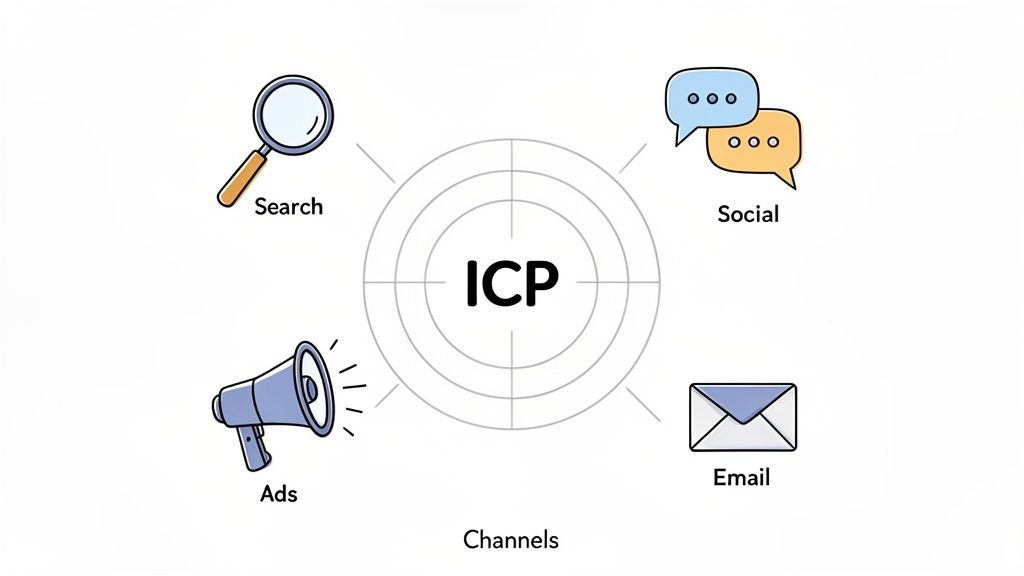
You have defined your Ideal Customer Profile and set clear commercial goals. Now it is time to move from planning to execution, which means deciding precisely where you will find these future customers.
This is where many businesses fail. They spread their budget thinly across every available platform, making a small impact everywhere but failing to gain traction anywhere.
The objective is not to be everywhere. It is to be exactly where your most profitable customers are, especially when they are looking for solutions or are open to new ideas. Every channel must be evaluated through a commercial lens: which one offers the most direct path to high-quality leads at a cost that makes business sense?
For most UK service-based businesses, a small handful of core channels consistently deliver results. Mastering these first is how you build momentum and gather the data needed to scale intelligently.
Prioritising High-Intent Channels
Your initial investment should target channels where buyer intent is highest. These are the platforms where your ICP is actively searching for the services you offer, making it far easier to capture qualified leads.
- Paid Search (Google Ads): This is almost always the fastest way to get in front of people with an immediate need. You can target hyper-specific, commercially-driven keywords, ensuring your budget is spent attracting people who are actively seeking a solution to their problem. The feedback is immediate and the results are measurable from day one.
- SEO (Search Engine Optimisation): SEO is a long-term investment, but one that delivers significant returns. It is about building a sustainable asset that generates high-quality, inbound leads for years. Ranking for your most valuable keywords positions you as an authority and captures organic traffic without paying for every click.
These are “pull” channels; they capture existing demand. A sound strategy starts here, but to truly grow, you also need to create new demand.
Creating Demand With Paid Social And Outreach
To scale beyond existing demand, you need to reach prospects who are a perfect fit but are not yet actively looking for you. This is where “push” channels are effective, placing your message in front of a precisely defined audience.
- Paid Social (Meta & LinkedIn Ads): For B2B, LinkedIn is a powerhouse. You can target specific job titles, industries, and company sizes. Meta (Facebook and Instagram) can also be highly effective, targeting users based on interests, behaviours, and demographics. Both are excellent for building awareness and generating leads from a specific audience segment.
- Targeted Outreach (Email & LinkedIn): Do not overlook direct outreach. When executed well, it delivers exceptional results. This is not about spam; it is about strategically identifying key individuals in your target companies and engaging them with a personal, value-led message. You are a helpful expert, not just another salesperson.
A common mistake is treating these channels as separate silos. The real power is in their integration. A prospect might see your ad on LinkedIn, then search on Google, find your site via an organic result, and finally convert. Each touchpoint builds trust.
The strongest lead generation systems are built on multi-channel foundations. Research shows that companies using multiple touchpoints can see conversion rates increase by as much as 287% compared to single-channel efforts. For B2B specifically, campaigns blending email and LinkedIn outreach see 34% higher response rates than email alone.
To help you decide where to focus your initial budget, here is a simple matrix.
Lead Generation Channel Suitability Matrix
This table breaks down the primary lead generation channels, outlining their best use, typical lead quality, and speed to impact.
| Channel | Best For | Typical Lead Quality | Speed to Impact |
|---|---|---|---|
| SEO | Building a long-term, sustainable asset for high-quality inbound leads. | Very High | Slow (6-12+ months) |
| Paid Search (PPC) | Capturing high-intent prospects who are actively searching for solutions. | High | Fast (Days) |
| Paid Social | Precise audience targeting to create awareness and generate demand. | Medium to High | Fast (Weeks) |
| Email/LI Outreach | Directly engaging specific decision-makers within target accounts. | Very High | Medium (Weeks) |
| Content Marketing | Establishing authority, educating the market, and nurturing leads. | High | Slow to Medium |
The right mix depends on your specific goals, audience, and budget. Our guide on social media vs pay-per-click explores this decision-making process in more detail.
The best approach? Start with one or two primary channels. Prove they deliver a return. Then, strategically expand your efforts.
Building Your Website Funnel and Conversion Assets
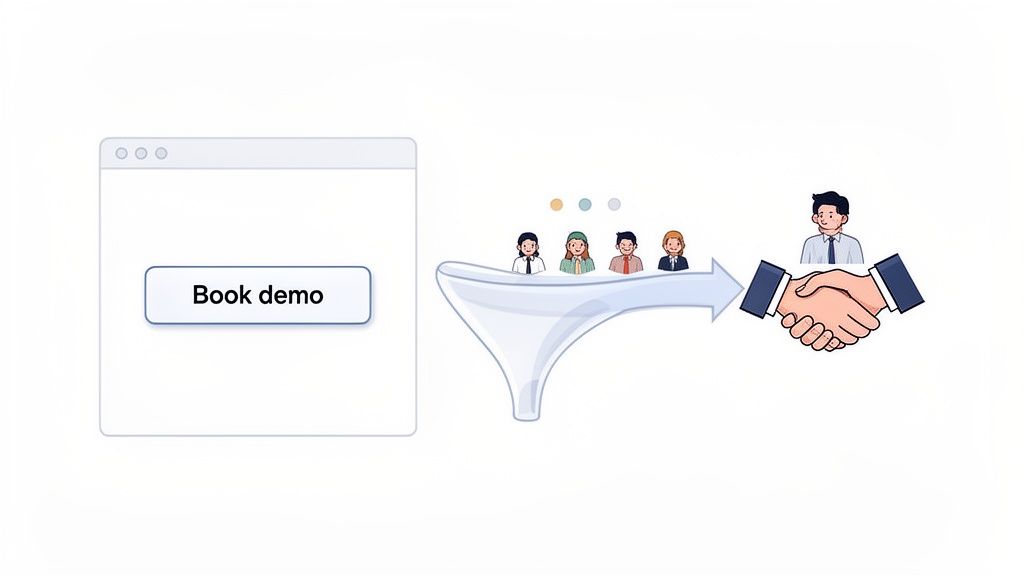
Your website is not a digital brochure. It is your single most important lead generation asset. Every pound invested in Google Ads or SEO is wasted if your website cannot convert that attention into a sales opportunity.
A high-performance website is engineered to do one job: guide your Ideal Customer Profile from visitor to qualified lead. It is a conversion system, not an art project. Every page, button, and headline must build trust and direct visitors towards a specific, valuable action.
The Anatomy of a High-Performing Landing Page
The core of your conversion efforts are your landing pages. These are specialist destinations built to receive traffic from a specific campaign and are focused on a single goal. Sending paid traffic to your generic homepage is one of the fastest ways to waste your budget.
An effective landing page has several non-negotiable elements:
- A Clear Value Proposition: A headline that instantly tells a visitor they are in the right place and what is in it for them. No jargon, no fluff.
- A Compelling Offer: A strong, low-friction reason for them to provide their details. This could be a free consultation, a tailored quote, or a product demo.
- Social Proof: Testimonials, case study excerpts, or client logos. These are trust signals that immediately reduce a prospect’s perceived risk.
- A Single, Unambiguous Call-to-Action (CTA): One clear button that tells the user exactly what to do next. Do not offer multiple options; this leads to decision paralysis.
For a deeper analysis, our guide explains precisely how to build a killer lead generation landing page that consistently converts clicks into customers.
Mapping Content to the Buyer’s Journey
A strategic website funnel maps different assets to each stage of your prospect’s decision-making process. Your entire strategy for lead generation must cater for people with different levels of awareness and intent.
A common mistake is to only offer a “Contact Us” or “Book a Demo” option. This high-commitment CTA alienates the 95% of visitors who are interested but not yet ready for a sales conversation.
You need to provide value at every step, creating a “conversion pathway” for every visitor.
- Top of Funnel (Awareness): These visitors are researching a problem. Capture their interest with educational blog posts, downloadable guides, or checklists in exchange for an email.
- Middle of Funnel (Consideration): Prospects are now actively evaluating solutions. This is the ideal place for webinars, in-depth case studies, or comparison guides that showcase your expertise.
- Bottom of Funnel (Decision): They are ready to act. This is the time for high-intent offers like free consultations, live demos, or personalised quotes.
By building these assets, you transform your website from a static page into a dynamic system. It becomes an engine that nurtures interest and captures leads at every stage of their journey, maximising the return on every visitor.
Using Data to Measure Performance and Drive Profit
A strategy without proper measurement is guesswork. Investing in campaigns hoping something works is the fastest way to waste your budget and frustrate your sales team. A disciplined, data-led approach transforms your lead generation from an unpredictable cost centre into a reliable engine for growth.
The foundation is a robust tracking setup. This is not optional; it is the core infrastructure that ensures every decision is based on facts, not intuition. As a minimum, your toolkit must include Google Analytics for website behaviour, conversion tracking for your ad platforms (like Google Ads and Meta Ads), and a CRM to track leads from first click to final sale.
Moving Beyond Vanity Metrics
Once your tracking is active, focus on the numbers that matter: the key performance indicators (KPIs) that directly impact your bottom line. Clicks and impressions might look impressive, but they do not pay the bills.
The metrics that tell the real story are grounded in commercial reality:
- Cost Per Acquisition (CPA): How much does it cost in total marketing spend to acquire one new customer? This is your ultimate efficiency metric.
- Lead Quality Score: A rating system, agreed with your sales team, to grade incoming leads. This is crucial for ensuring marketing generates genuine opportunities, not just contacts.
- Return on Ad Spend (ROAS): For every pound invested in advertising, how much revenue is generated? A 4:1 ROAS means you make £4 for every £1 spent. Simple, powerful, and essential.
To properly understand performance and drive profit, you need robust analytics. Tools that offer enhanced analytics dashboards can provide a clearer view of these critical KPIs, helping you see what is working at a glance.
Creating a Feedback Loop with CRO
With reliable data, you can begin systematic improvement through Conversion Rate Optimisation (CRO). CRO is a series of data-driven experiments, such as A/B testing, designed to make incremental improvements that increase the percentage of visitors who become leads.
A common mistake is treating CRO as a one-off project. It is a continuous feedback loop: analyse data to form a hypothesis, test it, measure the results, and feed the learnings back into your strategy.
This cycle allows you to refine everything in your funnel, from ad copy and landing page headlines to the colour of your call-to-action buttons. Every successful test delivers a permanent lift in performance, compounding your returns over time.
This disciplined approach is also vital for effective lead nurturing. For UK SMEs, only 13% of B2B leads convert into sales opportunities, and the average sales cycle is 84 days.
However, companies that implement a structured lead nurturing process generate 50% more sales-ready leads while reducing acquisition costs by 33%. This is because nurtured leads are 47% more likely to make a larger purchase. It is a perfect example of how a data-informed strategy delivers significant commercial value. You can explore more B2B marketing statistics to see the impact these approaches can have.
Your First 90 Days: An Actionable Implementation Plan
A brilliant strategy is worthless if it remains a document. Real value comes from disciplined execution. This section bridges that gap, turning your blueprint into a tangible, lead-generating engine with a clear 30-60-90-day plan.
This structured approach is about building momentum from day one, prioritising the right tasks, and managing expectations.
The first month is about establishing the foundations and launching quick-win campaigns. The goal is not perfection; it is data acquisition. By month two, the focus shifts to analysing that early performance data and optimising your channels. Month three is about scaling what works and building a culture of continuous improvement.
This timeline provides a high-level view of the key milestones for the initial 90-day push, taking you from launch to analysis and, finally, to scaling.
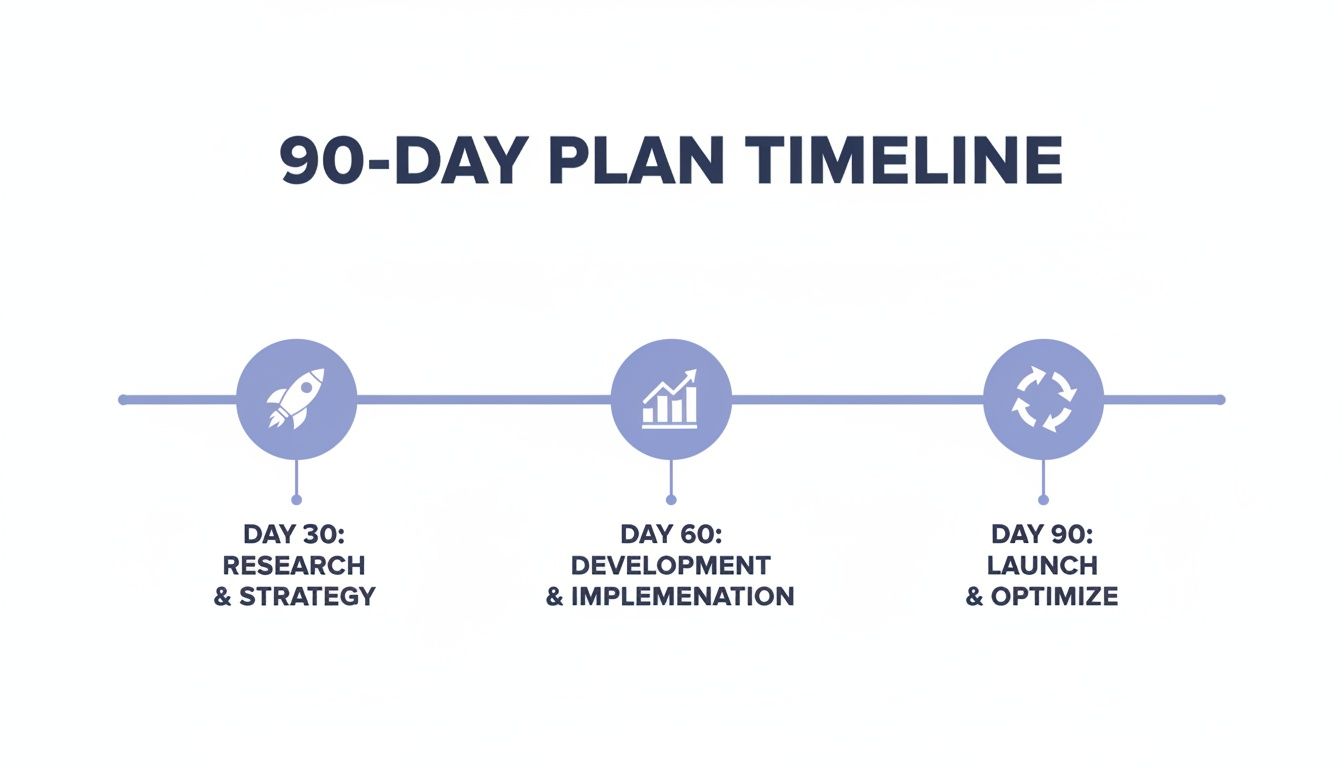
Think of this as your roadmap. It ensures your strategy for lead generation gains traction quickly and starts delivering measurable results, while laying the groundwork for sustainable, long-term growth. It provides the structure needed to move from planning to profitable action, quickly.
Your Lead Generation Strategy Questions Answered
When developing a lead generation plan, several common questions arise. Let’s address the key issues that business owners and marketing managers frequently ask.
How Much Should I Budget for Lead Generation?
There is no single magic number, but a solid benchmark for UK SMEs is to allocate 10-15% of your target revenue.
The key factor is your target Cost Per Acquisition (CPA). Before spending anything, you must know what a new customer is worth to your business. Once you have that lifetime value figure, you can work backwards to set a CPA that ensures profitability on every new client.
My advice is to start with a small test budget. Consider it an investment in data. Use it to prove the model works and generates a positive Return on Ad Spend (ROAS). Once you have proof of concept, you can scale your investment with confidence.
What Is the Difference Between Lead Generation and Demand Generation?
This is an important distinction.
Lead generation is the act of capturing contact details from prospects who are already showing interest, for example, someone completing a form to download a guide. It is a direct response activity focused on identifiable prospects.
Demand generation is a broader, long-term strategy focused on creating awareness and desire for your product or service in the first place. Demand generation builds the audience, and lead generation identifies the individuals in that audience who are ready to engage.
Which Channels Are Best for B2B vs B2C?
For UK B2B firms, certain channels are consistently strong performers. We see excellent results with LinkedIn Ads, SEO focused on commercial search terms, and highly targeted email outreach. These platforms are effective for reaching decision-makers in specific industries.
For B2C, the approach is different. Channels like Meta Ads (Facebook & Instagram), Google Shopping, and influencer marketing tend to perform better because they target consumer interests, life stages, and behaviours directly.
This is a starting point. The best channels for your business will always depend on your specific Ideal Customer Profile and where they spend their time online, not a generic B2B or B2C label. Your ICP is your North Star for channel selection.
Ready to stop guessing and start building a predictable pipeline? The expert team at Lead Genera builds and executes commercially-focused strategies that deliver measurable growth. Book a no-obligation consultation today to see how we can help.
Categories
Do You Need Assistance With
Sign Up To Our Newsletter