


Weekly marketing wisdom you can read in 5 minutes, for free. Add remarkable ideas and insights to your inbox, once a week, by subscribing to our newsletter.

Marketing
A Practical Go-to-Market Strategy Template For UK Businesses
A solid go-to-market strategy template is your blueprint for turning a promising product idea into measurable revenue. It separates a calculated launch from a hopeful punt. The process forces strategic clarity on who you’re selling to, what commercial value you provide, and how you’ll reach them profitably.
Table of contents:
Why Most Product Launches Fail And How A GTM Strategy Prevents It

Bringing a new product or service to market is a high-stakes moment for any business. You have poured significant investment into development, marketing, and sales resources, yet the risk of it all falling flat is alarmingly high. Without a structured plan, even the most innovative ideas can fail to gain traction, draining your budget and team morale.
In the competitive UK B2B space, a properly structured go-to-market (GTM) strategy is essential. Research from Harvard Business School suggests that a staggering 70–95% of product launches fail. That statistic is particularly brutal for small and medium-sized enterprises (SMEs), where every pound of investment must count.
This isn’t a matter of bad luck. It is a fundamental failure to connect a good product with the right market in a commercially viable way. A GTM strategy confronts these risks head-on before you spend a single pound on advertising.
Forcing Clarity and Alignment
The real value of a GTM strategy is that it forces difficult but essential conversations. It moves your team from assumptions to documented, agreed-upon decisions. This single process tackles the most common reasons launches go sideways, including:
- A poorly defined target market: Without a laser-focused Ideal Customer Profile (ICP), marketing messages become generic noise, and sales teams waste precious time chasing unqualified leads.
- A weak value proposition: If you cannot clearly state how your product solves a specific pain point better than any alternative, customers have no compelling reason to switch.
- Misaligned teams: When marketing, sales, and product operate in silos, the customer experience becomes disjointed. Leads get dropped, messaging is inconsistent, and internal friction kills momentum.
A formal GTM plan ensures everyone works from the same playbook, with shared goals and a unified picture of the customer.
A Go-to-Market strategy is not a document you create once and file away. It is a live operational tool that aligns your entire business around a single, focused objective: acquiring the right customers, profitably.
Mitigating Financial Risk
Launching without a plan is a financial gamble. You risk burning cash on marketing channels that do not reach your audience or building sales processes that are inefficient and cannot scale.
A GTM strategy is, in effect, a commercial risk assessment. It demands that you analyse the market properly, get a handle on your customer acquisition costs, and set realistic revenue goals. This foresight allows you to allocate your budget where it will work hardest, focusing on the channels with the highest potential return. It transforms your launch from a hopeful shot in the dark into a calculated business move designed for predictable growth. For a deeper dive into defining your audience, check our guide on segmenting your target market.
Breaking Down Your GTM Template’s Core Components
A go-to-market strategy template is only as solid as the commercial thinking you put into it. This is where we get practical, breaking down the essential pieces that will power your launch. These are not just boxes to tick; they are the strategic decisions that dictate where your budget goes, what your marketing looks like, and ultimately, whether you turn a profit.
Think of it this way: each component is a domino. A laser-focused Ideal Customer Profile (ICP) knocks over your value proposition. That value proposition then shapes your pricing. Your pricing and ICP then point you directly to the right marketing channels. Nailing these foundations is everything for a successful launch in the competitive UK market.
Who Are You Really Selling To? Defining Your Ideal Customer Profile
Before you sell anything, you need absolute clarity on who you’re selling to. Vague definitions like “SMEs in the UK” are a surefire way to burn through your marketing budget and leave your sales team chasing shadows. An Ideal Customer Profile is a sharp, documented description of the company that will gain the most value from your product and, just as importantly, bring the most value back to your business.
This goes beyond basic demographics. You need to get under the skin of the commercial realities your customers face daily.
- Firmographics: How large is the company (in both revenue and employees)? What industry are they in? Where are they based?
- Pain Points: What specific, expensive problem are you solving? Is it a clunky operational process, a stream of poor-quality leads, or the risk of non-compliance? Put a number on that pain: how much time, money, or resource is it costing them?
- Triggers: What pushes them to actively look for a solution like yours? It could be new regulations, a push into a new market, or a major internal project that is failing.
- Success Metrics: What does a “win” look like for them? How will they calculate the ROI on your solution? Knowing this is invaluable for your marketing messages and sales conversations.
Imagine a professional services firm selling compliance consultancy. Their ICP might be UK-based financial services companies with 50-250 employees, specifically those bracing for an upcoming regulatory shift. Their biggest pain point is the threat of six-figure fines for non-compliance. That level of detail guides every other decision you make.
Crafting a Value Proposition That Connects
Your value proposition is your clear, simple promise of the value a customer receives when they choose you. It must answer the critical question: “Why should I buy from you and not your competitor, or simply stick with what I’m doing now?” It needs to be compelling, different, and speak directly to the pain points of your ICP.
A great value proposition is not a catchy slogan. It is a strategic statement built on three key pillars:
- Relevance: How does your product fix your customer’s problems or improve their situation?
- Quantified Value: What specific, measurable benefits will they see? Think “cut invoice processing time by 40%” or “boost qualified leads by 25%.”
- Unique Differentiation: Why are you the best choice to deliver this value?
Look at the rising importance of corporate responsibility. Over 80% of small businesses now adopt eco-friendly practices like carbon reduction. If your ICP values sustainability, weaving this into your value proposition can be a powerful way to stand out.
Your value proposition must be tested in the real world. What you think is valuable might not be what your market is willing to pay for. Use sales calls, surveys, and landing page tests to ensure your message truly lands.
Nailing a Commercially Sound Pricing Model
Pricing is one of the trickiest, and most frequently mishandled, parts of any GTM strategy. Price too low, and you leave money on the table and signal a lack of confidence. Price too high, and you scare potential customers away. Your pricing must reflect the value you deliver, not just your cost to build.
Here are a few common models to consider:
- Value-Based Pricing: You price based on the perceived value to the customer. This is perfect for solutions that deliver a clear, measurable ROI.
- Cost-Plus Pricing: You add a markup to your production costs. It is straightforward, but you almost always undervalue your offering.
- Competitor-Based Pricing: You set your price by looking at what the competition charges. This can be a useful benchmark, but it should not be the only factor you consider.
For a UK SaaS business, a tiered, value-based model often works well. A ‘Basic’ plan could cover core features for smaller businesses, while an ‘Enterprise’ plan offers advanced analytics and dedicated support for larger clients, priced to reflect the significant commercial value it delivers.
Choosing the Right Marketing and Sales Channels
Your channels are the paths you use to deliver your value proposition to your ideal customer. The aim is not to be everywhere; it is to be in the right places, repeatedly. This decision should flow directly from understanding your ICP’s behaviour. Where do they go for information? Who do they trust?
This is where a solid grasp of market mapping becomes incredibly useful. You can check out our detailed guide on what market mapping is and how to use it to uncover the most profitable channels for your business.
To get started, consider using a comprehensive Product Launch Strategy Template. It offers a structured approach to ensure you have covered all your bases.
Let’s look at how these core sections fit together and the critical questions they must answer.
GTM Template Section Breakdown
| Template Section | Objective | Key Question to Answer |
|---|---|---|
| Ideal Customer Profile (ICP) | To define the exact type of company that will derive the most value from your product. | Who is our perfect customer, and what defines them commercially? |
| Value Proposition | To articulate the unique, measurable value your product delivers to the ICP. | Why should this specific customer buy from us over anyone else? |
| Pricing Model | To establish a pricing structure that reflects value and supports business profitability. | How will we charge for our solution in a way that aligns with its value? |
| Marketing & Sales Channels | To select the most efficient and effective paths to reach and convert the ICP. | Where can we most profitably connect with our ideal customers? |
A B2B software firm targeting enterprise-level clients will likely focus on a direct sales team, account-based marketing, and channels like LinkedIn. In contrast, a service business aiming for local homeowners might find Google Ads and local SEO far more effective. The key is to let data guide your decisions, not just follow the latest trend.
Mapping Your Go-to-Market Launch Timeline
A brilliant GTM strategy is just a document until you attach a clear, actionable timeline. The timeline turns strategic thinking into execution. It is the roadmap that ensures marketing has the right assets ready, sales knows exactly what to do, and your budget is being spent for maximum impact.
Trying to launch everything at once is a recipe for chaos. A phased approach prevents that last-minute scramble and lets you learn as you go.
Think of this less as a rigid checklist and more as a strategic framework. We will break it down into two crucial 90-day periods: the first for Pre-Launch and Launch, and the second for Post-Launch and Optimisation. This structure provides momentum but also builds in the feedback loops you need to adapt based on what the market tells you, not what you assumed in a meeting room.
This whole process visualises how your core GTM components slot together in a logical sequence.
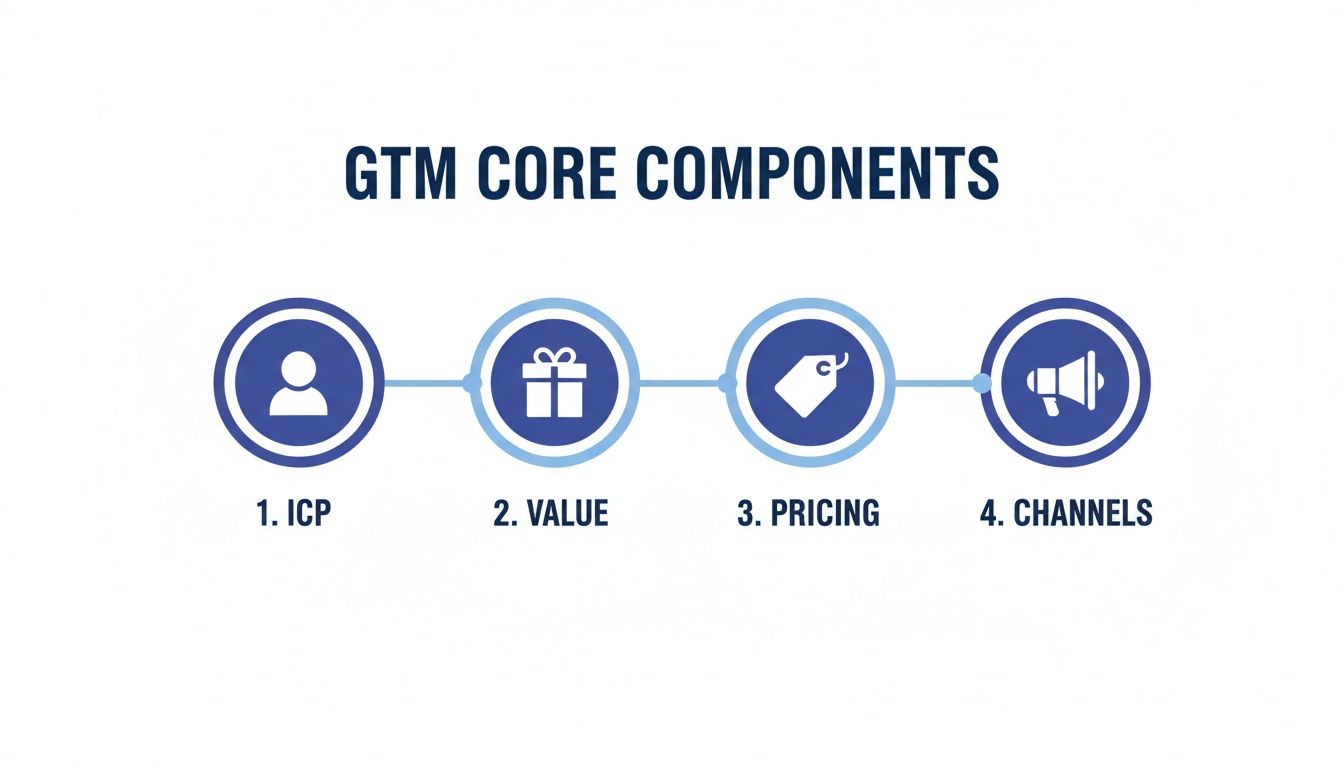
As you can see, your foundational decisions on your ICP, Value, Pricing, and Channels must be locked in before you can start mapping out your launch. Get those right first.
Phase 1: The First 90 Days (Pre-Launch and Launch)
The first 90 days are about laying the groundwork for a solid launch. This phase is heavily front-loaded with foundational work. It is the activity that ensures when you flip the switch, you do it with confidence and a clear path to getting those first leads in the door.
The focus here is simple: prepare, then execute flawlessly. Get everything aligned so that on day one, every click, call, and enquiry is tracked, nurtured, and attributed correctly. No excuses.
Here are the key milestones to hit:
-
Days 1-30: Finalising the Message and Core Assets
- Nail down your value proposition and core marketing messages based on your ICP research.
- Develop your primary lead generation assets. This could be a high-converting landing page, a detailed guide people will actually download, or a webinar registration page.
- Write and design the first batch of ad copy and creative for your chosen channels (e.g., Google Ads, Meta Ads).
-
Days 31-60: Technical Setup and Internal Readiness
- Get your tech stack sorted. Implement and test all your analytics and tracking, including Google Analytics 4, conversion tracking, and CRM integration.
- Build out and test your lead nurturing email sequences. Do they fire correctly? Are the links working?
- Run training sessions with the sales team. Ensure they understand the ICP, can articulate the value proposition, and know the lead qualification criteria inside-out.
-
Days 61-90: Campaign Activation and Initial Launch
- Launch your initial paid media campaigns.
- Push your organic content and SEO efforts live.
- Begin any outbound sales prospecting to your defined ICP list.
- Watch the incoming data like a hawk for early performance indicators.
Phase 2: The Next 90 Days (Post-Launch and Optimisation)
The moment you are live, the game changes. You shift from launching to learning. The goal of this second 90-day period is to dive into early performance data, get direct feedback from the market, and make smart decisions on where to focus investment.
This is where a performance-led approach truly shines.
Now is not the time for knee-jerk reactions. You must resist the urge to change everything after one bad day. Look for statistically significant trends that tell you what is truly working and what is just burning cash.
Your initial launch is not the finish line; it is the starting block for data-driven optimisation. The first few months of data are your most valuable asset for refining your GTM strategy and finding a path to profitable, scalable growth.
Here’s what you should focus on in this critical optimisation phase:
- Gather Customer and Market Feedback: Get on the phone with your first customers and sales prospects. What are the common objections? Is the value proposition resonating? Use this qualitative insight to sharpen your messaging.
- Analyse Channel Performance: Get deep into the metrics. Which channels are delivering the lowest Cost Per Lead (CPL) and the highest quality leads? Be ruthless. Double down on what is working and do not be afraid to pull the plug on underperforming channels.
- Optimise Conversion Pathways: Use tools like heatmaps and session recordings on your landing pages to spot where users get stuck. A/B test your headlines, calls-to-action, and form layouts to squeeze more conversions from your traffic.
- Plan for Scale: Once you have proven results, you can build a business case for more investment in your winning channels. This data-backed approach is how you turn a successful launch into a predictable engine for business growth.
Defining Success And Measuring GTM Performance
A go-to-market strategy without clear metrics is just a collection of well-intentioned activities. To drive real commercial growth, your plan needs accountability baked in from the start.
This means looking beyond vanity metrics, like social media likes or a spike in website traffic, and focusing on the numbers that actually move the needle on profitability.
Success is not about being busy; it is about being effective. A solid measurement framework lets you track what is working, justify your spend, and make smart, data-driven decisions to improve your launch. It turns your GTM plan from a hopeful campaign into a predictable revenue engine.
Business Metrics The Boardroom Cares About
At the highest level, your GTM strategy must answer to core business objectives. These are the top-line numbers that ultimately determine if you are winning or losing, informing long-term strategic decisions. Think of them as the final arbiters of your success.
- Revenue Growth: This one is simple. Is the new product or service adding to the company’s top line as projected? You need to track this from day one.
- Customer Acquisition Cost (CAC): This is your total sales and marketing spend divided by the number of new customers acquired. A sustainable business needs a CAC that is easily repaid by what a customer spends over their lifetime.
- Customer Lifetime Value (CLV): This metric forecasts the total revenue you can expect from a single customer relationship. A healthy CLV to CAC ratio (aiming for 3:1 or better) is a clear sign that you have built a profitable and scalable GTM model.
These metrics are your commercial reality check. With customer acquisition costs jumping by 60% in the last five years, keeping a close eye on your CAC is no longer a ‘nice-to-have’. For a deeper understanding of this key metric, you can learn more about what customer acquisition cost is in our detailed guide.
Sales Pipeline Metrics Driving Efficiency
Just beneath those big-picture business metrics sits your sales pipeline. These numbers tell you how healthy and efficient your process is for turning initial interest into a paying customer. They are the leading indicators of tomorrow’s revenue.
Monitoring these helps you spot bottlenecks before they become major problems. For instance, a high volume of leads that never convert could signal a disconnect between your marketing message and what the sales team considers a qualified prospect.
Key pipeline metrics to watch:
- Lead Volume: The raw number of new enquiries or prospects entering your pipeline.
- Lead-to-Opportunity Conversion Rate: The percentage of raw leads that are good enough to become genuine sales opportunities.
- Sales Cycle Length: The average time it takes to close a deal, from first contact to signed contract. A shorter cycle means cash in the bank, faster.
- Win Rate: Of all qualified opportunities, what percentage did your sales team close?
A well-crafted GTM plan does not just generate leads; it generates the right leads. Tracking pipeline metrics ensures marketing is fuelling the sales team with opportunities that have a realistic chance of closing, which boosts both efficiency and morale.
Marketing Channel Metrics Optimising Spend
Finally, you need to drill down into the performance of the individual channels you are using to get your message out. This is where you get granular, calculating the return on investment for every pound you put into paid ads, SEO, or content marketing.
This layer of measurement is critical for optimising your budget. It allows you to confidently shift money away from channels that are falling flat and double down on the ones delivering real results.
Essential channel metrics include:
- Cost Per Lead (CPL): How much does it cost you on a specific channel to generate a single lead?
- Return on Ad Spend (ROAS): This is a direct measure of how profitable your paid campaigns are. Simply divide the revenue generated by the cost of the ads.
- Channel-Specific Conversion Rate: Of the people who came from a specific channel (like organic search or a Meta Ads campaign), what percentage took the action you wanted?
By tracking these three tiers of metrics: business, pipeline, and channel, you create a complete, 360-degree view of your GTM performance. You can draw a straight line from day-to-day marketing activities to top-line business results, making sure every part of your strategy is accountable and focused on what truly matters: profitable growth.
Activating Your Strategy With Sales and Marketing Alignment

You can have the most brilliant GTM strategy on paper, but it can, and often does, fall apart at one crucial point: the handoff between marketing and sales. This is the leaky bucket where countless leads are lost, ad spend is wasted, and your launch momentum grinds to a halt.
For any GTM plan to truly work, you need both teams operating as a single, unified revenue engine.
Without that alignment, you get the classic scenario: marketing celebrates hitting its lead quota, while sales complains about the abysmal quality of those leads. This friction is not just bad for morale; it hits the bottom line hard by extending sales cycles and tanking conversion rates. Getting this handoff right is not a nice-to-have, it is non-negotiable.
The entire process boils down to one thing: ditching vague assumptions and creating a concrete, shared definition of what a good lead actually is.
Defining The Handoff Point
First, you need to collaboratively define what a Sales-Qualified Lead (SQL) looks like. This is not a job for the marketing team to do in a silo. Sales and marketing must sit down together and agree on the specific, measurable criteria that signal a prospect is ready for a sales conversation.
Think of these criteria as your rules of engagement. They ensure the sales team only invests time in opportunities that have real potential.
- Firmographic Fit: Does this lead match your Ideal Customer Profile? This includes industry, company size, revenue, and location.
- Demonstrated Intent: Have they taken high-value actions? Perhaps they requested a demo, viewed your pricing page three times in a week, or downloaded a bottom-of-funnel case study.
- Authority and Need: Is there evidence they are a decision-maker or a key influencer? Does their enquiry directly relate to a pain point your product solves?
This shared definition becomes the bedrock of your Service Level Agreement (SLA) between the two teams, which creates real accountability. Marketing commits to delivering a certain number of quality SQLs, and sales commits to following up on them within an agreed timeframe. No more finger-pointing.
Engineering A Seamless Information Transfer
Once a lead hits those SQL criteria, the information you pass over to sales must be clean, organised, and commercially useful. A salesperson receiving an alert with just a name and an email address is being set up to fail. It is the context behind the lead that empowers them to have a relevant and effective first conversation.
The handoff should feel less like lobbing a lead over a fence and more like passing a well-briefed case file to a colleague.
A successful lead handoff is about transferring intelligence, not just contact details. The goal is to equip the sales team with the context they need to add immediate value from the very first interaction.
Key information to include in every handoff:
- Lead Source: Where did they come from? A specific Google Ads campaign, a webinar, an organic search?
- Engagement History: Which pages did they visit on your site? What content did they download or engage with?
- Submitted Information: What specific details did they provide in a form, like their biggest challenge or team size?
This data, neatly organised in your CRM, lets a salesperson tailor their outreach immediately. They can reference the prospect’s known interests and skip repetitive, basic discovery questions.
Closing The Feedback Loop
The process does not end once the lead is passed over. The most crucial – and most frequently ignored – part of this system is creating a robust feedback loop from sales back to marketing. This is how your GTM strategy stops being static and becomes a learning system that constantly improves.
Sales needs a simple, consistent way to report back on lead quality. Was the contact information correct? Was the prospect actually qualified? Did the first call uncover new objections or pain points that marketing was unaware of?
This continuous stream of on-the-ground intelligence is invaluable. It allows marketing to constantly refine its targeting, tweak its messaging, and adjust its qualification criteria, ensuring that every campaign you run is smarter than the last.
Answering Your Go-to-Market Strategy Questions
Even with the best template, putting a GTM strategy together always brings up practical questions. Here are a few of the most common ones we hear from business owners and marketing directors, with straight-talking answers to guide your thinking.
How Often Should We Review Our GTM Strategy?
A GTM strategy is not a “set it and forget it” document. Think of it as a live operational tool, a dynamic blueprint that needs to adapt as you receive real-world feedback and performance data.
For any new product, you should formally review your strategy at least quarterly for the first year. This frequency gives you enough time to react to early data, customer feedback, and competitor activity, without making knee-jerk decisions based on a single bad week.
After the initial year, an annual review usually makes sense. However, a few triggers should prompt an immediate GTM meeting, regardless of where you are in the cycle:
- A major competitor makes a significant move, or a new one enters the market.
- You are launching into a completely new market segment or country.
- You are consistently missing your most important KPIs, like lead targets or customer acquisition costs.
- There is a fundamental change to your product or pricing model.
What Is The Biggest Mistake Companies Make When Launching?
Easy. A complete failure to get the marketing and sales teams genuinely on the same page before the launch. This almost always comes down to one thing: a poorly defined (or non-existent) Ideal Customer Profile (ICP).
When the ICP is vague, marketing generates leads based on one set of ideas, while sales prospects with a totally different picture in mind.
It is a recipe for disaster. You end up with wasted ad spend, frustrated sales reps chasing people who will never buy, and a sales pipeline that leaks money. It is the classic “marketing says the leads are great, sales says they are rubbish” argument, and a weak ICP is almost always the root cause.
A GTM strategy’s main job is to force clarity and create a single source of truth. Without a crystal-clear, jointly-agreed ICP, every other part of your plan – from your messaging to your channel selection – is built on shaky ground.
Can I Create A GTM Strategy On A Small Budget?
Absolutely. In fact, a smaller budget can be a hidden advantage. It forces you to be more strategic and ruthless with your choices, which is never a bad thing. A powerful GTM strategy is about sharp focus, not just a massive budget. The solution is to pour your limited resources into channels that give you the best chance of a high return for a lower initial cost.
For businesses on a tighter budget, this means prioritising organic, long-term assets over splashing cash on expensive, short-term campaigns. This approach aligns perfectly with current UK market trends. Forecasts for 2026 show 67% of UK SMEs plan to expand their SEO efforts and 69% aim to grow their organic social media presence. You can get more insight from this UK marketing trend predictions report.
Here’s how to build a solid GTM strategy without breaking the bank:
- Go all-in on SEO: Focus on a narrow list of commercial keywords that your ideal customers are actually typing into Google. Creating genuinely helpful content that answers their specific problems is one of the most cost-effective ways to build a lasting lead generation engine.
- Lean into organic social media: Forget paid ads for now. Pick one or two platforms where your ideal customers are active and focus on building a real community there. Share valuable insights, join conversations, and build your reputation as an authority.
- Make your content a sales tool: Develop one or two high-value pieces of content, like an in-depth guide or a practical webinar. This is not just a blog post; it is a lead magnet you can use for months.
- Prioritise email nurturing: Building an email list costs very little but delivers huge returns. A simple, automated welcome sequence can do the heavy lifting of nurturing new leads without constant manual intervention.
A small budget demands discipline. It forces you to make smart bets, obsess over your ideal customer, and measure every pound you spend.
Ready to build a GTM strategy that delivers a predictable pipeline of qualified leads? The team at Lead Genera acts as your strategic growth partner, translating plans into measurable commercial results. We specialise in building and executing data-driven strategies that connect you with the right customers, profitably.
Find out how we can help you launch with confidence at https://leadgenera.com.
Categories
Do You Need Assistance With
Sign Up To Our Newsletter