


Weekly marketing wisdom you can read in 5 minutes, for free. Add remarkable ideas and insights to your inbox, once a week, by subscribing to our newsletter.
SEO
SEO for Service Based Businesses: A Practical Guide to Boosting Leads
Effective SEO for service-based businesses is not a numbers game. It is not about racking up huge traffic volumes; it is about attracting the right people who are genuinely ready to make an enquiry.
A generic SEO strategy, the kind often promoted for e-commerce or large media sites, will fall flat. It misses the point because it overlooks the fundamental difference between selling a product off a shelf and selling professional expertise.
Table of contents:
Why Generic SEO Fails Service-Based Businesses
The standard SEO playbook is broken for service providers.
An approach designed for an online shop shifting thousands of products is completely misaligned with a business selling specialised expertise. For you, factors like trust, authority, and local relevance are paramount. Your goal is not to attract a million casual visitors; it is to connect with a much smaller, select group of high-intent prospects who are actively looking for the exact solution you provide.
To understand why this matters, it helps to grasp the basics of SEO in digital marketing in the first place. Once you understand that, you will see why a specialised approach is non-negotiable for commercial success.
The Problem with Vanity Metrics
Many SEO campaigns get fixated on vanity metrics. Think of large, flashy numbers like total organic traffic and keyword rankings. While they might look impressive on a monthly report, they often have very little connection to actual revenue for a service business.
Pulling in thousands of visitors for a broad, informational topic rarely translates into qualified enquiries. This disconnect leads to wasted budget and a false sense of progress.
Instead, a commercially-focused strategy zeroes in on metrics that directly impact your bottom line:
- Lead Quality and Volume: Are you getting more phone calls and contact form submissions from the right type of clients?
- Cost Per Acquisition (CPA): How much are you spending to generate one valuable lead through search?
- Sales Pipeline Value: What is the potential revenue from the leads SEO is bringing in?
Unique Challenges for Service Providers
Service businesses face a different set of challenges that generic SEO was not built to handle. Your success hinges on building trust before any money changes hands, often within a specific geographic area and for a high-value, considered service. This demands a different mindset entirely.
The real objective is not just to be found, but to be chosen. This means your SEO has to build confidence, showcase your expertise, and make it simple for a potential client to take the next step, whether that is a phone call or a consultation request.
This shift in focus is happening across the industry. The UK market for service-based SEO has grown significantly. Small business SEO services now fetch between £1,000 and £1,500 per month on average. It is clear that when executed properly, SEO is not just another cost; it is a powerful revenue-generating channel.
The rest of this guide will give you a practical framework to get a tangible return on that investment.
Conducting a Commercial-First SEO Audit
Before you consider tweaking a title tag or drafting new content, every solid SEO campaign must start with a sharp, commercially-focused audit. It is easy to get lost in an endless technical checklist, but for service businesses, the objective is different. The real goal is to find the quickest path to revenue, not to chase some mythical technical perfection.
This requires a mindset shift. Stop asking “how do we rank?” and start asking “how do we attract enquiries that turn into profitable work?”. Every part of the process should be guided by one question: where is the commercial opportunity? This way, you know every action you take is tied directly to generating qualified leads and building your sales pipeline.
Moving Beyond Keywords to Buyer Intent
The bedrock of a commercial audit is getting to grips with buyer intent. Not all keywords are created equal. Someone typing “how to fix a leaking tap” into Google is in a completely different headspace to someone searching for an “emergency plumber in Norwich”. The first is looking for a DIY guide; the second is ready to hire a professional, right now.
Your audit must be ruthless in prioritising keywords that signal an immediate need to buy. These high-intent keywords often have specific giveaways:
- Location-based terms: “accountants in Manchester”, “commercial cleaning Bristol”.
- Service-specific actions: “book a boiler service”, “get a quote for garden design”.
- Urgency indicators: “emergency electrician near me”, “same-day solicitor advice”.
By zeroing in on these from the start, you align your efforts with search queries that have a direct line to revenue. You avoid wasting your budget attracting informational traffic that almost never converts. An analysis this detailed is a world away from a simple surface-level check. For a much deeper dive into the technical aspects, our guide on how to perform a technical SEO audit provides a more granular framework.
Analysing Competitors for Commercial Gaps
Next, it is time to put your main competitors under the microscope, specifically the ones who are clearly winning the search terms you want most. Your objective is not just to see what keywords they rank for, but to reverse-engineer how they are turning that traffic into actual business.
Take a hard look at their service pages. What language are they using? How do they frame their calls to action? Are they using social proof like case studies or testimonials to build trust? This kind of analysis gives you priceless insight into what the market expects and, more importantly, where you can perform better.
A competitor’s high ranking is only half the story. The real intelligence lies in understanding their conversion strategy. By analysing their user journey from search result to contact form, you can identify weaknesses and opportunities to create a more compelling and effective path for your own prospects.
Assessing Your Website’s Conversion Architecture
Finally, you need to turn that critical eye onto your own website and ask, honestly, how effective is it at generating leads? Use tools like Google Analytics to find out where people are abandoning their journey. Are your contact forms buried three clicks deep? Is your phone number displayed prominently on every single page? How fast does your site load on a mobile?
These are not just technical SEO points; they are serious commercial hurdles. A slow-loading service page or a confusing menu can be the difference between landing a new client and handing them straight to a competitor.
This diagram shows the essential flow, moving from simply attracting traffic to generating leads and, ultimately, driving real revenue.
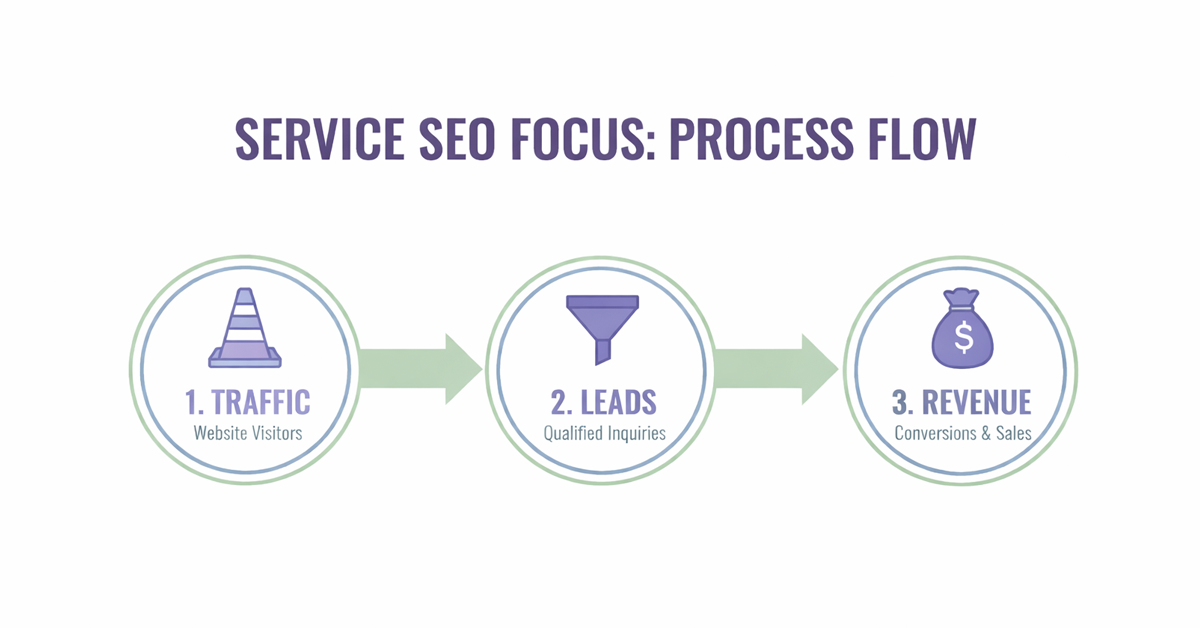
The key takeaway here is that traffic is just the beginning. The real value is created when you convert that visitor into a lead, and that lead into a paying customer. A proper audit identifies and helps you remove the friction at each of these stages, leaving you with an actionable plan that directly impacts your bottom line.
Mastering Local SEO to Dominate Your Service Area
For most service-based businesses, your best leads are on your doorstep. Mastering local search is not just a nice-to-have; it is the core commercial activity that drives phone calls and quote requests from people in your immediate area. This is where your highest-intent customers are searching, and being visible at that exact moment is critical.
The numbers confirm this. Research shows that a massive 46% of all Google searches have local intent. Even more telling, businesses that land in Google’s coveted “local 3-pack” map listings get a staggering 126% more traffic than those ranked just below in positions 4-10. This is not just about getting seen; it is about capturing the lion’s share of ready-to-buy customers in your territory.
Your Google Business Profile as a Lead Generator
Think of your Google Business Profile (GBP) as your best local lead-generation tool, not just an online business card. An incomplete or neglected profile is a huge missed opportunity. To turn it into a client magnet, you need to be strategic.
It all starts with getting the details right. Make sure your primary business category is correct. If you are a plumber, do not just put “Plumber.” Get specific. If your most profitable work comes from emergencies, choose “Emergency Plumber Service.” This small adjustment can make a huge difference to the quality of enquiries you receive.
Go beyond the basics and use all the features GBP offers:
- Services: List every single service you offer with a proper description. This helps Google match your profile to highly specific searches, like “boiler repair for Worcester Bosch models”.
- Updates: Post regularly. Share photos of recent jobs, announce a special offer, or introduce a new team member. This shows Google your business is active and engaged, which is a strong positive signal.
- Q&A Feature: Get ahead of the conversation. Ask and answer the most common questions you get from new clients yourself. This lets you control the narrative, handle objections before they are raised, and showcase your expertise.
For a full, step-by-step guide, check our post on how to optimise your Google Business Listing for the best results.
Building Trust with Citations and Reviews
When it comes to local authority, consistency is crucial. Your business’s NAP (Name, Address, Phone number) details must be identical everywhere they appear online. Small differences, like using “Ltd” on one site and “Limited” on another, can confuse search engines and weaken the trust signals that help you rank.
Building local citations, which are mentions of your business on other websites like local directories or trade-specific portals, is all about reinforcing that consistency. It is about quality, not quantity. A listing in a respected local chamber of commerce directory is worth far more than dozens of listings in low-quality ones.
Your online reputation is a direct reflection of your service quality. A steady stream of positive Google reviews is one of the most powerful conversion signals you have. It validates your expertise and massively influences whether a potential customer calls you or a competitor.
You need a system for requesting reviews. Make it a standard part of your process. After you finish a job, send happy clients a direct link to make it as easy as possible for them to leave feedback. And make sure you reply to all reviews, good and bad. It shows you care about customer service and builds a powerful layer of social proof that leads directly to more qualified enquiries.
Local SEO Priority Checklist
To help you focus your efforts, here is a quick checklist of where to start and what will deliver the most commercial impact for your business.
| Task | Priority Level | Primary Commercial Impact |
|---|---|---|
| Fully Optimise Google Business Profile | High | Increases map pack visibility & direct enquiries |
| Build High-Quality Local Citations | High | Improves local ranking signals & builds trust |
| Generate Consistent Positive Reviews | High | Boosts conversions & social proof |
| Create Localised Service Pages | Medium | Captures “near me” and location-specific searches |
| Add Local Business Schema to Website | Medium | Helps search engines understand your location |
| Ensure NAP Consistency Everywhere | Ongoing | Foundation of local SEO authority |
This is not an exhaustive list, but focusing on these high-priority items first will give you the best return on your time and investment, driving more local customers straight to your business.
Designing Service Pages That Convert Visitors Into Leads
Think of your service pages as your most dedicated salespeople. They work 24/7, never take a holiday, and their only job is to turn qualified visitors into valuable leads. To get this right, you need a smart approach to design and content, where every element works together to build trust, answer questions, and guide the user towards taking the next step.
Many businesses get this wrong. They treat these pages like a digital afterthought, stuffing them with generic descriptions and corporate buzzwords. That is a one-way ticket to a high bounce rate and a quiet phone. A high-performing service page is something else entirely; it is an intentionally engineered lead generation asset.
The Anatomy of a High-Converting Service Page
To transform a casual browser into a genuine lead, your service page needs a few non-negotiable elements. These are not just boxes to tick; they work in harmony to tell a persuasive story that speaks directly to a prospect’s needs and positions you as the only logical solution.
Here is the structure that works time and again:
- A Crystal-Clear Value Proposition: Immediately, tell them what the service is, who it is for, and the main benefit. A visitor should understand it within five seconds. No ambiguity.
- Agitate the Problem: Show them you genuinely understand their pain points. What challenges are they dealing with that your service eliminates?
- Present Your Solution & Process: Clearly explain what your service involves. Break down the steps. When you demystify your process, you build confidence and lower the barrier to entry.
- Show, Don’t Just Tell (Social Proof): This is vital. Weave in testimonials, mini case studies, client logos, or review ratings. Trust is everything for a service business.
- Strategic Calls-to-Action (CTAs): Place clear, benefit-focused CTAs throughout the page. Guide the user naturally towards what you want them to do next.
This is not about just listing what you do. It is about building a compelling argument that connects with the visitor on both a logical and emotional level.
Building Trust and Overcoming Objections
For any service business, trust is your most valuable currency. A potential client is not just buying a service; they are buying into your expertise, your reliability, and the promise of a result. Your page has to build that trust from the ground up and tackle any objections before they can fully form.
The best service pages act like a pre-consultation. They answer all the questions a prospect would ask on that first call, building confidence and qualifying the lead before they even get in touch.
This is where your social proof really comes into play. Instead of just claiming you deliver great results, prove it. A short case study detailing a client’s problem, the solution you provided, and the tangible outcome is infinitely more powerful than a vague promise.
Try to incorporate elements like these:
- Specific Testimonials: Ditch generic praise. Use quotes that highlight real results or ease specific anxieties.
- Relevant Case Studies: Showcase your success with clients who are just like the person reading the page.
- Team Member Profiles: Putting a face to the business makes you more human and approachable.
This focus on conversion-centric design is a cornerstone of effective lead generation. For a much deeper dive, our guide on website design for lead generation lays out the full framework.
Crafting Calls to Action That Actually Drive Enquiries
Finally, you have to make it incredibly easy for a visitor to take the next step. Your calls-to-action (CTAs) need to be impossible to miss, easy to understand, and compelling. Stop using “Contact Us.”
Instead, try action-oriented language that highlights the value of what comes next:
- “Get Your Free Consultation”
- “Request a Project Quote”
- “Schedule a 15-Minute Demo”
Place these CTAs at logical points in the journey, such as right after you have explained your process or shared a powerful case study. When you structure your service pages with this level of commercial intent, you turn them from passive digital brochures into reliable, automated lead generation systems for your business.
Creating Content That Builds Authority and Attracts Clients
Forget trying to game the algorithm. The most effective content marketing comes down to one simple thing: solving your clients’ problems, publicly. For any service business, this is your chance to showcase your expertise, build that all-important trust, and guide potential clients from browsing to actively wanting to hire you.
Every article, every guide, every case study has to serve a clear commercial purpose.
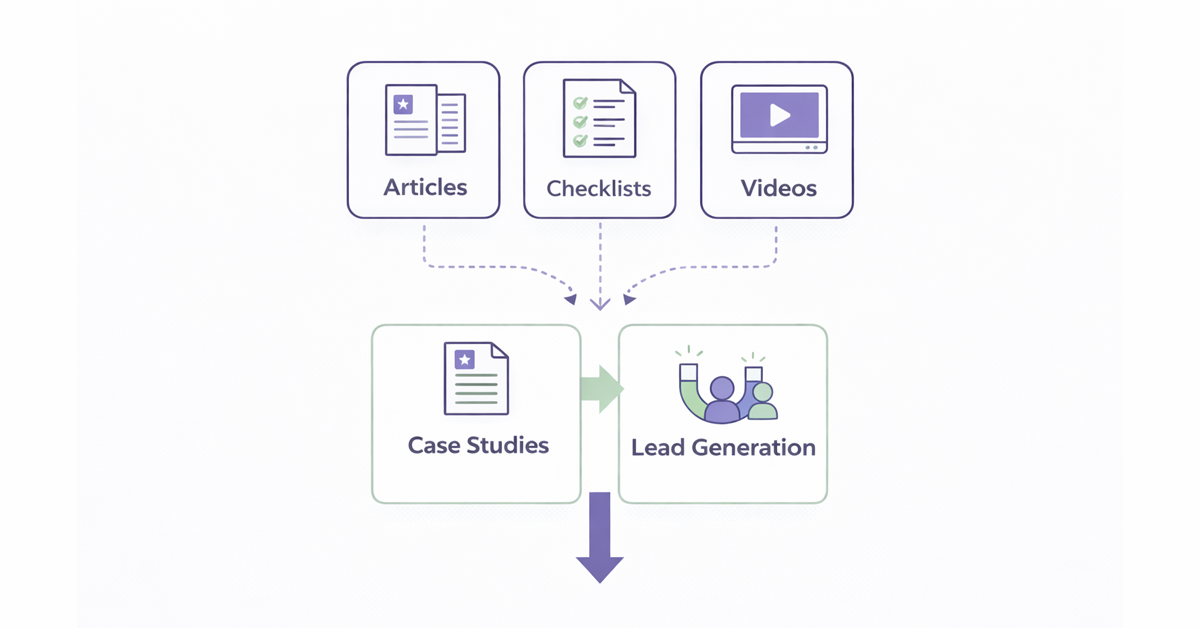
It is a mindset shift. You are not writing for a machine; you are writing for your ideal customer. When you start answering the genuine questions they are already asking, you naturally create content that is relevant, valuable, and, as a positive side effect, gets favoured by Google over time.
Aligning Content with the Buyer’s Journey
Your potential clients do not just wake up one day and decide to hire you. They go through a process, a journey. Your content needs to meet them at every stage, giving them the right information at the right time. This is not just about creating content; it is about creating a sales funnel.
Here is a straightforward way to look at it:
- Awareness Stage: The person knows they have a problem, but they are not sure what to do about it. Your content here should be educational and genuinely helpful. This includes “how-to” guides, articles that break down common industry issues, or simple checklists to help them self-diagnose their situation.
- Consideration Stage: Now, they are actively researching solutions. Your content needs to compare different options and start positioning your service as the best choice. This is the perfect place for in-depth service guides, comparison articles, or webinars that walk through your unique approach.
- Decision Stage: They are on the verge of making a choice. At this point, your content needs to seal the deal by proving you can deliver. Nothing does this better than powerful case studies, detailed project breakdowns, and glowing client testimonials.
When you map your content ideas to these stages, you are not just throwing articles at a wall. You are building a complete system that nurtures people from their first flicker of interest right through to becoming a client.
Brainstorming Content That Converts
Some of the best content ideas will not come from a keyword tool. They will come directly from your customers. Step away from the spreadsheets for a moment and just listen to the questions you are already answering every single day.
Your sales calls, client emails, and initial consultations are a goldmine for content ideas. Every time a prospect asks “how do you handle X?” or “what’s the difference between Y and Z?”, you have a topic for an article that will attract others with the same question.
This approach guarantees your content is never generic. It directly addresses real commercial pain points, positioning you as an expert who truly understands the challenges. That builds authority far more effectively than any keyword-stuffed blog post ever could.
Maximising Reach Through Repurposing
Creating great content takes a lot of work. The last thing you want is for it to be a one-hit-wonder. A single, comprehensive guide can be the seed for a dozen other pieces of content, letting you reach more people on more platforms without starting from scratch.
Take one deep-dive blog post. That can become:
- A PDF checklist you can offer in exchange for an email address.
- A series of short video tips for your social channels.
- A sharp infographic that visualises the key takeaways.
- A slide deck for your next webinar or industry talk.
This is not just about being efficient; it is about making your core ideas work harder. Once your content is optimised for search, sharing it on professional platforms like LinkedIn can be a massive boost for building authority. By repurposing, you reinforce your key messages and ensure every ounce of effort you put in delivers a much bigger return for your business.
Measuring What Matters: SEO and Your Bottom Line
This is where the strategy meets reality. SEO for a service business is not a marketing exercise; it is about making the phone ring, filling your inbox with quote requests, and ultimately, driving profitable growth. To achieve that, you must hold your efforts accountable.
Forget chasing rankings for their own sake. While seeing your site climb to the top spot feels good, it does not pay the bills. The real questions you should be asking are: Is this new traffic actually turning into leads? Are they the right kind of leads? And is our investment in SEO paying for itself?
From Rankings to Revenue
To get real answers, you need to track the numbers that have a direct line to your sales pipeline. These are the metrics that measure the actual commercial impact of your SEO, not just your performance on a results page.
Here is what you should be tracking:
- Organic Lead Volume: This is your primary indicator. Count every single phone call, contact form submission, and direct email that comes from your organic search traffic. This tells you if the engine is running.
- Cost Per Acquisition (CPA): How much are you spending to get one qualified lead through SEO? A simple calculation, dividing your monthly SEO spend by the number of organic leads, shows you how efficient your strategy is.
- Lead-to-Client Conversion Rate: Of all the leads SEO brings in, what percentage actually become clients? This is a huge indicator of lead quality. A high conversion rate tells you you are attracting the right people who genuinely need your service.
- Sales Pipeline Value: Put a potential monetary value on the leads coming from organic search. This helps you see the future revenue your SEO is generating, making it much easier to justify the ongoing investment.
When you start measuring success this way, SEO stops being an abstract expense and becomes a predictable growth engine. You can draw a straight line from specific SEO activities to real revenue, which allows you to make much smarter decisions about where to invest for the biggest return.
Getting Your Tracking Right
Of course, none of this is possible without the right setup. You absolutely need a system that can accurately trace a lead back to its source. Without it, you are just guessing whether that new client came from your SEO efforts, a paid ad, or a referral.
To build a solid foundation for tracking, you need two things in place:
- Goal Tracking in Google Analytics: You need to tell Google Analytics what a “win” looks like on your website. Set up specific goals to track every important action, like someone submitting your ‘Request a Quote’ form, clicking your email address, or tapping your phone number to call.
- Call Tracking Software: For most service businesses, the phone is where the real business happens. Dynamic call tracking is non-negotiable. Software like this shows each visitor a unique phone number based on how they found you. This means you know, with 100% certainty, which calls came directly from an organic search.
Once you have this kind of tracking in place, the guesswork disappears. You will know exactly which marketing channels are delivering results, allowing you to double down on what works and build predictable, profitable growth for your business.
Got Questions? We’ve Got Answers
We have covered a lot of ground, but it is only natural to have a few specific questions about how SEO for service-based businesses really works in practice. Let’s tackle some of the most common ones we hear from business owners.
How Long Until My Phone Starts Ringing from SEO?
Everyone wants to know this, and the honest answer is: it is a process. You might see some quick wins from local SEO tweaks in as little as one to three months, but building a truly sustainable pipeline of high-quality leads generally takes six to twelve months.
Think of it as building a valuable asset for your business, not just flicking a switch. The first few months are about laying a solid foundation: technical fixes, local optimisation, and getting the content strategy right. It is in the later months that you will really see all that hard work compound, bringing in a steady, predictable flow of the right kind of traffic and enquiries. The key is consistency and always focusing on what drives revenue, not just rankings.
SEO or Paid Ads – Where Should I Put My Money?
This is not an either/or question. The smartest strategy usually involves both, as they achieve different but complementary goals for your business.
Paid ads, like Google Ads, are excellent for generating enquiries right now. They deliver immediate visibility and leads, which is vital for cash flow. SEO, on the other hand, is your long-term strategy. It builds lasting authority and a reliable source of leads that, over time, will have a much lower cost per enquiry.
Our advice is to use paid ads for an immediate injection of business while you simultaneously invest in an SEO strategy. That way, the ads keep you busy today, while the SEO builds the primary growth engine for your future. It is a powerful, balanced approach.
If I Can Only Do One Thing for SEO, What Should It Be?
For almost any local service business, the single most critical factor is a fully optimised and active Google Business Profile. It’s your ticket to getting seen in the local map pack, which is prime real estate where a huge number of high-intent customers make their choice.
A well-managed profile with accurate information, a steady stream of positive reviews, and regular posts or updates sends massive trust signals to both Google and your potential clients. It is often the fastest path to generating more local jobs and should be your absolute top priority.
Ready to stop chasing vanity metrics and start building a predictable pipeline of qualified leads? The team at Lead Genera specialises in commercially-focused SEO that delivers measurable results for service-based businesses. Explore our SEO services and find out how we can help you grow.
Categories
Do You Need Assistance With
Sign Up To Our Newsletter