


Weekly marketing wisdom you can read in 5 minutes, for free. Add remarkable ideas and insights to your inbox, once a week, by subscribing to our newsletter.
Sales
What is appointment setting: A 2026 Guide to Predictable Revenue
Appointment setting is not just about putting meetings on a calendar. When executed correctly, it is the crucial bridge between the interest your marketing creates and the sales conversations that drive revenue. It is the engine that ensures your highly skilled sales team spends their time doing what they do best: closing deals.
Table of contents:
What Is Appointment Setting and Why It Matters for Growth
A great appointment setter acts as the air traffic controller for your sales team. Just as a controller expertly guides valuable aircraft onto the runway, an appointment setter navigates potential customers through the early stages of your sales funnel. Their job is to ensure only qualified, high-value prospects land on your sales team’s calendar.
Without this function, your sales pipeline becomes chaotic. Your top salespeople waste their days on calls with people who were never going to buy, or worse, they miss out on major opportunities because they are buried in prospecting.
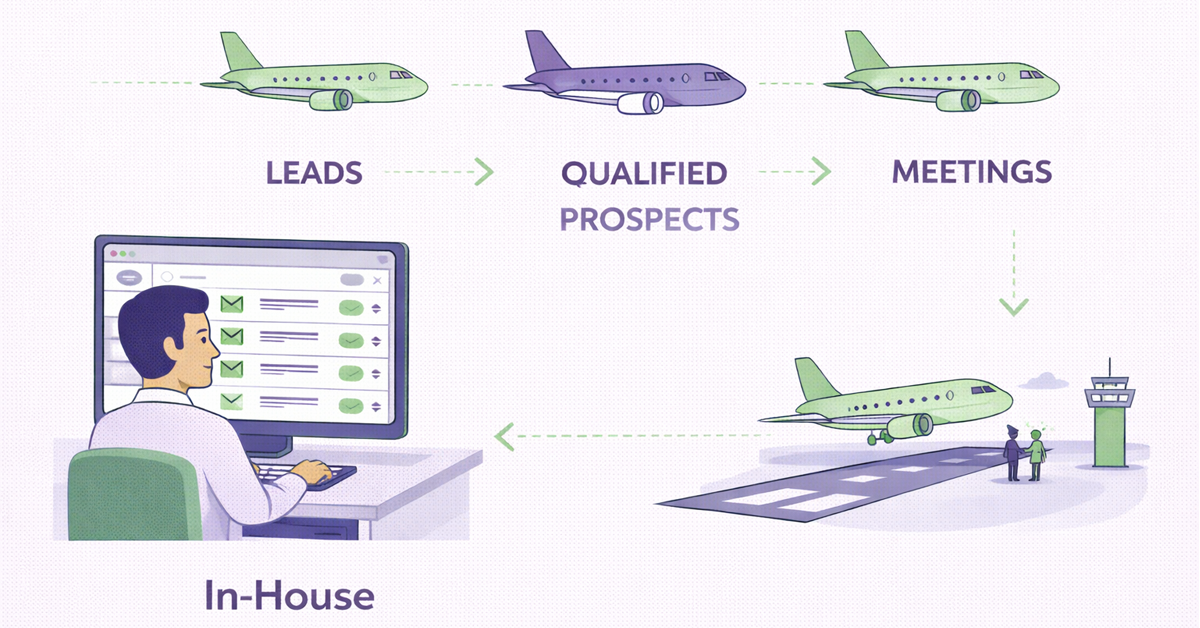
This process is a core component of any robust lead generation strategy. In short, appointment setting is the system that turns vague interest from your marketing efforts into tangible, commercial opportunities that your sales team can close.
The Commercial Impact of Strategic Appointment Setting
When you move beyond just booking meetings and become strategic, appointment setting becomes a powerful driver for business growth. It creates a predictable, scalable system for filling your sales pipeline, which allows you to forecast revenue with far more confidence. It is less about administration and more about engineering a consistent flow of quality sales opportunities.
A well-executed appointment setting process delivers several key commercial benefits, which are summarised in the table below.
Appointment Setting At a Glance
| Component | Description | Commercial Outcome |
|---|---|---|
| Prospecting & Outreach | Identifying and engaging potential customers through channels like cold calls, emails, and LinkedIn. | Fills the top of the sales funnel with new, potential leads. |
| Lead Qualification | Vetting leads against pre-defined criteria to confirm they are a good fit for your product or service. | Prevents sales executives from wasting time on unsuitable prospects. |
| Meeting Coordination | Handling the logistics of scheduling meetings between the qualified prospect and a sales executive. | Creates a smooth, professional handover from initial contact to a sales conversation. |
| Nurturing & Follow-up | Maintaining contact with prospects who are not ready to buy yet, keeping your business top-of-mind. | Maximises the value of every lead generated, even those with longer buying cycles. |
Ultimately, these components work together to deliver significant commercial advantages:
- Increased Sales Efficiency: Your most experienced sales professionals can stop wasting hours on cold prospecting and research. They can walk into meetings ready to do their real job: selling and closing deals.
- Improved Lead Quality: With a dedicated person or team vetting every lead, you guarantee that every meeting holds genuine potential. This directly translates to higher conversion rates.
- Predictable Revenue Growth: A systematised flow of meetings makes your sales pipeline far more reliable. This predictability is essential for strategic planning, hiring, and scaling your business.
- Faster Sales Cycles: Prospects come into the meeting already briefed. They have been qualified, they know who you are, and they have a basic understanding of your value. This reduces the time it takes to get from the first conversation to a signed contract.
In essence, appointment setting transforms your lead generation from a passive activity into an active pursuit of revenue. It is the engine that powers your sales team, ensuring they always have a steady stream of opportunities to fuel growth. For any B2B company serious about scaling efficiently, it is a non-negotiable part of its commercial strategy.
The Appointment Setting Process: From Lead to Meeting
A robust appointment setting process is not just a series of random phone calls and emails. It is a repeatable, scalable system designed to turn a list of potential leads into a calendar filled with valuable sales meetings. Think of it as the vital bridge between identifying a lead and having a proper sales conversation, ensuring no opportunity is lost.
The entire process starts with thorough research and qualification. Before you even consider reaching out, you need to understand the prospect’s business, their specific role, and the challenges they are likely facing. The first step is ensuring you are talking to the right people. If you are unsure where to start, getting a handle on how to find prospects effectively is a massive help. Once you have established that a lead is a good fit, the strategic outreach can begin.
Designing a Multi-Touchpoint Outreach Cadence
Relying on one channel is a recipe for failure. A professional approach uses a multi-touchpoint cadence, blending different channels to build awareness and encourage a response without becoming a nuisance. This methodical approach is about being persistent and professional.
For a typical UK B2B prospect, a sequence might unfold like this:
- Day 1: Personalised Email. The first contact should be a highly personalised email. This is not a generic template, but a message that shows you have done your research. Reference their company, a recent news story, or a specific problem you know is common in their industry.
- Day 3: LinkedIn Connection Request. Next, send a simple, non-salesy connection request. The aim is to get on their radar, moving from a complete stranger to a recognised name in their network.
- Day 5: Follow-up Email & Call. It is time for a second email that gently refers back to the first one. Shortly after sending it, make a focused phone call. Remember, the goal of this call is not to sell on the spot; it is to reference the email and book a proper meeting for a later date.
- Day 8: LinkedIn Engagement. Subtle interaction goes a long way. A thoughtful comment on a post they have shared shows you are genuinely interested in their world, adding another non-intrusive touchpoint.
- Day 10: Final Email. A final, courteous email gives them one last chance to connect. This is often called a “break-up” email, which respectfully closes the loop if you have not heard back.
This structured flow respects the prospect’s busy schedule while giving you the best possible chance of cutting through the noise. It also provides a clear path for how marketing efforts feed directly into the lead generation sales funnel, guiding people towards a meaningful conversation.
The Role of Technology and Human Skill
Throughout this entire process, technology should be your assistant, not the star of the show. Tools like Customer Relationship Management (CRM) systems are brilliant for tracking all your interactions and scheduling follow-ups. They are your safety net, stopping good leads from falling through the cracks. Likewise, scheduling tools like Calendly are fantastic for removing the tedious back-and-forth of finding a meeting time, making it effortless for the prospect.
However, technology can only automate simple tasks. The real art of appointment setting comes down to human skill. It is the ability to handle objections with grace, build rapport instantly, and convey your value in just a few sharp sentences. Tools manage the process; people create the opportunities. When you combine a systematic workflow with skilled execution, you build a powerful engine for predictable growth.
The KPIs That Truly Measure Appointment Setting Success
Effective appointment setting is not just about keeping calendars busy. It is about methodically creating high-value sales opportunities. To get it right, you have to measure what matters.
Relying on vanity metrics like the number of calls dialled or emails sent is a fast track to a pipeline filled with low-quality leads. Real success is measured by the tangible outcomes that drive revenue.
The diagram below shows the simple but critical flow from identifying a prospect to securing that all-important meeting.
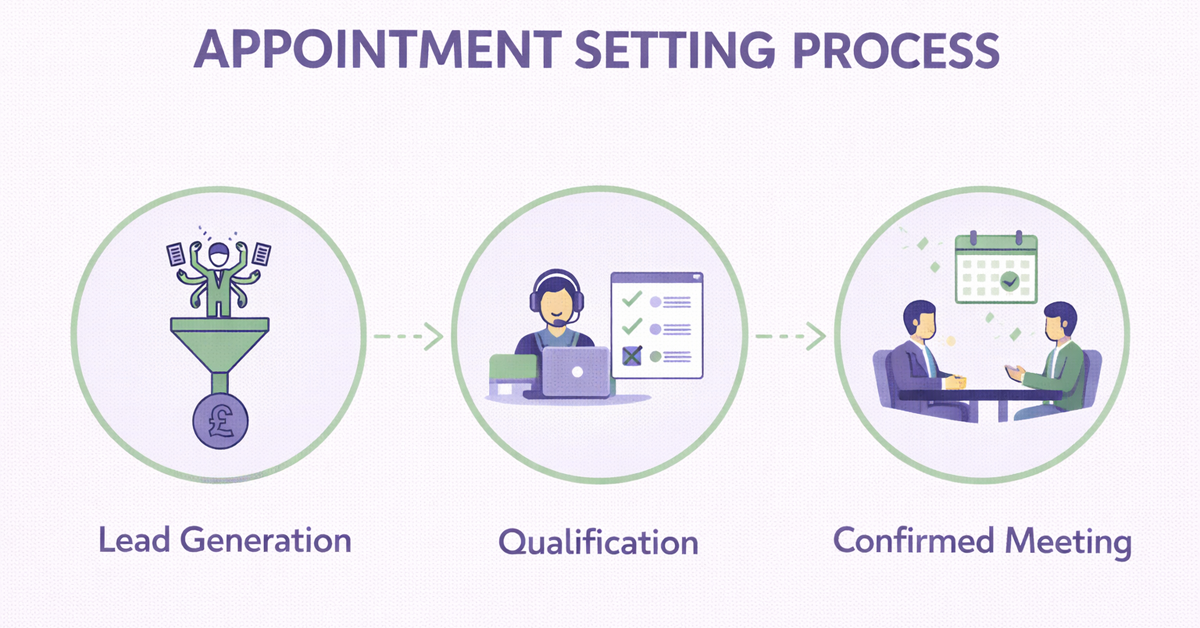
This process visualises how a raw lead is turned into a confirmed sales appointment, which is the core output of any appointment setting function. But a booked meeting is only the start of the measurement journey.
From Activity to Commercial Impact
To hold your team or an agency partner accountable, you need to track a handful of key performance indicators (KPIs) that connect directly to business growth. These are the metrics that move beyond basic activity to measure efficiency, quality, and financial return.
Here are the key operational KPIs to track:
- Conversation-to-Appointment Ratio: This tells you how effective your outreach conversations are. You calculate it by dividing the number of appointments set by the number of meaningful conversations you have had. A low ratio often points to problems with the pitch, qualification, or general rapport-building skills.
- Appointment Show-Up Rate: A booked meeting has zero value if the prospect does not attend. This KPI is simply the percentage of booked appointments that actually happen. A low show-up rate signals a weak confirmation process or that the prospect does not see enough value in the meeting itself.
- Lead-to-Qualified-Appointment Rate: This is the ultimate measure of quality. It tracks the percentage of initial leads that successfully become a sales-qualified meeting that goes ahead. This single metric reveals the health of your entire top-of-funnel process, from the quality of your leads to the effectiveness of your outreach.
The Ultimate Metric: Cost Per Qualified Opportunity
While the operational KPIs above are crucial for managing the process, the metric that every business leader should care about most is the cost per qualified sales opportunity. This ties all your efforts back to a clear financial figure. You can learn more about the components that make up this figure in our guide on understanding customer acquisition cost. A high show-up rate is absolutely essential here; every missed meeting is a sunk cost that inflates this number.
This is not just a business problem. A recent report on NHS England’s GP appointments revealed that 16 million appointments were missed, with nearly one in four people forgetting or being late. Just as the NHS uses reminders to tackle this waste, businesses must have robust confirmation processes to protect pipeline value and ensure resources are not poured down the drain.
By focusing on these commercially-grounded KPIs, you shift the conversation from “How many calls did you make?” to “What is the value of the pipeline you generated?”. This is the mindset required for predictable, scalable growth. It ensures your appointment setting function is not an administrative cost centre, but a strategic revenue driver.
Essential Best Practices for Effective Outreach
Effective appointment setting is much more than a numbers game; it is about starting a genuine conversation. Real success comes from a professional, value-first approach that builds credibility from the very first email or phone call.
Sending out generic, self-serving messages is the quickest way to be ignored. You have to shift your mindset from “What can I sell them?” to “How can I help them?”. The goal is to position the meeting as a valuable consultation, not a sales pitch.
Personalisation Beyond the First Name
True personalisation goes far beyond just slotting a prospect’s name into a template. It is about proving you have done your homework and understand their business and its challenges. This is your single best tool for cutting through the inbox noise.
Your outreach has to show you have put in the effort. Instead of a generic opener, try referencing a recent company milestone, a connection you share on LinkedIn, or a specific industry challenge you know they are facing. Research shows a significant number of B2B decision-makers feel that sales representatives are unprepared, so doing your research is a simple way to stand out.
Crafting a Compelling Value Proposition
You need to communicate your value with absolute clarity. A prospect must understand “what is in it for me” within seconds of opening your email or picking up the phone. Vague promises like “improving efficiency” or “driving growth” will not cut it.
Instead, zero in on a specific, outcome-focused statement. Connect their problem directly to a concrete result you can deliver. For example, do not just say “we help businesses with marketing”. A much better approach is, “we help manufacturing firms like yours generate qualified engineering leads, reducing their sales team’s prospecting time by up to 50%“.
The core principle is simple: lead with value, not with your request. Frame the meeting as an opportunity for the prospect to gain insight, solve a problem, or explore a strategic advantage. This turns the interaction from a sales call into a valuable business conversation.
The difference between a weak email and a powerful, personalised one is night and day. A good approach respects the prospect’s time, establishes your credibility, and makes a compelling case for a brief conversation.
Let’s look at a quick comparison to see what this looks like in practice.
Email Outreach Template Comparison
| Element | Ineffective Approach | Effective Approach |
|---|---|---|
| Subject Line | Meeting Request | Idea for [Company Name]’s lead flow |
| Opening Line | My name is John from XYZ, we offer marketing services. | I saw your recent post about expanding into the North. |
| Value Prop | We help companies like yours grow. | We helped a similar firm in your sector double their MQLs. |
| Call to Action | Are you free for a chat next week? | Does Tuesday at 10 am work for a 15-minute call? |
This structured, thoughtful communication is what separates amateur outreach from professional appointment setting. It does not just secure more meetings; it secures higher-quality meetings with prospects who are actually engaged and ready to talk business.
Choosing Your Model: In-House Versus Outsourced Teams
One of the biggest decisions a growing business faces is whether to build its own appointment setting team or to partner with a specialist. It is a choice that directly impacts your costs, speed to market, and ability to scale. The right answer depends on your company’s resources, growth ambitions, and how much operational heavy lifting you are prepared to do.
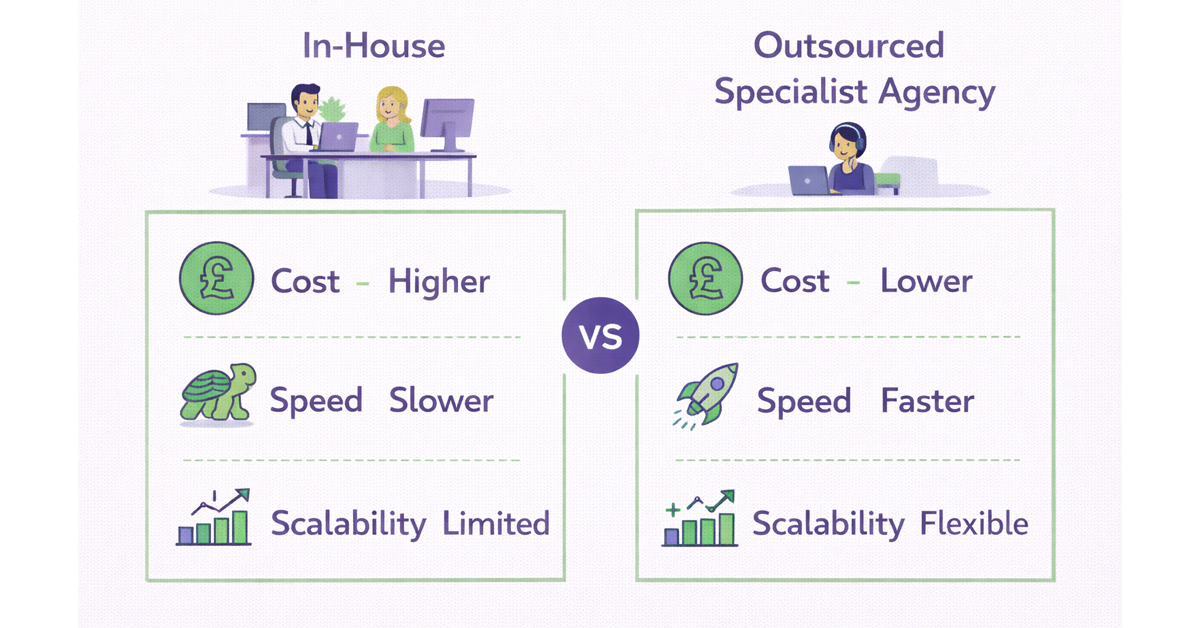
An in-house team gives you complete control and ensures they live and breathe your brand. But this path is filled with hidden costs that go well beyond salaries. You must factor in recruitment fees, lengthy training, management overheads, software licences, employee benefits, and the very real cost of staff turnover.
Analysing the True Cost of In-House Hiring
The time it takes to hire alone can be a huge drain, putting the brakes on your revenue goals. To put it in perspective, recent UK government data showed that ministerial departments took an average of a staggering 212 days to fill public appointments. Only 12% of roles were finalised within three months.
While that is the public sector, the lesson for a commercial business is clear. Delays like that translate directly into a dry pipeline and missed opportunities. You can see the full numbers in the public appointments data report.
An in-house model usually only makes sense for large, established companies that already have the infrastructure and deep pockets to fund a dedicated sales development department.
The Outsourced Model: Speed and Specialisation
Outsourcing, on the other hand, offers a much faster and more predictable route to getting qualified appointments in the diary. When you partner with a specialist agency, you get immediate access to trained professionals, battle-tested processes, and a ready-made technology stack. It is a way to completely bypass the long and expensive ramp-up period of building a team from scratch.
For any company thinking about getting external support for their outreach, exploring different outsourced sales solutions can reveal flexible and scalable ways to handle appointment setting.
The main advantages of outsourcing are compelling:
- Speed to Impact: An experienced agency can start generating qualified meetings in a matter of weeks, not months or quarters.
- Cost Predictability: You pay a set fee or a performance-based rate, which eliminates the unpredictable overheads that come with employees.
- Scalability: If you need to ramp up for a product launch or dial back during a quiet season, you can scale your activity up or down easily, without the HR headaches of hiring and firing.
- Access to Expertise: You are tapping into a team whose entire focus is mastering the art and science of appointment setting across different industries.
It all boils down to a trade-off: control versus speed. Building your own team gives you total ownership, but it is a slow and resource-heavy process. Outsourcing delivers immediate expertise and scalability, letting you focus on your core business while a partner builds your sales pipeline. For most growing businesses that are focused on ROI and efficient growth, a specialist partner offers a clear commercial advantage.
Frequently Asked Questions About Appointment Setting
If you are a business leader looking at ways to grow, you likely have a few questions about appointment setting. Here are some straightforward, commercially focused answers to the queries we hear most often, designed to give you the clarity you need.
How Is Appointment Setting Different from Cold Calling?
While a cold call can sometimes be part of the process, it is a mistake to think they are the same thing. Cold calling is often a brute-force numbers game, which involves dialling as many people as possible and hoping something sticks.
Strategic appointment setting is far more nuanced. It is a complete process focused on qualifying and building relationships with prospects, who might already be warm from your marketing efforts. The goal is not a quick sale; it is to secure a valuable, dedicated meeting for a sales expert. Think of it as intelligence-gathering that tees up a high-quality opportunity, whereas traditional cold calling is often just about hitting a dial count.
What Is a Realistic Cost Per Appointment in the UK?
The cost for a qualified B2B appointment in the UK can vary wildly, depending on your industry, the seniority of your target, and the complexity of what you sell. A realistic range can be anywhere from £75 to over £500.
What drives this cost? A few key things:
- The quality and price of the prospect data you are using.
- The skill and experience of the person setting the appointments.
- The tech stack needed to run the outreach efficiently.
The most important thing to focus on is not just the cost per booked meeting, but the cost per qualified appointment that actually happens. The real measure of success is the return you get from those meetings. Paying slightly more for a high-value opportunity is always more profitable than paying less for a poor-quality one that goes nowhere.
When Is the Right Time to Invest in Appointment Setting?
The perfect time to formalise an appointment setting function is when you have a proven product or service and you need a more predictable way to fill your sales pipeline. If your senior sales team is spending more time hunting for leads than closing deals, that is a huge red flag. It is time to act.
Likewise, if your inbound leads are not being followed up effectively and turned into meetings, or if you have ambitious growth targets but no consistent flow of sales conversations to get you there, this is the missing piece. A dedicated appointment setting function bridges that critical gap between your marketing spend and tangible revenue.
What Skills Define a Great Appointment Setter?
An elite appointment setter is a unique blend of resilience, professional persistence, and exceptional listening skills. They need to be incredibly organised to manage follow-up sequences across phone, email, and LinkedIn, all while maintaining a confident and unshakeable tone.
However, it goes beyond just talking. The best are strategic thinkers. They can quickly grasp a prospect’s business pains, crisply articulate a value proposition, and know exactly when to push for a meeting versus when to nurture the relationship for the long run. They are not just salespeople; they are expert opportunity creators, laying the essential groundwork for your sales team to succeed.
At Lead Genera, we specialise in building predictable sales pipelines through strategic appointment setting. We act as your performance-led growth partner, focusing on delivering qualified meetings that convert into real revenue.
Discover how our appointment setting services can fuel your growth.
Categories
Do You Need Assistance With
Sign Up To Our Newsletter