


Weekly marketing wisdom you can read in 5 minutes, for free. Add remarkable ideas and insights to your inbox, once a week, by subscribing to our newsletter.
SEO
8 Actionable SEO Tips for Small Businesses That Drive Growth in 2026
For small and medium sized businesses, search engine optimisation is not about vanity metrics or appearing number one for obscure terms. It is a critical commercial activity designed to generate high quality leads, reduce your cost per acquisition, and build a sustainable pipeline of new business.
Many businesses are told SEO is a dark art, a slow burn strategy with uncertain returns. The reality is that a commercially grounded approach, focused on tangible outcomes, can deliver measurable results faster than you might expect. This guide moves beyond generic advice to provide eight actionable SEO tips for small businesses, each designed to drive commercial growth. Every point is a strategic lever you can pull to improve your visibility, attract the right customers, and turn your website into a reliable lead generation asset.
Table of contents:
We will cover the foundational work that delivers quick wins, from local SEO and on page fixes to the long term strategies that create a lasting competitive advantage. This is not a theoretical exercise; it is a practical blueprint for building a predictable engine for customer acquisition. You will learn how to:
- Establish a strong technical foundation to ensure search engines can find and understand your site.
- Dominate local search to attract customers in your immediate service area.
- Create content that directly addresses customer needs and drives conversions.
- Build authority through strategic link building that signals trust to Google.
- Measure what matters, focusing on lead volume and quality, not just rankings.
Each tip is framed with a clear focus on commercial outcomes and return on investment, providing you with the clarity needed to take decisive action.
1. Conduct Thorough Keyword Research and Target Long Tail Keywords
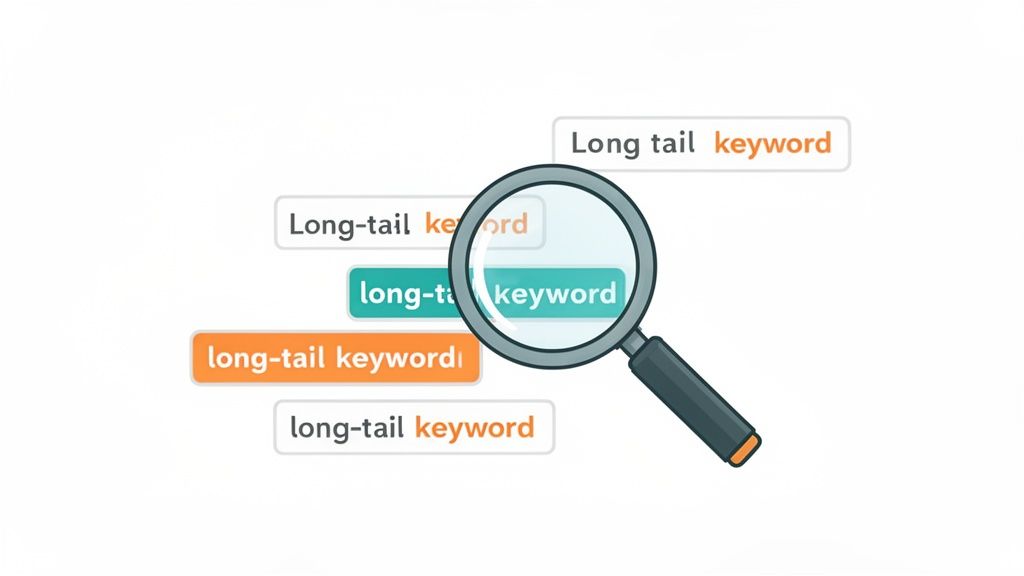
Keyword research is the strategic foundation of any successful SEO campaign. It involves identifying the specific words and phrases your target audience uses to find solutions like yours online. For a small business, competing with established industry giants for broad, high volume keywords like “plumber” or “accountant” is often an inefficient use of resources. This is where a targeted approach becomes one of the most critical seo tips for small businesses.
The key is to focus on long tail keywords: longer, more specific search phrases of three or more words. These keywords typically have lower search volume but signal much higher purchase intent. A user searching for “emergency plumber in Norwich city centre” has a more immediate and specific need than someone searching for “plumber”. By targeting these precise terms, you attract highly qualified prospects who are further along in their buying journey, leading to better conversion rates and a stronger return on your marketing investment.
Why This Approach Works for SMEs
This strategy levels the playing field. Instead of trying to outspend larger competitors for broad, expensive keywords, you can carve out a profitable niche by answering very specific user questions. This method is particularly effective for service based firms and B2B companies where the quality of a lead is far more valuable than the sheer volume of website traffic. For example, a professional services firm will see greater commercial success by ranking for “GDPR compliance consultant for small businesses” than for the generic term “compliance consultant”.
Actionable Steps for Implementation:
- Utilise Keyword Research Tools: Start with tools like Ahrefs, SEMrush, or accessible alternatives such as Ubersuggest and Google Keyword Planner to brainstorm initial ideas and analyse search volumes.
- Prioritise Commercial Intent: Focus on keywords that suggest a user is ready to buy. Look for modifiers like “services,” “near me,” “[city name],” “for sale,” “quote,” or “prices.”
- Analyse Your Competitors: Look at the top ranking pages for your target keywords. Understand the type of content that is performing well and identify gaps you can fill.
- Review Google Search Console: This free tool is invaluable. Check the “Performance” report to find keywords where you are already ranking on page two or three (positions 11-30). Optimising the corresponding pages can deliver quick ranking improvements.
2. Optimise On Page SEO Elements (Title Tags, Meta Descriptions, Headers)
On page SEO is the practice of optimising the individual elements of your webpages to improve search engine visibility and user engagement. For a small business, mastering on page factors like title tags, meta descriptions, and header structure is one of the highest impact, lowest cost seo tips for small businesses available. It provides direct control over how search engines understand your content and how potential customers perceive your brand in search results, making it a foundational step for commercial growth.
These elements are your first opportunity to capture a searcher’s attention. A well crafted title tag and meta description act as a compelling advert on the search engine results page (SERP), encouraging clicks over competitors, even if you rank slightly lower. Strong on page optimisation ensures that every piece of content you create is structured to communicate its purpose clearly to both algorithms and human readers, maximising its ranking potential and conversion value from day one.
Why This Approach Works for SMEs
Perfecting on page elements delivers immediate and measurable results without requiring a significant budget for link building or complex technical overhauls. Small businesses can directly influence their click through rates and perceived authority by making strategic tweaks. For example, a tradesperson can instantly stand out by changing a generic title like ‘Loft Conversions’ to ‘Professional Loft Conversions in Manchester | Award Winning Builders’. This more descriptive title targets a local keyword and builds trust with words like “Professional” and “Award Winning”, attracting higher quality leads.
Actionable Steps for Implementation:
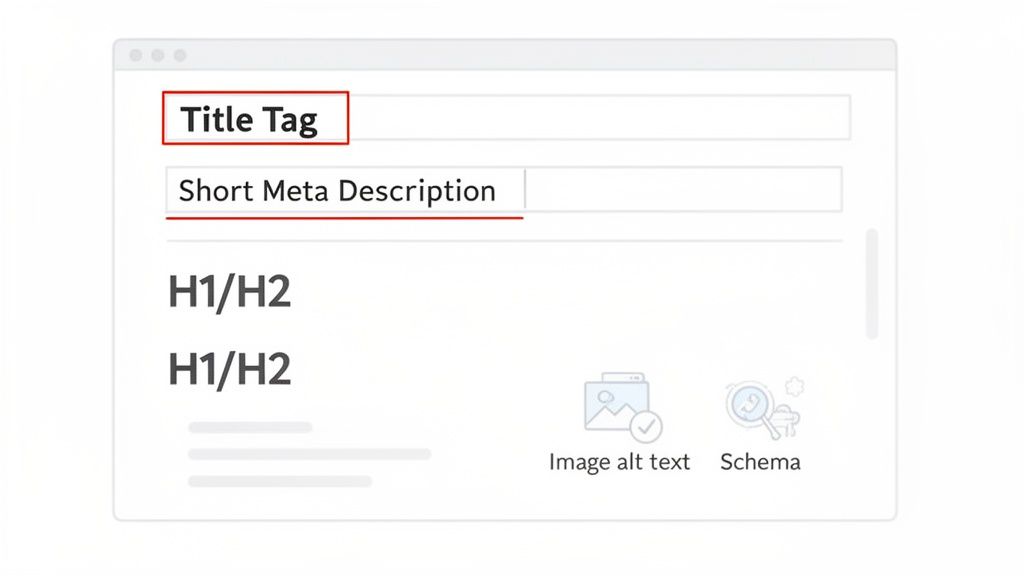
- Optimise Title Tags: Place your primary target keyword near the beginning of the title tag. Keep titles under 60 characters and add compelling modifiers like “Certified,” “Reliable,” or “Guaranteed” to improve click through rates.
- Write Compelling Meta Descriptions: Treat meta descriptions as a call to action. While not a direct ranking factor, they heavily influence clicks. Summarise the page’s value and tell the user what to do next. Keep them under 160 characters.
- Structure Content Logically: Use one unique H1 tag per page that includes your main keyword. Organise the rest of the content with H2 and H3 subheadings to improve readability for users and provide clear topical signals for search engines.
- Leverage Schema Markup: Add structured data (schema) to your pages to help search engines better understand your content. For a local business, this can enable rich snippets in search results, showing reviews, opening hours, and service areas directly.
3. Build High Quality Backlinks Through Strategic Outreach and Content
Backlinks, which are links from other websites pointing to yours, remain one of Google’s most powerful ranking signals. For a small business, earning these links is a direct way to build digital authority and signal to search engines that your website is a credible, trustworthy resource. Instead of chasing a high volume of low quality links, a successful SEO strategy focuses on acquiring high quality backlinks from relevant and authoritative sources within your industry or local area.
This methodical approach builds a sustainable competitive advantage that grows over time. A single, powerful link from a respected industry publication or a local authority can have a greater impact on your search rankings than dozens of links from irrelevant, low authority websites. Understanding the importance of backlinks for your business is a foundational step in creating a long term SEO asset that drives qualified traffic and leads.
Why This Approach Works for SMEs
Link building is a potent tool for small businesses to establish expertise and compete with larger, more established players. For B2B companies and professional services firms, earning a link from an industry news outlet by publishing original research is a direct endorsement of their expertise. Similarly, a trades business that secures links from local community groups or complementary service providers (e.g., an electrician linking to a trusted plumber) reinforces its local relevance and authority, directly impacting local search performance. This strategy is about building genuine digital relationships and creating assets that attract links naturally.
Actionable Steps for Implementation:
- Create “Linkable Assets”: Develop content that others will want to reference and link to. This includes original research, comprehensive guides, free tools, insightful case studies, or unique industry reports.
- Analyse Competitor Backlinks: Use tools like Ahrefs or SEMrush to see which websites are linking to your direct competitors. This provides a clear roadmap of high value, relevant websites to target for your own outreach.
- Claim and Optimise Local Citations: Ensure your business is listed correctly on Google Business Profile, Yelp, and other relevant local and industry directories. These listings create foundational local links and improve local SEO.
- Engage in Strategic Outreach: Identify relevant blogs, resource pages, and industry publications. Build genuine relationships with editors and journalists before asking for a link. Offer them value, such as a unique data point or an expert quote.
- Leverage HARO (Help A Reporter Out): This service connects journalists with expert sources. Responding to relevant queries can earn your business high authority media mentions and powerful backlinks from news websites.
- Focus on Relevance and Authority: Prioritise earning links from websites that are topically relevant to your business and have strong domain authority. Quality will always outperform quantity in a modern SEO strategy.
4. Create a Technical SEO Foundation (Site Speed, Mobile Optimisation, Crawlability)
Technical SEO is the backstage crew of your website; it ensures search engines can efficiently find, crawl, index, and understand your content. Without a solid technical foundation, even the most brilliant content strategy can fail to rank. For small businesses, getting these foundational elements right is a prerequisite for being competitive, making it one of the most essential seo tips for small businesses.
Key technical factors include site speed, mobile responsiveness, and a clean site structure. A slow, clunky website frustrates users and signals poor quality to Google, directly impacting your rankings and conversion rates. Similarly, with over 60% of searches now happening on mobile devices, Google’s mobile first indexing means your site’s mobile experience is the primary version it evaluates. A robust technical SEO foundation also involves ensuring your site’s crawlability, partly achieved through implementing a properly structured XML sitemap.
Why This Approach Works for SMEs
Fixing technical issues delivers a double benefit: it improves user experience and satisfies search engine requirements. For example, reducing page load time from five seconds to under two can significantly decrease bounce rates and increase conversions. This approach allows small businesses to compete on quality and performance, not just marketing budget. A technically sound website is seen as more authoritative and trustworthy by search engines, giving your content a better chance to rank for your target keywords.
Actionable Steps for Implementation:
- Benchmark and Improve Site Speed: Use free tools like Google PageSpeed Insights and GTmetrix to test your site’s performance. Focus on compressing images (using modern formats like WebP), enabling browser caching, and minimising code.
- Prioritise Mobile First Design: Test your website with Google’s Mobile Friendly Test to ensure it is fully responsive. Every element, from navigation menus to contact forms, should be easy to use on a small screen.
- Monitor Core Web Vitals: Regularly check the Core Web Vitals report in Google Search Console. This tells you how users experience your site in terms of loading speed (Largest Contentful Paint), interactivity (First Input Delay), and visual stability (Cumulative Layout Shift).
- Conduct Regular Crawl Audits: Use the “Coverage” report in Google Search Console to find and fix crawl errors. This ensures search engines can access all of your important pages without issues.
- Implement Structured Data: Use schema markup to help Google understand the context of your content, such as your business address, opening hours, product details, or services offered. This can enhance your appearance in search results.
5. Develop an Effective Local SEO Strategy (Google Business Profile, Local Citations, Reviews)
For businesses operating within specific geographic areas, such as trades, professional services, or storefronts, local SEO is often more valuable than chasing national rankings. It is the practice of optimising your online presence to attract more business from relevant local searches. When a potential customer in your service area searches for what you offer, a strong local strategy ensures you appear prominently in the search results, particularly in the valuable Google “Map Pack”.
This approach focuses on demonstrating your relevance and authority within a defined location. By optimising key platforms like your Google Business Profile (GBP), managing local directory listings (citations), and cultivating customer reviews, you build trust with both search engines and potential customers. This is one of the most direct and high impact seo tips for small businesses looking to generate qualified, geographically relevant leads.

Why This Approach Works for SMEs
Local SEO levels the playing field, allowing a well optimised small business to outrank larger national chains in local search results. A local plumbing company in Norwich, for instance, can dominate the results for “emergency plumber Norwich” through focused GBP optimisation and consistent positive reviews. This strategy directly targets users with immediate, location specific needs, resulting in higher quality leads and a superior return on investment compared to broader, more competitive national SEO campaigns.
Actionable Steps for Implementation:
- Claim and Fully Optimise Your Google Business Profile: This is your most critical local SEO asset. Complete every section: services, categories, opening hours, photos, and a detailed business description. You can learn more about how to optimise your Google Business Listing to turn it into a lead generation machine.
- Build Consistent Local Citations: Ensure your business name, address, and phone number (NAP) are consistent across all major online directories like Yelp, Thomson Local, and relevant industry specific sites. Consistency is key to building trust with Google.
- Implement a Review Generation System: Actively and systematically request reviews from satisfied customers. A steady stream of positive reviews is a powerful ranking factor and a crucial social proof signal for potential clients.
- Respond to All Reviews: Engage with both positive and negative feedback promptly and professionally. This demonstrates excellent customer service and shows that you value your clients’ opinions.
- Use Google Posts Regularly: Share updates, offers, and news directly on your GBP using the Posts feature. This keeps your profile active and provides another touchpoint to engage searchers directly in the search results.
6. Create High Quality, Conversion Focused Content Aligned with the Buyer Journey
Content marketing is the engine of modern SEO, but simply publishing blog posts is not enough. For small businesses, content must serve a dual purpose: ranking in search results and converting those readers into qualified leads. This means moving beyond thin, keyword stuffed pages and instead creating valuable resources that educate potential customers at every stage of their decision making process. This approach is one of the most commercially focused seo tips for small businesses.
The goal is to address customer pain points, answer common questions, and guide prospects towards a solution, establishing your business as a trusted authority. A B2B SaaS company might publish a ‘Complete Guide to [Industry Process]’ that ranks for high intent keywords and generates qualified leads monthly. Similarly, a local trades business could create a ‘Homeowner’s Guide to [Service]’ with cost saving tips, building trust and encouraging enquiries. This strategy turns your website into a valuable asset that attracts and nurtures potential customers.
Why This Approach Works for SMEs
This method builds a sustainable pipeline of inbound leads. Instead of relying solely on paid advertising, you create long term assets that generate organic traffic and conversions month after month. High quality content demonstrates expertise and builds trust, which is crucial for B2B and high value service businesses where the sales cycle is longer. By aligning content with the buyer journey, you meet customers where they are, providing the right information at the right time and positioning your business as the obvious choice when they are ready to buy.
Actionable Steps for Implementation:
- Map Content to the Buyer Journey: Create content for each stage: awareness (guides, blog posts), consideration (case studies, comparison articles), and decision (service pages, pricing information).
- Target Keywords Naturally: Integrate your primary keywords within the first 100 words and throughout the text, but always prioritise readability and a natural flow for the user.
- Invest in Cornerstone Content: For competitive keywords, aim for in depth, long form content (2000+ words) that comprehensively covers a topic. These ‘pillar’ pages act as hubs for your expertise.
- Include Clear Calls to Action (CTAs): Every piece of content should have a clear next step. This could be signing up for a newsletter, downloading a guide, requesting a demo, or contacting your sales team.
- Optimise for Featured Snippets: Structure content to answer questions directly. Use lists, tables, and short, concise paragraphs to increase your chances of capturing the “position zero” featured snippet in Google search results.
- Update Content Regularly: Keep your evergreen content fresh and relevant by reviewing and updating it every few months. This signals to Google that your information is current and valuable.
7. Leverage User Experience Signals (Click Through Rate, Dwell Time, Bounce Rate)
Modern SEO extends beyond keywords and backlinks; it is increasingly influenced by how users interact with your website. Google pays close attention to user experience signals like click through rate (CTR), dwell time (how long a visitor stays on your page), and bounce rate. Optimising for these metrics is one of the most commercially astute seo tips for small businesses because it aligns your website’s performance with both user satisfaction and search engine priorities.
A high click through rate from search results tells Google your page title and meta description are compelling and relevant. Once on the page, long dwell times and low bounce rates signal that your content successfully answers the user’s query. This creates a positive feedback loop: better user engagement signals a quality result, which can lead to higher rankings and more qualified traffic. This approach shifts the focus from simply ranking to engaging and converting the traffic you earn.
Why This Approach Works for SMEs
Small businesses can gain a significant competitive edge by creating a superior user experience. While larger competitors might dominate with massive backlink profiles, you can win by providing content that is more engaging, easier to navigate, and better at satisfying user intent. For example, a professional services firm that creates clear, scannable content with strong calls to action can see its CTR from search results improve from 2% to 4.5%, doubling its qualified traffic without needing a higher ranking.
This focus on user behaviour naturally complements conversion goals. A visitor who finds what they need quickly, stays to explore your solution, and understands the next step is far more likely to become a lead. Mastering these user signals is a direct investment in your sales pipeline.
Actionable Steps for Implementation:
- Optimise Titles and Meta Descriptions for Clicks: Write compelling, value driven titles and meta descriptions that stand out in search results. Think of them as adverts for your content, designed to attract the right clicks.
- Answer User Intent Immediately: Ensure the content at the top of your page directly addresses the search query. A user should know within seconds that they are in the right place.
- Improve Readability and Engagement: Use short paragraphs, clear subheadings (H2s, H3s), bullet points, and bold text to make your content easy to scan. Integrate relevant images, diagrams, or videos to hold attention.
- Encourage Deeper Exploration: Include internal links to other relevant pages on your site. This reduces bounce rate and increases dwell time by guiding users on a logical journey.
- Monitor Key Pages: Use Google Analytics and Google Search Console to identify pages with high bounce rates or low CTR. Prioritise these for user experience improvements. By implementing some of these strategies, you can begin to master conversion rate optimisation best practices and turn more visitors into customers.
8. Implement a Consistent SEO Monitoring and Iteration System
Effective SEO is not a “set it and forget it” task; it is a dynamic process that requires continuous monitoring, analysis, and refinement. For a small business, treating SEO as an ongoing cycle of improvement is essential for sustainable growth. It involves tracking key performance metrics, understanding what is working, and making data driven adjustments to your strategy. This is one of the most crucial seo tips for small businesses for turning search visibility into tangible commercial results.
The core principle is to use data to guide your decisions. Free tools like Google Search Console and Google Analytics offer a wealth of information about your website’s performance. By regularly reviewing this data, you can move beyond guesswork and focus your limited resources on activities that generate the highest return. This iterative approach allows you to identify new opportunities, fix issues before they escalate, and consistently improve your organic lead generation.
Why This Approach Works for SMEs
A continuous monitoring system ensures your SEO efforts remain aligned with business goals. Instead of blindly creating content or building links, you can pinpoint which keywords drive qualified leads and which pages convert visitors into customers. For example, a small service business might discover that a single, in depth blog post is responsible for generating ten qualified enquiries per month. This insight allows them to double down on creating similar high value content, directly increasing their sales pipeline. This data driven cycle of measure, learn, and adapt ensures your marketing budget is always working as efficiently as possible.
Actionable Steps for Implementation:
- Set Up Foundational Tools: Ensure Google Analytics and Google Search Console are correctly installed and connected. Set up conversion tracking for key actions like form submissions or phone calls.
- Create a Simple Tracking Dashboard: Use a spreadsheet to track 5-10 of your most important target keywords monthly. Monitor organic traffic trends in Google Analytics, paying close attention to performance by landing page.
- Review GSC for Quick Wins: Weekly, check the “Performance” report in Google Search Console for keywords where you rank in positions 11-20. Optimising the associated pages can deliver rapid ranking improvements.
- Establish a Monthly Review Cadence: Dedicate 30 minutes each month to review your data. Look at organic traffic, keyword rankings, and, most importantly, the number of leads generated.
- Conduct Quarterly Audits: Use free tools like Screaming Frog (the free version crawls up to 500 URLs) or Google’s Lighthouse to perform a basic technical audit each quarter to catch any emerging issues.
8 Point Small Business SEO Comparison
| Strategy | Implementation Complexity | Resource Requirements | Expected Outcomes | Ideal Use Cases | Key Advantage |
|---|---|---|---|---|---|
| Conduct Thorough Keyword Research and Target Long Tail Keywords | Medium: requires ongoing research and competitor analysis | Low–Medium (keyword tools, analyst time) | Targeted, high intent traffic; improves qualified traffic (~20–40% in 3 months) | Service based, B2B, local businesses seeking qualified leads | Targets intent with lower competition for faster rankings |
| Optimise On Page SEO Elements (Title Tags, Meta Descriptions, Headers) | Low: page level edits and content audits | Low (content edits, SEO plugin) | Quick CTR and visibility gains; modest organic lift (5–15%) | Small sites, pages needing improved CTR or clarity | Fast, low cost wins that improve click through and UX |
| Build High Quality Backlinks Through Strategic Outreach and Content | High: outreach, relationship building, and content creation | High (content production, outreach tools, time) | Increased authority and compounded visibility; notable impact in 3–6 months | B2B, competitive niches, firms building authority | Sustainable ranking improvements and referral traffic |
| Create a Technical SEO Foundation (Site Speed, Mobile, Crawlability) | Medium–High: requires development skills and audits | Medium–High (dev time, hosting, tools) | Better crawlability, UX and rankings; measurable traffic/CR gains (5–20%) | Large sites, older sites, sites with speed or indexing issues | One time fixes with long lasting technical benefits |
| Develop an Effective Local SEO Strategy (GMB, Citations, Reviews) | Low: focused setup and ongoing review management | Low–Medium (GMB management, citations, review system) | Fast local visibility; often 2–3x lead increase within 90 days | Trades, local services, retail with a geographic focus | Highest commercial intent and fastest ROI for local businesses |
- Create High Quality, Conversion Focused Content Aligned with the Buyer Journey | Medium: planning, research, and consistent output | High (writers, research, multimedia) | Compounding organic authority and leads; first results in 8–12 weeks | B2B, lead generation, education driven buyer journeys | Generates leads while building long term organic authority |
| Leverage User Experience Signals (CTR, Dwell Time, Bounce Rate) | Medium: requires testing, design and UX improvements | Medium (analytics, CRO tools, design resources) | Improved rankings and conversions; CTR +5–30%, better dwell time | Conversion focused pages, high traffic landing pages | Directly influences rankings and conversion performance |
| Implement a Consistent SEO Monitoring and Iteration System | Low: setup and regular reporting; recurring cadence | Low–Medium (GSC/GA, rank trackers, analyst time) | Identifies quick wins and prevents losses; measurable ROI (quick wins each quarter) | Any business pursuing sustainable, data driven SEO | Enables continuous improvement and accountable results |
Your Next Steps: From Insight to Implementation
We have covered a significant amount of ground, moving from quick wins in local SEO to the strategic nuances of content marketing and technical optimisation. The eight core pillars discussed provide a comprehensive blueprint, but knowledge without action is simply an academic exercise. The true value lies in translating these SEO tips for small businesses into a consistent, commercially focused programme of work that drives tangible growth for your organisation.
Your journey does not have to be an overwhelming overhaul. True momentum is built through systematic, incremental improvements. By breaking down the process into manageable stages, you can transform your website from a passive digital brochure into a powerful, lead generating asset that works for you around the clock.
Prioritising for Maximum Commercial Impact
For most small businesses, the path to SEO success is paved with strategic prioritisation. Not all activities deliver the same return on investment, and your initial focus should be on the areas that generate the most significant commercial uplift in the shortest time frame.
-
Phase 1: Secure Your Foundations (Weeks 1-4): Your immediate priority should be the foundational, high impact tasks. This means a complete optimisation of your Google Business Profile and a thorough audit and refinement of your core on page SEO elements. These actions directly influence how you appear in local searches and how effectively you convert existing visibility. They are the lowest hanging fruit and deliver the most immediate results.
-
Phase 2: Build Authority and Relevance (Months 2-6): With the fundamentals in place, shift your focus to building authority. This involves developing a targeted content strategy that answers your ideal customers’ most pressing questions. Simultaneously, begin a sustainable link building campaign and ensure your website’s technical health is robust, particularly focusing on site speed and mobile friendliness.
-
Phase 3: Refine and Scale (Ongoing): SEO is not a one time project; it is a continuous process of analysis and refinement. Use tools like Google Analytics and Google Search Console to understand what is working. Monitor your keyword rankings, user engagement metrics, and, most importantly, the quality and volume of leads generated. This data provides the crucial feedback loop needed to double down on successful tactics and adjust your strategy for sustained growth.
From Checklist to Growth Engine
Viewing SEO as a mere checklist of technical tasks is a common mistake. Instead, you should approach it as an integral part of your commercial strategy. Each keyword you target represents a customer need. Each piece of content you create is an opportunity to demonstrate your expertise and build trust. Every technical improvement you make reduces friction in the buyer’s journey.
The ultimate goal of implementing these SEO tips for small businesses is not just to rank higher but to create a predictable and scalable channel for acquiring high quality leads. It is about attracting the right visitors, engaging them with valuable information, and guiding them towards taking a commercially valuable action, whether that is filling out a contact form, making a phone call, or purchasing a product.
By systematically working through these pillars, from on page optimisation and local SEO to content creation and technical integrity, you are not just “doing SEO.” You are building a sustainable competitive advantage and a powerful engine for long term business growth. The key is to start today, stay consistent, and always measure your efforts against real world commercial outcomes.
Ready to turn these insights into a predictable pipeline of qualified leads? Lead Genera is a performance led growth partner that builds commercially focused SEO strategies and conversion optimised websites designed for one purpose: generating measurable results. If you are ready for a strategic approach that ties every action back to your bottom line, visit Lead Genera to learn how we can help you grow.
Categories
Do You Need Assistance With
Sign Up To Our Newsletter