


Weekly marketing wisdom you can read in 5 minutes, for free. Add remarkable ideas and insights to your inbox, once a week, by subscribing to our newsletter.
Lead Generation
Mastering Mortgage Lead Generation for Predictable Growth
In the mortgage world, lead generation is the system for finding and attracting potential borrowers. It is the process of turning prospects, such as first-time buyers or homeowners seeking a better deal, into qualified enquiries for your mortgage products. A successful system builds a steady, profitable pipeline of clients.
Laying the Groundwork for a Healthy Lead Flow
Before spending a single pound on advertising, you must get your commercial foundations in order. Too many brokers waste money chasing any and every enquiry. Real success comes from attracting the right kind of client with a message that resonates. To do that, you need to lay the groundwork, a core principle in mastering services lead generation.
This comes down to two things: knowing exactly who your ideal client is and having a value proposition so sharp it cuts through the market noise.
Defining Your Ideal Mortgage Client
Forget basic demographics. A useful client persona goes deeper than just age and income. You need to understand the specific life events, worries, and financial pressures that send them looking for a mortgage.
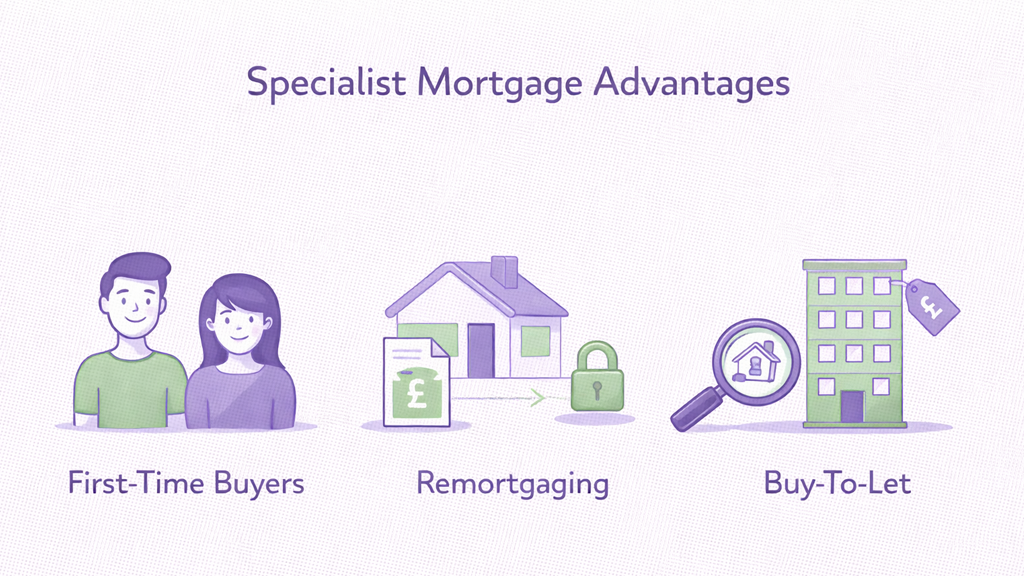
Consider who you really want to work with. Your ideal clients likely fall into one of these groups:
- First-Time Buyers: Often younger, digitally savvy, and feeling overwhelmed by the process. They are not just looking for a rate; they need a guide, reassurance, and clear explanations.
- Remortgage Seekers: These are existing homeowners, usually with a fixed-term deal about to expire. They are focused on saving money with a better rate and appreciate a quick, efficient process.
- Buy-to-Let Investors: This is a purely commercial audience. They care about rental yields, loan-to-value, and growing their portfolio. They need an adviser who thinks like an investor.
- Specialist Cases: This includes self-employed people, contractors, or anyone with a complex income stream. They have often been turned away by high street banks and are looking for genuine expertise from a problem-solver.
Look at market data for commercial insights. For example, a recent surge saw first-time buyer activity jump by 45% in a single quarter, mostly for properties between £150,000 and £250,000. That is not just a statistic; it is a roadmap pointing you to a large, clearly-defined group of clients you can target directly.
Crafting a Compelling Value Proposition
Once you know who you are talking to, you must answer their most important question: “Why should I choose you over everyone else?” Your value proposition is the answer. It is your clear, simple promise of the value you deliver.
A value proposition is not a list of your services. It is a powerful statement that explains the specific benefit a client gets by choosing you, making it obvious why you are different from any other broker.
To define yours, figure out what makes you genuinely unique. Is it how fast you secure offers? Your expert knowledge of adverse credit cases? Or perhaps you have access to exclusive rates they cannot find anywhere else?
Whatever your unique strength is, it needs to be the golden thread running through all your marketing, from your website’s homepage to the copy in your Google Ads. This is the core message that will attract your ideal clients and start qualifying them before they even pick up the phone. A solid plan is crucial, which you can read more about in our guide to building a strategy for lead generation.
Choosing Your Channels for High-Quality Mortgage Leads
Relying on just one source for your mortgage leads, whether it is word-of-mouth referrals or a single paid ad campaign, is a high-risk strategy. It leaves your business exposed to market swings and unpredictable dry spells. The secret to consistent growth is not finding one magic bullet; it is building a balanced mix of channels that brings in leads today, tomorrow, and well into the future.
The opportunity in the UK mortgage market is huge. With gross mortgage advances recently jumping 36.9% to £80.4 billion in one quarter, the demand is undeniable. Add to that an estimated £140 billion in loans set to mature by mid-2026, and you have a massive pool of potential clients for both new purchases and remortgages. To tap into this, you need to be visible across multiple channels.

To make sense of the options, it helps to compare the main channels side-by-side. Each has its own strengths when it comes to speed, cost, and overall strategic value.
Comparison of Mortgage Lead Generation Channels
| Channel | Speed to Results | Typical Cost Structure | Best For |
|---|---|---|---|
| PPC (e.g., Google Ads) | Immediate (days) | Pay-Per-Click (PPC) | Capturing high-intent borrowers actively searching |
| SEO | Long-term (months) | Upfront/Ongoing Investment | Building a sustainable, low-cost lead source |
| Social Media (Meta) | Variable | Ad Spend (CPM) / Organic | Generating demand and targeting by life events |
| Partnerships/Referrals | Variable | Commission / Reciprocal | Acquiring high-trust, pre-qualified leads |
This table gives you a quick overview, but the real advantage comes from understanding how to use each channel effectively to complement the others.
Paid Advertising for Immediate Lead Flow
When you need to get the phone ringing now, nothing beats paid advertising. Platforms like Google Ads put you directly in front of people who are actively looking for a mortgage. These are not just casual browsers; they are high-intent individuals typing in specific queries like “best 5-year fixed rate remortgage” or “95% LTV mortgage for first time buyer”.
The value of Pay-Per-Click (PPC) is its speed and control. You can launch a campaign and, if it is set up correctly, see leads coming in within days. But getting it right comes down to a few key elements:
- Keyword Strategy: Do not waste money on broad terms like “mortgage”. Focus on long-tail keywords that show real intent, such as “self employed mortgage broker near me”. These prospects are much further along in their journey.
- Compelling Ad Copy: Your ad needs to speak directly to the searcher’s problem. Mentioning things like “specialist in complex cases” or “fast mortgage offers” can significantly improve your click-through rates.
- Landing Page Alignment: The experience from ad to enquiry form must be seamless. If your ad promises help for first-time buyers, your landing page needs to deliver on that promise with a clear call-to-action and a simple form.
A well-managed PPC campaign is like a tap you can turn on for leads. But it is not a ‘set and forget’ channel. It demands constant monitoring and optimisation to keep your Cost per Lead (CPL) down and deliver a solid return on ad spend.
You can learn much more about the mechanics by reading our in-depth article on PPC lead generation.
SEO as a Long-Term Commercial Asset
While PPC gives you speed, Search Engine Optimisation (SEO) builds you a lasting commercial asset. At its core, SEO is about optimising your website to show up in organic search results for valuable mortgage-related terms. This is not about quick tricks; it is a long-term strategy for generating a steady flow of high-quality leads at a cost that gets lower over time.
Think of SEO as building your digital reputation. By creating genuinely useful content that answers the real questions your ideal clients are asking, you position your firm as an authority they can trust. This could be a detailed guide on the Help to Buy scheme, a blog post demystifying the remortgaging process, or an interactive buy-to-let affordability calculator.
This approach attracts potential clients at every stage of their journey, from those just starting their research to those ready to apply. Over time, a strong SEO presence means you are not completely reliant on paid ads, creating a more robust and profitable business.
Social Media and Strategic Partnerships
Platforms like Meta (Facebook and Instagram) offer a different approach. Instead of waiting for people to search for you, you can proactively reach potential clients based on life events, demographics, and interests. For example, you could target users who have recently become engaged, shown an interest in property portals, or fit the profile of a portfolio landlord. This is about generating demand, not just capturing it.
Finally, never forget the power of professional networking. Forging referral partnerships with estate agents, solicitors, accountants, and IFAs is still one of the most effective ways to get high-quality mortgage leads. These enquiries often arrive pre-vetted and with a high degree of trust already built-in, which translates to excellent conversion rates.
Engineering a High-Conversion Website and Landing Pages
Think of your website as your most important sales tool, not just a digital brochure. In mortgage lead generation, every pound you spend on advertising is pointing traffic towards your site. Its performance, therefore, has a direct and significant impact on your bottom line.
A large number of potential borrowers do their initial research on their smartphones, often in the evenings or over the weekend. This makes a mobile-first design completely non-negotiable. If your site is difficult to use on a mobile, you are throwing away leads before you even get a chance to speak to them. The journey from seeing an ad to filling out your form must be quick and easy.
Every button, image, and piece of text on the page has a job: guide the visitor towards making an enquiry. Your goal is to make this journey feel effortless, removing any friction that might cause them to leave.
The Anatomy of a High-Performing Landing Page
A classic mistake is sending paid advertising traffic to your generic homepage. Do not do it. Instead, you need to build dedicated landing pages that perfectly match your ad copy and targeting. Each landing page should be a finely tuned conversion asset, built for one specific purpose.
A successful mortgage landing page must have a few key ingredients:
- A Headline That Connects: Your headline needs to speak directly to what the visitor wants. Instead of a bland “Mortgage Services,” try something like, “Secure Your First Home with a 5% Deposit Mortgage.” It immediately aligns with their goal.
- Crystal-Clear Trust Signals: Borrowing money for a house is a huge financial step. You must build trust instantly. Ensure your FCA registration number, professional awards, and real client reviews are prominent.
- Effortless Contact Forms: Keep your initial forms short. All you need to start the conversation is a name, email, and phone number. Asking for too much information upfront is a guaranteed way to reduce your conversion rate.
This focused approach ensures your message is consistent from the ad right through to the landing page, which seriously boosts the chances of a visitor getting in touch. To get this right, you can find more practical tips in our guide on how to build a killer lead generation landing page.
Driving Performance with Conversion Rate Optimisation
Getting people to your landing page is only half the job. The real task is turning as many of those visitors as possible into actual leads. This process is called Conversion Rate Optimisation (CRO), and it is all about continuous testing and improvement.
Your website and landing pages are never truly ‘finished’. They are dynamic assets that should be continuously improved based on real user data to systematically increase your return on investment.
A solid CRO strategy is vital for long-term success. As part of building a high-conversion website, you must understand how to optimise landing pages for conversions. It is a methodical process of finding and fixing the small issues that are costing you leads.
Here are some of the most effective CRO tactics to get you started:
- A/B Test Your Calls-to-Action (CTAs): Do not just guess what works. Systematically test different button text, colours, and positions. Does “Get a Free Quote” work better than “Check My Eligibility“? Let the data decide.
- Boost Your Page Load Speed: Every second counts. A slow-loading page will cause potential clients to leave. Use tools to compress your images and ensure your website hosting is fast.
- Align Your Messaging: The language on your page must be a perfect mirror of the ad that brought the visitor there. If your ad talks about “remortgaging,” the landing page needs to be all about that and nothing else. This creates a smooth, persuasive user experience.
Building a Lead Nurturing and Qualification System
Generating a lead is just the beginning. The real commercial value is realised when you systematically turn that initial enquiry into a completed mortgage application. This comes down to a solid process for qualifying, nurturing, and managing your leads to maximise the return from your marketing spend.
In the mortgage sector, speed is critical. A quick and persistent follow-up is vital, but you must handle it with care to build a relationship, not just bombard a potential client. This is where having a proper system in place changes everything, turning a simple contact list into a powerful sales pipeline.
Every landing page should guide a user through a simple three-step flow: from trusting you, to filling out a form, and hitting submit.
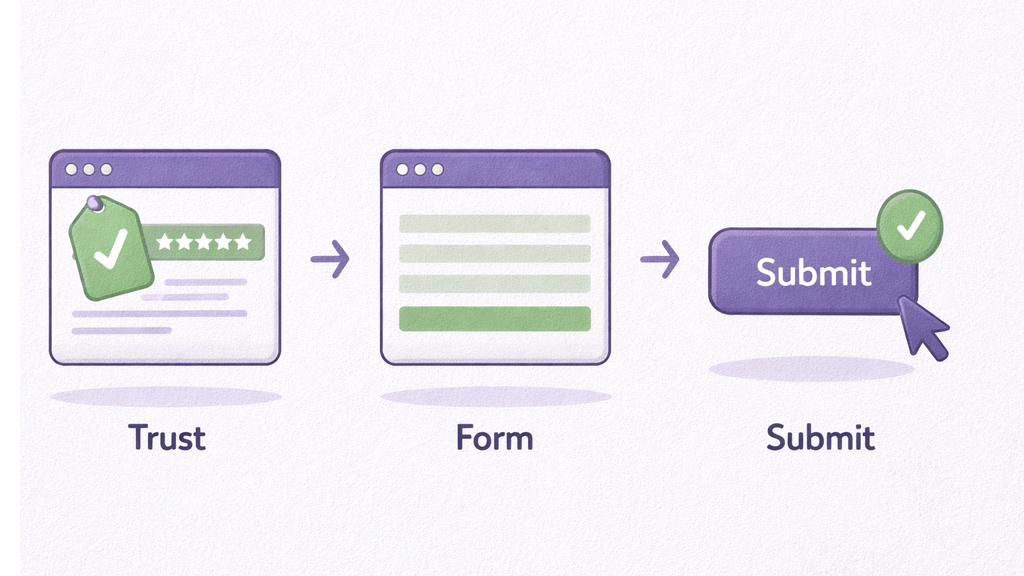
This simple journey is the front door to your entire nurturing system. Once they are in, the real work begins.
How to Prioritise Your Efforts with Lead Scoring
Not all leads are created equal. Some people are ready to apply today, while others are just starting their research. A lead scoring model is a powerful tool for distinguishing between them, allowing your advisers to focus their time where it counts most.
It is a simple system that automatically assigns points to leads based on the data they provide and how they behave. For instance:
- High-Intent Data: Someone who provides a specific remortgage date or has a significant deposit is a much hotter prospect than someone with vague details. They get more points.
- Engagement Signals: A person who opens several of your emails, clicks a link to your ‘buy-to-let guide’, or repeatedly visits your affordability calculator is showing strong interest. They should be prioritised.
Once you set a points threshold, you can automatically flag ‘sales-ready’ leads for an immediate phone call, while everyone else gets placed into an automated nurturing campaign. This ensures your hottest prospects get the attention they deserve, which significantly boosts your conversion rates.
Using a CRM to Manage Leads Professionally
A Customer Relationship Management (CRM) system is the engine room of any serious mortgage lead generation strategy. It is time to replace messy spreadsheets and scattered notes with a central hub that tracks every lead, conversation, and follow-up.
A CRM is not just a database. It is a tool that provides the structure to handle hundreds of enquiries at once, making sure every prospect gets a professional and timely response.
For a mortgage broker, a good CRM is a game-changer. It helps you:
- Automate Follow-Ups: Set automatic reminders for calls and emails so no one ever falls through the cracks.
- Track Your Sales Funnel: See exactly where every prospect is in their journey, from first contact to application submission.
- Improve Client Communication: Keep a detailed log of every email and call, so any adviser can pick up the conversation without missing a beat.
Designing Nurture Sequences That Work
Most people are not ready to proceed after one conversation. They need information, reassurance, and time to build trust. This is where automated email nurture sequences excel; they build that relationship for you over time without manual effort.
Think about what is happening in the market. By Q4 2026, high loan-to-income (LTI) lending hit 46.5% of new mortgages. This shows that many borrowers are dealing with complex situations that require more guidance. A great nurturing system is essential for guiding these high-LTI prospects and winning their business. You can read more in the Bank of England’s report on these mortgage lending trends.
So, what does a good nurture sequence look like? Here is a simple one for a ‘first-time buyer’ lead:
- Immediately: Send a thank you email with a helpful ‘First-Time Buyer’s Guide’ attached. Provide value right away.
- A few days later: Send an email breaking down common mortgage jargon in plain English.
- After a week: Share a client testimonial video from another first-time buyer you helped. Social proof is powerful.
- After two weeks: Send a friendly email prompting them to book a no-obligation chat with an adviser.
This kind of sequence delivers real value, demonstrates your expertise, and gently nudges the prospect towards the next step. All of this happens automatically, leaving your team free to focus on closing deals with the most engaged leads.
Measuring Performance to Optimise for Growth
In mortgage lead generation, there is a simple truth: if you cannot measure it, you cannot improve it. A successful campaign is not just about generating a flood of enquiries; it is about building a predictable and, most importantly, profitable engine for growth.
This means looking past vanity metrics like clicks and impressions. You must focus on the numbers that actually move the needle commercially. Every pound spent on marketing must be held accountable, creating a data-driven feedback loop that informs your strategy. The end goal is a scalable system where you know exactly what it costs to land a new client, allowing you to invest confidently to increase revenue.
Core Metrics for Commercial Success
While you could track dozens of different numbers, only a handful genuinely show the commercial health of your lead generation efforts. By focusing on these, you ensure your work is always tied directly to your bottom line. These are the figures that should be on your weekly dashboard, guiding every strategic decision.
Here are the essential KPIs you must track:
- Cost per Lead (CPL): This is your total marketing spend divided by the number of leads you have generated. It gives you a clear picture of what you are paying for each initial enquiry.
- Cost per Acquisition (CPA): Taking it a crucial step further, this is your total marketing spend divided by the number of actual clients you have secured. This is your true cost of winning a new piece of business.
- Lead-to-Application Rate: This is the percentage of your leads that progress to a formal mortgage application. It is a vital sign of your lead quality and the effectiveness of your initial qualification process.
- Return on Investment (ROI): This is the ultimate benchmark of success. It compares the profit generated from new clients against the marketing cost to acquire them, telling you exactly how much you are earning for every pound spent.
Tracking these core metrics is fundamental. The table below breaks down the key performance indicators that will tell you if your campaign is a commercial success, moving from the top of the funnel right down to the bottom-line impact.
Key Performance Indicators for Mortgage Lead Generation
| Metric (KPI) | What It Measures | Why It Matters Commercially |
|---|---|---|
| Cost per Lead (CPL) | The direct cost to generate a single enquiry from a marketing campaign. | Keeps top-of-funnel spending in check and provides a baseline for efficiency. |
| Lead-to-Application Rate | The percentage of raw leads that progress to a full mortgage application. | A direct indicator of lead quality; a low rate means you are wasting time and money on poor-fit prospects. |
| Application-to-Completion Rate | The percentage of applications that successfully result in a completed mortgage. | Highlights the effectiveness of your advising and processing, impacting final revenue. |
| Cost per Acquisition (CPA) | The total marketing and sales cost to secure one paying client. | The true cost of winning business. This figure determines the real profitability of your campaigns. |
| Customer Lifetime Value (CLV) | The total net profit a business can expect from a single customer over time. | Informs how much you can afford to spend on CPA while remaining profitable, especially with repeat business. |
| Return on Investment (ROI) | The total profit generated from a campaign versus the total cost invested in it. | The ultimate measure of marketing success, showing how much revenue is generated for every pound spent. |
Ultimately, a deep understanding of these KPIs allows you to build a marketing function that does not just generate activity, but reliably drives profit for the business.
Setting Up a Watertight Tracking System
You simply cannot measure accurately without a robust tracking and attribution model. You must know, with certainty, which channels, campaigns, and even which specific keywords are delivering your most valuable leads. Anything less is just guesswork, and you might as well be throwing your budget away.
Setting this up properly means connecting the dots between your marketing platforms, like Google Ads and Meta, and your website. By using tools like Google Analytics and your CRM, you can follow a customer’s journey from their very first ad click all the way through to becoming a client. This is how you spot the difference between a channel that sends you cheap but low-quality leads and one that delivers high-value clients, even if its CPL seems higher at first glance.
A proper attribution model is the bedrock of optimisation. It gives you the confidence to double down on what works and cut what does not, systematically improving your ROI over time.
This level of insight empowers you to answer the important questions. Is SEO bringing in better-quality remortgage leads than PPC? Are the leads from your professional partnerships converting at a higher rate? The data holds all the answers and provides a clear map for scalable growth.
The Optimisation Feedback Loop
Data is only valuable if you act on it. Optimisation is a continuous cycle: measure, analyse, adjust, repeat. This data-first approach takes ego and guesswork out of your marketing decisions, replacing them with a clear, logical path towards improvement.
For instance, you might notice the CPL on a specific Google Ads campaign is increasing. By diving into the data, you could discover a particular keyword is underperforming or that your ad copy is no longer effective. By making a small, informed adjustment and monitoring the results, you can bring that CPL back down.
This constant process of refinement is what separates thriving firms from those that see marketing as a black hole for money. When you embrace a performance-led mindset, you transform your mortgage lead generation from a cost centre into a powerful, reliable driver of business profitability.
Common Questions Answered
We are often asked the same questions by mortgage brokers and lenders looking to build a proper lead generation system. Here are some clear, practical answers focused on what really matters: achieving commercial results.
How Much Should I Budget for Mortgage Lead Generation?
There is no single magic number. Your budget depends on your growth ambitions, the competitiveness of your local market, and the channels you choose to use.
The biggest mistake we see is starting too small. If your investment is insufficient, you simply will not get enough data back to determine what is working and what is not.
For a serious campaign using paid ads like Google Ads, a sensible starting point is in the £1,500 to £3,000 per month range. This is usually enough to generate the traffic required to start optimising your campaigns for better performance.
However, instead of focusing on a total monthly spend, it is much smarter to think about your target Cost per Lead (CPL) and Cost per Acquisition (CPA). A competitive CPL for mortgage leads can be anything from £25 to over £80, depending on your specialism.
The best way to determine this is to work backwards. What is your average revenue per client? What profit margin do you need? That tells you the maximum CPA you can afford, and from there, you can set a realistic lead generation budget.
Is SEO or PPC Better for Generating Mortgage Leads?
This is a common question, but it is the wrong one. It is not about choosing one over the other. The most successful strategies use both, because they perform very different jobs.
- PPC is about speed and control. You can launch a Google Ads campaign and, in theory, see your first leads within 48 hours. It is perfect for getting in front of borrowers who are actively searching for a mortgage right now.
- SEO is your long-term asset. This is about building up your website’s authority to rank for valuable search terms without paying for every click. It takes longer, but it eventually delivers a steady stream of high-quality leads at a much lower cost, creating a sustainable business model.
The best approach? Use PPC for immediate results and to learn what works, while you invest in a solid SEO campaign to build a cost-effective lead machine for the future.
The two channels feed each other. The keywords that bring you the best leads from your PPC campaigns are exactly the ones you should be targeting with your SEO efforts.
How Quickly Can I Expect to See Results?
Your timeline for seeing results is completely tied to the channels you use. You must set realistic expectations for each one to avoid becoming frustrated and stopping too early.
With a well-managed PPC campaign, you can start getting leads in the first week. However, that initial phase is all about gathering data. It usually takes four to eight weeks of ongoing adjustments to achieve a stable, cost-effective flow of good quality leads.
SEO is a much longer game. You might see some small, positive shifts in your search rankings within three to four months. But to get the kind of organic traffic that truly generates leads in the competitive mortgage space, you are realistically looking at six to twelve months of consistent work.
How Do I Ensure the Leads I Generate Are High Quality?
Generating high-quality leads is not about luck. It is a direct result of sharp targeting, clear messaging, and a solid qualification process. If you are attracting unsuitable prospects, one of those three things is off.
First, your targeting needs to be laser-focused. In your paid search and SEO, use specific, long-tail keywords like ‘bad credit mortgage broker Manchester’ instead of just ‘mortgage broker’. On social media, you can target people based on specific life events or financial interests.
Second, your ad copy and landing page must act as a filter. Be upfront about who you help and what you offer. This pre-qualifies people before they even fill out a form.
Finally, use your enquiry forms to your advantage. Just adding one or two qualifying questions can dramatically improve the quality of your leads without significantly harming your conversion rate.
At Lead Genera, we specialise in building these kinds of predictable, high-performance lead generation systems for businesses like yours. If you are ready to move beyond inconsistent referrals and build a scalable pipeline of high-quality mortgage leads, we can help. Explore our strategic lead generation services.
Categories
Do You Need Assistance With
Sign Up To Our Newsletter