


Weekly marketing wisdom you can read in 5 minutes, for free. Add remarkable ideas and insights to your inbox, once a week, by subscribing to our newsletter.
Automation
Marketing automation for agencies: A proven framework to scale client results
For a modern agency, marketing automation is not just about scheduling a few emails. It is about building intelligent, automated systems that handle the heavy lifting: nurturing leads, qualifying prospects, and streamlining client reporting. It is the engine that drives predictable growth and makes your entire operation more efficient.
Table of contents:
Why Marketing automation is a commercial necessity for UK agencies

Let’s get straight to the point. For any UK agency today, marketing automation has moved from a ‘nice to have’ to an absolute commercial necessity. Agencies face constant pressure to prove ROI, operate on thin margins, and serve clients who rightfully expect significant results.
Trying to manage these demands with manual processes is not just inefficient; it is a genuine threat to your profitability and ability to scale.
This is where automation becomes a strategic advantage. It helps you graduate from a simple service provider, trading hours for pounds, to an indispensable growth partner that clients value for the results you deliver. By systemising core marketing functions, you create a more professional, consistent, and effective service that directly grows your clients’ revenue.
Shifting from manual effort to scalable systems
At its heart, marketing automation is about swapping time consuming, repetitive jobs for intelligent, reliable workflows. This simple shift has a massive commercial impact on how your agency runs and what you can deliver.
It is all about efficiency. You can automate repetitive tasks, freeing up your team’s valuable time for the high impact work that actually moves the needle. Suddenly, your senior people are spending less time buried in admin and more time on client strategy, creative thinking, and relationship building.
This operational leverage gives you serious commercial firepower:
- Healthier profit margins: Every manual hour you save on a client retainer goes straight to your bottom line.
- Greater capacity: You can comfortably handle more clients without immediately needing to hire more staff. Headcount is no longer your main barrier to growth.
- Flawless service delivery: Automation ensures follow ups, reports, and vital communications go out on time, every time. This reduces human error and keeps clients satisfied.
The real goal here is to build an operational engine that works, humming quietly in the background. This engine frees up your brightest minds to focus on what clients truly pay for: strategic insight, creative problem solving, and measurable results.
To give you a clearer picture, here is a quick breakdown of where automation can drive commercial value for your agency and your clients.
Core automation opportunities for agency growth
| Opportunity Area | Primary Benefit for the Agency | Key Outcome for the Client |
|---|---|---|
| Lead Nurturing | Increases the value of each lead generated, proving campaign ROI. | Higher conversion rates from lead to customer. |
| Client Onboarding | Standardises the welcome process, improving client satisfaction from day one. | A smooth, professional, and consistent onboarding experience. |
| Automated Reporting | Frees up account managers’ time from manual data collection. | Regular, data rich performance updates delivered on schedule. |
| Internal Workflows | Reduces admin overhead and minimises errors in project management. | Faster turnaround times and more reliable project delivery. |
These are just a few examples, but they illustrate how automation strengthens your agency’s commercial foundation while simultaneously delivering a better, more results driven service.
Meeting modern client expectations
Today’s clients are not interested in activity for its own sake. They want to see a clear, undeniable line connecting their marketing spend to their revenue growth. Automation gives you the framework not only to deliver on this but to prove it with hard data.
You can track a lead from their very first click all the way through to a closed deal, giving you the evidence you need to demonstrate the real world value of your work.
The UK market is already responding. The marketing automation sector is on track to become a £700 million industry by 2030. This growth is fuelled by tangible results, with businesses using these platforms reporting a 50% increase in sales ready leads at a 33% lower cost. It is clear the tide has turned, and manual marketing is being left behind.
Building your agency’s automation service framework
Moving from theory to practice means you need a framework that works in the real world. To successfully offer marketing automation, you cannot just present it as a technical add on. You need to package it as a clear, value focused service that directly impacts your client’s bottom line.
A smart way to do this is to weave automation services directly into your core offerings, like lead generation or web development. This frames automation as the engine powering the results you already deliver, making it a much easier and more logical investment for your clients.
A three tiered service model
A tiered model brings clarity for clients and protects your margins. It lets you meet businesses where they are right now, with a clear path to upgrade as their needs and budget grow.
Here is a structure that builds on itself:
-
Foundational Setup: This is a one off project focused on getting the technical and strategic fundamentals right. It is perfect for clients new to automation or those who do not have the in house team to implement it properly. You would typically deliver strategy workshops, platform configuration, core workflow builds (like a welcome sequence), and CRM integration. This tier lays the essential groundwork for everything that follows.
-
Managed Nurturing: Think of this as a monthly retainer service for clients who have the foundation in place but need ongoing support to keep the engine running. This is where you actively run campaigns, manage lead nurturing sequences, and provide regular performance reports. Your agency takes control, making sure the system is consistently generating and qualifying leads.
-
Strategic Optimisation: This is your premium retainer, designed for more mature clients who are focused on continuous improvement and ROI. Here, you go beyond just managing the system to provide proactive strategic guidance. We are talking about A/B testing, conversion rate optimisation (CRO) on landing pages, building out advanced lead scoring models, and creating sophisticated, behaviour triggered workflows. The goal is to squeeze every last drop of value out of their pipeline and make their sales process incredibly efficient.
Pitching your automation services
Your pitch has to connect with the specific commercial pains of the person you are talking to. An operations director is worried about efficiency; a sales manager just wants better quality leads.
For a B2B marketing manager wrestling with an inefficient sales pipeline, you would frame automation as the bridge between marketing and sales. You can explain how automated lead scoring stops marketing from passing unqualified leads to sales, ensuring only genuinely sales ready prospects land with the sales team. That means better conversion rates and less wasted time for everyone.
For a service business owner, the conversation should centre on lead quality and the client experience. Show them how an automated booking and follow up system can filter out unsuitable prospects and provide a polished, seamless journey for high value leads, directly impacting their revenue.
The key is to sell the outcome, not the process. Clients do not buy “automation workflows”; they buy a predictable sales pipeline, a lower cost per lead, and the ability to grow without operational friction. Frame every single conversation around these commercial goals.
The market trend is undeniable. Half of all UK businesses now integrate AI into their marketing operations, with that number jumping to 65% among mid market companies turning over £10 to £30 million. For agencies, this translates into real results: teams using AI automation are seeing a 32% uplift in marketing ROI and saving an average of 11 hours per marketer every single week.
Ultimately, a well structured service framework turns marketing automation into a profitable, scalable part of your agency. It takes a complex piece of technology and turns it into a clear, valuable solution that solves genuine business problems. When you pair this with a powerful CRM, the potential to drive client growth is huge. You can check out our guide on why you should use HubSpot as your CRM system to see how these two pieces fit together.
Designing high performance automation workflows
Effective marketing automation is not about setting up dozens of complicated, robotic sequences. It is about building a few core, high performance workflows that solve real commercial problems for your clients, from capturing initial interest to setting up a smooth sales conversation.
These workflows are the engine room of your automation service. They need to be logical, relevant, and designed to gently guide a prospect through their decision making process, not just bombard them with generic messages.
Below is a high level view of how these stages typically flow, from the initial setup and nurturing to the ongoing optimisation that drives commercial results.

As you can see, successful automation is a cycle of building, engaging, and refining. It is never a ‘set it and forget it’ task.
Instant lead capture and qualification
At the top of the funnel, speed is everything. When someone shows interest by downloading a guide or filling out a contact form, the follow up has to be instant and relevant. This is how you ensure no lead ever goes cold.
The immediate goal is to acknowledge their action and deliver the value you promised. In the background, a second process kicks in to start qualifying them.
- Trigger: A user completes a key form, for example, on a ‘Download Our B2B Tech Buying Guide’ landing page.
- Action 1 (Instant): Send an email with the link to the guide. The subject line needs to be direct and simple, like “Here is your B2B Tech Buying Guide”.
- Action 2 (Internal): Create a new contact in the CRM. Tag them with their interest (‘B2B Tech Guide’) and note their original source (e.g., ‘Google Ads’).
- Action 3 (Qualification): Wait an hour or so, then send a low pressure follow up. Keep it simple and ask an open question like, “Did the guide answer your initial questions?” The idea is to start a conversation, not to force a sale.
This first sequence immediately tells the prospect that your client is organised and responsive, setting a professional tone from the start.
Multi touch lead nurturing sequences
Most leads are not ready to buy the moment they land on your client’s site. A nurturing workflow is all about building trust and educating them over time, keeping your client top of mind until the prospect is ready to talk business.
Relevance is the most important factor here. The content you send must connect directly back to their initial interest.
An effective nurture sequence is a conversation, not a monologue. Each email should offer genuine value and build upon the last, guiding the prospect towards a solution without feeling forceful.
For a professional services client, a nurturing sequence might look something like this:
- Day 3: Send an email linking to a relevant case study. Show them how a similar business solved a problem they’re likely facing.
- Day 7: Share a short video or a blog post that tackles a common pain point related to the guide they downloaded.
- Day 14: Invite them to a webinar or offer a more substantial piece of content, like a white paper.
- Day 21: If they have been engaging with the emails, send a soft call to action, perhaps an invitation for a no obligation strategy call.
This paced approach respects the buyer’s timeline while building serious credibility. For a deeper dive into crafting these, check out our guide on trigger emails best practices and examples.
Behaviour based lead scoring
Not all leads are created equal. Lead scoring is how you assign value to prospects based on what they do, allowing the sales team to focus their energy where it matters most.
This is not a static number; it is a dynamic system. A lead’s score should climb as they show more buying intent.
- High value actions (+10 points): Visiting the pricing page, requesting a demo, viewing multiple case studies.
- Medium value actions (+5 points): Opening a nurture email, downloading a second piece of content.
- Low value actions (+1 point): Visiting the blog.
Once a lead hits a certain score (say, 50 points), they officially become a Marketing Qualified Lead (MQL). This is the trigger for the final, and most critical, step.
Seamless sales handoff protocols
The moment a lead moves from marketing to sales has to be flawless. When a lead becomes an MQL, your automation should make the handoff to the sales team smooth and packed with context.
- Trigger: A lead’s score passes the MQL threshold.
- Action 1 (Internal): An instant notification is sent to the assigned sales rep via email or Slack. This alert must include the lead’s name, contact details, and a quick summary of their activity (e.g., ‘Downloaded B2B Tech Guide, viewed pricing page’).
- Action 2 (CRM): The lead’s status in the CRM is automatically changed to ‘Sales Ready’, and a task is created for the sales rep to follow up within 24 hours.
This automated handoff ensures that sales reps get timely, warm leads with all the background information they need for a meaningful conversation. It transforms a cold call into a well informed follow up, dramatically boosting the chance of conversion.
Choosing the right automation platform for your agency
Picking your agency’s core marketing automation platform is a high stakes decision you cannot afford to get wrong. Think of it less like a software purchase and more like a long term strategic commitment. It is the engine that will power your operational efficiency, your profitability, and the results you deliver for clients. A misstep here does not just mean a wasted budget; it means painful, costly migrations and a frustrated team down the line.
It is easy to be distracted by feature lists, but your evaluation has to be grounded in commercial reality. The right tool for your agency needs to do a lot more than just send emails. It has to act as the central nervous system for your entire client service delivery, supporting your business model.
Core evaluation criteria for agencies
When you are looking at different platforms, you need to use a different checklist from a standard B2B buyer. An agency’s needs are unique, and you have to view everything through that specific lens. To make sure the platform you choose is a genuine asset and not a hidden liability, focus your evaluation on these four critical areas.
-
Multi Tenancy and Client Management: This is crucial. Can you efficiently manage multiple, completely separate client accounts from a single dashboard? You are looking for platforms with dedicated agency portals that prevent any data crossover and let your team switch between client environments without constantly logging in and out. For operational efficiency, this is non negotiable.
-
Integration Capabilities: Your chosen platform has to work with the tools your clients are already using. Prioritise native integrations with major CRMs like Salesforce and HubSpot, paid media platforms (Google Ads, Meta Ads), and other essential business software. A robust API is also vital for those times you need to build a custom connection.
-
Scalability and Performance: The system must grow with you and your clients. Ask yourself: how will this platform handle a spike in contact volumes, increasingly complex workflows, or more users from my team? You cannot have performance degrading just because you have successfully onboarded more accounts. A platform that works for five clients has to work just as smoothly for fifty.
-
Pricing Model and Reselling: How is the platform priced, and does that model support your growth as an agency? You need to find pricing tiers, whether based on contacts or features, that you can profitably resell. Be wary of models that penalise you for adding new clients or have unpredictable costs, as they will reduce your margins.
To help structure your thinking, we have put together a simple framework. Use this to compare platforms side by side and keep the discussion focused on what truly matters for an agency.
Platform evaluation framework for agencies
| Evaluation Criterion | What to Look For | Commercial Implication |
|---|---|---|
| Agency Portal | Dedicated dashboard for managing multiple client accounts securely and separately. | Increases team efficiency, reduces login friction, and minimises the risk of human error (e.g., sending a campaign to the wrong client list). |
| Native Integrations | Pre built connections to key CRMs (Salesforce, HubSpot), ad platforms (Google, Meta), and common client tools. | Reduces setup time and technical overhead. Allows you to deliver integrated campaigns for clients more quickly and reliably. |
| API & Webhooks | A well documented, robust API for custom development and webhooks for real time data transfer. | Provides the flexibility to solve unique client challenges and create bespoke solutions, which can become a key differentiator for your agency. |
| Pricing Structure | A model that scales predictably (e.g., per contact/account) and offers agency partner discounts or reseller margins. | Protects your profitability. A clear, scalable pricing model allows you to build service packages with healthy margins. |
| White Labelling | The ability to brand the platform’s interface with your agency’s logo and colours. | Reinforces your brand’s value and presents a unified, professional front to clients, positioning the tech as part of your solution. |
| Training & Support | Dedicated agency partner support, comprehensive documentation, and robust training resources for your team. | Reduces your team’s learning curve and provides a safety net when issues arise, ensuring you can support your clients effectively. |
This is not just about ticking boxes; it is about seeing how each criterion directly connects to your bottom line and your ability to serve clients effectively.
All in one suites vs best of breed tools
One of the biggest strategic decisions is whether to go for an all in one platform or build your own ‘best of breed’ stack from multiple specialised tools. Each path comes with significant commercial trade offs.
An all in one suite, as the name suggests, offers a single, integrated environment. The main appeal here is simplicity. Your data flows smoothly between the CRM, the email marketing module, and the landing page builder because they were all built to work together. This can dramatically reduce integration headaches and make reporting much cleaner. The downside? The individual tools within the suite might not be the absolute best in their class.
On the other hand, a best of breed approach means you are hand picking the top tool for each specific job: the best email platform, a separate landing page builder known for its conversion power, a world class analytics tool. This gives you maximum functionality and power, but it also introduces complexity. You are now responsible for making all these systems communicate, which can demand real technical expertise and ongoing maintenance.
Your choice here really comes down to your agency’s operational model. If your core strength is strategic marketing and you want the technology to work seamlessly in the background, an all in one suite is often the smarter commercial choice. But if you have strong in house technical skills and serve clients with highly specific, complex needs, a best of breed stack could give you a powerful competitive edge.
Ultimately, your goal is to choose a technology partner that empowers your agency to deliver exceptional, measurable results. Let your service model, your team’s capabilities, and the commercial outcomes you need to achieve for both your agency and your clients be your guide.
Measuring success and proving ROI to clients
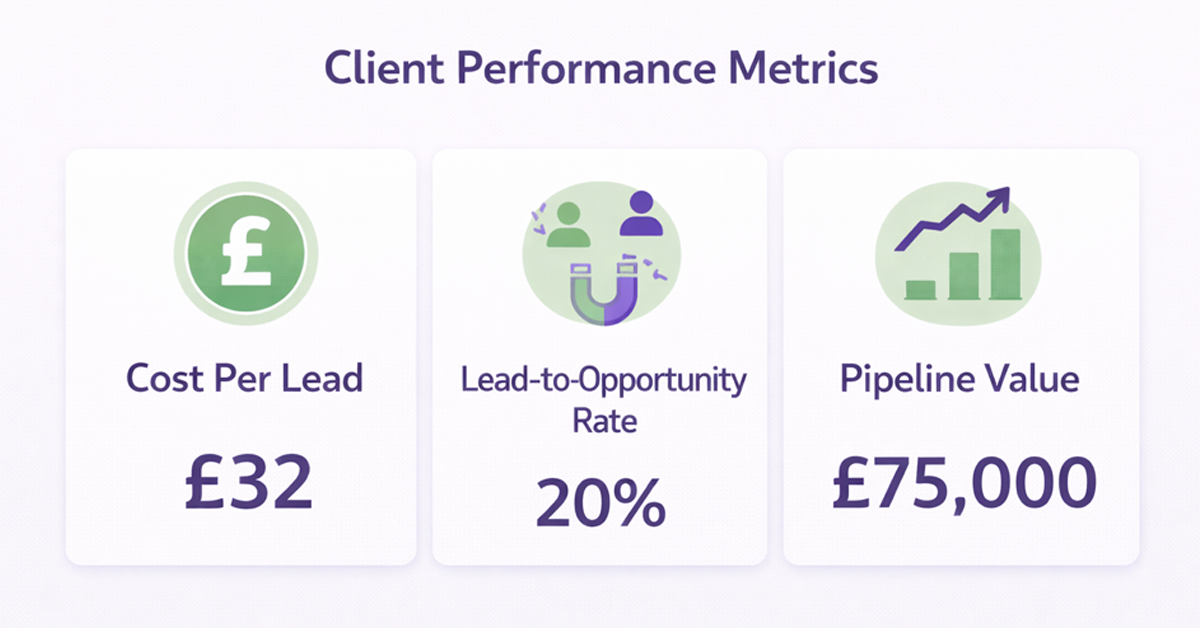
Rolling out marketing automation for your clients is about more than setting up workflows. It is about delivering tangible commercial value. To truly become an indispensable partner, you have to connect every automated action directly back to a business outcome for your client.
Forget vanity metrics. Indicators like email open rates or social media follows might look nice, but they do not influence a finance director looking at the bottom line. Your reporting needs to speak their language: the language of profitability, efficiency, and pipeline growth.
This is where your automation platform becomes your most valuable asset. It is the source of truth, providing the clear, objective evidence you need to show exactly how your strategic work is turning marketing spend into revenue. It is how you build trust and maintain client relationships.
Key performance indicators that matter
If you want to prove your commercial impact, your client dashboards need to be built around a core set of commercially relevant Key Performance Indicators (KPIs). These are the metrics that bridge the gap between marketing effort and sales results.
Your job is to track progress across the entire sales funnel, not just the top. This paints a complete picture of how automation is improving efficiency and generating value at every stage.
- Cost Per Marketing Qualified Lead (MQL): This shows how efficiently your automated campaigns are generating high intent leads. A falling CPL is a direct win, proving better ROI from ad spend and content.
- Lead to Opportunity Conversion Rate: This KPI is all about the quality of the leads your system is producing. A rising rate is concrete proof that your nurturing and scoring workflows are delivering well prepared prospects to the sales team.
- Sales Cycle Length: By delivering better qualified leads and consistent nurturing, automation can shorten the time it takes to close a deal. Tracking this shows a direct impact on the sales team’s efficiency and, crucially, the client’s cash flow.
- Pipeline Value Influenced by Automation: This is the most important metric. It puts a clear monetary value on the opportunities that have been touched by your automated marketing activities, directly linking what you do to what they earn.
When you report on these metrics, the conversation with your client completely changes. You are no longer talking about marketing tasks; you are discussing business growth, sales efficiency, and return on investment. You are talking like a strategic partner.
For a deeper dive into how these costs are calculated, our guide on what customer acquisition cost is is a great place to start.
Connecting automation to revenue outcomes
The real power of marketing automation is its ability to track the complete customer journey. You can draw a straight line from a prospect’s first website visit, through every email they opened and link they clicked, all the way to the final sale. This attribution model is impossible to achieve manually.
This level of insight is invaluable. UK based research shows that companies using automation for lead nurturing generate 50% more sales ready leads at a 33% lower cost. When you consider that 35% of UK marketers are already using AI for automation, and their top priorities are sales revenue (62%) and customer engagement (60%), the commercial case is undeniable.
This data does more than just prove your worth; it creates a feedback loop for constant improvement. By analysing which workflows and content pieces contribute most to pipeline value, you can make sharp, informed decisions to optimise your client’s entire marketing engine.
For instance, if you see that leads nurtured through a particular webinar sequence have a much higher lead to opportunity rate, you can confidently advise the client to invest more of their ad budget into promoting it. This kind of data backed guidance elevates your agency from a simple executor to a core driver of their commercial strategy.
Your questions about agency automation answered
Implementing marketing automation services, or trying to scale them up, naturally brings up many practical questions. Getting the commercial and operational side of things right from day one is crucial for success.
Here are the most common questions we get from agencies about implementation, client management, and the typical hurdles you will face.
How should we price marketing automation services for clients?
First, you are selling strategic value, not just software access. Your pricing has to reflect that. A three tiered model is a proven approach that works well, as it can be adapted to fit a client’s budget and their stage in their marketing journey.
A solid structure usually looks something like this:
- A one off setup fee: This covers all the initial strategic work. Think strategy workshops, platform setup, CRM integration, and building out those first crucial workflows. A fee between £1,500 and £3,000 is a standard range here.
- A monthly management retainer: For all the ongoing work, a monthly retainer of £750 to £2,500+ is typical. This fee covers running campaigns, managing lists and data, continuous optimisation, and regular performance reporting.
- A performance based model: For more mature clients, you could tie your fees to commercial results. This could be based on the number of Marketing Qualified Leads (MQLs) you generate or the pipeline value you influence.
One critical tip: Always separate the software subscription cost from your management fee in your proposals. This transparency protects your margins and makes it clear what the client is paying for: your expertise, not just a tool.
What is the biggest mistake agencies make when starting with automation?
The most common, and most expensive, mistake is putting technology before strategy. Many agencies invest in a powerful platform and then try to figure out how to use it. That is completely backwards.
This approach almost always leads to overly complicated workflows that confuse potential customers and fail to deliver any real results.
The right way to do it is to start with the client’s customer journey. Map the entire process out first, define what each lead stage means, and agree on a content plan to nurture people at every step. Only then do you build the automation architecture to support that strategy. The platform is just the enabler; it cannot fix a broken or non existent marketing process.
How much content do we need before we start?
You do not need a huge library, you just need a strategic one. For a basic lead nurturing workflow, you should aim for at least three to five high value pieces of content that match different stages of the buyer’s journey. Relevance and quality trump sheer quantity every time.
A great starting point could include:
- Top of Funnel: A comprehensive guide or an insightful industry report to capture initial interest.
- Middle of Funnel: A detailed case study or a recorded webinar that shows off your client’s expertise and results.
- Bottom of Funnel: A compelling consultation offer or a product demo to encourage them to start a sales conversation.
A simple content audit is a great place to begin. Look at what the client already has, identify what is usable, and spot the gaps. Creating these initial assets can even be scoped as part of your setup project, giving you another valuable revenue stream.
How can we efficiently manage automation for multiple clients?
To do this without damaging your profit margins, you need two things: standardisation and the right platform. You cannot afford to build every client’s system from scratch.
Start by developing a core set of ‘playbook’ workflow templates for common scenarios. Think lead nurturing, event follow ups, and even client onboarding. You can then customise these templates for each client, which reduces your setup time and ensures you deliver a consistently high quality service.
When it comes to picking a platform, prioritise one with strong multi account management or a dedicated agency portal. This is not a nice to have; it is essential. It allows your team to switch between client accounts from a single dashboard. Finally, invest in making one or two people on your team the go to experts on your chosen platform. This will streamline everything you do and build a centre of excellence within your agency.
At Lead Genera, we build the strategic automation systems that drive predictable growth for our clients. If you need a partner to help you turn marketing activity into a reliable lead generation engine, we should talk.
Find out how we can help at https://leadgenera.com.
Categories
Do You Need Assistance With
Sign Up To Our Newsletter